×
Request Free Sample ×

Kindly complete the form below to receive a free sample of this Report

* Please use a valid business email

Leading companies partner with us for data-driven Insights

clients tt-cursor
Hero Background

Germany Cutting Equipment Market

ID: MRFR/Equip/46810-HCR
128 Pages
Snehal Singh
February 2026

Germany Cutting Equipment Market Research Report By Cutting Technology (Plasma, Laser, Waterjet, Carbon-arc) and By End User (Automotive, Metal Fabrication, Construction, Aerospace and Defense, Shipbuilding, Others)- Forecast to 2035

Share:
Download PDF ×

We do not share your information with anyone. However, we may send you emails based on your report interest from time to time. You may contact us at any time to opt-out.

Germany Cutting Equipment Market Infographic
Purchase Options

Germany Cutting Equipment Market Summary

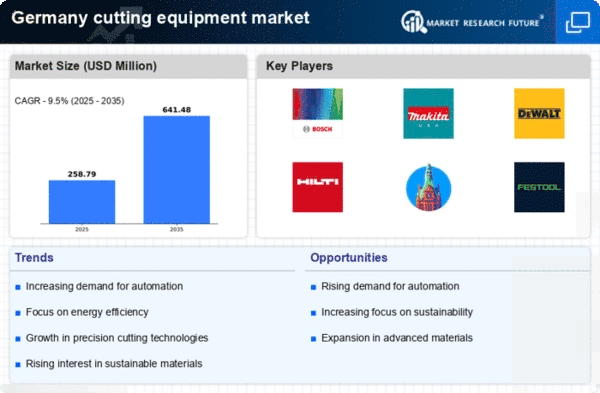
As per Market Research Future analysis, the Germany cutting equipment market size was estimated at 236.34 USD Million in 2024. The Germany cutting equipment market is projected to grow from 258.79 USD Million in 2025 to 641.48 USD Million by 2035, exhibiting a compound annual growth rate (CAGR) of 9% during the forecast period 2025 - 2035

Key Market Trends & Highlights

The Germany cutting equipment market is experiencing a dynamic shift driven by technological advancements and sustainability initiatives.

  • Technological advancements are reshaping the cutting equipment landscape, enhancing efficiency and precision.
  • Sustainability initiatives are increasingly influencing product development and consumer preferences in the market.
  • Customization trends are gaining traction, allowing manufacturers to cater to specific client needs and applications.
  • The rising demand in the manufacturing sector and investment in infrastructure development are key drivers propelling market growth.

Market Size & Forecast

2024 Market Size 236.34 (USD Million)
2035 Market Size 641.48 (USD Million)
CAGR (2025 - 2035) 9.5%

Major Players

Bosch (DE), Makita (JP), DeWalt (US), Hilti (LI), Milwaukee (US), Festool (DE), Hitachi (JP), Klein Tools (US)

Our Impact
Enabled $4.3B Revenue Impact for Fortune 500 and Leading Multinationals
Partnering with 2000+ Global Organizations Each Year
30K+ Citations by Top-Tier Firms in the Industry

Germany Cutting Equipment Market Trends

The cutting equipment market in Germany is currently experiencing a dynamic phase characterized by technological advancements and evolving consumer preferences. Innovations in materials and design are driving the development of more efficient and precise cutting tools. This shift is largely influenced by the increasing demand for automation in manufacturing processes, which necessitates high-performance equipment that can enhance productivity and reduce operational costs. Furthermore, sustainability concerns are prompting manufacturers to adopt eco-friendly practices, leading to the creation of cutting tools that minimize waste and energy consumption. In addition, the market is witnessing a growing trend towards customization, as businesses seek tailored solutions to meet specific operational needs. This trend is indicative of a broader movement within the industry, where flexibility and adaptability are becoming essential for maintaining competitive advantage. As a result, suppliers are increasingly offering bespoke cutting equipment options, allowing clients to optimize their production processes. Overall, the cutting equipment market in Germany is poised for continued growth, driven by innovation, sustainability, and customization.

Technological Advancements

The cutting equipment market is seeing rapid technological advancements that enhance efficiency and precision. Innovations such as computer numerical control (CNC) and laser cutting technologies are becoming more prevalent, allowing for intricate designs and improved production speeds. These advancements are likely to attract a wider range of industries seeking to optimize their manufacturing processes.

Sustainability Initiatives

Sustainability initiatives are gaining traction within the cutting equipment market, as manufacturers increasingly focus on eco-friendly practices. This includes the development of tools that reduce energy consumption and waste generation. Such initiatives not only align with regulatory requirements but also appeal to environmentally conscious consumers.

Customization Trends

Customization trends are emerging as a key driver in the cutting equipment market. Businesses are increasingly seeking tailored solutions that cater to their specific operational requirements. This shift towards bespoke equipment allows for greater flexibility and efficiency, enabling companies to enhance their production capabilities.

Germany Cutting Equipment Market Drivers

Focus on Quality and Precision

Quality and precision remain paramount in the cutting equipment market, particularly in Germany's highly competitive industrial landscape. As companies strive to meet stringent quality standards, the demand for high-precision cutting tools is expected to grow. Industries such as aerospace and medical device manufacturing require cutting equipment that can deliver exceptional accuracy and reliability. In 2025, it is projected that the market for high-precision cutting tools will account for approximately 25% of the overall cutting equipment market. This focus on quality not only enhances product performance but also minimizes waste and rework, thereby improving overall efficiency. Consequently, manufacturers are likely to invest in advanced cutting technologies that ensure superior quality and precision, further driving market growth.

Rising Demand in Manufacturing Sector

The cutting equipment market in Germany experiences a notable surge in demand, primarily driven by the robust growth of the manufacturing sector. As industries such as automotive, aerospace, and metal fabrication expand, the need for precision cutting tools becomes increasingly critical. In 2025, the manufacturing sector is projected to contribute approximately 20% to the national GDP, indicating a strong reliance on advanced cutting technologies. This growth necessitates the adoption of high-performance cutting equipment to enhance productivity and maintain competitive advantage. Furthermore, the integration of automation in manufacturing processes amplifies the demand for sophisticated cutting solutions, as companies seek to optimize efficiency and reduce operational costs. Consequently, the cutting equipment market is poised for significant growth, reflecting the broader trends within the manufacturing landscape.

Environmental Regulations and Compliance

The cutting equipment market in Germany is increasingly shaped by stringent environmental regulations and compliance requirements. As the government enforces policies aimed at reducing carbon emissions and promoting sustainable practices, manufacturers are compelled to adopt eco-friendly cutting technologies. This shift is evident in the growing demand for cutting equipment that minimizes waste and energy consumption. In 2025, it is anticipated that around 40% of cutting equipment sales will be attributed to environmentally compliant products. This trend not only aligns with regulatory mandates but also resonates with the growing consumer preference for sustainable solutions. As a result, manufacturers who prioritize environmental considerations in their cutting equipment offerings are likely to gain a competitive edge in the market.

Investment in Infrastructure Development

Germany's commitment to infrastructure development plays a pivotal role in shaping the cutting equipment market. With substantial investments earmarked for transportation, energy, and urban development projects, the demand for cutting tools is expected to rise. The government has allocated over €100 billion for infrastructure projects in 2025, which includes extensive road and rail construction, as well as energy sector upgrades. These initiatives require advanced cutting equipment for tasks such as metal cutting, concrete sawing, and road construction. As a result, manufacturers of cutting equipment are likely to benefit from increased orders and contracts, thereby driving market growth. The emphasis on modernizing infrastructure not only enhances the operational capabilities of cutting equipment but also aligns with the broader economic objectives of fostering sustainable development.

Technological Integration and Automation

The cutting equipment market in Germany is significantly influenced by the integration of advanced technologies and automation. As industries increasingly adopt Industry 4.0 principles, the demand for smart cutting solutions rises. These solutions often incorporate features such as IoT connectivity, real-time monitoring, and data analytics, which enhance operational efficiency and precision. In 2025, it is estimated that around 30% of cutting equipment will be equipped with smart technology, reflecting a shift towards more automated processes. This trend not only improves productivity but also reduces waste and operational costs, making it a compelling proposition for manufacturers. The cutting equipment market is thus likely to evolve rapidly, driven by the need for innovative solutions that meet the demands of modern manufacturing environments.


Market Segment Insights

By Cutting Technology: Plasma (Largest) vs. Laser (Fastest-Growing)

In the Germany cutting equipment market, the distribution of market share reveals that Plasma technology holds a significant portion, being recognized as the largest segment due to its efficiency and versatility across various applications. Meanwhile, Laser technology is quickly gaining traction, admired for its precision and ability to cut complex geometries, positioning it as the fastest-growing segment within this competitive landscape. The growth trends in the cutting technology segment are driven by increasing demand across industries such as automotive, aerospace, and manufacturing. The transition towards automation and advancements in technology are propelling Laser and Plasma technologies forward. As companies seek more efficient and sustainable cutting solutions, the focus on innovation and energy-efficient processes will continue to shape the market dynamics, fostering a competitive environment for both established and emerging technologies.

Technology: Plasma (Dominant) vs. Laser (Emerging)

Plasma technology is characterized by its robust capabilities in cutting thick materials at high speeds, making it the dominant choice in heavy-duty applications. This technology's flexibility allows it to cut a variety of metals, providing significant advantages in operational efficiency. In contrast, Laser technology is emerging as a favorite for precision cutting applications, capable of delivering intricate designs and clean cuts with minimal material wastage. This makes Laser an attractive solution for industries that demand high accuracy, such as electronics and machinery manufacturing. The comparative advantages of both technologies illustrate a dynamic market landscape in which Plasma's strength lies in heavy materials, while Laser adapts to the nuanced needs of precision manufacturing.

By End User: Automotive (Largest) vs. Aerospace and Defense (Fastest-Growing)

In the Germany cutting equipment market, the automotive sector holds the largest market share, driven by the robust automotive manufacturing industry in the country. This segment dominates due to the high demand for precision cutting tools that enhance production efficiency and quality. Following closely is the metal fabrication industry, which also commands a significant share, thanks to its reliance on cutting equipment for various applications. Aerospace and defense represents the fastest-growing segment, primarily fueled by advancements in technology and increasing investment in defense infrastructure. The construction sector is also witnessing growth, albeit at a slower pace, influenced by rising construction activities. Overall, the market is characterized by a shift towards high-precision cutting technologies, driven by evolving industry needs and a focus on efficiency.

Automotive: Largest vs. Aerospace and Defense: Emerging

The automotive segment stands out as the largest in the Germany cutting equipment market, characterized by its extensive use of cutting tools in manufacturing processes to produce high-quality components efficiently. Automotive manufacturers demand advanced cutting solutions to meet stringent quality standards and enhance productivity. On the other hand, the aerospace and defense sector is emerging as a key player, driven by increasing demand for lightweight materials and complex component designs. This segment is rapidly adopting advanced cutting technologies to facilitate the production of critical parts, reflecting an upward trend as these industries invest significantly in innovation and quality enhancement. As such, both segments showcase the importance of precision cutting in their respective manufacturing processes.

Get more detailed insights about Germany Cutting Equipment Market

Key Players and Competitive Insights

The cutting equipment market in Germany exhibits a dynamic competitive landscape characterized by rapid technological advancements and a growing emphasis on sustainability. Key players such as Bosch (DE), DeWalt (US), and Festool (DE) are at the forefront, leveraging innovation and strategic partnerships to enhance their market positions. Bosch (DE) focuses on integrating smart technologies into its product lines, aiming to improve user experience and operational efficiency. Meanwhile, DeWalt (US) emphasizes expanding its product portfolio through strategic acquisitions, thereby enhancing its competitive edge in various segments of the market. Festool (DE) is known for its commitment to high-quality, precision tools, which positions it favorably among professional users seeking reliability and performance.
The business tactics employed by these companies reflect a concerted effort to optimize supply chains and localize manufacturing processes. The market structure appears moderately fragmented, with several players vying for market share while also collaborating on technological advancements. This collective influence of key players fosters a competitive environment where innovation and quality are paramount, driving overall market growth.
In October 2025, Bosch (DE) announced the launch of a new line of battery-powered cutting tools designed for enhanced energy efficiency and reduced environmental impact. This strategic move not only aligns with the growing demand for sustainable solutions but also reinforces Bosch's commitment to innovation in the cutting equipment sector. The introduction of these tools is likely to attract environmentally conscious consumers and professionals alike, thereby expanding Bosch's market reach.
In September 2025, DeWalt (US) completed the acquisition of a leading manufacturer of precision cutting tools, which is expected to bolster its product offerings and enhance its competitive positioning. This acquisition signifies DeWalt's strategy to diversify its portfolio and cater to a broader range of customer needs, particularly in the professional segment. The integration of advanced technologies from the acquired company may also lead to improved product performance and customer satisfaction.
In August 2025, Festool (DE) entered into a strategic partnership with a technology firm specializing in AI-driven tool management systems. This collaboration aims to develop smart tools that can provide real-time data analytics to users, enhancing productivity and efficiency on job sites. The strategic importance of this partnership lies in its potential to set Festool apart from competitors by offering cutting-edge solutions that address the evolving needs of modern users.
As of November 2025, the competitive trends in the cutting equipment market are increasingly defined by digitalization, sustainability, and the integration of AI technologies. Strategic alliances among key players are shaping the landscape, fostering innovation and enhancing product offerings. The shift from price-based competition to a focus on technological advancement and supply chain reliability is evident, suggesting that future competitive differentiation will hinge on the ability to innovate and adapt to changing market demands.

Key Companies in the Germany Cutting Equipment Market include

Industry Developments

The Germany Cutting Equipment Market has seen significant activity lately, characterized by technological advancements and strategic mergers. Bosch has been focusing on enhancing its automation technologies in cutting solutions. ESAB and Hypertherm have expanded their product lines, integrating innovative features to improve efficiency and precision in cutting processes. 

A notable merger occurred in September 2023, where LVD Group acquired a controlling stake in a local competitor, bolstering its position in the market. Trumpf and Bystronic have been collaborating on Research and Development initiatives aimed at sustainable cutting solutions, reflecting the industry's shift towards eco-friendliness. Additionally, the market valuation of companies like KUKA and Messer Cutting Systems has shown upward trends, driven by increased demand in the manufacturing sector, particularly in automotive and aerospace applications. 

Developments over the past few years include the introduction of high-speed plasma cutting technologies in April 2022, which have significantly improved production turnaround times in German manufacturing. This competitive landscape highlights the importance of innovation and collaboration within the cutting equipment sector in Germany, influencing market dynamics as companies adapt to evolving customer needs.

Future Outlook

Germany Cutting Equipment Market Future Outlook

The Cutting Equipment Market is projected to grow at a 9.5% CAGR from 2025 to 2035, driven by technological advancements, increased automation, and rising demand across various industries.

New opportunities lie in:

  • Development of advanced CNC cutting systems for precision applications.
  • Expansion into eco-friendly cutting technologies to meet regulatory demands.
  • Integration of IoT solutions for real-time monitoring and predictive maintenance.

By 2035, the cutting equipment market is expected to achieve substantial growth and innovation.

Market Segmentation

Germany Cutting Equipment Market End User Outlook

  • Automotive
  • Metal Fabrication
  • Construction
  • Aerospace and Defense
  • Shipbuilding
  • Others

Germany Cutting Equipment Market Cutting Technology Outlook

  • Plasma
  • Laser
  • Waterjet
  • Carbon-arc

Report Scope

MARKET SIZE 2024 236.34(USD Million)
MARKET SIZE 2025 258.79(USD Million)
MARKET SIZE 2035 641.48(USD Million)
COMPOUND ANNUAL GROWTH RATE (CAGR) 9.5% (2025 - 2035)
REPORT COVERAGE Revenue Forecast, Competitive Landscape, Growth Factors, and Trends
BASE YEAR 2024
Market Forecast Period 2025 - 2035
Historical Data 2019 - 2024
Market Forecast Units USD Million
Key Companies Profiled Bosch (DE), Makita (JP), DeWalt (US), Hilti (LI), Milwaukee (US), Festool (DE), Hitachi (JP), Klein Tools (US)
Segments Covered Cutting Technology, End User
Key Market Opportunities Adoption of advanced automation technologies enhances efficiency in the cutting equipment market.
Key Market Dynamics Technological advancements drive efficiency and precision in cutting equipment, reshaping competitive dynamics in the market.
Countries Covered Germany
Leave a Comment

FAQs

What is the expected market size of the Germany Cutting Equipment Market in 2024?

The Germany Cutting Equipment Market is expected to be valued at 236.4 million USD in 2024.

What will the market size be by 2035 for the Germany Cutting Equipment Market?

By 2035, the Germany Cutting Equipment Market is projected to reach a value of 641.7 million USD.

What is the expected CAGR for the Germany Cutting Equipment Market from 2025 to 2035?

The expected CAGR for the Germany Cutting Equipment Market from 2025 to 2035 is 9.503%.

Which cutting technology segment is projected to have the highest value in 2035?

In 2035, the Laser cutting technology segment is expected to reach a value of 220.8 million USD.

What is the market value of the Plasma cutting technology segment in 2024?

The Plasma cutting technology segment is valued at 60.0 million USD in 2024.

Who are the key players in the Germany Cutting Equipment Market?

Major players in the Germany Cutting Equipment Market include Bosch, ESAB, Hypertherm, and Trumpf.

What is the projected market size for the Waterjet cutting technology in 2035?

The Waterjet cutting technology segment is projected to be valued at 135.3 million USD in 2035.

What challenges does the Germany Cutting Equipment Market face currently?

The market currently faces challenges including supply chain disruptions and increasing competition among key players.

How is the growth trend for Carbon-arc cutting technology from 2024 to 2035?

The Carbon-arc cutting technology segment is expected to grow from 46.4 million USD in 2024 to 121.1 million USD in 2035.

What are the emerging opportunities in the Germany Cutting Equipment Market?

Emerging opportunities in the market include advancements in automation and increasing demand for precision cutting solutions.

Download Free Sample

Kindly complete the form below to receive a free sample of this Report

Compare Licence

×
Features License Type
Single User Multiuser License Enterprise User
Price $4,950 $5,950 $7,250
Maximum User Access Limit 1 User Upto 10 Users Unrestricted Access Throughout the Organization
Free Customization
Direct Access to Analyst
Deliverable Format
Platform Access
Discount on Next Purchase 10% 15% 15%
Printable Versions