Regulatory Support for E-Learning Initiatives
benefits from supportive regulatory frameworks that encourage digital education. The government has implemented policies aimed at promoting lifelong learning and enhancing workforce skills through technology. Initiatives such as subsidies for e-learning programs and tax incentives for companies investing in employee training are becoming more prevalent. This regulatory support not only alleviates financial burdens on organizations but also fosters a culture of continuous improvement. As a result, the corporate e-learning market is expected to expand, with more companies leveraging these incentives to enhance their training programs.
Growing Emphasis on Employee Skill Development
In the context of the corporate e-learning market, there is a pronounced focus on upskilling and reskilling employees in Japan. Companies are increasingly recognizing the necessity of continuous learning to remain competitive in a rapidly changing business environment. This trend is underscored by a report indicating that 70% of employees feel they lack the skills needed for their current roles. As a result, organizations are investing in e-learning programs that address skill gaps, particularly in areas such as digital literacy and leadership. This emphasis on skill development not only enhances workforce capabilities but also contributes to higher employee retention rates, thereby propelling the growth of the corporate e-learning market.
Increased Demand for Flexible Learning Solutions
is shifting towards flexible learning solutions in Japan. Organizations are increasingly adopting blended learning approaches that combine online and offline training methods. This flexibility allows employees to learn at their own pace and convenience, which is particularly appealing in a culture that values work-life balance. Data suggests that companies offering flexible learning options see a 30% increase in employee engagement and completion rates. As businesses strive to accommodate diverse learning preferences, the demand for customizable e-learning platforms is likely to rise, further fueling the corporate e-learning market.
Technological Advancements in E-Learning Platforms
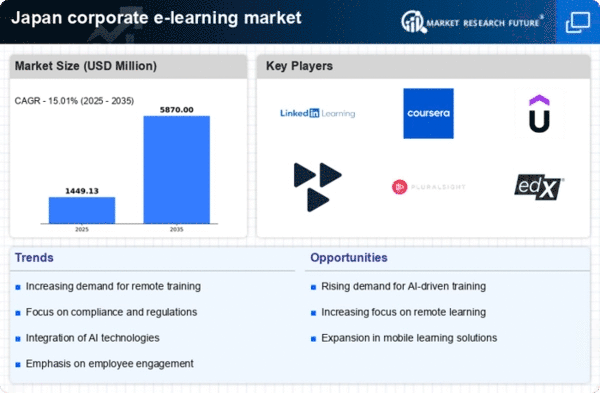
is surging due to rapid technological advancements. Innovations such as artificial intelligence (AI) and machine learning are enhancing the personalization of learning experiences. These technologies allow for adaptive learning paths, catering to individual employee needs. Furthermore, the integration of virtual reality (VR) and augmented reality (AR) is transforming traditional training methods, making them more engaging and effective. According to recent data, the e-learning market in Japan is projected to reach approximately $10 billion by 2025, indicating a robust growth trajectory. This technological evolution not only improves knowledge retention but also increases employee satisfaction, thereby driving the demand for corporate e-learning solutions.
Rising Importance of Data Analytics in Learning Outcomes
Data analytics is emerging as a crucial driver in the corporate e-learning market, particularly in Japan. Organizations are increasingly utilizing data to assess the effectiveness of their training programs and to tailor content to meet specific learning objectives. By analyzing employee performance metrics and engagement levels, companies can identify areas for improvement and optimize their e-learning strategies. This data-driven approach is likely to enhance learning outcomes and ensure that training investments yield tangible results. As businesses continue to prioritize measurable performance, the role of data analytics in shaping the corporate e-learning market is expected to grow.