×
Request Free Sample ×

Kindly complete the form below to receive a free sample of this Report

* Please use a valid business email

Leading companies partner with us for data-driven Insights

clients tt-cursor
Hero Background

Japan Cardless ATM Market

ID: MRFR/ICT/57479-HCR
200 Pages
Aarti Dhapte
February 2026

Japan Cardless ATM Market Research Report By Type (On-site ATM, Off-site ATM, Others), By Technology (Near-field Communication (NFC), Quick Response (QR) Codes, Biometric Verification), and By End User (Bank and Financial Institutions, Independent ATM Deployer)-Forecast to 2035

Share:
Download PDF ×

We do not share your information with anyone. However, we may send you emails based on your report interest from time to time. You may contact us at any time to opt-out.

Japan Cardless ATM Market Infographic
Purchase Options

Japan Cardless ATM Market Summary

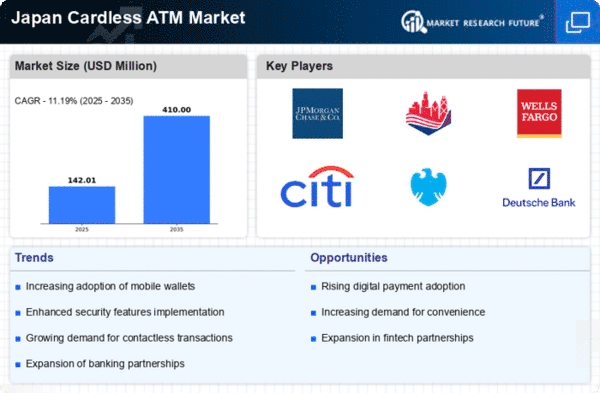
As per Market Research Future analysis, the Japan Cardless ATM Market Size was estimated at 127.72 USD Million in 2024. The Japan cardless atm market is projected to grow from 142.01 USD Million in 2025 to 410.0 USD Million by 2035, exhibiting a compound annual growth rate (CAGR) of 11.1% during the forecast period 2025 - 2035

Key Market Trends & Highlights

The Japan cardless ATM market is experiencing robust growth driven by technological advancements and changing consumer preferences.

  • The largest segment in the Japan cardless ATM market is mobile banking, which is witnessing increased adoption among consumers.
  • Enhanced security features are becoming a critical focus, as users seek safer transaction methods.
  • The fastest-growing segment is contactless payment solutions, reflecting a shift towards convenience in financial transactions.
  • Technological advancements in banking and consumer preference for convenience are key drivers propelling market expansion.

Market Size & Forecast

2024 Market Size 127.72 (USD Million)
2035 Market Size 410.0 (USD Million)
CAGR (2025 - 2035) 11.19%

Major Players

JPMorgan Chase (US), Bank of America (US), Wells Fargo (US), Citibank (US), Barclays (GB), Deutsche Bank (DE), BNP Paribas (FR), Santander (ES)

Our Impact
Enabled $4.3B Revenue Impact for Fortune 500 and Leading Multinationals
Partnering with 2000+ Global Organizations Each Year
30K+ Citations by Top-Tier Firms in the Industry

Japan Cardless ATM Market Trends

The Cardless ATM Market is experiencing notable growth, driven by advancements in technology and changing consumer preferences. In Japan, the adoption of mobile banking applications has surged, allowing users to access their accounts and withdraw cash without the need for physical cards. This shift not only enhances convenience but also aligns with the increasing demand for contactless transactions. Financial institutions are investing in infrastructure to support this trend, ensuring that cardless options are widely available across urban and rural areas. As a result, the landscape of cash withdrawal is evolving, with more users embracing the ease of cardless transactions. Moreover, security concerns are prompting banks to implement robust authentication measures for cardless transactions. Biometric verification, such as fingerprint and facial recognition, is becoming more prevalent, providing an additional layer of protection for users. This focus on security is crucial, as it addresses potential risks associated with digital transactions. The cardless atm market in Japan appears poised for further expansion, as both consumers and financial institutions recognize the benefits of this innovative approach to banking. The future may see even more integration of technology, enhancing user experience and accessibility in the financial sector.

Increased Adoption of Mobile Banking

The rise of mobile banking applications is significantly influencing the cardless atm market. Users are increasingly utilizing their smartphones to manage finances, leading to a higher demand for cardless withdrawal options. This trend reflects a broader shift towards digital solutions in banking.

Enhanced Security Features

Security remains a top priority in the cardless atm market. Financial institutions are implementing advanced authentication methods, such as biometric verification, to ensure safe transactions. This focus on security is essential for building consumer trust in cardless options.

Expansion of Infrastructure

To accommodate the growing demand for cardless transactions, banks are investing in expanding their atm networks. This includes upgrading existing machines and installing new ones that support cardless technology, thereby increasing accessibility for users.

Japan Cardless ATM Market Drivers

Consumer Preference for Convenience

In Japan, there is a notable shift in consumer preferences towards convenience, significantly impacting the Cardless ATM Market. As lifestyles become increasingly fast-paced, individuals are seeking quick and efficient banking solutions. Surveys indicate that over 60% of consumers express a preference for cardless transactions, citing ease of use and time savings as primary factors. This trend is prompting banks to adapt their services to meet evolving customer expectations. The cardless atm market is likely to expand as financial institutions enhance their offerings to include mobile app integrations and user-friendly interfaces. This consumer-driven demand for convenience is expected to play a crucial role in shaping the future landscape of the cardless atm market in Japan.

Rise of Contactless Payment Solutions

The rise of contactless payment solutions is significantly influencing the Cardless ATM Market in Japan. With the increasing adoption of NFC (Near Field Communication) technology, consumers are becoming more accustomed to making transactions without physical contact. This trend is reflected in the growing number of contactless-enabled ATMs, which are projected to account for nearly 40% of all ATMs in Japan by 2025. The convenience and speed of contactless transactions are appealing to tech-savvy consumers, driving demand for cardless options. Financial institutions are likely to respond by enhancing their ATM networks to include contactless capabilities, thereby expanding the cardless atm market. This shift towards contactless solutions is expected to reshape consumer behavior and preferences in the banking sector.

Technological Advancements in Banking

The Cardless ATM Market in Japan is experiencing a surge due to rapid technological advancements in banking. Innovations such as biometric authentication and QR code scanning are enhancing user experience and security. As of 2025, approximately 30% of ATMs in Japan are expected to support cardless transactions, reflecting a growing trend towards digital banking solutions. This shift is driven by consumer demand for convenience and efficiency, as users increasingly prefer to access their funds without physical cards. The integration of advanced technologies not only streamlines transactions but also reduces the risk of card-related fraud, thereby fostering trust in the cardless atm market. Financial institutions are likely to invest heavily in these technologies to remain competitive, further propelling the growth of the cardless atm market in Japan.

Increased Focus on Financial Inclusion

There is an increasing focus on financial inclusion in Japan, which is positively impacting the Cardless ATM Market. Efforts to provide banking services to underserved populations are driving the demand for accessible and user-friendly financial solutions. Cardless ATMs offer a viable option for individuals who may not have traditional banking access or prefer not to use physical cards. As of 2025, initiatives aimed at improving financial literacy and access to digital banking are expected to result in a 20% increase in the usage of cardless ATMs among marginalized communities. This emphasis on inclusion not only broadens the customer base for financial institutions but also enhances the overall growth potential of the cardless atm market in Japan.

Regulatory Support for Digital Transactions

The regulatory environment in Japan is becoming increasingly supportive of digital transactions, which is beneficial for the Cardless ATM Market. Government initiatives aimed at promoting cashless payments are encouraging financial institutions to adopt innovative technologies. Recent policies have been introduced to streamline the approval process for cardless ATM implementations, making it easier for banks to upgrade their systems. As a result, the cardless atm market is projected to grow by approximately 25% over the next few years. This regulatory support not only facilitates the expansion of cardless ATMs but also enhances consumer confidence in digital banking solutions. The alignment of regulatory frameworks with technological advancements is likely to create a conducive environment for the cardless atm market in Japan.


Market Segment Insights

By Type: On-site (Largest) vs. Off-site (Fastest-Growing)

In the Japan cardless atm market, the distribution of market share among different types reveals that on-site cardless ATMs hold a substantial portion, reflecting consumer preference for easily accessible services. Off-site and other types follow, with off-site experiences significant traction due to their convenience and flexibility. The presence of other types, while smaller, contributes to the overall diversity of options available to users, showcasing the market's adaptability to various user needs. Growth trends indicate a robust upsurge for off-site cardless ATMs, driven by increasing demand for convenience and innovation in financial services. This segment is responding to evolving consumer behaviors, as more users gravitate towards app-based banking solutions that facilitate cash withdrawals without traditional cards. As technology continues to advance, the overall growth for cardless ATMs is projected to intensify, capitalizing on the push for more advanced and user-friendly banking solutions.

On-site: Dominant vs. Off-site: Emerging

The On-site segment is characterized by its established presence, offering users reliable access to cash withdrawals directly from recognizable locations such as bank branches. This dominance stems from consumers' ingrained trust and familiarity with traditional banking operations. Conversely, the Off-site segment represents a burgeoning area, characterized by increased deployment of cardless ATMs in strategic locations like shopping malls and public transport hubs. This emerging segment appeals to a tech-savvy demographic seeking convenience, emphasizing the importance of integrating innovative technology for seamless banking experiences. Together, these segments illustrate the dynamic landscape of the Japan cardless atm market, balancing established reliability with cutting-edge convenience.

By Technology: NFC (Largest) vs. QR Codes (Fastest-Growing)

In the Japan cardless atm market, the distribution of market share among technology segments reveals that Near-field Communication (NFC) holds the largest share, significantly influencing consumer preferences and ease of transactions. Quick Response (QR) Codes are establishing a notable presence, perceived as a convenient option for users seeking quick access to funds without physical cards. Biometric Verification, although valuable, plays a more complementary role in the overall market dynamics. Growth trends within this segment indicate that NFC is bolstered by its established technology and widespread acceptance among consumers and financial institutions. QR Codes are emerging rapidly, fueled by increasing smartphone penetration and a growing preference for contactless transactions. Biometric Verification continues to gain traction due to its enhanced security features, appealing to consumers who prioritize security alongside convenience. These trends signify a shift toward more advanced technology in the Japan cardless atm market.

Technology: NFC (Dominant) vs. QR Codes (Emerging)

NFC technology stands as the dominant force in the Japan cardless atm market, recognized for its robust security and user-friendly interface, allowing seamless transactions. This technology enables users to simply tap their devices on payment terminals, ensuring a smooth user experience. QR Codes are emerging as a convenient alternative, especially amid the growing adoption of mobile banking apps; they offer a versatile form of payment that can be integrated into various applications, enhancing customer accessibility. Biometric Verification complements these technologies by adding layers of security; however, it is slower to adopt due to the need for specialized hardware. Together, these technologies illustrate the market's evolution towards one that values speed, convenience, and security.

By End User: Bank and Financial Institutions (Largest) vs. Independent ATM Deployers (Fastest-Growing)

In the Japan cardless atm market, the distribution of market share reveals that Bank and Financial Institutions hold a significant portion, reflecting their established presence and customer trust. This segment benefits from a robust infrastructure and extensive customer base, allowing them to dominate the market. In contrast, Independent ATM Deployers are gaining traction, accounting for an increasingly noticeable share as they leverage technological advancements to enhance customer convenience and access. The growth trends in this segment indicate that Independent ATM Deployers are rapidly becoming a preferred choice due to their flexibility and ability to adapt to market needs. Their agile operations enable them to implement innovative solutions quickly, thus appealing to tech-savvy consumers seeking cash access without traditional banking barriers. Meanwhile, Bank and Financial Institutions continue to innovate, focusing on digital integrations that cater to customer demands, ensuring their sustained relevance in a competitive landscape.

Bank and Financial Institutions (Dominant) vs. Independent ATM Deployers (Emerging)

The Bank and Financial Institutions segment represents the dominant force in the Japan cardless atm market due to their extensive network and consumer trust. They leverage well-established brands and a vast footprint, which provides customers with reliable access to financial services. Investments in technology have allowed them to integrate cardless banking features, catering to a tech-savvy clientele. In contrast, Independent ATM Deployers are emerging as a vital player, tapping into niche markets and offering specialized services. Their rapid growth is fueled by the demand for convenient, user-friendly cash access solutions, positioning them as an innovative alternative in a traditionally banking-dominated space. These deployers are focusing on enhancing customer experiences while streamlining operational efficiencies.

Get more detailed insights about Japan Cardless ATM Market

Key Players and Competitive Insights

The cardless ATM market in Japan is characterized by a rapidly evolving competitive landscape, driven by technological advancements and changing consumer preferences. Key players such as JPMorgan Chase (US), Citibank (US), and Barclays (GB) are actively enhancing their service offerings through digital transformation and strategic partnerships. These companies are focusing on innovation to improve customer experience, streamline operations, and expand their market presence. The collective strategies of these firms indicate a shift towards a more integrated and customer-centric approach, which is reshaping the competitive dynamics of the market.In terms of business tactics, companies are increasingly localizing their operations and optimizing supply chains to enhance efficiency and responsiveness. The market structure appears moderately fragmented, with several players vying for market share. However, the influence of major banks like JPMorgan Chase (US) and Citibank (US) is substantial, as they leverage their extensive networks and technological capabilities to maintain a competitive edge.

In October JPMorgan Chase (US) announced a partnership with a leading fintech firm to enhance its cardless ATM capabilities, allowing customers to access funds via mobile applications. This strategic move is likely to bolster its market position by attracting tech-savvy consumers who prefer seamless digital transactions. The integration of advanced security features in this partnership may also address growing concerns regarding fraud and data security, further solidifying customer trust.

In September Citibank (US) launched a new initiative aimed at expanding its cardless ATM network across urban areas in Japan. This expansion is significant as it aligns with the increasing demand for convenient banking solutions in densely populated regions. By enhancing accessibility, Citibank (US) is positioning itself to capture a larger share of the market, particularly among younger demographics who prioritize convenience and technology.

In August Barclays (GB) introduced an innovative biometric authentication system for its cardless ATMs, which allows users to withdraw cash using facial recognition technology. This development not only enhances user experience but also addresses security concerns, potentially setting a new standard in the industry. The adoption of such cutting-edge technology may provide Barclays (GB) with a competitive advantage, appealing to customers who value both convenience and security in their banking transactions.

As of November current trends in the cardless ATM market are heavily influenced by digitalization, sustainability, and the integration of artificial intelligence. Strategic alliances among key players are fostering innovation and enhancing service delivery. The competitive landscape is shifting from traditional price-based competition to a focus on technological advancements and supply chain reliability. Moving forward, differentiation will likely hinge on the ability to innovate and adapt to consumer needs, as companies strive to create unique value propositions in an increasingly digital world.

Key Companies in the Japan Cardless ATM Market include

Industry Developments

Recent developments in the Japan Cardless ATM Market highlight the growing trend among financial institutions to enhance cash withdrawal convenience and security. Notable players such as Mizuho Financial Group and Sumitomo Mitsui Banking Corporation have expanded their cardless ATM offerings, facilitating transactions via smartphones and QR codes.

In March 2023, Japan Post Bank implemented new cardless technology, improving user accessibility and promoting digital transaction methods amidst the nation's push for cashless solutions.

Furthermore, Seven Bank has introduced innovative services aimed at catering to tech-savvy consumers, which is in line with the increasing demand for seamless financial transactions. The market valuation of companies involved has experienced notable growth, driven by enhanced user experiences and technological advancements.

Additionally, various institutions are exploring partnerships to develop integrated solutions. In recent years, from 2021 to 2023, the shift towards digitized banking and financial services has accelerated, indicating a significant transformation in consumer behavior and banking practices in Japan. With major companies such as Rakuten Bank and Shinsei Bank entering the cardless space, the sector is poised to witness further innovation and market penetration.

Future Outlook

Japan Cardless ATM Market Future Outlook

The Cardless ATM Market in Japan is projected to grow at 11.19% CAGR from 2025 to 2035, driven by technological advancements and increasing consumer demand for convenience.

New opportunities lie in:

  • Integration of biometric authentication for enhanced security
  • Partnerships with fintech firms for innovative payment solutions
  • Expansion of cardless services in rural and underserved areas

By 2035, the market is expected to achieve substantial growth, reflecting evolving consumer preferences and technological integration.

Market Segmentation

Japan Cardless ATM Market Type Outlook

  • On-site
  • Off-site
  • Others

Japan Cardless ATM Market End User Outlook

  • Bank and Financial Institutions
  • Independent ATM Deployers

Japan Cardless ATM Market Technology Outlook

  • Near-field Communication (NFC)
  • Quick Response (QR) Codes
  • Biometric Verification

Report Scope

MARKET SIZE 2024 127.72(USD Million)
MARKET SIZE 2025 142.01(USD Million)
MARKET SIZE 2035 410.0(USD Million)
COMPOUND ANNUAL GROWTH RATE (CAGR) 11.19% (2025 - 2035)
REPORT COVERAGE Revenue Forecast, Competitive Landscape, Growth Factors, and Trends
BASE YEAR 2024
Market Forecast Period 2025 - 2035
Historical Data 2019 - 2024
Market Forecast Units USD Million
Key Companies Profiled JPMorgan Chase (US), Bank of America (US), Wells Fargo (US), Citibank (US), Barclays (GB), Deutsche Bank (DE), BNP Paribas (FR), Santander (ES)
Segments Covered Type, Technology, End User
Key Market Opportunities Integration of biometric authentication enhances security and user experience in the cardless atm market.
Key Market Dynamics Rising consumer preference for digital banking drives innovation in cardless ATM technology and services.
Countries Covered Japan
Leave a Comment

FAQs

What is the expected market size of the Japan Cardless ATM Market by 2035?

The Japan Cardless ATM Market is expected to be valued at approximately 283.2 million USD by 2035.

What was the market size of the Japan Cardless ATM Market in 2024?

In 2024, the Japan Cardless ATM Market is valued at around 84.96 million USD.

What is the expected compound annual growth rate (CAGR) of the Japan Cardless ATM Market from 2025 to 2035?

The expected CAGR for the Japan Cardless ATM Market from 2025 to 2035 is 11.567 percent.

Which type of cardless ATMs is expected to hold the largest market share by 2035?

The On-site ATM segment is projected to reach a market value of 100 million USD by 2035.

What is the projected value of the Off-site ATM segment in 2035?

The Off-site ATM segment is anticipated to be valued at approximately 140 million USD by 2035.

Who are some of the key players in the Japan Cardless ATM Market?

Major players in the Japan Cardless ATM Market include Saison Capital, Mizuho Financial Group, and Seven Bank, among others.

What is the expected market size for the 'Others' category in the cardless ATM market by 2035?

The 'Others' category is projected to reach a market size of around 43.2 million USD by 2035.

What opportunities exist for growth within the Japan Cardless ATM Market?

Emerging trends in digital payments and technology advancements present significant growth opportunities in the market.

What challenges might impact the Japan Cardless ATM Market during the forecast period?

Regulatory constraints and cybersecurity concerns are potential challenges that may impact market growth.

How is the growth rate of the Japan Cardless ATM Market compared to previous years?

The market's expected growth rate shows a notable increase, driven by the shift toward cashless transactions and technological innovations.

Download Free Sample

Kindly complete the form below to receive a free sample of this Report

Compare Licence

×
Features License Type
Single User Multiuser License Enterprise User
Price $4,950 $5,950 $7,250
Maximum User Access Limit 1 User Upto 10 Users Unrestricted Access Throughout the Organization
Free Customization
Direct Access to Analyst
Deliverable Format
Platform Access
Discount on Next Purchase 10% 15% 15%
Printable Versions