×
Request Free Sample ×

Kindly complete the form below to receive a free sample of this Report

* Please use a valid business email

Leading companies partner with us for data-driven Insights

clients tt-cursor
Hero Background

Japan Biometric ATM Market

ID: MRFR/BS/57338-HCR
200 Pages
Aarti Dhapte
February 2026

Japan Biometric ATM Market Size, Share and Research Report By Application (Withdrawals, Deposits), By Product Type (Iris Recognition, Fingerprint Biometrics, Voice Recognition, Facial Recognition, Others) and By Component (Hardware, Software, Services)-Forecast to 2035

Share:
Download PDF ×

We do not share your information with anyone. However, we may send you emails based on your report interest from time to time. You may contact us at any time to opt-out.

Japan Biometric ATM Market Infographic
Purchase Options

Japan Biometric ATM Market Summary

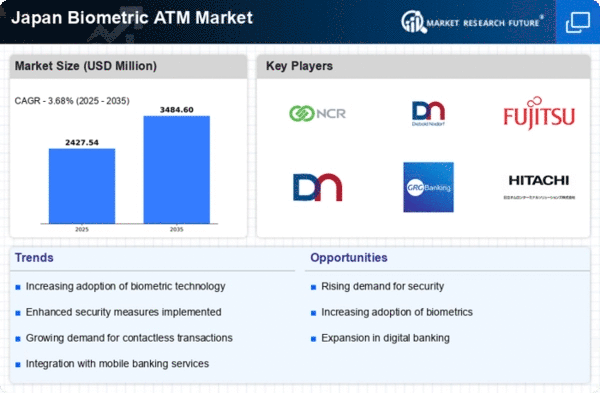
As per Market Research Future analysis, the Japan Biometric ATM Market Size was estimated at 2341.38 USD Million in 2024. The Japan biometric atm market is projected to grow from 2427.54 USD Million in 2025 to 3484.6 USD Million by 2035, exhibiting a compound annual growth rate (CAGR) of 3.6% during the forecast period 2025 - 2035

Key Market Trends & Highlights

The Japan biometric ATM market is poised for substantial growth driven by security and user-centric innovations.

  • The market is witnessing increased security measures to combat fraud and enhance user trust.
  • User-centric innovations are becoming prevalent, focusing on convenience and accessibility for customers.
  • Regulatory support for biometric solutions is fostering a favorable environment for market expansion.
  • Rising demand for secure transactions and technological advancements in biometric systems are key drivers of market growth.

Market Size & Forecast

2024 Market Size 2341.38 (USD Million)
2035 Market Size 3484.6 (USD Million)
CAGR (2025 - 2035) 3.68%

Major Players

NCR Corporation (US), Diebold Nixdorf (US), Fujitsu (JP), Wincor Nixdorf (DE), GRG Banking (CN), Hitachi-Omron Terminal Solutions (JP), Triton (US), KAL ATM Software (GB)

Our Impact
Enabled $4.3B Revenue Impact for Fortune 500 and Leading Multinationals
Partnering with 2000+ Global Organizations Each Year
30K+ Citations by Top-Tier Firms in the Industry

Japan Biometric ATM Market Trends

The biometric atm market is experiencing notable advancements, driven by the increasing demand for enhanced security and user convenience. In Japan, financial institutions are progressively adopting biometric technologies to streamline transactions and reduce fraud. This shift is largely influenced by the growing awareness of identity theft and the need for secure banking solutions. As a result, biometric atms are becoming more prevalent, offering features such as fingerprint recognition and facial identification. These innovations not only improve customer experience but also align with the technological advancements in the banking sector. Moreover, the regulatory environment in Japan appears to support the integration of biometric systems within financial services. Government initiatives aimed at promoting digital transformation in banking are likely to further accelerate the adoption of biometric atms. The collaboration between technology providers and financial institutions is fostering an ecosystem that encourages innovation and enhances operational efficiency. As the market evolves, it seems poised for significant growth, with potential expansions into various regions and demographics, thereby reshaping the landscape of banking in Japan.

Increased Security Measures

The biometric atm market is witnessing a trend towards heightened security protocols. Financial institutions are increasingly implementing biometric authentication methods to combat fraud and enhance customer trust. This shift is driven by the need for more secure transactions, as traditional PINs and cards are often vulnerable to theft and misuse.

User-Centric Innovations

There is a growing emphasis on user-friendly designs and functionalities within the biometric atm market. Institutions are focusing on creating intuitive interfaces that cater to diverse customer needs. This trend reflects a broader commitment to improving customer experience and accessibility, ensuring that biometric atms are easy to use for all demographics.

Regulatory Support for Biometric Solutions

The regulatory landscape in Japan is evolving to support the adoption of biometric technologies in banking. Government policies are increasingly favoring the integration of advanced security measures, which may encourage financial institutions to invest in biometric atm solutions. This trend indicates a proactive approach to enhancing security and efficiency in the banking sector.

Japan Biometric ATM Market Drivers

Rising Demand for Secure Transactions

The biometric atm market in Japan is experiencing a notable surge in demand for secure transaction methods. As financial institutions and consumers alike prioritize security, the adoption of biometric authentication technologies is becoming increasingly prevalent. In 2025, it is estimated that the market for biometric ATMs will grow by approximately 15%, driven by the need to mitigate fraud and enhance user trust. This trend is particularly pronounced in urban areas, where the concentration of financial activities necessitates robust security measures. The biometric atm market is thus positioned to benefit from this heightened focus on security, as banks and service providers invest in advanced biometric solutions to safeguard customer transactions.

Competitive Landscape and Market Dynamics

The competitive landscape of the biometric atm market in Japan is evolving, with numerous players vying for market share. This dynamic environment is fostering innovation and driving advancements in biometric technologies. As companies strive to differentiate their offerings, the biometric atm market is likely to witness an influx of new products and services. By 2025, the market is expected to grow by around 11%, as established banks and emerging fintech companies invest in biometric solutions to enhance their service portfolios. This competition not only benefits consumers through improved options but also accelerates the overall growth of the biometric atm market.

Technological Advancements in Biometric Systems

Technological innovations are playing a pivotal role in shaping the biometric atm market in Japan. The integration of advanced biometric systems, such as facial recognition and fingerprint scanning, is enhancing the efficiency and accuracy of ATM transactions. In recent years, the market has seen a shift towards multi-modal biometric systems, which combine various authentication methods to improve security and user experience. By 2025, the biometric atm market is projected to witness a growth rate of around 12%, as financial institutions increasingly adopt these cutting-edge technologies. This trend not only streamlines the transaction process but also addresses the growing concerns regarding identity theft and unauthorized access.

Government Initiatives Promoting Biometric Adoption

The Japanese government is actively promoting the adoption of biometric technologies across various sectors, including banking. Initiatives aimed at enhancing digital security and financial inclusion are likely to bolster the biometric atm market. In 2025, government policies may facilitate the integration of biometric systems in ATMs, potentially leading to a market growth of 10%. These initiatives are designed to encourage financial institutions to invest in biometric solutions, thereby improving customer access to secure banking services. The biometric atm market stands to gain from these supportive measures, as they create a conducive environment for innovation and investment in biometric technologies.

Consumer Preference for Convenient Banking Solutions

Consumer behavior is shifting towards a preference for convenient and efficient banking solutions, which is significantly impacting the biometric atm market in Japan. As customers seek faster and more user-friendly transaction methods, biometric ATMs are emerging as a preferred choice. The biometric atm market is likely to see an increase in adoption rates, with projections indicating a growth of approximately 14% by 2025. This trend is particularly relevant among younger demographics, who are more inclined to embrace technology-driven solutions. Financial institutions are responding to this demand by enhancing their ATM offerings with biometric capabilities, thereby aligning with consumer expectations for convenience and speed.


Market Segment Insights

By Application: Withdrawals (Largest) vs. Deposits (Fastest-Growing)

In the Japan biometric atm market, the application segment is largely dominated by withdrawals, capturing a significant portion of the market share. This trend reflects the strong consumer preference and reliance on ATMs for cash withdrawals. On the other hand, deposits represent a growing niche within this segment, benefiting from technological advancements and changing consumer behavior that favors convenience and efficiency in banking operations. The growth drivers for deposits can be attributed to an increasing number of users seeking seamless banking experiences. As more consumers and businesses embrace digital banking solutions, the demand for biometric ATMs that facilitate secure and quick deposits is rapidly climbing. This trend indicates a shift in user preferences, with deposits becoming an indispensable part of the ATM usage landscape in the Japan biometric atm market.

Withdrawals: Dominant vs. Deposits: Emerging

Withdrawals are the dominant force in the application segment, as they are the primary function for most ATM users, driven by the high demand for cash transactions. The reliability and speed offered by biometric ATMs reinforce their position in this category. Conversely, deposits are emerging as an essential functionality within the segment, encouraged by innovations that enhance user experience. This shift towards deposits is also supported by the increasing awareness of financial technology, making it easier for consumers to deposit cash or checks through ATMs. As the Japan biometric atm market evolves, both withdrawals and deposits are expected to complement each other, catering to diverse consumer needs.

By Product Type: Fingerprint Biometrics (Largest) vs. Facial Recognition (Fastest-Growing)

In the Japan biometric atm market, Fingerprint Biometrics has emerged as the dominant product type, commanding a significant share due to its reliability and user-friendliness. Iris Recognition and Voice Recognition contribute to the market but remain less prominent, while Facial Recognition is quickly gaining ground as security standards evolve and consumers demand more advanced features. The Others segment incorporates niche technologies that, while currently marginal, may see increased adoption in the future. Growth trends in this segment indicate a shift towards advanced biometric systems, particularly in the context of heightened security concerns and the integration of artificial intelligence. The increasing public awareness of identity theft and fraud has bolstered the appeal of biometric solutions. As technology advances, convenience and accuracy are expected to drive further investments in innovative biometric ATMs, particularly in Facial Recognition and other emerging technologies.

Fingerprint Biometrics (Dominant) vs. Facial Recognition (Emerging)

Fingerprint Biometrics stands as the dominant force in the Japan biometric atm market, favored for its established technology and ability to deliver quick, accurate results. This method enhances user experience by simplifying the transaction process and minimizing the risks associated with traditional PIN-based systems. On the other hand, Facial Recognition is rapidly emerging as a game-changing technology, driven by advancements in deep learning algorithms and camera technology. This segment is characterized by its non-intrusive nature, allowing for seamless user interactions. The growth of Facial Recognition is fueled by its potential applications in security and customer experience improvement, positioning it as a key player for future development in the market.

By Components: Hardware (Largest) vs. Software (Fastest-Growing)

In the Japan biometric atm market, the Components segment showcases a diverse distribution among hardware, software, and services. Hardware currently holds the largest market share, primarily due to the essential role physical devices play in biometric authentication. Meanwhile, software, which encompasses the development and integration of biometric systems, is rapidly catching up as it represents the fastest-growing sector within this segment. Growth trends in the Components segment indicate an increasing investment in biometric technologies, driven by security concerns and a push for enhanced user experience. The demand for seamless integration of software with existing hardware systems is accelerating the development of innovative solutions. This evolution reflects a broader trend of digital transformation in financial services, where biometrics are pivotal in preventing fraud and improving operational efficiency.

Hardware: Dominant vs. Software: Emerging

Hardware remains the dominant component in the Japan biometric atm market due to its foundational role in deploying biometric systems. This segment includes physical devices and components essential for capturing biometric data, such as fingerprint scanners and facial recognition cameras. Software, on the other hand, is an emerging force, focusing on the algorithms that process and analyze biometric inputs. As security threats evolve, the emerging software segment is quickly adapting, leading to innovative solutions that enhance user verification and streamline operations. Both segments are crucial, but hardware's established presence gives it a solid lead, while software shows immense potential for growth and adaptation in response to market needs.

Get more detailed insights about Japan Biometric ATM Market

Key Players and Competitive Insights

The biometric ATM market in Japan is characterized by a dynamic competitive landscape, driven by technological advancements and increasing demand for secure banking solutions. Key players such as NCR Corporation (US), Diebold Nixdorf (US), and Fujitsu (JP) are at the forefront, each adopting distinct strategies to enhance their market presence. NCR Corporation (US) focuses on innovation, particularly in integrating biometric technologies with existing ATM systems, thereby improving user experience and security. Meanwhile, Diebold Nixdorf (US) emphasizes partnerships with local banks to tailor solutions that meet specific regional needs, which appears to strengthen their foothold in the market. Fujitsu (JP), leveraging its strong technological base, is investing in digital transformation initiatives that align with Japan's push towards cashless transactions, indicating a strategic pivot towards future-proofing their offerings.
The market structure is moderately fragmented, with several players vying for market share. Key business tactics include localizing manufacturing to reduce costs and enhance supply chain efficiency. This approach not only mitigates risks associated with The biometric atm market demands. The collective influence of these key players shapes a competitive environment where innovation and customer-centric solutions are paramount.
In September 2025, NCR Corporation (US) announced a partnership with a leading Japanese financial institution to deploy a new line of biometric ATMs equipped with advanced facial recognition technology. This strategic move is significant as it not only enhances security but also aligns with the growing consumer preference for contactless banking solutions. The collaboration is expected to bolster NCR's market position while addressing the evolving needs of Japanese consumers.
In October 2025, Diebold Nixdorf (US) launched a new software platform designed to integrate seamlessly with existing ATM networks, enabling biometric authentication features. This initiative is crucial as it allows banks to upgrade their current systems without the need for complete overhauls, thereby reducing costs and downtime. Such flexibility in service offerings may enhance customer loyalty and attract new clients looking for efficient solutions.
In August 2025, Fujitsu (JP) unveiled a pilot program for biometric ATMs that utilize palm vein recognition technology, aimed at enhancing user convenience and security. This innovative approach not only differentiates Fujitsu's offerings but also reflects a broader trend towards integrating advanced biometric solutions in financial services. The pilot program's success could pave the way for wider adoption across Japan, potentially setting new industry standards.
As of November 2025, the competitive trends in the biometric ATM market are increasingly defined by digitalization, sustainability, and the integration of artificial intelligence. Strategic alliances among key players are shaping the landscape, fostering innovation and enhancing service delivery. The shift from price-based competition to a focus on technological advancement and supply chain reliability is evident, suggesting that future competitive differentiation will hinge on the ability to innovate and adapt to changing consumer preferences.

Key Companies in the Japan Biometric ATM Market include

Industry Developments

The Japan Biometric ATM Market has seen significant advancements with increasing focus on security and user authentication technologies. Companies like NCR Corporation and Diebold Nixdorf are rolling out biometric ATMs that utilize fingerprint and facial recognition to streamline banking experiences.

Recent regulatory changes in Japan emphasize the need for enhanced security measures, prompting key players such as Hitachi and Panasonic to invest in Research and Development.

In November 2022, NEC announced a strategic collaboration with Fujitsu to develop next-generation biometric ATM technology, enhancing the safety and user experience for customers. Furthermore, Toshiba has been actively promoting biometric solutions as a response to rising cyber threats, aligning their product offerings with national security standards.

The market is expected to grow further, driven by a push towards digitization and contactless transactions, particularly in the aftermath of the COVID-19 pandemic.

Over the past two years, there has been a noticeable shift towards integrating artificial intelligence with biometric systems, which is anticipated to optimize operation and increase customer engagement in Japan's financial services sector. This trend showcases a commitment from major corporations to modernize ATM functionalities while addressing security concerns.

Future Outlook

Japan Biometric ATM Market Future Outlook

The biometric ATM market in Japan is projected to grow at a 3.68% CAGR from 2025 to 2035, driven by technological advancements and increasing security demands.

New opportunities lie in:

  • Integration of AI-driven biometric verification systems
  • Expansion into rural areas with mobile biometric ATMs
  • Partnerships with fintech firms for innovative payment solutions

By 2035, the market is expected to achieve robust growth and enhanced security features.

Market Segmentation

Japan Biometric ATM Market Components Outlook

  • Hardware
  • Software
  • Services

Japan Biometric ATM Market Application Outlook

  • Withdrawals
  • Deposits

Japan Biometric ATM Market Product Type Outlook

  • Iris Recognition
  • Fingerprint Biometrics
  • Voice Recognition
  • Facial Recognition
  • Others

Report Scope

MARKET SIZE 2024 2341.38(USD Million)
MARKET SIZE 2025 2427.54(USD Million)
MARKET SIZE 2035 3484.6(USD Million)
COMPOUND ANNUAL GROWTH RATE (CAGR) 3.68% (2025 - 2035)
REPORT COVERAGE Revenue Forecast, Competitive Landscape, Growth Factors, and Trends
BASE YEAR 2024
Market Forecast Period 2025 - 2035
Historical Data 2019 - 2024
Market Forecast Units USD Million
Key Companies Profiled NCR Corporation (US), Diebold Nixdorf (US), Fujitsu (JP), Wincor Nixdorf (DE), GRG Banking (CN), Hitachi-Omron Terminal Solutions (JP), Triton (US), KAL ATM Software (GB)
Segments Covered Application, Product Type, Components
Key Market Opportunities Integration of advanced biometric technologies enhances security and user experience in the biometric atm market.
Key Market Dynamics Rising demand for secure transactions drives innovation in biometric ATM technology within Japan's financial sector.
Countries Covered Japan
Leave a Comment

FAQs

What is the projected market size of the Japan Biometric ATM Market in 2024?

The Japan Biometric ATM Market is expected to be valued at 2.6 billion USD in 2024.

What will be the market size of the Japan Biometric ATM Market by 2035?

By 2035, the Japan Biometric ATM Market is anticipated to reach a valuation of 3.3 billion USD.

What is the expected CAGR for the Japan Biometric ATM Market from 2025 to 2035?

The market is expected to grow at a CAGR of 2.191 percent during the forecast period from 2025 to 2035.

Which application holds the largest share in the Japan Biometric ATM Market?

As of 2024, the Withdrawals application segment holds the largest share, valued at 1.5 billion USD.

What is the market value for the Deposits application in 2024?

The Deposits application segment of the Japan Biometric ATM Market is valued at 1.1 billion USD in 2024.

Who are the key players in the Japan Biometric ATM Market?

Major players in the Japan Biometric ATM Market include NCR Corporation, Toshiba, NEC, and Diebold Nixdorf among others.

What is the market size for Withdrawals by 2035?

The Withdrawals application segment is projected to grow to 1.9 billion USD by 2035.

What will be the value of the Deposits segment by 2035?

The Deposits segment is estimated to reach 1.4 billion USD in value by 2035.

What are the growth drivers for the Japan Biometric ATM Market?

The growth drivers for this market include increasing demand for secure banking transactions and advancements in biometric technology.

What trends are emerging in the Japan Biometric ATM Market?

Emerging trends include enhanced user authentication methods and the integration of biometric systems for improved transaction security.

Download Free Sample

Kindly complete the form below to receive a free sample of this Report

Compare Licence

×
Features License Type
Single User Multiuser License Enterprise User
Price $4,950 $5,950 $7,250
Maximum User Access Limit 1 User Upto 10 Users Unrestricted Access Throughout the Organization
Free Customization
Direct Access to Analyst
Deliverable Format
Platform Access
Discount on Next Purchase 10% 15% 15%
Printable Versions