×
Request Free Sample ×

Kindly complete the form below to receive a free sample of this Report

* Please use a valid business email

Leading companies partner with us for data-driven Insights

clients tt-cursor
Hero Background

Jadc2 Technology Market

ID: MRFR/AD/31042-HCR
128 Pages
Sejal Akre
February 2026

JADC2 Technology Market Size, Share, Industry Trend & Analysis Research Report By Application (Military Operations, Disaster Response, Civil Defense, Intelligence Surveillance Reconnaissance), By Technology (Data Integration, Communication Systems, Artificial Intelligence, Cloud Computing), By Deployment Type (On-Premises, Cloud-Based), By End Use (Defense Agencies, Government Organizations, Private Security Firms) and By Regional (North America, Europe, South America, Asia Pacific, Middle East and Africa) - Forecast to 2035.

Share:
Download PDF ×

We do not share your information with anyone. However, we may send you emails based on your report interest from time to time. You may contact us at any time to opt-out.

Jadc2 Technology Market Infographic
Purchase Options

Jadc2 Technology Market Summary

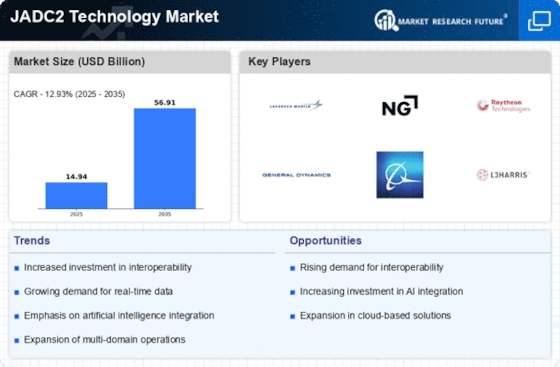
As per Market Research Future analysis, the JADC2 Technology Market Size was estimated at 14.94 USD Billion in 2024. The JADC2 industry is projected to grow from 16.87 USD Billion in 2025 to 56.91 USD Billion by 2035, exhibiting a compound annual growth rate (CAGR) of 12.93% during the forecast period 2025 - 2035

Key Market Trends & Highlights

The JADC2 Technology Market is poised for substantial growth driven by technological advancements and increasing defense needs.

  • The integration of advanced technologies is reshaping the JADC2 landscape, particularly in North America.
  • Emphasis on interoperability is becoming crucial as military operations evolve in complexity and scope.
  • Collaboration between sectors is fostering innovation, especially in the Asia-Pacific region, which is experiencing rapid growth.
  • Increased defense budgets and growing cybersecurity concerns are key drivers propelling the demand for enhanced interoperability in military operations and artificial intelligence segments.

Market Size & Forecast

2024 Market Size 14.94 (USD Billion)
2035 Market Size 56.91 (USD Billion)
CAGR (2025 - 2035) 12.93%

Major Players

Lockheed Martin (US), Northrop Grumman (US), Raytheon Technologies (US), General Dynamics (US), Boeing (US), L3Harris Technologies (US), Thales Group (FR), Leonardo S.p.A. (IT), SAIC (US), Hewlett Packard Enterprise (US)

Our Impact
Enabled $4.3B Revenue Impact for Fortune 500 and Leading Multinationals
Partnering with 2000+ Global Organizations Each Year
30K+ Citations by Top-Tier Firms in the Industry

Jadc2 Technology Market Trends

The JADC2 Technology Market is currently experiencing a transformative phase, driven by the increasing need for integrated command and control systems across military and defense sectors. This market appears to be evolving in response to the growing complexity of modern warfare, where rapid decision-making and real-time data sharing are paramount. As nations invest in advanced technologies, the emphasis on interoperability among various platforms and services becomes more pronounced. The integration of artificial intelligence, machine learning, and cloud computing into JADC2 systems suggests a shift towards more agile and responsive military operations. Moreover, the focus on enhancing situational awareness and improving operational efficiency indicates a broader trend towards modernization within defense strategies. Stakeholders in the JADC2 Technology Market are likely to prioritize solutions that facilitate seamless communication and collaboration among joint forces. This trend may lead to increased partnerships between government entities and private sector innovators, fostering a collaborative ecosystem that supports the development of cutting-edge technologies. As the landscape continues to evolve, the JADC2 Technology Market is poised for significant advancements that could redefine military capabilities in the coming years.

Integration of Advanced Technologies

The JADC2 Technology Market is witnessing a notable integration of advanced technologies such as artificial intelligence and machine learning. These innovations are expected to enhance decision-making processes and improve the overall efficiency of military operations.

Emphasis on Interoperability

A growing emphasis on interoperability among various defense systems is evident within the JADC2 Technology Market. This trend indicates a shift towards ensuring that different platforms can communicate effectively, thereby enhancing joint operational capabilities.

Collaboration Between Sectors

The JADC2 Technology Market is likely to see increased collaboration between government and private sectors. This partnership may foster innovation and accelerate the development of solutions that address the evolving needs of modern military operations.

Jadc2 Technology Market Drivers

Increased Defense Budgets

The JADC2 Technology Market is experiencing a notable surge in defense budgets across various nations. Governments are prioritizing modernization efforts to enhance military capabilities, which includes investments in advanced command and control systems. For instance, the U.S. Department of Defense has allocated substantial funds to develop and implement JADC2 technologies, aiming to improve operational efficiency and decision-making processes. This trend is mirrored in other countries, where defense spending is increasingly directed towards integrating cutting-edge technologies into military operations. As nations recognize the strategic importance of JADC2 systems, the market is likely to expand, driven by the need for enhanced situational awareness and rapid response capabilities.

Growing Cybersecurity Concerns

In the context of the JADC2 Technology Market, the escalating threat of cyberattacks is a critical driver. As military operations become more reliant on interconnected systems, the potential vulnerabilities associated with these technologies have come to the forefront. Defense organizations are compelled to invest in robust cybersecurity measures to protect sensitive data and maintain operational integrity. This has led to an increased demand for JADC2 solutions that incorporate advanced cybersecurity features. The market is projected to grow as stakeholders seek to mitigate risks associated with cyber threats, ensuring that JADC2 systems remain resilient and secure in an increasingly hostile digital landscape.

Need for Enhanced Interoperability

Interoperability remains a pivotal concern within the JADC2 Technology Market. As military forces increasingly collaborate across different branches and allied nations, the ability to seamlessly share information and coordinate actions becomes essential. This need drives the development of JADC2 systems that can integrate diverse platforms and technologies. Efforts to standardize communication protocols and data formats are underway, facilitating smoother interactions among various military entities. The market is poised for growth as stakeholders recognize the importance of interoperability in achieving mission success, leading to investments in JADC2 solutions that promote cohesive operations across multiple domains.

Shift Towards Multi-Domain Operations

The JADC2 Technology Market is witnessing a paradigm shift towards multi-domain operations, where military forces operate across land, air, sea, space, and cyber domains. This strategic approach necessitates advanced command and control systems capable of integrating information from various sources. As defense organizations adapt to this evolving operational landscape, the demand for JADC2 technologies that support multi-domain integration is expected to increase. This shift is driven by the recognition that modern conflicts require a holistic view of the battlefield, enabling forces to respond effectively to threats across multiple environments. Consequently, the market is likely to expand as military planners seek to implement JADC2 solutions that facilitate comprehensive situational awareness and coordinated responses.

Advancements in Artificial Intelligence

The integration of artificial intelligence (AI) into the JADC2 Technology Market is transforming military operations. AI technologies enhance data processing capabilities, enabling faster and more accurate decision-making. As militaries adopt AI-driven solutions, the demand for JADC2 systems that leverage these advancements is expected to rise. For example, AI can analyze vast amounts of data from various sources, providing commanders with actionable insights in real-time. This capability is crucial for maintaining a competitive edge in modern warfare. Consequently, the market is likely to witness significant growth as defense agencies prioritize the incorporation of AI into their JADC2 frameworks, thereby improving operational effectiveness.


Market Segment Insights

By Application: Military Operations (Largest) vs. Intelligence Surveillance Reconnaissance (Fastest-Growing)

In the JADC2 Technology Market, application segments are critical in defining operational effectiveness across various domains. Military Operations holds a significant majority share, as governments prioritize investments in defense capabilities. In contrast, segments like Disaster Response and Civil Defense play essential roles but do not match the scale of military funding. intelligence surveillance reconnaissance, while not the largest sector, is rapidly gaining traction due to the increase in global threats and the need for more sophisticated surveillance capabilities.

Applications: Military Operations (Dominant) vs. intelligence surveillance reconnaissance (Emerging)

Military Operations, as the dominant application segment in the JADC2 Technology Market, is characterized by significant government contracts and pivotal funding directed towards enhancing combat readiness and strategic operations. This segment leverages cutting-edge technology for real-time communication and data analytics, ensuring that military personnel have instant access to vital information. On the other hand, Intelligence Surveillance Reconnaissance is emerging strongly as a critical area of growth, driven by the necessitation of advanced technologies in counter-terrorism and monitoring activities. The rapid evolution of digital technologies and the increasing importance placed on situational awareness are driving this segment's expansion, making it a focal point in contemporary security strategies.

By Technology: Artificial Intelligence (Largest) vs. Communication Systems (Fastest-Growing)

In the JADC2 Technology Market, the segment of Artificial Intelligence holds a pivotal position, commanding a substantial share of the overall market. This dominance is attributed to its critical role in enhancing decision-making and operational efficiencies within military operations. Meanwhile, Communication Systems have emerged as the fastest-growing segment, fueled by the increasing demand for secure and reliable communication solutions in interconnected battlefields.

Technology: Artificial Intelligence (Dominant) vs. Communication Systems (Emerging)

Artificial Intelligence has established itself as the dominant force in the JADC2 Technology Market, providing advanced algorithms for data analysis, predictive modeling, and autonomous systems integration. Its capabilities significantly improve situational awareness and mission effectiveness. Communication Systems, on the other hand, are rapidly gaining traction due to the necessity for real-time, encrypted communications across diverse platforms and the increasing reliance on networked military operations. As the demand for interoperability grows, communication solutions are evolving to support multi-domain operations, enhancing their market relevance and paving the way for their expansion.

By Deployment Type: On-Premises (Largest) vs. Cloud-Based (Fastest-Growing)

In the JADC2 Technology Market, the deployment type segment is primarily dominated by On-Premises solutions, which account for a substantial portion of the market. Organizations tend to prefer On-Premises deployments due to concerns over security, control, and compliance with regulations. However, Cloud-Based solutions are gaining traction, catering to those seeking flexibility and scalability in operations, thus presenting a competitive alternative in this market.

Deployment Type: On-Premises (Dominant) vs. Cloud-Based (Emerging)

On-Premises deployment is characterized by complete control over the infrastructure, allowing for tailored security protocols that align with military and government standards. This segment is favored by entities that prioritize data sovereignty and risk management, which are critical in defense applications. Conversely, Cloud-Based deployment represents an emerging trend fueled by the need for rapid scalability and cost-effectiveness. This segment is particularly appealing to organizations looking to enhance collaboration and data sharing across various missions and units. The flexibility offered by Cloud-Based technologies is accelerating its adoption, marking it as a contender in the JADC2 ecosystem.

By End Use: Defense Agencies (Largest) vs. Government Organizations (Fastest-Growing)

In the JADC2 Technology Market, the Defense Agencies segment holds the largest share, representing a significant proportion of the overall market. This dominance can be attributed to the increasing investments in advanced technologies and the ongoing modernization of military operations. Meanwhile, Government Organizations are emerging as the fastest-growing segment as they seek enhanced inter-agency collaboration and improved situational awareness through JADC2 technologies. This shift underscores the relevance of these technologies in non-military applications, aiming to augment national security and response capabilities. The growth trends in this segment are driven by rising defense budgets and an emphasis on interoperability among various agencies. The need for real-time data sharing and operational efficiency is propelling Defense Agencies to adopt JADC2 solutions aggressively. Conversely, Government Organizations are discovering the potential of JADC2 technologies in crisis management, disaster response, and homeland security, leading to their rapid growth. As the landscape of national security evolves, both segments will play crucial roles in shaping the future of defense-tech integration.

End Use: Defense Agencies (Dominant) vs. Government Organizations (Emerging)

In the JADC2 Technology Market, Defense Agencies are recognized as the dominant end user, leveraging these technologies to enhance combat readiness and mission success. Their strategic focus is on integrating advanced communication systems that facilitate rapid decision-making and coordination across varied forces. On the other hand, Government Organizations are regarded as emerging players within this sector. They are increasingly adopting JADC2 technologies to optimize their operational frameworks and improve responses in crisis situations. These organizations prioritize the interoperability of systems that bolster national security missions, reflecting a dynamic shift in focus from traditional military applications to broader public safety and inter-agency collaboration efforts. As a result, both segments are essential in shaping the future landscape of JADC2 Technology.

Get more detailed insights about Jadc2 Technology Market

Regional Insights

North America : Global Leader in JADC2

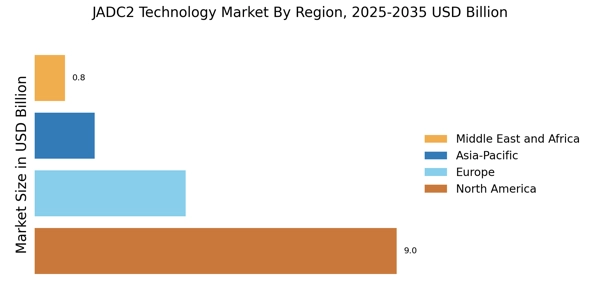
North America is the largest market for JADC2 technology, holding approximately 60% of the global share. The region's growth is driven by increasing defense budgets, technological advancements, and a focus on interoperability among military branches. Regulatory support from the U.S. Department of Defense, emphasizing modernization and integration, further fuels demand for JADC2 solutions. The United States is the primary player in this market, with key companies like Lockheed Martin, Northrop Grumman, and Raytheon Technologies leading the charge. The competitive landscape is characterized by significant investments in R&D and partnerships aimed at enhancing capabilities. The presence of advanced technology firms ensures a robust ecosystem for JADC2 development, making North America a pivotal region in this sector.

Europe : Emerging JADC2 Market

Europe is witnessing a significant rise in JADC2 technology adoption, accounting for about 25% of the global market. The growth is propelled by collaborative defense initiatives among NATO countries and increased focus on joint operations. Regulatory frameworks, such as the European Defence Fund, are catalyzing investments in advanced military technologies, including JADC2 systems. Leading countries in this region include the United Kingdom, France, and Germany, which are actively investing in JADC2 capabilities. Key players like Thales Group and Leonardo S.p.A. are at the forefront, driving innovation through partnerships and technological advancements. The competitive landscape is evolving, with a focus on enhancing interoperability and joint operational capabilities among European nations.

Asia-Pacific : Rapidly Growing Defense Sector

Asia-Pacific is emerging as a significant player in the JADC2 technology market, holding approximately 10% of the global share. The region's growth is driven by increasing military modernization efforts, geopolitical tensions, and a focus on enhancing defense capabilities. Countries like India and Japan are investing heavily in JADC2 technologies to improve their operational effectiveness and interoperability with allies. China, India, and Japan are the leading countries in this market, with a competitive landscape that includes both state-owned and private enterprises. Companies are focusing on developing indigenous technologies while also collaborating with Western firms to enhance their capabilities. The region's strategic importance is underscored by its commitment to advancing military technology and ensuring regional security.

Middle East and Africa : Strategic Defense Investments

The Middle East and Africa region is gradually recognizing the importance of JADC2 technology, currently holding about 5% of the global market share. The growth is driven by increasing defense budgets, regional conflicts, and a push for modernization among armed forces. Countries like Saudi Arabia and the UAE are leading investments in advanced military technologies, including JADC2 systems, to enhance their operational capabilities. The competitive landscape is characterized by a mix of local and international players, with companies focusing on partnerships to deliver tailored solutions. The presence of key players is growing, as nations seek to improve interoperability and joint operations. The region's strategic investments in defense technology are expected to drive future growth in the JADC2 market.

Jadc2 Technology Market Regional Image

Key Players and Competitive Insights

The JADC2 Technology Market is characterized by a rapidly evolving competitive landscape, driven by the increasing demand for integrated command and control systems across military and defense sectors. Key players such as Lockheed Martin (US), Northrop Grumman (US), and Raytheon Technologies (US) are at the forefront, each adopting distinct strategies to enhance their market positioning. Lockheed Martin (US) emphasizes innovation through advanced technologies, focusing on developing next-generation systems that enhance interoperability among allied forces. Northrop Grumman (US) is strategically investing in partnerships and collaborations to bolster its capabilities in artificial intelligence and data analytics, which are crucial for effective decision-making in complex operational environments. Meanwhile, Raytheon Technologies (US) is concentrating on mergers and acquisitions to expand its technological portfolio, thereby strengthening its competitive edge in the JADC2 domain.The business tactics employed by these companies reflect a concerted effort to optimize supply chains and localize manufacturing processes, which are essential for meeting the demands of various defense contracts. The market structure appears moderately fragmented, with several players vying for dominance while also collaborating on joint ventures and technology sharing. This collective influence of key players fosters a dynamic environment where innovation and strategic partnerships are paramount.

In August Lockheed Martin (US) announced a significant partnership with a leading AI firm to enhance its JADC2 capabilities. This collaboration aims to integrate advanced machine learning algorithms into existing systems, thereby improving real-time data processing and decision-making. The strategic importance of this move lies in Lockheed Martin's commitment to staying ahead in the technological race, ensuring that its systems remain relevant and effective in modern warfare scenarios.

In September Northrop Grumman (US) unveiled a new initiative focused on developing a cloud-based platform for JADC2 operations. This platform is designed to facilitate seamless communication and data sharing among allied forces, which is critical for joint operations. The strategic significance of this initiative is underscored by the growing need for agile and responsive command structures in an increasingly complex global security environment.

In July Raytheon Technologies (US) completed the acquisition of a cybersecurity firm specializing in defense applications. This acquisition is expected to enhance Raytheon's capabilities in securing JADC2 systems against emerging cyber threats. The strategic relevance of this move highlights the increasing importance of cybersecurity in the defense sector, particularly as JADC2 systems become more interconnected and reliant on digital infrastructure.

As of October current competitive trends in the JADC2 Technology Market are heavily influenced by digitalization, sustainability, and the integration of artificial intelligence. Strategic alliances are increasingly shaping the landscape, as companies recognize the need for collaborative approaches to tackle complex challenges. Looking ahead, competitive differentiation is likely to evolve from traditional price-based competition to a focus on innovation, technological advancement, and supply chain reliability, reflecting the changing priorities of defense procurement in a rapidly advancing technological era.

Key Companies in the Jadc2 Technology Market include

Industry Developments

The JADC2 Technology Market has been witnessing significant activity, particularly with major players like Oracle Corporation, General Dynamics, Cisco Systems, and Lockheed Martin making notable advancements.

Recent developments indicate a surge in investment and collaboration among these companies to enhance interoperable capabilities that align with the U.S. Department of Defense’s strategic priorities.

L3Harris Technologies and Raytheon Technologies have also been focusing on integrating AI and cloud solutions to bolster command and control systems, thereby improving situational awareness on the battlefield.

Meanwhile, Microsoft Corporation and Palantir Technologies continue to innovate in data analytics and AI-driven solutions, enhancing decision-making processes within military operations. Mergers and acquisitions are notable, especially with BAE Systems acquiring cybersecurity firms to fortify its defense capabilities.

Northrop Grumman's commitment to advancing sensor technology further exemplifies the industry's competitive landscape. The market is expected to grow rapidly, influenced by technological advancements and an increasing need for enhanced defense systems, ensuring these companies remain at the forefront of the JADC2 initiative.

As the market valuation rises, companies are actively adapting their strategies to remain competitive and meet the evolving requirements of defense and military operationsly.

Future Outlook

Jadc2 Technology Market Future Outlook

The JADC2 Technology Market is projected to grow at a 12.93% CAGR from 2025 to 2035, driven by advancements in AI, interoperability, and defense modernization.

New opportunities lie in:

  • Development of AI-driven decision support systems for military operations.
  • Integration of advanced cybersecurity solutions for JADC2 platforms.
  • Creation of modular communication systems for enhanced interoperability among forces.

By 2035, the JADC2 Technology Market is expected to be robust, reflecting substantial growth and innovation.

Market Segmentation

Jadc2 Technology Market End Use Outlook

  • Defense Agencies
  • Government Organizations
  • Private Security Firms

Jadc2 Technology Market Technology Outlook

  • Data Integration
  • Communication Systems
  • Artificial Intelligence
  • Cloud Computing

Jadc2 Technology Market Application Outlook

  • Military Operations
  • Disaster Response
  • Civil Defense
  • Intelligence Surveillance Reconnaissance

Jadc2 Technology Market Deployment Type Outlook

  • On-Premises
  • Cloud-Based

Report Scope

MARKET SIZE 202414.94(USD Billion)
MARKET SIZE 202516.87(USD Billion)
MARKET SIZE 203556.91(USD Billion)
COMPOUND ANNUAL GROWTH RATE (CAGR)12.93% (2025 - 2035)
REPORT COVERAGERevenue Forecast, Competitive Landscape, Growth Factors, and Trends
BASE YEAR2024
Market Forecast Period2025 - 2035
Historical Data2019 - 2024
Market Forecast UnitsUSD Billion
Key Companies ProfiledLockheed Martin (US), Northrop Grumman (US), Raytheon Technologies (US), General Dynamics (US), Boeing (US), L3Harris Technologies (US), Thales Group (FR), Leonardo S.p.A. (IT), SAIC (US), Hewlett Packard Enterprise (US)
Segments CoveredApplication, Technology, Deployment Type, End Use, Regional
Key Market OpportunitiesIntegration of artificial intelligence enhances decision-making capabilities in the JADC2 Technology Market.
Key Market DynamicsRising demand for integrated command and control systems drives innovation and competition in the JADC2 Technology Market.
Countries CoveredNorth America, Europe, APAC, South America, MEA
Leave a Comment

FAQs

What is the projected market valuation of the JADC2 Technology Market by 2035?

The JADC2 Technology Market is projected to reach a valuation of 56.91 USD Billion by 2035.

What was the market valuation of the JADC2 Technology Market in 2024?

In 2024, the JADC2 Technology Market was valued at 14.94 USD Billion.

What is the expected CAGR for the JADC2 Technology Market during the forecast period 2025 - 2035?

The expected CAGR for the JADC2 Technology Market during the forecast period 2025 - 2035 is 12.93%.

Which companies are considered key players in the JADC2 Technology Market?

Key players in the JADC2 Technology Market include Lockheed Martin, Northrop Grumman, Raytheon Technologies, and Boeing, among others.

What segment of the JADC2 Technology Market is projected to have the highest valuation by 2035?

The Military Operations segment is projected to reach a valuation of 22.0 USD Billion by 2035.

How does the projected valuation of the Cloud-Based deployment type compare to On-Premises by 2035?

By 2035, the Cloud-Based deployment type is expected to reach 34.79 USD Billion, surpassing the On-Premises valuation of 22.12 USD Billion.

What is the anticipated growth in the Artificial Intelligence segment of the JADC2 Technology Market?

The Artificial Intelligence segment is projected to grow to 16.0 USD Billion by 2035.

Which end-use segment is expected to show significant growth in the JADC2 Technology Market?

The Defense Agencies end-use segment is expected to grow to 22.56 USD Billion by 2035.

What is the projected valuation for the Communication Systems technology segment by 2035?

The Communication Systems technology segment is projected to reach a valuation of 15.0 USD Billion by 2035.

How does the projected growth of the JADC2 Technology Market reflect on government organizations?

Government Organizations are expected to see a market valuation of 17.06 USD Billion by 2035, indicating substantial growth.

Download Free Sample

Kindly complete the form below to receive a free sample of this Report

Compare Licence

×
Features License Type
Single User Multiuser License Enterprise User
Price $4,950 $5,950 $7,250
Maximum User Access Limit 1 User Upto 10 Users Unrestricted Access Throughout the Organization
Free Customization
Direct Access to Analyst
Deliverable Format
Platform Access
Discount on Next Purchase 10% 15% 15%
Printable Versions