×
Request Free Sample ×

Kindly complete the form below to receive a free sample of this Report

* Please use a valid business email

Leading companies partner with us for data-driven Insights

clients tt-cursor
Hero Background

Italy Mental Health Software Devices Market

ID: MRFR/HC/52785-HCR
200 Pages
Rahul Gotadki
February 2026

Italy Mental Health Software Devices Market Research Report By Component (Software, Devices), By Functionality (Clinical, Administrative, Financial) and By End User (Providers, Payers, Patients) - Growth & Industry Forecast 2025 To 2035

Share:
Download PDF ×

We do not share your information with anyone. However, we may send you emails based on your report interest from time to time. You may contact us at any time to opt-out.

Italy Mental Health Software Devices Market Infographic
Purchase Options

Italy Mental Health Software Devices Market Summary

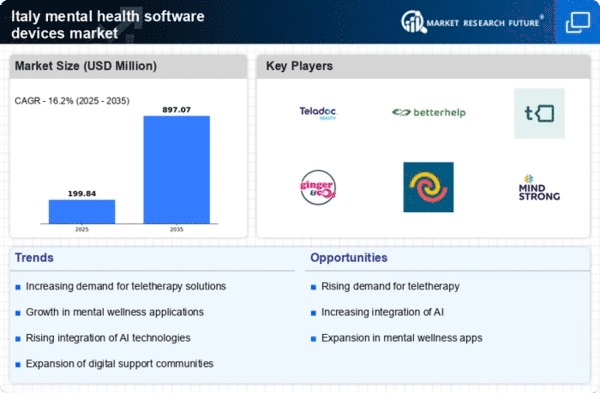
As per Market Research Future analysis, the Italy Mental Health Software Devices Market size was estimated at 171.98 USD Million in 2024. The Mental Health-software-devices market is projected to grow from 199.84 USD Million in 2025 to 897.07 USD Million by 2035, exhibiting a compound annual growth rate (CAGR) of 16% during the forecast period 2025 - 2035

Key Market Trends & Highlights

The Italy mental health-software-devices market is experiencing robust growth driven by technological advancements and increasing awareness.

  • The largest segment in the Italy mental health-software-devices market is teletherapy solutions, which are witnessing increased adoption.
  • Wearable technology is the fastest-growing segment, reflecting a shift towards integrating health monitoring with mental wellness.
  • The market is characterized by a strong focus on personalized mental health solutions tailored to individual needs.
  • Key drivers include rising awareness of mental health issues and government initiatives and funding supporting mental health solutions.

Market Size & Forecast

2024 Market Size 171.98 (USD Million)
2035 Market Size 897.07 (USD Million)
CAGR (2025 - 2035) 16.2%

Major Players

Teladoc Health (US), BetterHelp (US), Talkspace (US), Ginger (US), Woebot Health (US), Mindstrong Health (US), SilverCloud Health (IE), Headspace (US), Calm (US)

Our Impact
Enabled $4.3B Revenue Impact for Fortune 500 and Leading Multinationals
Partnering with 2000+ Global Organizations Each Year
30K+ Citations by Top-Tier Firms in the Industry

Italy Mental Health Software Devices Market Trends

The Italy Mental Health Software Devices Market is currently experiencing a notable transformation, driven by advancements in technology and a growing awareness of mental health issues. In Italy, there is an increasing demand for innovative solutions that cater to the diverse needs of individuals seeking mental health support. This shift is reflected in the rising adoption of mobile applications, teletherapy platforms, and wearable devices designed to monitor mental well-being. As the stigma surrounding mental health diminishes, more individuals are likely to seek assistance through these digital tools, which offer convenience and accessibility. Furthermore, the integration of artificial intelligence and machine learning into mental health solutions appears to enhance personalized care, making it more effective and tailored to individual requirements. Moreover, the regulatory landscape in Italy is evolving to accommodate the rapid growth of the mental health-software-devices market. Government initiatives aimed at promoting mental health awareness and improving access to care are likely to foster a supportive environment for innovation. This includes funding for research and development, as well as partnerships between public health organizations and technology firms. As a result, the market is poised for sustained growth, with an emphasis on user-friendly interfaces and evidence-based practices. The future of mental health solutions in Italy seems promising, as stakeholders continue to prioritize mental well-being and invest in technologies that facilitate better outcomes for users.

Increased Adoption of Teletherapy Solutions

The mental health-software-devices market is witnessing a surge in the use of teletherapy platforms. These solutions provide individuals with the ability to connect with mental health professionals remotely, offering flexibility and convenience. This trend is particularly relevant in urban areas where access to traditional therapy may be limited. Teletherapy not only reduces barriers to care but also allows for a broader range of therapeutic options.

Integration of Wearable Technology

Wearable devices are becoming increasingly popular within the mental health-software-devices market. These gadgets, which can track physiological indicators such as heart rate and sleep patterns, offer valuable insights into an individual's mental state. By monitoring these metrics, users can gain a better understanding of their mental health and make informed decisions about their well-being.

Focus on Personalized Mental Health Solutions

There is a growing emphasis on personalized approaches within the mental health-software-devices market. Solutions that utilize artificial intelligence to tailor interventions based on individual needs are gaining traction. This trend suggests a shift towards more customized care, where users receive recommendations and support that align with their unique mental health profiles.

Italy Mental Health Software Devices Market Drivers

Government Initiatives and Funding

Government initiatives aimed at improving mental health services in Italy are significantly impacting the mental health-software-devices market. The Italian government has allocated substantial funding to enhance mental health care, which includes the integration of technology into treatment protocols. Recent reports indicate that public spending on mental health services has increased by 15% over the past two years, reflecting a commitment to addressing mental health issues. This financial support is likely to encourage the development and adoption of software and devices that facilitate mental health care, such as mobile applications and telehealth platforms. Consequently, the mental health-software-devices market is expected to benefit from these initiatives, as they create a conducive environment for innovation and accessibility in mental health solutions.

Rising Awareness of Mental Health Issues

The increasing awareness of mental health issues in Italy is driving the mental health-software-devices market. Public campaigns and educational initiatives have highlighted the importance of mental well-being, leading to a greater demand for mental health solutions. According to recent surveys, approximately 30% of Italians report experiencing mental health challenges, which has prompted a surge in the utilization of software and devices designed to address these concerns. This heightened awareness is likely to foster a more supportive environment for individuals seeking help, thereby expanding the market for innovative mental health solutions. As a result, stakeholders in the mental health-software-devices market are focusing on developing user-friendly applications and devices that cater to the diverse needs of the population, potentially increasing market penetration and accessibility.

Increased Focus on Preventive Mental Health Care

There is a growing emphasis on preventive mental health care in Italy, which is influencing the mental health-software-devices market. As individuals and healthcare providers recognize the importance of early intervention, there is a shift towards solutions that promote mental wellness and resilience. This trend is reflected in the rising popularity of mental health apps that offer mindfulness exercises, stress management techniques, and self-assessment tools. Market data suggests that the demand for preventive mental health solutions has increased by 25% in the last year, indicating a shift in consumer preferences. This focus on prevention is likely to drive innovation within the mental health-software-devices market, as developers seek to create tools that empower users to take charge of their mental health proactively.

Technological Advancements in Mental Health Solutions

Technological advancements are playing a crucial role in shaping the mental health-software-devices market. Innovations in artificial intelligence, machine learning, and data analytics are enabling the development of sophisticated mental health applications that provide personalized support. For instance, AI-driven chatbots and virtual therapists are becoming increasingly prevalent, offering users immediate assistance and resources. The market for mental health applications in Italy is projected to grow by 20% annually, driven by these technological advancements. As consumers become more tech-savvy, the demand for advanced mental health solutions is likely to rise, prompting developers to create more effective and engaging tools. This trend indicates a shift towards a more integrated approach to mental health care, where technology and human interaction coexist to enhance treatment outcomes.

Integration of Mental Health Services into Primary Care

The integration of mental health services into primary care settings is transforming the landscape of the mental health-software-devices market. In Italy, healthcare providers are increasingly recognizing the importance of addressing mental health alongside physical health, leading to a more holistic approach to patient care. This integration is likely to enhance the accessibility of mental health services, as patients can receive comprehensive care in one location. Recent studies indicate that approximately 40% of primary care visits in Italy now include mental health assessments, which is expected to drive demand for software and devices that facilitate this integration. As a result, the mental health-software-devices market may experience growth as healthcare systems adopt technology to streamline the delivery of mental health services within primary care frameworks.


Market Segment Insights

By Component: Software (Largest) vs. Devices (Fastest-Growing)

In the Italy mental health-software-devices market, the distribution of market share reveals that the software sector holds a substantial portion, positioning itself as the largest segment. This dominance is propelled by an increasing demand for digital solutions that enhance mental health care accessibility and efficiency. Meanwhile, the devices segment is witnessing rapid growth, fueled by technological advancements and a rising awareness of mental health issues among the population. The growth trends in this market segment indicate a robust shift towards integrating advanced technologies in mental health solutions. The software segment not only benefits from innovations but also serves a broader customer base, improving user engagement and satisfaction. Devices, on the other hand, are emerging as essential tools for personalized mental health support, with trends indicating increasing adoption rates in both clinical and at-home settings.

Software (Dominant) vs. Devices (Emerging)

In the Italy mental health-software-devices market, the software segment is characterized by its comprehensive range of applications aimed at enhancing mental health services. These applications provide functionalities such as therapy management, tracking patient progress, and offering resources that are easily accessible. This dominance stems from the broad adoption of technology in healthcare, making software solutions indispensable. Conversely, the devices segment represents an emerging market that focuses on delivering innovative tools like wearable devices and mobile health technologies. These devices aim to provide real-time monitoring and personalized care options, appealing to a diverse audience that increasingly values proactive mental health management.

By Functionality: Clinical (Largest) vs. Administrative (Fastest-Growing)

In the Italy mental health-software-devices market, the functionality segment is characterized by three main values: Clinical, Administrative, and Financial. The Clinical aspect holds the largest market share, driven by increasing demand for effective therapeutic solutions and patient management tools. Meanwhile, the Administrative part is experiencing significant growth, attributed to enhancements in operational efficiency and regulatory compliance needs, positioning it as a key player in the sector. Growth trends indicate a strong push towards digital transformation in mental health services, with innovations in Clinical functionalities leading the way in user engagement and treatment effectiveness. Administrative functionalities are rapidly evolving, focusing on automation and seamless integration with existing healthcare structures, thus enabling healthcare providers to streamline their operations while prioritizing patient care. The Financial segment, although essential, is currently overshadowed by these burgeoning trends in Clinical and Administrative functionalities.

Clinical (Dominant) vs. Administrative (Emerging)

The Clinical functionality segment is considered dominant due to its extensive adoption in therapeutic practices, providing a range of tools that enhance patient care and clinical decision-making. This segment encompasses various software solutions, including teletherapy platforms, electronic health records, and mental health assessment tools, which are essential for mental health professionals. On the other hand, the Administrative segment is emerging quickly, characterized by its focus on optimizing operational workflows and improving regulatory compliance. This segment includes solutions for scheduling, billing, and reporting, which are increasingly necessary for mental health organizations aiming to reduce overhead costs while enhancing service delivery. Both segments reflect a shift towards more integrated and efficient mental health care solutions in Italy.

By End-User: Patients (Largest) vs. Providers (Fastest-Growing)

In the Italy mental health-software-devices market, the end-user segment is primarily composed of three categories: Providers, Payers, and Patients. Among these, Patients represent the largest share, reflecting a growing awareness and acceptance of mental health technologies. Providers, on the other hand, are witnessing an increasing market presence due to their pivotal role in delivering mental health services and integrating technology into their practices. Growth trends in this segment indicate that the demand for patient-centered services is on the rise, with technologies that address mental health needs gaining traction. The Providers segment is growing rapidly as more healthcare professionals adopt software and devices to enhance their service delivery. Innovations in teletherapy and data analytics are key drivers, enabling improved patient outcomes and personalized treatment plans.

Patients (Dominant) vs. Providers (Emerging)

Patients are the dominant force in the Italy mental health-software-devices market, utilizing various applications and tools to manage their mental well-being. This segment benefits from a surge in demand for accessible, user-friendly solutions that empower individuals to take charge of their mental health. On the other hand, Providers are an emerging segment, increasingly integrating technology into their clinical practices. They are adopting software solutions that facilitate better patient engagement, streamline workflows, and enhance therapeutic outcomes. Provider-focused technologies are characterized by their emphasis on clinical efficiency and data security, enabling professionals to deliver high-quality care while adhering to regulatory standards.

Get more detailed insights about Italy Mental Health Software Devices Market

Key Players and Competitive Insights

The mental health-software-devices market in Italy is characterized by a dynamic competitive landscape, driven by increasing awareness of mental health issues and the growing demand for accessible mental health solutions. Key players such as Teladoc Health (US), BetterHelp (US), and SilverCloud Health (IE) are strategically positioned to leverage digital transformation and innovative service delivery models. Teladoc Health (US) focuses on expanding its telehealth services, while BetterHelp (US) emphasizes personalized therapy solutions. SilverCloud Health (IE) is enhancing its platform with evidence-based interventions, collectively shaping a competitive environment that prioritizes user engagement and clinical efficacy.The market structure appears moderately fragmented, with a mix of established players and emerging startups. Key business tactics include localizing services to meet regional needs and optimizing supply chains to ensure timely delivery of mental health resources. This fragmentation allows for diverse offerings, yet the influence of major players remains significant, as they set benchmarks for quality and accessibility in mental health care.

In October Teladoc Health (US) announced a partnership with a leading Italian healthcare provider to enhance its teletherapy services, aiming to increase accessibility for underserved populations. This strategic move is likely to bolster Teladoc's market presence in Italy, aligning with the growing trend of integrating telehealth into traditional healthcare frameworks. The partnership underscores the importance of collaboration in expanding service reach and improving patient outcomes.

In September BetterHelp (US) launched a new initiative focused on integrating AI-driven chatbots into its platform to provide immediate support for users. This innovation is expected to enhance user experience by offering timely responses and personalized recommendations, thereby increasing user retention and satisfaction. The incorporation of AI reflects a broader trend towards technology-driven solutions in mental health care, positioning BetterHelp as a forward-thinking leader in the market.

In August SilverCloud Health (IE) introduced a new suite of digital tools aimed at improving mental health literacy among users. This initiative is particularly relevant in the context of rising mental health awareness, as it empowers individuals to better understand their mental health needs. By focusing on education and self-management, SilverCloud Health is likely to differentiate itself in a crowded market, fostering a more informed user base.

As of November current competitive trends indicate a strong emphasis on digitalization, AI integration, and sustainability within the mental health-software-devices market. Strategic alliances are increasingly shaping the landscape, as companies recognize the value of collaboration in enhancing service offerings. Looking ahead, competitive differentiation is expected to evolve from traditional price-based competition towards innovation, technology integration, and reliable supply chains, reflecting a shift in consumer expectations and market dynamics.

Key Companies in the Italy Mental Health Software Devices Market include

Industry Developments

The Italy Mental Health Software Devices Market has been experiencing significant growth and developments in recent months. Companies such as Intelichart, McKesson, and Epic Systems are increasingly focusing on enhancing their digital solutions, responding to the rising demand for telehealth services. In recent months, the mental health sector has seen a surge in user adoption of software solutions that facilitate remote patient monitoring and mental health assessment, driven largely by the COVID-19 pandemic's long-lasting effects.

Notable merger and acquisition activities include Meditech's acquisition of certain assets relevant to mental health in September 2023, aimed at expanding its service offerings in this sector. Additionally, Athenahealth's collaboration with Valant Medical Solutions earlier in 2023 has paved the way for improved integration and streamlined services for mental health providers in Italy. The government of Italy has also invested in digital health initiatives to better support mental health services, reflecting a national commitment to improving mental healthcare access.

Over the past few years, the market has shown sustained growth, with an increasing emphasis on technology-driven solutions to address mental health challenges.

Future Outlook

Italy Mental Health Software Devices Market Future Outlook

The Mental Health Software Devices Market is projected to grow at a 16.2% CAGR from 2025 to 2035, driven by increasing demand for digital mental health solutions and technological advancements.

New opportunities lie in:

  • Development of AI-driven personalized therapy applications
  • Integration of mental health tools in corporate wellness programs
  • Expansion of teletherapy platforms for remote patient engagement

By 2035, the market is expected to be robust, reflecting substantial growth and innovation.

Market Segmentation

Italy Mental Health Software Devices Market End-User Outlook

  • Providers
  • Payers
  • Patients

Italy Mental Health Software Devices Market Component Outlook

  • Software
  • Devices

Italy Mental Health Software Devices Market Functionality Outlook

  • Clinical
  • Administrative
  • Financial

Report Scope

MARKET SIZE 2024 171.98(USD Million)
MARKET SIZE 2025 199.84(USD Million)
MARKET SIZE 2035 897.07(USD Million)
COMPOUND ANNUAL GROWTH RATE (CAGR) 16.2% (2025 - 2035)
REPORT COVERAGE Revenue Forecast, Competitive Landscape, Growth Factors, and Trends
BASE YEAR 2024
Market Forecast Period 2025 - 2035
Historical Data 2019 - 2024
Market Forecast Units USD Million
Key Companies Profiled Teladoc Health (US), BetterHelp (US), Talkspace (US), Ginger (US), Woebot Health (US), Mindstrong Health (US), SilverCloud Health (IE), Headspace (US), Calm (US)
Segments Covered Component, Functionality, End-User
Key Market Opportunities Integration of artificial intelligence in mental health-software-devices enhances personalized treatment and user engagement.
Key Market Dynamics Rising demand for mental health software and devices driven by increased awareness and regulatory support in Italy.
Countries Covered Italy
Leave a Comment

FAQs

What is the projected market size of the Italy Mental Health Software Devices Market in 2024?

The projected market size of the Italy Mental Health Software Devices Market in 2024 is valued at 172.0 million USD.

What is the expected CAGR for the Italy Mental Health Software Devices Market from 2025 to 2035?

The expected CAGR for the Italy Mental Health Software Devices Market from 2025 to 2035 is 18.287%.

What will be the market size of the Italy Mental Health Software Devices Market in 2035?

The market size of the Italy Mental Health Software Devices Market is expected to reach 1,091.0 million USD by 2035.

How is the Italy Mental Health Software Devices Market segmented by component?

The market is segmented into Software, valued at 76.0 million USD in 2024, and Devices, valued at 96.0 million USD in the same year.

Which component is expected to grow more significantly in the Italy Mental Health Software Devices Market by 2035?

By 2035, Software is expected to grow significantly to 473.0 million USD, while Devices are expected to reach 618.0 million USD.

Who are the key players in the Italy Mental Health Software Devices Market?

Key players in the Italy Mental Health Software Devices Market include Intelichart, McKesson, Epic Systems, and Meditech among others.

What are the main growth drivers for the Italy Mental Health Software Devices Market?

Main growth drivers include increased awareness of mental health issues and advancements in technology enhancing mental health services.

What market growth trends are anticipated in the Italy Mental Health Software Devices Market?

Anticipated trends include a rise in digital health solutions and integrated services catering to comprehensive mental health care.

What challenges might affect the growth of the Italy Mental Health Software Devices Market?

Challenges include regulatory hurdles, data privacy concerns, and varying adoption rates of technology among health practitioners.

How has the global scenario impacted the Italy Mental Health Software Devices Market?

The global scenario has increased focus on mental health which is boosting the demand for software devices in Italy's healthcare sector.

Download Free Sample

Kindly complete the form below to receive a free sample of this Report

Compare Licence

×
Features License Type
Single User Multiuser License Enterprise User
Price $4,950 $5,950 $7,250
Maximum User Access Limit 1 User Upto 10 Users Unrestricted Access Throughout the Organization
Free Customization
Direct Access to Analyst
Deliverable Format
Platform Access
Discount on Next Purchase 10% 15% 15%
Printable Versions