×
Request Free Sample ×

Kindly complete the form below to receive a free sample of this Report

* Please use a valid business email

Leading companies partner with us for data-driven Insights

clients tt-cursor
Hero Background

Italy Epilepsy Devices Market

ID: MRFR/HC/48245-HCR
200 Pages
Rahul Gotadki
February 2026

Italy Epilepsy Devices Market Research Report By Product Type (Conventional Devices, Wearable Devices, Implantable Devices, Diet, Others), By Technology (Vagus Nerve Stimulation, Deep Brain Stimulation, Accelerometery, Responsive Neurostimulation, Others), and By End Users (Hospitals and Clinics, Neurology Centers, Home Care Settings, Others) -Forecast to 2035

Share:
Download PDF ×

We do not share your information with anyone. However, we may send you emails based on your report interest from time to time. You may contact us at any time to opt-out.

Italy Epilepsy Devices Market Infographic
Purchase Options

Italy Epilepsy Devices Market Summary

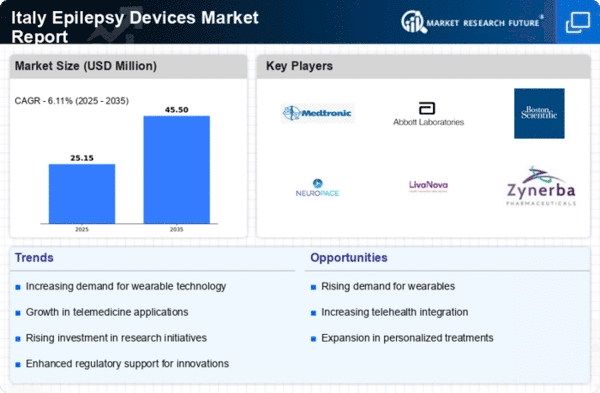
As per Market Research Future analysis, the Italy epilepsy devices market size was estimated at 23.7 USD Million in 2024.. The Italy epilepsy devices market is projected to grow from 25.15 USD Million in 2025 to 45.5 USD Million by 2035, exhibiting a compound annual growth rate (CAGR) of 6.1% during the forecast period 2025 - 2035

Key Market Trends & Highlights

The Italy epilepsy devices market is experiencing robust growth driven by technological advancements and increased patient engagement.

  • Technological advancements in epilepsy devices are enhancing treatment efficacy and patient outcomes.
  • The largest segment in the Italy epilepsy devices market is neurostimulation devices, while the fastest-growing segment is wearable devices.
  • Increased patient engagement is fostering a more proactive approach to epilepsy management among patients and healthcare providers.
  • Rising incidence of epilepsy and advancements in medical technology are key drivers propelling market growth.

Market Size & Forecast

2024 Market Size 23.7 (USD Million)
2035 Market Size 45.5 (USD Million)
CAGR (2025 - 2035) 6.11%

Major Players

Medtronic (US), Abbott (US), Boston Scientific (US), NeuroPace (US), LivaNova (GB), Zynerba Pharmaceuticals (US), Elekta (SE), Natus Medical (US)

Our Impact
Enabled $4.3B Revenue Impact for Fortune 500 and Leading Multinationals
Partnering with 2000+ Global Organizations Each Year
30K+ Citations by Top-Tier Firms in the Industry

Italy Epilepsy Devices Market Trends

The epilepsy devices market is experiencing notable growth, driven by advancements in technology and increasing awareness of epilepsy management. In Italy, the rising prevalence of epilepsy has prompted healthcare providers to seek innovative solutions that enhance patient care. This trend is further supported by government initiatives aimed at improving access to medical devices and treatment options for individuals living with epilepsy. As a result, manufacturers are focusing on developing devices that are not only effective but also user-friendly, catering to the diverse needs of patients and healthcare professionals alike. Moreover, the integration of digital health technologies into the epilepsy devices market is transforming the landscape of patient monitoring and management. Wearable devices and mobile applications are becoming increasingly popular, allowing for real-time data collection and analysis. This shift towards digital solutions appears to empower patients, enabling them to take a more active role in their treatment. Additionally, the collaboration between technology companies and healthcare providers is likely to foster innovation, leading to the development of more sophisticated devices that can improve the quality of life for those affected by epilepsy. Overall, the future of the epilepsy devices market in Italy seems promising, with ongoing advancements and a commitment to enhancing patient outcomes.

Technological Advancements

The epilepsy devices market is experiencing rapid technological advancements, particularly in the development of wearable devices. These innovations are designed to monitor seizure activity in real-time, providing valuable data for both patients and healthcare providers. Such devices may enhance the accuracy of diagnosis and treatment, ultimately leading to improved patient outcomes.

Increased Patient Engagement

There is a growing trend towards increased patient engagement in the epilepsy devices market. Patients are becoming more involved in their treatment plans, often utilizing mobile applications and digital platforms to track their health. This shift may lead to better adherence to treatment regimens and a more personalized approach to managing epilepsy.

Government Support and Regulation

Government support plays a crucial role in shaping the epilepsy devices market. Regulatory bodies are actively working to streamline the approval process for new devices, ensuring that innovative solutions reach the market more efficiently. This support may encourage manufacturers to invest in research and development, fostering a more dynamic and responsive market.

Italy Epilepsy Devices Market Drivers

Rising Incidence of Epilepsy

The increasing prevalence of epilepsy in Italy is a crucial driver for the market. Recent estimates suggest that approximately 600,000 individuals in Italy are affected by epilepsy, which translates to about 1% of the population. This rising incidence necessitates the development and adoption of advanced epilepsy devices, as healthcare providers seek effective solutions to manage this condition. The growing patient population is likely to stimulate demand for innovative devices, including seizure detection systems and neurostimulation devices. As awareness of epilepsy continues to grow, the market is expected to expand, with more patients seeking reliable and efficient management options. Consequently, the epilepsy devices market is poised for growth, driven by the urgent need to address the healthcare challenges posed by this neurological disorder.

Increased Awareness and Education

Raising awareness about epilepsy and its management is a vital driver for the epilepsy devices market. In Italy, various organizations and advocacy groups are actively working to educate the public and healthcare professionals about epilepsy. This increased awareness leads to a greater understanding of the condition, reducing stigma and encouraging individuals to seek treatment. As more patients become informed about available devices, the demand for effective epilepsy management solutions is expected to rise. Furthermore, educational initiatives are likely to promote the adoption of advanced devices, as patients and caregivers recognize their potential benefits. The epilepsy devices market will benefit from this heightened awareness, as it fosters a more informed patient population that actively engages in their healthcare decisions.

Supportive Regulatory Environment

The regulatory landscape in Italy is becoming increasingly supportive of the market. Recent initiatives by the Italian government aim to streamline the approval process for medical devices, facilitating quicker access to innovative solutions for patients. This supportive environment encourages manufacturers to invest in research and development, leading to the introduction of new and improved epilepsy devices. Additionally, the government has implemented policies to promote the use of advanced medical technologies in healthcare settings, further driving market growth. As regulatory barriers diminish, the epilepsy devices market is likely to experience accelerated expansion, with more products entering the market to meet the needs of patients and healthcare providers alike.

Advancements in Medical Technology

Technological innovation plays a pivotal role in shaping the epilepsy devices market. The introduction of cutting-edge technologies, such as wearable devices and mobile health applications, has transformed the landscape of epilepsy management in Italy. These advancements enable real-time monitoring of seizures and provide valuable data for healthcare professionals. For instance, devices equipped with artificial intelligence algorithms can analyze seizure patterns and predict potential episodes, enhancing patient safety. The market for these advanced devices is projected to grow significantly, with estimates indicating a compound annual growth rate (CAGR) of around 8% over the next five years. As technology continues to evolve, the epilepsy devices market is likely to witness an influx of innovative solutions that improve patient outcomes and streamline healthcare processes.

Growing Investment in Healthcare Infrastructure

Investment in healthcare infrastructure in Italy is a significant driver for the epilepsy devices market. The government has committed to enhancing healthcare facilities and services, which includes the integration of advanced medical technologies. This investment is expected to improve access to epilepsy devices, particularly in underserved areas. As healthcare facilities upgrade their equipment and adopt new technologies, the demand for innovative epilepsy devices is likely to increase. Furthermore, collaborations between public and private sectors are fostering the development of new solutions tailored to the needs of patients. The epilepsy devices market is poised to benefit from this growing investment, as it aligns with the broader goal of improving healthcare outcomes for individuals living with epilepsy.


Market Segment Insights

By Product Type: Wearable Devices (Largest) vs. Implantable Devices (Fastest-Growing)

In the Italy epilepsy devices market, the product type segment exhibits a diverse range of offerings including Conventional Devices, Wearable Devices, Implantable Devices, Diet, and Others. Among these, Wearable Devices stand out as the largest category, appealing to patients seeking non-invasive and user-friendly options. Following suit, Implantable Devices emerge as a significant contender, although their market share lags behind the wearables. Conventional Devices continue to have a stable presence, while Diet and Others contribute modestly to the overall landscape. Growth trends indicate a notable shift towards more innovative and technology-driven solutions. The wearable devices segment benefits from increasing demand for remote patient monitoring and lifestyle integration. Conversely, implantable devices are gaining rapid traction due to technological advancements and the need for more effective epilepsy management solutions. Factors like rising awareness of epilepsy treatments and healthcare investments further propel the growth of these segments.

Wearable Devices (Dominant) vs. Implantable Devices (Emerging)

Wearable Devices are currently the dominant force in the Italy epilepsy devices market, characterized by their ease of use, portability, and ability to monitor patients in real-time. These devices include smartwatches and other fitness trackers tailored for epilepsy patients, equipped with features such as seizure detection and health monitoring capabilities. In contrast, Implantable Devices represent an emerging segment with significant growth potential. These include devices such as responsive neurostimulation systems and deep brain stimulators, which offer targeted therapies and have shown promising results in managing seizures. The increasing focus on personalized treatment solutions and advancements in implantable technology are enhancing their attractiveness amongst healthcare providers and patients alike.

By Technology: Vagus Nerve Stimulation (Largest) vs. Responsive Neurostimulation (Fastest-Growing)

The Italy epilepsy devices market showcases a diverse range of technologies including Vagus Nerve Stimulation (VNS), Deep Brain Stimulation (DBS), Accelerometry, Responsive Neurostimulation (RNS), and others. VNS holds the largest market share due to its established efficacy and increasing adoption among healthcare providers. Meanwhile, RNS is gaining traction due to its innovative approach that allows for real-time monitoring and treatment of seizures, though it currently holds a smaller share compared to VNS. Growth trends in the Italy epilepsy devices market are primarily driven by advancements in technology and increased awareness surrounding epilepsy treatments. VNS remains dominant due to continued clinical validation and favorable reimbursement policies, while RNS is projected to grow at the fastest rate. Factors such as ongoing research, enhancements in device functionality, and integration with digital health technologies are expected to further propel both segments, catering to the evolving needs of patients and providers alike.

Technology: Vagus Nerve Stimulation (Dominant) vs. Responsive Neurostimulation (Emerging)

Vagus Nerve Stimulation (VNS) is the dominant technology in the Italy epilepsy devices market, recognized for its long-term efficacy in seizure control and minimal invasiveness. It has become a standard choice for patients who do not respond to conventional medication. In contrast, Responsive Neurostimulation (RNS) represents an emerging technology that dynamically responds to seizure activity, providing a tailored approach for patients. Although currently less adopted, RNS is attracting interest due to its unique capability to monitor and adjust therapy in real time, making it appealing for personalized treatment. Both technologies reflect significant advancements in neurostimulation, aiming to enhance quality of life for patients with epilepsy.

By End User: Hospitals and Clinics (Largest) vs. Home Care Settings (Fastest-Growing)

In the Italy epilepsy devices market, the end user segment is predominantly led by hospitals and clinics, which hold a major share due to their advanced healthcare facilities and access to specialized services. Neurology centers also contribute significantly, followed by home care settings and others, which are gradually gaining traction as more patients prefer receiving care at home. The growth trends for the end user segment are significantly influenced by the increasing prevalence of epilepsy and the rising demand for patient-centric care. Home care settings are emerging as the fastest-growing segment due to technological advancements in monitoring devices and the shift towards outpatient care, while hospitals and clinics remain stable, offering comprehensive treatment solutions.

Hospitals and Clinics (Dominant) vs. Home Care Settings (Emerging)

Hospitals and clinics are the dominant end users in the Italy epilepsy devices market, characterized by their extensive resources, specialized medical staff, and comprehensive service offerings that effectively cater to patients with epilepsy. These facilities provide advanced diagnostic tools and treatment options that address varied patient needs. In contrast, home care settings are labeled as emerging, fueled by the growing popularity of remote monitoring and telehealth services. This shift allows patients to receive continuous care in a comfortable environment, thus improving their quality of life and driving demand for portable and user-friendly devices.

Get more detailed insights about Italy Epilepsy Devices Market

Key Players and Competitive Insights

The epilepsy devices market in Italy is characterized by a dynamic competitive landscape, driven by technological advancements and increasing awareness of epilepsy management. Key players such as Medtronic (US), Abbott (US), and LivaNova (GB) are at the forefront, focusing on innovation and strategic partnerships to enhance their market presence. Medtronic (US) emphasizes its commitment to developing advanced neurostimulation devices, while Abbott (US) is leveraging its expertise in diagnostics to create integrated solutions for epilepsy care. LivaNova (GB) is actively pursuing collaborations with healthcare providers to expand its reach and improve patient outcomes, collectively shaping a competitive environment that prioritizes patient-centric solutions.In terms of business tactics, companies are increasingly localizing manufacturing and optimizing supply chains to enhance operational efficiency. The market appears moderately fragmented, with several players vying for market share. However, the collective influence of major companies like NeuroPace (US) and Boston Scientific (US) is notable, as they introduce innovative products that challenge existing paradigms in epilepsy treatment. This competitive structure fosters an environment where continuous improvement and adaptation are essential for success.

In October NeuroPace (US) announced the launch of its latest responsive neurostimulation device, which is designed to provide real-time monitoring and intervention for epilepsy patients. This strategic move is significant as it positions NeuroPace (US) as a leader in personalized epilepsy management, potentially improving patient adherence and outcomes. The introduction of such technology reflects a broader trend towards integrating digital health solutions into traditional medical devices, enhancing the overall value proposition for patients and healthcare providers alike.

In September LivaNova (GB) entered into a partnership with a leading Italian healthcare institution to conduct clinical trials for its innovative seizure detection technology. This collaboration is crucial as it not only validates LivaNova's (GB) commitment to research and development but also strengthens its foothold in the Italian market. By aligning with local healthcare providers, LivaNova (GB) is likely to gain valuable insights into patient needs and preferences, further refining its product offerings.

In August Abbott (US) expanded its product portfolio by acquiring a small Italian startup specializing in wearable epilepsy monitoring devices. This acquisition is indicative of Abbott's (US) strategy to diversify its offerings and enhance its capabilities in the epilepsy space. By integrating cutting-edge wearable technology, Abbott (US) aims to provide comprehensive solutions that address the multifaceted challenges faced by epilepsy patients, thereby reinforcing its competitive position in the market.

As of November the competitive trends in the epilepsy devices market are increasingly defined by digitalization, sustainability, and the integration of artificial intelligence (AI). Strategic alliances are becoming more prevalent, as companies recognize the value of collaboration in driving innovation. The shift from price-based competition to a focus on technological advancement and supply chain reliability is evident, suggesting that future competitive differentiation will hinge on the ability to deliver innovative, patient-centered solutions that leverage the latest advancements in technology.

Key Companies in the Italy Epilepsy Devices Market include

Industry Developments

The Italy Epilepsy Devices Market has seen significant developments in recent months, with a considerable focus on technological advancements and increased healthcare investments. Companies such as LivaNova, Medtronic, and Boston Scientific are actively introducing innovative devices aimed at improving epilepsy treatment, highlighting the importance of Research and Development initiatives. In September 2023, Medtronic released an updated version of its neurostimulator, enhancing its capabilities for treating epilepsy patients. Additionally, the collaboration between Cleveland Clinic and Roche aims to facilitate better diagnostic tools, further advancing the market.

Recent mergers and acquisitions also play a role; for instance, in August 2023, Stryker announced its acquisition of a neurostimulation technology company, a move expected to bolster its position in the epilepsy market. Furthermore, as Italy's healthcare system prioritizes technology integration, the country has experienced a growth in the market valuation of epilepsy devices, benefiting from strong governmental support for healthcare innovation. Notably, the continuous push for advanced treatment methodologies in Italy reflects a broader trend toward personalized healthcare solutions in the epilepsy space.

Future Outlook

Italy Epilepsy Devices Market Future Outlook

The Epilepsy Devices Market in Italy is projected to grow at a 6.11% CAGR from 2025 to 2035, driven by technological advancements and increasing patient awareness.

New opportunities lie in:

  • Development of AI-driven seizure prediction algorithms
  • Expansion of telehealth services for remote monitoring
  • Partnerships with healthcare providers for integrated care solutions

By 2035, the market is expected to achieve substantial growth, enhancing patient outcomes and industry innovation.

Market Segmentation

Italy Epilepsy Devices Market End User Outlook

  • Hospitals and Clinics
  • Neurology Centers
  • Home Care Settings
  • Others

Italy Epilepsy Devices Market Technology Outlook

  • Vagus Nerve Stimulation
  • Deep Brain Stimulation
  • Accelerometery
  • Responsive Neurostimulation
  • Others

Italy Epilepsy Devices Market Product Type Outlook

  • Conventional Devices
  • Wearable Devices
  • Implantable Devices
  • Diet
  • Others

Report Scope

MARKET SIZE 2024 23.7(USD Million)
MARKET SIZE 2025 25.15(USD Million)
MARKET SIZE 2035 45.5(USD Million)
COMPOUND ANNUAL GROWTH RATE (CAGR) 6.11% (2025 - 2035)
REPORT COVERAGE Revenue Forecast, Competitive Landscape, Growth Factors, and Trends
BASE YEAR 2024
Market Forecast Period 2025 - 2035
Historical Data 2019 - 2024
Market Forecast Units USD Million
Key Companies Profiled Medtronic (US), Abbott (US), Boston Scientific (US), NeuroPace (US), LivaNova (GB), Zynerba Pharmaceuticals (US), Elekta (SE), Natus Medical (US)
Segments Covered Product Type, Technology, End User
Key Market Opportunities Integration of advanced wearable technology enhances monitoring and management in the epilepsy devices market.
Key Market Dynamics Rising demand for innovative epilepsy devices driven by regulatory support and technological advancements in Italy.
Countries Covered Italy
Leave a Comment

FAQs

What is the expected market size of the Italy Epilepsy Devices Market in 2024?

The Italy Epilepsy Devices Market is expected to be valued at 19.75 USD Million in 2024.

What growth rate is projected for the Italy Epilepsy Devices Market from 2025 to 2035?

The expected compound annual growth rate (CAGR) for the Italy Epilepsy Devices Market from 2025 to 2035 is 7.541%.

How much will the market be valued by 2035?

By 2035, the Italy Epilepsy Devices Market is anticipated to reach a value of 43.94 USD Million.

Which products are included in the Italy Epilepsy Devices Market?

The market is divided into Conventional Devices, Wearable Devices, Implantable Devices, Diet, and Others.

What is the market size for Conventional Devices in 2024?

The market size for Conventional Devices is projected to be 7.5 USD Million in 2024.

What is the growth outlook for Wearable Devices in the Italy Epilepsy Devices Market?

Wearable Devices will see an increase from 4.8 USD Million in 2024 to 10.5 USD Million by 2035.

Who are the major players in the Italy Epilepsy Devices Market?

Major players include LivaNova, GE Healthcare, Medtronic, and Boston Scientific among others.

What is the expected market value for Implantable Devices in 2035?

The market value for Implantable Devices is expected to be 6.2 USD Million in 2035.

What challenges does the Italy Epilepsy Devices Market face?

Challenges include regulatory hurdles and the need for technological advancements in devices.

What are the opportunities for growth in the Italy Epilepsy Devices Market?

The market offers growth opportunities in innovative device development and increasing healthcare awareness.

Download Free Sample

Kindly complete the form below to receive a free sample of this Report

Compare Licence

×
Features License Type
Single User Multiuser License Enterprise User
Price $4,950 $5,950 $7,250
Maximum User Access Limit 1 User Upto 10 Users Unrestricted Access Throughout the Organization
Free Customization
Direct Access to Analyst
Deliverable Format
Platform Access
Discount on Next Purchase 10% 15% 15%
Printable Versions