×
Request Free Sample ×

Kindly complete the form below to receive a free sample of this Report

* Please use a valid business email

Leading companies partner with us for data-driven Insights

clients tt-cursor
Hero Background
English
Chinese
French
Japanese
Korean
German
Spanish

Interactive Video Wall Market Analysis

ID: MRFR/SEM/2689-HCR
100 Pages
Shubham Munde
October 2025

Interactive Video Wall Market Size, Share and Research Report By Types (Landscape & Portrait, Custom Layout, 3D Installation), By Display Type (LED, LCD, LPD), By Frame Size (2x2, 3x3, 4x4), And By Region (North America, Europe, Asia-Pacific, And Rest Of The World) – Industry Forecast Till 2035

Share:
Download PDF ×

We do not share your information with anyone. However, we may send you emails based on your report interest from time to time. You may contact us at any time to opt-out.

Interactive Video Wall Market Infographic
×
Interactive Video Wall Market Infographic Full View
Purchase Options

Market Analysis

In-depth Analysis of Interactive Video Wall Market Industry Landscape

The growing need for engaging and intense visual experiences in many fields is a key factor moving the business forward. Businesses, schools, and companies are using interactive video walls more and more to improve communication, keep viewers interested, and encourage people to work together to make decisions.

New developments in technology have a big effect on how markets work. The uses of interactive video walls have grown as touch-sensitive technology, high-resolution screens, and dynamic apps have gotten better over time. Now there are more uses, which makes these systems more flexible and appealing to a wider range of end users.

live video boards are used a lot in the business world for things like presentations, workplace talks, and live data display. These systems may turn boring, static information into interesting, moving material in order to get people more involved and help them understand. As long as businesses are looking for new ways to meet and work together in an international, digital world, this trend is likely to keep going.

Teachers have had to rethink how they teach in ways that have been used for a long time since interactive video walls came out. Schools use these tools to make learning settings that are interesting, interactive, and get students involved. Big dynamic screens make learning more fun by showing complicated ideas in a way that is easier to understand and remember.

Many more interactive video walls are being needed in the hotel and entertainment industries compared to earlier. Video walls are used for many things in these fields, like digital signs, interactive shows, and screens that change the material all the time. Making customer encounters better by making settings that look good and are fun to deal with could lead to more lasting and interesting interactions.

There is an extra level of complication because the market trends may be different in different regions. Countries that have a strong IT infrastructure and a lot of extra cash are usually the first to use interactive video wall systems. However, developing countries are catching up as they improve their technology and realize the many ways these systems can help different areas.

A unique thing about the competitive world is that it has big companies that are always coming up with new ideas to get ahead. Many businesses are putting a lot of money into research and development to make it easier to add new features. These skills include being able to understand motions, talk to multiple people at once, and easily work with other devices. To keep growing as the industry changes, it is important to focus on making options that are cheaper without lowering efficiency.


Author
Shubham Munde
Research Analyst Level II

With a technical background in information technology & semiconductors, Shubham has 4.5+ years of experience in market research and analytics with the tasks of data mining, analysis, and project execution. He is the POC for our clients, for their consulting projects running under the ICT/Semiconductor domain. Shubham holds a Bachelor’s in Information and Technology and a Master of Business Administration (MBA). Shubham has executed over 150 research projects for our clients under the brand name Market Research Future in the last 2 years. His core skill is building the research respondent relation for gathering the primary information from industry and market estimation for niche markets. He is having expertise in conducting secondary & primary research, market estimations, market projections, competitive analysis, analysing current market trends and market dynamics, deep-dive analysis on market scenarios, consumer behaviour, technological impact analysis, consulting, analytics, etc. He has worked on fortune 500 companies' syndicate and consulting projects along with several government projects. He has worked on the projects of top tech brands such as IBM, Google, Microsoft, AWS, Meta, Oracle, Cisco Systems, Samsung, Accenture, VMware, Schneider Electric, Dell, HP, Ericsson, and so many others. He has worked on Metaverse, Web 3.0, Zero-Trust security, cyber-security, blockchain, quantum computing, robotics, 5G technology, High-Performance computing, data centers, AI, automation, IT equipment, sensors, semiconductors, consumer electronics and so many tech domain projects.

Leave a Comment

FAQs

How much is the Interactive Video Wall market?

The Interactive Video Wall market size was valued at USD 28.10 billion in 2024.

What is the growth rate of the Interactive Video Wall market?

The market is projected to grow at a CAGR of 16.00% during the forecast period, 2025 to 2035.

Which region held the largest market share in the Interactive Video Wall market?

North America had the largest share in the Interactive Video Wall market.

Who are the key players in the Interactive Video Wall market?

The key players in the market are Samsung Electronics Co. Ltd, Sony Corporation, Barco, NEC Display Solutions, Omnivex Corporation, Panasonic Corporation, Adflow Networks, AU Optronics Corp, Philips N.V., LG Display Co. Ltd.

Which type led the Interactive Video Wall market?

The landscape & Portrait category dominated the market in 2022.

The landscape & Portrait category dominated the market in 2022.

The 3x3 had the largest share in the market for Interactive Video Wall.

Market Summary

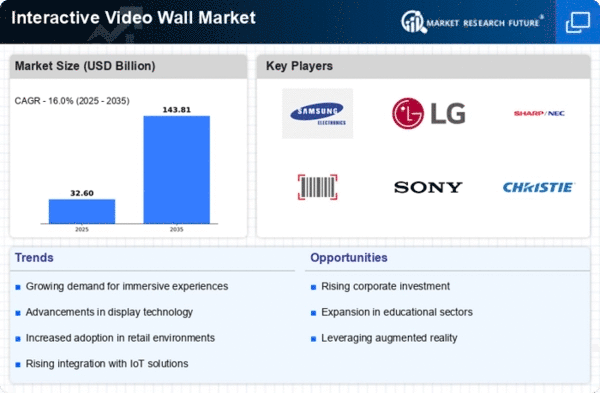
As per MRFR analysis, the Interactive Video Wall Market Size was estimated at 28.1 USD Billion in 2024. The Interactive Video Wall industry is projected to grow from 32.59 USD Billion in 2025 to 143.81 USD Billion by 2035, exhibiting a compound annual growth rate (CAGR) of 16.0 during the forecast period 2025 - 2035.

Key Market Trends & Highlights

The Interactive Video Wall Market is poised for substantial growth driven by technological advancements and increasing demand for interactive experiences.

  • Technological advancements in display quality are enhancing the visual appeal of interactive video walls, particularly in North America. The growing demand for interactive experiences is evident in the advertising segment, which remains the largest market for video walls. Integration with smart technologies is becoming increasingly prevalent, especially in the fast-growing corporate communication segment in Asia-Pacific. Rising adoption in retail environments and a focus on enhanced customer engagement are key drivers propelling market expansion.

Market Size & Forecast

2024 Market Size 28.1 (USD Billion)
2035 Market Size 143.81 (USD Billion)
CAGR (2025 - 2035) 16.0%
Largest Regional Market Share in 2024 North America

Major Players

Samsung Electronics (KR), LG Electronics (KR), NEC Display Solutions (JP), Barco (BE), Sony Corporation (JP), Christie Digital Systems (CA), Planar Systems (US), Sharp Corporation (JP), ViewSonic (US)

Market Trends

The Interactive Video Wall Market is currently experiencing a dynamic evolution, driven by advancements in display technology and increasing demand for immersive visual experiences across various sectors. Organizations are increasingly adopting video walls for applications in retail, corporate environments, and public spaces, as these installations enhance communication and engagement. The integration of high-resolution displays, interactive capabilities, and real-time content management systems appears to be reshaping how businesses utilize visual technology. Furthermore, the growing trend towards digital transformation is likely to propel the market forward, as companies seek innovative solutions to captivate audiences and convey messages effectively. In addition, the rise of remote collaboration tools and the need for effective communication in hybrid work environments seem to be influencing the adoption of interactive video walls. These systems facilitate seamless information sharing and collaboration, making them an attractive option for organizations aiming to improve productivity and engagement. As the market continues to evolve, it is essential to monitor emerging technologies and consumer preferences that may further impact the landscape of the Interactive Video Wall Market.

Technological Advancements in Display Quality

Recent innovations in display technology, such as OLED and microLED, are enhancing the visual quality of interactive video walls. These advancements provide superior color accuracy, contrast ratios, and energy efficiency, making installations more appealing to end-users.

Growing Demand for Interactive Experiences

There is an increasing preference for interactive video walls that allow users to engage with content actively. This trend is particularly evident in retail and entertainment sectors, where immersive experiences can drive customer engagement and satisfaction.

Integration with Smart Technologies

The integration of interactive video walls with smart technologies, such as IoT and AI, is becoming more prevalent. This convergence enables real-time data analysis and personalized content delivery, enhancing the overall effectiveness of visual communication.

Interactive Video Wall Market Market Drivers

Technological Advancements

The Global Interactive Video Wall Market Industry is experiencing rapid technological advancements, particularly in display technologies such as OLED and LCD. These innovations enhance image quality, reduce energy consumption, and improve user interaction. For instance, the integration of touch-sensitive surfaces allows for more engaging presentations in retail and corporate environments. As organizations increasingly adopt these technologies, the market is projected to reach 28.1 USD Billion in 2024, with a significant push towards interactive solutions that foster collaboration and communication. This trend indicates a growing demand for high-quality, interactive displays that cater to diverse applications.

Market Segment Insights

By Application: Advertising (Largest) vs. Corporate Communication (Fastest-Growing)

The Application segment in the Interactive Video Wall Market showcases a diverse range of uses, with Advertising taking the lead as the largest segment. This category benefits significantly from ongoing investment in digital billboards and public displays, enhancing brand visibility and engagement. Following closely is Corporate Communication, which has emerged as a vital platform for businesses looking to improve internal communication and collaboration through sophisticated video wall technologies. Other notable applications include Education, Entertainment, and Public Information, each contributing to a well-rounded market composition.

Advertising (Dominant) vs. Corporate Communication (Emerging)

Advertising stands tall as the dominant force within the Interactive Video Wall Market, leveraging eye-catching displays to attract consumer attention and drive marketing campaigns. Its robust capabilities in creating immersive experiences make it a preferred choice for brands aiming to enhance their visibility in competitive landscapes. On the other hand, Corporate Communication is rapidly emerging, with organizations recognizing the value of video walls in fostering better communication and collaboration among teams. This segment focuses on improving information flow, facilitating presentations, and engaging employees through dynamic visuals, making it a key area of growth in the coming years.

By End Use: Retail (Largest) vs. Healthcare (Fastest-Growing)

In the Interactive Video Wall Market, the end-use segments are showing varied distribution patterns. The retail sector holds the largest market share, capitalizing on the growing demand for engaging customer experiences through immersive displays. This has led to significant investments in high-quality video walls to create visually stimulating environments that can attract and retain customers. Meanwhile, transportation and hospitality are also notable sectors, utilizing video walls for enhanced communication and information dissemination. On the other hand, the healthcare segment is emerging as the fastest-growing area in the interactive video wall market. As healthcare facilities increasingly adopt advanced technologies to improve patient care and operational efficiency, video walls are becoming crucial tools for displaying critical information, real-time data, and even interactive health education. The momentum in technological advancements and the need for enhanced communication in healthcare settings are key drivers for its rapid growth.

Retail (Dominant) vs. Government (Emerging)

The retail sector dominates the interactive video wall market, leveraging the technology to transform customer engagement strategies. Retailers are increasingly deploying video walls in store environments to showcase products, create immersive advertisements, and enhance the customer experience. The focus on experiential retail is driving the need for high-impact visual displays. In contrast, the government sector is emerging in this market, exploring video walls for applications like public information dissemination, emergency management communications, and public service announcements. Although currently smaller in market size compared to retail, government investment in digital signage is on the rise, emphasizing the need for improved communication strategies and citizen engagement initiatives.

By Technology: LED (Largest) vs. OLED (Fastest-Growing)

In the Interactive Video Wall Market, the market share is predominantly led by LED technology, which is favored for its high brightness, energy efficiency, and longevity. LED video walls are widely used in various settings, including retail, events, and advertising, providing vibrant displays that attract viewers. Following LED, LCD technology holds significant market share, offering good image quality at a relatively lower cost. Meanwhile, projection technology, though less favored, is utilized in specific situations such as large venue projections due to its ability to create expansive images at a distance. The growth trends reveal a strong upward trajectory for OLED technology, driven by its superior display quality and flexibility. As OLED displays continue to evolve, they are increasingly seen in high-end applications, gaining popularity in environments where image quality is paramount. On the other hand, MicroLED is carving out its niche, known for its individual pixel control and potential for large-scale installations, making it an exciting prospect for the future of interactive displays.

Technology: LED (Dominant) vs. MicroLED (Emerging)

LED technology holds a dominant position in the Interactive Video Wall Market, characterized by its widespread adoption across diverse industries due to its brightness and durability. These video walls are particularly essential in retail and advertising sectors, where impactful visual displays drive customer engagement. In contrast, MicroLED technology, while still emerging, presents a promising alternative with its ability to deliver high contrast and energy efficiency. MicroLED utilizes microscopic LEDs to create images, allowing for finer pixel density and modular designs. Though it is in the nascent stages of market penetration, the trend towards customization and the demand for seamless large displays indicate that MicroLED will become more significant in future applications, particularly in high-end and immersive environments.

By Screen Size: Large (Largest) vs. Medium (Fastest-Growing)

In the Interactive Video Wall Market, screen sizes play a crucial role in determining consumer preference and application efficiency. Currently, the large screen size segment holds the largest market share, appealing to clients who prioritize visibility and impact in their displays. Meanwhile, medium-sized screens are gaining substantial ground, hinting at a growing preference for versatility in various environments, such as retail and educational institutions. This shift indicates a gradual reallocation of market resources toward these segments, underscoring their significance in current trends.

Screen Size: Large (Dominant) vs. Medium (Emerging)

The large screen size in the Interactive Video Wall Market remains the dominant choice due to its visual effectiveness and ability to create immersive experiences. Large displays are often utilized in significant venues such as airports, stadiums, and large retail spaces where visibility from a distance is crucial. On the other hand, medium screens are emerging as a popular option among small to medium-sized enterprises and educational institutions. Their flexible applications and cost-effectiveness cater to a diverse consumer base, driving innovation and adaptation to various display needs.

By Installation Type: Wall Mounted (Largest) vs. Floor Standing (Fastest-Growing)

The installation type segment of the Interactive Video Wall Market reveals diverse preferences among end-users, with wall-mounted solutions commanding the largest share. This dominance is primarily due to their space-saving advantages and aesthetic integration in various environments, such as retail spaces, corporate settings, and public venues. Floor-standing video walls show a rapid increase in adoption, favored for their flexibility and ease of installation in high-traffic areas, creating an appealing visual impact without permanent fixtures.

Wall Mounted (Dominant) vs. Floor Standing (Emerging)

Wall-mounted installations represent a dominant segment in the Interactive Video Wall Market, offering a seamless design that is widely favored in professional settings. They are ideal for locations where space is limited, providing a polished, sleek appearance. In contrast, floor-standing video walls are emerging rapidly, driven by their ease of mobility and adaptability in dynamic settings such as exhibitions and retail promotions. The ability to reconfigure them for various events stands out, catering to clients that require temporary installations without compromising on visual quality.

Get more detailed insights about Interactive Video Wall Market Research Report- Forecast 2035

Regional Insights

North America : Market Leader in Innovation

North America continues to lead the Interactive Video Wall market, holding a significant share of 12.5 in 2024. The region's growth is driven by increasing demand for advanced display technologies in sectors like retail, education, and corporate environments. Regulatory support for digital signage and smart technologies further fuels this expansion, as businesses seek to enhance customer engagement and operational efficiency. The competitive landscape is robust, with key players such as Samsung Electronics, LG Electronics, and Christie Digital Systems dominating the market. The U.S. stands out as a primary contributor, leveraging its technological advancements and consumer base. Companies are investing heavily in R&D to innovate and meet the evolving needs of various industries, ensuring North America's position as a market leader.

Europe : Emerging Market with Growth Potential

Europe's Interactive Video Wall market is poised for growth, currently valued at 8.5. The region benefits from increasing investments in smart city initiatives and digital transformation across various sectors. Regulatory frameworks promoting digital signage and environmental sustainability are key drivers, encouraging businesses to adopt innovative display solutions to enhance user experience and operational efficiency. Leading countries like Germany, the UK, and France are at the forefront of this market, with a competitive landscape featuring major players such as Barco and NEC Display Solutions. The presence of these companies, along with a growing emphasis on interactive technologies, positions Europe as a significant player in the global market. The region's focus on sustainability and innovation is expected to further boost market growth.

Asia-Pacific : Rapid Growth in Emerging Markets

The Asia-Pacific region, with a market size of 5.5, is experiencing rapid growth in the Interactive Video Wall sector. This expansion is driven by increasing urbanization, technological advancements, and a rising demand for digital signage in retail and entertainment. Governments are also promoting smart city initiatives, which further catalyze the adoption of interactive display technologies across various industries. Countries like China, Japan, and India are leading the charge, with significant investments from key players such as Sony Corporation and Sharp Corporation. The competitive landscape is evolving, with local manufacturers emerging alongside established global brands. This dynamic environment is fostering innovation and driving down costs, making interactive video walls more accessible to a broader range of businesses.

Middle East and Africa : Untapped Market with Potential

The Middle East and Africa region, currently valued at 1.6, presents untapped opportunities in the Interactive Video Wall market. The growth is primarily driven by increasing investments in infrastructure and digital transformation initiatives across various sectors. Governments are recognizing the importance of digital signage in enhancing communication and engagement, leading to supportive regulatory frameworks that encourage adoption. Countries like the UAE and South Africa are emerging as key players in this market, with a growing presence of international brands. The competitive landscape is gradually evolving, with local companies beginning to invest in interactive technologies. This shift is expected to drive market growth, as businesses seek innovative solutions to improve customer experiences and operational efficiency.

Key Players and Competitive Insights

The Interactive Video Wall Market is currently characterized by a dynamic competitive landscape, driven by technological advancements and increasing demand for immersive visual experiences across various sectors. Key players such as Samsung Electronics (KR), LG Electronics (KR), and Barco (BE) are strategically positioning themselves through innovation and partnerships. Samsung Electronics (KR) has focused on enhancing its product offerings with cutting-edge display technologies, while LG Electronics (KR) emphasizes sustainability and energy efficiency in its solutions. Barco (BE), on the other hand, is leveraging its expertise in visualization technology to cater to the growing needs of the corporate and entertainment sectors, thereby shaping a competitive environment that prioritizes technological differentiation and customer-centric solutions.
In terms of business tactics, companies are increasingly localizing manufacturing to reduce lead times and optimize supply chains. The market structure appears moderately fragmented, with several players vying for market share. This fragmentation allows for a diverse range of products and solutions, fostering innovation and competition among key players. The collective influence of these companies is significant, as they continuously adapt to changing consumer preferences and technological advancements.
In November 2025, LG Electronics (KR) announced the launch of its new line of OLED video walls, which are designed to provide superior image quality and energy efficiency. This strategic move not only reinforces LG's commitment to sustainability but also positions the company as a leader in high-performance display technology. The introduction of these products is likely to attract a broader customer base, particularly in sectors that prioritize visual excellence and environmental responsibility.
In October 2025, Samsung Electronics (KR) unveiled its latest interactive video wall solution, which integrates AI-driven analytics to enhance user engagement. This innovation is significant as it allows businesses to leverage data insights for more effective communication and marketing strategies. By incorporating AI, Samsung is not only enhancing the functionality of its products but also setting a new standard for interactivity in the market.
In September 2025, Barco (BE) entered into a strategic partnership with a leading software company to develop integrated solutions for the entertainment industry. This collaboration aims to create immersive experiences that combine visual technology with advanced software capabilities. Such partnerships are indicative of a trend where companies are seeking to enhance their offerings through synergies, thereby expanding their market reach and enhancing customer experiences.
As of December 2025, the competitive trends in the Interactive Video Wall Market are increasingly defined by digitalization, sustainability, and the integration of AI technologies. Strategic alliances are playing a crucial role in shaping the current landscape, as companies recognize the need for collaboration to drive innovation. Looking ahead, competitive differentiation is expected to evolve, with a shift from price-based competition to a focus on technological innovation, reliability in supply chains, and sustainable practices. This transition underscores the importance of adapting to market demands while fostering a culture of continuous improvement and innovation.

Key Companies in the Interactive Video Wall Market include

Industry Developments

April 2024: Vestel Visual Solutions UK has launched a new range of interactive video display screens incorporating Zero Bonded Technology.

The new Dynamic Series leverages the benefits of Vestel's unrivalled European manufacturing scale and single-continent logistics to make the latest interactive technology for ed-tech and corporate more accessible than ever.

The 4K UHD resolution Dynamic (DA) Series is available in 65", 75" and 85" screen sizes and runs a customised Android 13 OS for unparalleled flexibility and wide-ranging integration with third-party applications.

Zero-bonded screen technology enhances clarity, improves touchscreen response, and increases screen longevity to deliver tablet-like, seamless touchscreen performance. The DA series is more resistant to dust, moisture, and other contaminants getting between the screen layers than air-gapped interactive displays, prolonging the working lifespan of the device.

The technology removes the air gap between the LCD display panel and the touch-sensitive layer of the screen by using an optically clear bonding process. The elimination of the air gap between the two layers, as is typical in more affordable interactive displays’, significantly reduces reflections and glare, leading to better visibility in bright lighting conditions.

Tim Mathews, Senior Product Manager for Display at Vestel UK, said: "Our new zero-bonded Dynamic Series displays enhance touch sensitivity and accuracy, reduce parallax errors, and widen the field of view. They are also slimmer and lighter for easier installation, offer a wide range of connectivity options, and offer cloud-based account and device management support. The Dynamic series offers unrivalled performance and features at the price, backed by our enviable reputation for long-term reliability and customer support."

Connectivity across the new range covers Gigabit Ethernet, Wi-Fi, Bluetooth 5.0, 4 x HDMI ports and USB A, B and C sockets. The 20-point IR touch technology features over 1bn pixel touch resolution with +/-1mm accuracy, and compatibility with finger, glove, or pointer interaction. Built-in 20W speakers eliminate the need for external audio in ll but the largest installation scenarios and the range comes supplied with a remote control and two magnetic pen/pointers.

Vestel offers a wide range of built-in applications straight out of the box, including customisable home screen, Vdraw, Eshare, Officesuite, AquaMail, Chromium , Vmeet (powered by Zoom), File Manager, Media Player, and Cloud File Manager. The suite of software makes them fully functional for ed-tech and corporate customers immediately, and the Android 13 OS affords the flexibility for unrivalled customisation and integration of bespoke applications and content.

September 2020 Barco has announced the launch of a cloud-based remote monitoring and management solution named WallConnect Cloud.

Future Outlook

Interactive Video Wall Market Future Outlook

The Interactive Video Wall Market is projected to grow at a 16.0% CAGR from 2025 to 2035, driven by technological advancements, increasing demand for immersive experiences, and expanding applications across various sectors.

New opportunities lie in:

  • Integration of AI-driven analytics for enhanced user engagement.
  • Development of modular video wall solutions for flexible installations.
  • Expansion into emerging markets with tailored interactive solutions.

By 2035, the market is expected to solidify its position as a leader in visual display technology.

Market Segmentation

Interactive Video Wall Market End Use Outlook

  • Retail
  • Transportation
  • Healthcare
  • Hospitality
  • Government

Interactive Video Wall Market Technology Outlook

  • LED
  • LCD
  • Projection
  • OLED
  • MicroLED

Interactive Video Wall Market Application Outlook

  • Advertising
  • Corporate Communication
  • Education
  • Entertainment
  • Public Information

Interactive Video Wall Market Screen Size Outlook

  • Small
  • Medium
  • Large
  • Extra Large

Interactive Video Wall Market Installation Type Outlook

  • Wall Mounted
  • Floor Standing
  • Portable
  • Integrated

Report Scope

MARKET SIZE 2024 28.1(USD Billion)
MARKET SIZE 2025 32.59(USD Billion)
MARKET SIZE 2035 143.81(USD Billion)
COMPOUND ANNUAL GROWTH RATE (CAGR) 16.0% (2025 - 2035)
REPORT COVERAGE Revenue Forecast, Competitive Landscape, Growth Factors, and Trends
BASE YEAR 2024
Market Forecast Period 2025 - 2035
Historical Data 2019 - 2024
Market Forecast Units USD Billion
Key Companies Profiled Samsung Electronics (KR), LG Electronics (KR), NEC Display Solutions (JP), Barco (BE), Sony Corporation (JP), Christie Digital Systems (CA), Planar Systems (US), Sharp Corporation (JP), ViewSonic (US)
Segments Covered Application, End Use, Technology, Screen Size, Installation Type
Key Market Opportunities Integration of artificial intelligence enhances interactivity and personalization in the Interactive Video Wall Market.
Key Market Dynamics Rising demand for immersive experiences drives innovation and competition in the Interactive Video Wall Market.
Countries Covered North America, Europe, APAC, South America, MEA

FAQs

How much is the Interactive Video Wall market?

The Interactive Video Wall market size was valued at USD 28.10 billion in 2024.

What is the growth rate of the Interactive Video Wall market?

The market is projected to grow at a CAGR of 16.00% during the forecast period, 2025 to 2035.

Which region held the largest market share in the Interactive Video Wall market?

North America had the largest share in the Interactive Video Wall market.

Who are the key players in the Interactive Video Wall market?

The key players in the market are Samsung Electronics Co. Ltd, Sony Corporation, Barco, NEC Display Solutions, Omnivex Corporation, Panasonic Corporation, Adflow Networks, AU Optronics Corp, Philips N.V., LG Display Co. Ltd.

Which type led the Interactive Video Wall market?

The landscape & Portrait category dominated the market in 2022.

The landscape & Portrait category dominated the market in 2022.

The 3x3 had the largest share in the market for Interactive Video Wall.

  1. SECTION I: EXECUTIVE SUMMARY AND KEY HIGHLIGHTS
    1. | 1.1 EXECUTIVE SUMMARY
    2. | 1.1.1 Market Overview
    3. | 1.1.2 Key Findings
    4. | 1.1.3 Market Segmentation
    5. | 1.1.4 Competitive Landscape
    6. | 1.1.5 Challenges and Opportunities
    7. | 1.1.6 Future Outlook
  2. SECTION II: SCOPING, METHODOLOGY AND MARKET STRUCTURE
    1. | 2.1 MARKET INTRODUCTION
    2. | 2.1.1 Definition
    3. | 2.1.2 Scope of the study
    4. |-- 2.1.2.1 Research Objective
    5. |-- 2.1.2.2 Assumption
    6. |-- 2.1.2.3 Limitations
    7. | 2.2 RESEARCH METHODOLOGY
    8. | 2.2.1 Overview
    9. | 2.2.2 Data Mining
    10. | 2.2.3 Secondary Research
    11. | 2.2.4 Primary Research
    12. |-- 2.2.4.1 Primary Interviews and Information Gathering Process
    13. |-- 2.2.4.2 Breakdown of Primary Respondents
    14. | 2.2.5 Forecasting Model
    15. | 2.2.6 Market Size Estimation
    16. |-- 2.2.6.1 Bottom-Up Approach
    17. |-- 2.2.6.2 Top-Down Approach
    18. | 2.2.7 Data Triangulation
    19. | 2.2.8 Validation
  3. SECTION III: QUALITATIVE ANALYSIS
    1. | 3.1 MARKET DYNAMICS
    2. | 3.1.1 Overview
    3. | 3.1.2 Drivers
    4. | 3.1.3 Restraints
    5. | 3.1.4 Opportunities
    6. | 3.2 MARKET FACTOR ANALYSIS
    7. | 3.2.1 Value chain Analysis
    8. | 3.2.2 Porter's Five Forces Analysis
    9. |-- 3.2.2.1 Bargaining Power of Suppliers
    10. |-- 3.2.2.2 Bargaining Power of Buyers
    11. |-- 3.2.2.3 Threat of New Entrants
    12. |-- 3.2.2.4 Threat of Substitutes
    13. |-- 3.2.2.5 Intensity of Rivalry
    14. | 3.2.3 COVID-19 Impact Analysis
    15. |-- 3.2.3.1 Market Impact Analysis
    16. |-- 3.2.3.2 Regional Impact
    17. |-- 3.2.3.3 Opportunity and Threat Analysis
  4. SECTION IV: QUANTITATIVE ANALYSIS
    1. | 4.1 Semiconductor & Electronics, BY Application (USD Billion)
    2. | 4.1.1 Advertising
    3. | 4.1.2 Corporate Communication
    4. | 4.1.3 Education
    5. | 4.1.4 Entertainment
    6. | 4.1.5 Public Information
    7. | 4.2 Semiconductor & Electronics, BY End Use (USD Billion)
    8. | 4.2.1 Retail
    9. | 4.2.2 Transportation
    10. | 4.2.3 Healthcare
    11. | 4.2.4 Hospitality
    12. | 4.2.5 Government
    13. | 4.3 Semiconductor & Electronics, BY Technology (USD Billion)
    14. | 4.3.1 LED
    15. | 4.3.2 LCD
    16. | 4.3.3 Projection
    17. | 4.3.4 OLED
    18. | 4.3.5 MicroLED
    19. | 4.4 Semiconductor & Electronics, BY Screen Size (USD Billion)
    20. | 4.4.1 Small
    21. | 4.4.2 Medium
    22. | 4.4.3 Large
    23. | 4.4.4 Extra Large
    24. | 4.5 Semiconductor & Electronics, BY Installation Type (USD Billion)
    25. | 4.5.1 Wall Mounted
    26. | 4.5.2 Floor Standing
    27. | 4.5.3 Portable
    28. | 4.5.4 Integrated
    29. | 4.6 Semiconductor & Electronics, BY Region (USD Billion)
    30. | 4.6.1 North America
    31. |-- 4.6.1.1 US
    32. |-- 4.6.1.2 Canada
    33. | 4.6.2 Europe
    34. |-- 4.6.2.1 Germany
    35. |-- 4.6.2.2 UK
    36. |-- 4.6.2.3 France
    37. |-- 4.6.2.4 Russia
    38. |-- 4.6.2.5 Italy
    39. |-- 4.6.2.6 Spain
    40. |-- 4.6.2.7 Rest of Europe
    41. | 4.6.3 APAC
    42. |-- 4.6.3.1 China
    43. |-- 4.6.3.2 India
    44. |-- 4.6.3.3 Japan
    45. |-- 4.6.3.4 South Korea
    46. |-- 4.6.3.5 Malaysia
    47. |-- 4.6.3.6 Thailand
    48. |-- 4.6.3.7 Indonesia
    49. |-- 4.6.3.8 Rest of APAC
    50. | 4.6.4 South America
    51. |-- 4.6.4.1 Brazil
    52. |-- 4.6.4.2 Mexico
    53. |-- 4.6.4.3 Argentina
    54. |-- 4.6.4.4 Rest of South America
    55. | 4.6.5 MEA
    56. |-- 4.6.5.1 GCC Countries
    57. |-- 4.6.5.2 South Africa
    58. |-- 4.6.5.3 Rest of MEA
  5. SECTION V: COMPETITIVE ANALYSIS
    1. | 5.1 Competitive Landscape
    2. | 5.1.1 Overview
    3. | 5.1.2 Competitive Analysis
    4. | 5.1.3 Market share Analysis
    5. | 5.1.4 Major Growth Strategy in the Semiconductor & Electronics
    6. | 5.1.5 Competitive Benchmarking
    7. | 5.1.6 Leading Players in Terms of Number of Developments in the Semiconductor & Electronics
    8. | 5.1.7 Key developments and growth strategies
    9. |-- 5.1.7.1 New Product Launch/Service Deployment
    10. |-- 5.1.7.2 Merger & Acquisitions
    11. |-- 5.1.7.3 Joint Ventures
    12. | 5.1.8 Major Players Financial Matrix
    13. |-- 5.1.8.1 Sales and Operating Income
    14. |-- 5.1.8.2 Major Players R&D Expenditure. 2023
    15. | 5.2 Company Profiles
    16. | 5.2.1 Samsung Electronics (KR)
    17. |-- 5.2.1.1 Financial Overview
    18. |-- 5.2.1.2 Products Offered
    19. |-- 5.2.1.3 Key Developments
    20. |-- 5.2.1.4 SWOT Analysis
    21. |-- 5.2.1.5 Key Strategies
    22. | 5.2.2 LG Electronics (KR)
    23. |-- 5.2.2.1 Financial Overview
    24. |-- 5.2.2.2 Products Offered
    25. |-- 5.2.2.3 Key Developments
    26. |-- 5.2.2.4 SWOT Analysis
    27. |-- 5.2.2.5 Key Strategies
    28. | 5.2.3 NEC Display Solutions (JP)
    29. |-- 5.2.3.1 Financial Overview
    30. |-- 5.2.3.2 Products Offered
    31. |-- 5.2.3.3 Key Developments
    32. |-- 5.2.3.4 SWOT Analysis
    33. |-- 5.2.3.5 Key Strategies
    34. | 5.2.4 Barco (BE)
    35. |-- 5.2.4.1 Financial Overview
    36. |-- 5.2.4.2 Products Offered
    37. |-- 5.2.4.3 Key Developments
    38. |-- 5.2.4.4 SWOT Analysis
    39. |-- 5.2.4.5 Key Strategies
    40. | 5.2.5 Sony Corporation (JP)
    41. |-- 5.2.5.1 Financial Overview
    42. |-- 5.2.5.2 Products Offered
    43. |-- 5.2.5.3 Key Developments
    44. |-- 5.2.5.4 SWOT Analysis
    45. |-- 5.2.5.5 Key Strategies
    46. | 5.2.6 Christie Digital Systems (CA)
    47. |-- 5.2.6.1 Financial Overview
    48. |-- 5.2.6.2 Products Offered
    49. |-- 5.2.6.3 Key Developments
    50. |-- 5.2.6.4 SWOT Analysis
    51. |-- 5.2.6.5 Key Strategies
    52. | 5.2.7 Planar Systems (US)
    53. |-- 5.2.7.1 Financial Overview
    54. |-- 5.2.7.2 Products Offered
    55. |-- 5.2.7.3 Key Developments
    56. |-- 5.2.7.4 SWOT Analysis
    57. |-- 5.2.7.5 Key Strategies
    58. | 5.2.8 Sharp Corporation (JP)
    59. |-- 5.2.8.1 Financial Overview
    60. |-- 5.2.8.2 Products Offered
    61. |-- 5.2.8.3 Key Developments
    62. |-- 5.2.8.4 SWOT Analysis
    63. |-- 5.2.8.5 Key Strategies
    64. | 5.2.9 ViewSonic (US)
    65. |-- 5.2.9.1 Financial Overview
    66. |-- 5.2.9.2 Products Offered
    67. |-- 5.2.9.3 Key Developments
    68. |-- 5.2.9.4 SWOT Analysis
    69. |-- 5.2.9.5 Key Strategies
    70. | 5.3 Appendix
    71. | 5.3.1 References
    72. | 5.3.2 Related Reports

Semiconductor & Electronics Market Segmentation

Semiconductor & Electronics By Application (USD Billion, 2025-2035)

  • Advertising
  • Corporate Communication
  • Education
  • Entertainment
  • Public Information

Semiconductor & Electronics By End Use (USD Billion, 2025-2035)

  • Retail
  • Transportation
  • Healthcare
  • Hospitality
  • Government

Semiconductor & Electronics By Technology (USD Billion, 2025-2035)

  • LED
  • LCD
  • Projection
  • OLED
  • MicroLED

Semiconductor & Electronics By Screen Size (USD Billion, 2025-2035)

  • Small
  • Medium
  • Large
  • Extra Large

Semiconductor & Electronics By Installation Type (USD Billion, 2025-2035)

  • Wall Mounted
  • Floor Standing
  • Portable
  • Integrated
Infographic

Free Sample Request

Kindly complete the form below to receive a free sample of this Report

Get Free Sample

Customer Strories

Compare Licence

×
Features License Type
Single User Multiuser License Enterprise User
Price $4,950 $5,950 $7,250
Maximum User Access Limit 1 User Upto 10 Users Unrestricted Access Throughout the Organization
Free Customization
Direct Access to Analyst
Deliverable Format
Platform Access
Discount on Next Purchase 10% 15% 15%
Printable Versions