×
Request Free Sample ×

Kindly complete the form below to receive a free sample of this Report

* Please use a valid business email

Leading companies partner with us for data-driven Insights

clients tt-cursor
Hero Background

Integrated Bridge Systems Market

ID: MRFR/AD/6040-CR
99 Pages
Sejal Akre
February 2019

Integrated Bridge Systems (IBS) Market: By Type (Radar System, Communication Console, and ECDIS), By Application (Commercial Ships and Naval Warships) and Region (North America, Europe, Asia Pacific, Latin America and the Middle East Africa) - Global Forecast Till 2035

Share:
Download PDF ×

We do not share your information with anyone. However, we may send you emails based on your report interest from time to time. You may contact us at any time to opt-out.

Integrated Bridge Systems Market Infographic
Purchase Options

Integrated Bridge Systems Market Summary

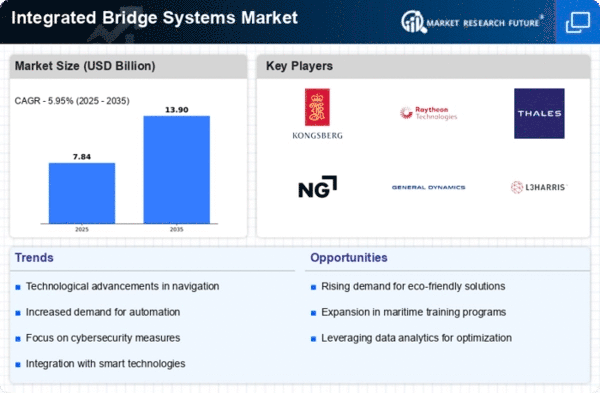
As per MRFR analysis, the Integrated Bridge Systems Market Size was estimated at 7.4 USD Billion in 2024. The Integrated Bridge Systems industry is projected to grow from 7.8 in 2025 to 13.9 by 2035, exhibiting a compound annual growth rate (CAGR) of 5.95 during the forecast period 2025 - 2035.

Key Market Trends & Highlights

The Integrated Bridge Systems Market is poised for substantial growth driven by technological advancements and a focus on sustainability.

  • Technological advancements are reshaping the Integrated Bridge Systems Market, enhancing operational efficiency and safety.
  • North America remains the largest market, while the Asia-Pacific region is emerging as the fastest-growing area for integrated bridge systems.
  • The navigation segment holds the largest share, whereas the communication segment is witnessing rapid growth due to increasing demand for smart shipping solutions.
  • Key market drivers include the rising demand for automation and stringent regulatory compliance, which are propelling the adoption of integrated bridge systems.

Market Size & Forecast

2024 Market Size 7.4 (USD Billion)
2035 Market Size 13.9 (USD Billion)
CAGR (2025 - 2035) 5.95%

Major Players

Kongsberg Gruppen (NO), Raytheon Technologies (US), Thales Group (FR), Northrop Grumman (US), General Dynamics (US), L3Harris Technologies (US), Furuno Electric Co., Ltd. (JP), Wärtsilä Corporation (FI), Siemens AG (DE)

Our Impact
Enabled $4.3B Revenue Impact for Fortune 500 and Leading Multinationals
Partnering with 2000+ Global Organizations Each Year
30K+ Citations by Top-Tier Firms in the Industry

Integrated Bridge Systems Market Trends

The Integrated Bridge Systems Market is currently experiencing a transformative phase, driven by advancements in technology and increasing demand for enhanced navigation solutions. This market encompasses a range of systems that integrate various components of a vessel's operations, including navigation, communication, and control systems. As maritime operations become more complex, the need for efficient and reliable bridge systems has become paramount. Stakeholders are increasingly focusing on developing systems that not only improve safety but also enhance operational efficiency. Furthermore, the integration of automation and digital technologies is reshaping the landscape, allowing for more streamlined operations and better decision-making processes. In December 2025, the market appears poised for further growth, as regulatory frameworks evolve to support the adoption of innovative technologies. The emphasis on sustainability and environmental considerations is also influencing the development of integrated systems, as companies seek to minimize their ecological footprint. Additionally, the rise of smart shipping initiatives suggests a shift towards more connected and intelligent vessels. This trend may lead to increased collaboration among technology providers, shipbuilders, and operators, fostering a more integrated approach to maritime operations. Overall, the Integrated Bridge Systems Market is likely to continue evolving, reflecting the dynamic nature of the maritime industry and the ongoing quest for improved safety and efficiency.

Technological Advancements

The integration of cutting-edge technologies is reshaping the Integrated Bridge Systems Market. Innovations such as artificial intelligence, machine learning, and advanced data analytics are enhancing decision-making processes and operational efficiency. These advancements enable real-time monitoring and predictive maintenance, which could significantly reduce downtime and improve safety.

Sustainability Focus

There is a growing emphasis on sustainability within the Integrated Bridge Systems Market. Companies are increasingly prioritizing eco-friendly solutions that minimize environmental impact. This trend may lead to the development of systems that optimize fuel consumption and reduce emissions, aligning with global efforts to promote greener maritime practices.

Smart Shipping Initiatives

The rise of smart shipping initiatives is influencing the Integrated Bridge Systems Market. As vessels become more connected, the demand for integrated systems that facilitate communication and data sharing is likely to increase. This trend suggests a shift towards more collaborative approaches among stakeholders, enhancing overall operational effectiveness.

Integrated Bridge Systems Market Drivers

Regulatory Compliance

The Global Integrated Bridge Systems Market (IBS) Market Industry is also driven by stringent regulatory compliance requirements imposed by maritime authorities. These regulations mandate the implementation of advanced navigation and safety systems to enhance maritime safety and environmental protection. Compliance with international standards such as the International Maritime Organization's regulations necessitates the adoption of integrated bridge systems that can provide real-time data and analytics. This trend is likely to propel the market forward, as companies invest in IBS to meet these regulatory demands and avoid penalties, thereby ensuring operational continuity.

Technological Advancements

The Global Integrated Bridge Systems Market (IBS) Market Industry is witnessing rapid technological advancements, particularly in automation and digitalization. Innovations such as integrated navigation systems, advanced data analytics, and enhanced user interfaces are transforming how maritime operations are conducted. For instance, the integration of artificial intelligence in IBS allows for predictive maintenance, reducing downtime and operational costs. As a result, the market is projected to reach 5.29 USD Billion in 2024, reflecting a growing demand for sophisticated systems that enhance safety and efficiency in maritime operations.

Increasing Maritime Traffic

The Global Integrated Bridge Systems Market (IBS) Market Industry is significantly influenced by the rising maritime traffic across the globe. With the expansion of global trade and the increasing number of vessels, the need for efficient navigation and communication systems becomes paramount. This surge in maritime activities necessitates the adoption of advanced IBS to ensure safe and effective vessel operations. As the industry adapts to these changes, the market is expected to grow, with projections indicating a value of 8.43 USD Billion by 2035, highlighting the critical role of IBS in managing increased maritime traffic.

Focus on Safety and Efficiency

The Global Integrated Bridge Systems Market (IBS) Market Industry is increasingly focused on enhancing safety and operational efficiency. The integration of advanced technologies in IBS allows for improved situational awareness, reducing the likelihood of maritime accidents. For example, systems that provide real-time weather updates and navigational data can significantly enhance decision-making processes for vessel operators. This emphasis on safety is likely to drive market growth, as stakeholders recognize the potential for IBS to mitigate risks and improve overall operational performance, contributing to a projected CAGR of 4.33% from 2025 to 2035.

Growing Demand for Eco-Friendly Solutions

The Global Integrated Bridge Systems Market (IBS) Market Industry is experiencing a shift towards eco-friendly solutions as environmental concerns gain prominence. The maritime sector is under pressure to reduce its carbon footprint, prompting the adoption of integrated systems that optimize fuel consumption and minimize emissions. IBS equipped with energy-efficient technologies can significantly contribute to sustainability goals. As the industry evolves, the demand for such eco-friendly solutions is expected to rise, further driving the market's growth and aligning with global initiatives aimed at promoting sustainable maritime practices.


Market Segment Insights

By Application: Navigation (Largest) vs. Communication (Fastest-Growing)

The Integrated Bridge Systems Market showcases a diverse distribution of application segments, with Navigation occupying the largest share. This segment is integral for safe and efficient vessel operations, helping in real-time route planning and obstacle avoidance. Communication, while smaller comparatively, is rapidly growing as demand for enhanced intra-vessel and inter-vessel connectivity increases. Monitoring, Control, and Automation applications follow, providing essential functionalities but lacking the same growth momentum.

Navigation: Dominant vs. Communication: Emerging

Navigation applications in Integrated Bridge Systems are crucial for modern maritime operations, allowing vessels to navigate accurately and safely through varied environments. This segment has established itself as the backbone of bridge systems, offering comprehensive solutions for chart plotting, route optimization, and hazard management. Conversely, Communication applications are emerging as key players, driven by advancements in digital technologies and the need for real-time data sharing. These applications facilitate seamless interactions within vessels and enhance coordination among fleets, thus are increasingly viewed as essential for contemporary maritime operations.

By End Use: Commercial Vessels (Largest) vs. Naval Vessels (Fastest-Growing)

In the Integrated Bridge Systems Market, the 'End Use' segment reveals a significant distribution across various vessel types, with commercial vessels holding the largest share. These vessels typically include cargo ships, tankers, and passenger ferries, which contribute significantly to the market due to their high demand for efficient navigation and control systems. In contrast, naval vessels, geared for defense and military purposes, are emerging as a fast-growing segment, driven by increasing global defense budgets and modernization efforts within military fleets.

Commercial Vessels (Dominant) vs. Research Vessels (Emerging)

Commercial vessels are the dominant segment in the Integrated Bridge Systems Market, characterized by their advanced navigation systems that ensure operational efficiency and safety in busy maritime routes. These vessels are often equipped with integrated systems that enhance situational awareness and decision-making capabilities. On the other hand, research vessels are considered an emerging segment as they gain traction due to rising investments in marine research and environmental monitoring. These vessels are outfitted with specialized systems for data collection and analysis, driving their market presence, particularly in scientific and ecological studies.

By Technology: Integrated Systems (Largest) vs. Modular Systems (Fastest-Growing)

The Integrated Bridge Systems Market presents a diverse landscape of technology segments, with Integrated Systems leading in market share due to their comprehensive solutions that combine various functionalities, enhancing operational efficiency. Modular Systems follow closely, gaining traction for their flexibility and scalability in adapting to different maritime applications, capturing a significant portion of market interest.

Technology: Integrated Systems (Dominant) vs. Modular Systems (Emerging)

Integrated Systems serve as the backbone of modern maritime operations, offering cohesive solutions that integrate navigation, communication, and vessel control functions into a single platform. Their dominance stems from the increasing demand for fully-integrated systems that streamline operations and improve safety at sea. Conversely, Modular Systems are emerging rapidly, appealing to shipbuilders and operators looking for customizable solutions that can be easily upgraded as technology evolves. This adaptability makes them particularly appealing in a market that values innovation and efficiency.

By Component Type: Display Systems (Largest) vs. Control Consoles (Fastest-Growing)

The Integrated Bridge Systems Market is characterized by a diverse distribution of component types, with Display Systems holding the largest share among all segment values. These systems integrate navigation and operational data in a cohesive manner, enhancing situational awareness for maritime operators. Control Consoles follow closely, previously seen as static components but evolving into dynamic interfaces that offer advanced functionality and user engagement. The integral role of these component types in facilitating robust marine operations underscores their criticality within the market. As the demand for enhanced safety and efficiency in maritime operations rises, so too does the growth potential for various component types. Display Systems, being essential for real-time data visualization, continuously dominate due to their critical integration in bridge systems. Conversely, Control Consoles are emerging rapidly thanks to advancements in user interface technology and automation, marking them as the fastest-growing segment in the market as operators seek more intuitive control environments that improve operational efficiency.

Display Systems (Dominant) vs. Communication Equipment (Emerging)

Display Systems have established their dominance in the Integrated Bridge Systems market by providing comprehensive visualization of navigational information, thereby improving operational efficacy. These systems are typically characterized by their high-definition screens and advanced graphics, making them essential tools for modern maritime operations. On the other hand, Communication Equipment is witnessing a surge in interest as an emerging component type. This equipment is crucial for maintaining seamless communication channels between vessels and command centers, and its evolution towards digital and interconnected solutions is driven by the need for enhanced data sharing and real-time decision-making. Both segments reflect the ongoing shift towards smarter maritime navigation and control systems.

By System Type: Centralized Systems (Largest) vs. Hybrid Systems (Fastest-Growing)

The Integrated Bridge Systems Market displays a distinct distribution among its salient segments: Centralized Systems, Distributed Systems, and Hybrid Systems. Centralized Systems maintain a reasonable market share due to their streamlined control and operational efficiency, catering primarily to larger vessels. In contrast, Distributed Systems and Hybrid Systems are emerging players; the latter, in particular, is gaining traction due to increasing demands for flexibility and real-time data processing in navigation and safety operations. Growth trends in the Integrated Bridge Systems Market are fueled by advancements in technology and a shifting preference toward automation. Hybrid Systems, being the fastest-growing segment, stem from the maritime industry's overall push towards more sustainable and efficient operations. Demand for integrated solutions that offer both centralized control and decentralized benefits highlights a crucial evolution in onboard systems, paving the way for innovative hybrid models that enhance functionality and adaptability at sea.

Centralized Systems (Dominant) vs. Hybrid Systems (Emerging)

Centralized Systems dominate the Integrated Bridge Systems Market, offering a unified control platform that simplifies navigation and vessel management. These systems are characterized by their centralized screen display, which integrates various functionalities, thereby enhancing situational awareness and operational efficiency. Their reliability and straightforward deployment make them especially appealing to the commercial shipping sector, where operational consistency is vital. Meanwhile, Hybrid Systems represent a growing segment, blending elements of both centralized and distributed architectures. Their emergence caters to evolving maritime needs, focusing on enhancing operational flexibility and real-time data access, making them particularly attractive to fleet operators looking to optimize performance while adhering to sustainability practices. This transition heralds a new era where adaptability and efficiency are paramount.

Get more detailed insights about Integrated Bridge Systems Market

Regional Insights

North America : Market Leader in Innovation

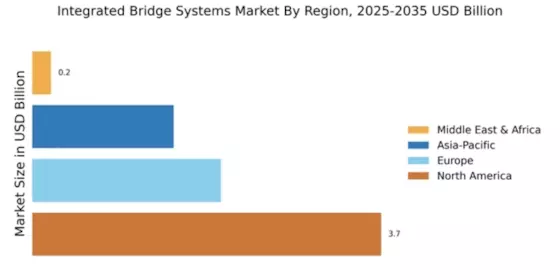
North America is poised to maintain its leadership in the Integrated Bridge Systems market, holding a significant share of 3.7 in 2024. The region's growth is driven by advancements in maritime technology, increasing demand for automation, and stringent safety regulations. The U.S. government has been actively promoting initiatives to enhance maritime safety and efficiency, further fueling market expansion. Key players such as Raytheon Technologies, Northrop Grumman, and L3Harris Technologies are at the forefront of this market, leveraging their technological expertise to innovate and meet the growing demands. The competitive landscape is characterized by a focus on R&D and strategic partnerships, ensuring that North America remains a hub for cutting-edge integrated bridge solutions.

Europe : Emerging Market with Growth Potential

Europe, with a market size of 2.0, is witnessing a surge in demand for Integrated Bridge Systems, driven by the need for enhanced navigational safety and efficiency. Regulatory frameworks such as the EU's Maritime Safety Directive are catalyzing investments in advanced maritime technologies. The region's commitment to sustainability and innovation is also shaping market dynamics, as companies seek to comply with environmental regulations. Leading countries like Germany, France, and the UK are home to major players such as Thales Group and Siemens AG, who are investing heavily in R&D. The competitive landscape is marked by collaborations and partnerships aimed at developing next-generation integrated systems, positioning Europe as a key player in the global market.

Asia-Pacific : Rapidly Growing Market Segment

The Asia-Pacific region, with a market size of 1.5, is rapidly emerging as a significant player in the Integrated Bridge Systems market. The growth is fueled by increasing maritime trade, investments in port infrastructure, and a rising focus on safety regulations. Countries like Japan and China are leading the charge, driven by their robust shipping industries and government initiatives aimed at modernizing maritime operations. The competitive landscape features key players such as Furuno Electric Co., Ltd. and Wärtsilä Corporation, who are actively expanding their presence in the region. The market is characterized by a mix of local and international companies, all vying to capture the growing demand for advanced integrated systems, making Asia-Pacific a dynamic market to watch.

Middle East and Africa : Emerging Market with Challenges

The Middle East and Africa (MEA) region, with a market size of 0.2, presents unique challenges and opportunities in the Integrated Bridge Systems market. The growth is primarily driven by increasing investments in maritime infrastructure and a growing focus on enhancing navigational safety. However, regulatory hurdles and varying levels of technological adoption across countries pose challenges to market expansion. Countries like the UAE and South Africa are leading the way, with initiatives aimed at modernizing their maritime sectors. The presence of key players is gradually increasing, but the market remains fragmented, offering opportunities for new entrants to establish themselves in this developing landscape.

Integrated Bridge Systems Market Regional Image

Key Players and Competitive Insights

The Integrated Bridge Systems Market is characterized by a dynamic competitive landscape, driven by technological advancements and increasing demand for enhanced maritime safety and efficiency. Key players such as Kongsberg Gruppen (Norway), Raytheon Technologies (US), and Thales Group (France) are at the forefront, each adopting distinct strategies to solidify their market positions. Kongsberg Gruppen (Norway) emphasizes innovation through the development of advanced digital solutions, while Raytheon Technologies (US) focuses on integrating AI and machine learning into their systems to improve operational efficiency. Thales Group (France) is actively pursuing partnerships with maritime operators to enhance their service offerings, thereby shaping a competitive environment that prioritizes technological integration and customer-centric solutions.In terms of business tactics, companies are increasingly localizing manufacturing to reduce costs and enhance supply chain resilience. The market structure appears moderately fragmented, with several players vying for market share, yet the collective influence of major companies is significant. This competitive structure fosters an environment where innovation and strategic partnerships are essential for maintaining a competitive edge.

In November Kongsberg Gruppen (Norway) announced a strategic partnership with a leading shipping company to develop next-generation integrated bridge systems that leverage real-time data analytics. This collaboration is poised to enhance navigational safety and operational efficiency, reflecting Kongsberg's commitment to innovation and customer collaboration. The strategic importance of this partnership lies in its potential to set new industry standards for integrated systems, thereby reinforcing Kongsberg's market leadership.

In October Raytheon Technologies (US) unveiled a new AI-driven navigation system designed to optimize route planning and fuel efficiency for commercial vessels. This launch underscores Raytheon's focus on integrating cutting-edge technology into their offerings, which is likely to attract a broader customer base seeking advanced solutions. The introduction of this system may significantly impact operational costs for shipping companies, positioning Raytheon as a key player in the market.

In September Thales Group (France) expanded its portfolio by acquiring a small tech firm specializing in cybersecurity for maritime applications. This acquisition is strategically important as it enhances Thales's capabilities in providing secure integrated bridge systems, addressing growing concerns over cyber threats in the maritime sector. By bolstering its cybersecurity offerings, Thales is likely to strengthen its competitive position and appeal to clients prioritizing safety and security.

As of December current trends in the Integrated Bridge Systems Market indicate a strong shift towards digitalization, sustainability, and AI integration. Strategic alliances are increasingly shaping the competitive landscape, enabling companies to pool resources and expertise. The evolution of competitive differentiation appears to be moving away from price-based competition towards a focus on innovation, technology, and supply chain reliability. This shift suggests that companies that prioritize these aspects will likely emerge as leaders in the market.

Key Companies in the Integrated Bridge Systems Market include

Industry Developments

  • Q2 2024: Kongsberg Maritime launches next-generation Integrated Bridge System for commercial vessels Kongsberg Maritime announced the launch of its new K-Bridge 5 Integrated Bridge System, designed to enhance navigation safety and operational efficiency for commercial shipping fleets. The system features advanced automation, improved user interface, and expanded connectivity options.
  • Q2 2024: Wärtsilä secures contract to supply integrated bridge systems for 10 new LNG carriers Wärtsilä was awarded a contract to deliver its NACOS Platinum Integrated Bridge Systems Market for a series of 10 new LNG carriers being built at a major Asian shipyard, supporting advanced navigation and safety requirements.
  • Q3 2024: Raytheon Anschütz wins contract to retrofit integrated bridge systems on German Navy frigates Raytheon Anschütz announced a contract to retrofit its Synapsis Integrated Bridge System on several German Navy F124-class frigates, aiming to modernize navigation and combat management capabilities.
  • Q2 2024: Northrop Grumman delivers Integrated Bridge and Navigation Systems for U.S. Navy’s new Constellation-class frigates Northrop Grumman completed delivery of its latest Integrated Bridge and Navigation Systems for the U.S. Navy’s Constellation-class frigates, providing enhanced situational awareness and automation.
  • Q1 2025: Navico Group announces partnership with Damen Shipyards for integrated bridge solutions Navico Group entered a strategic partnership with Damen Shipyards to supply integrated bridge systems for a new series of offshore support vessels, focusing on digitalization and operational efficiency.
  • Q2 2025: Japan Radio Co. launches new J-Marine NeCST integrated bridge platform Japan Radio Co. introduced its J-Marine NeCST, a next-generation integrated bridge platform featuring AI-powered navigation support and enhanced cybersecurity for commercial and government vessels.
  • Q2 2024: Rolls-Royce secures contract to supply integrated bridge systems for Norwegian Coast Guard vessels Rolls-Royce was awarded a contract to deliver its Unified Bridge integrated bridge systems for three new Norwegian Coast Guard vessels, supporting advanced navigation and mission management.
  • Q3 2024: Saab to provide integrated bridge systems for Swedish Navy’s new corvettes Saab announced it will supply its latest integrated bridge systems for the Swedish Navy’s new corvette program, enhancing automation and interoperability with other onboard systems.
  • Q1 2025: Transas launches new cloud-enabled integrated bridge system for global shipping fleets Transas, a Wärtsilä company, unveiled a cloud-enabled integrated bridge system designed to support remote diagnostics, software updates, and fleet-wide data analytics for commercial shipping operators.
  • Q2 2025: Navis Engineering wins contract to supply integrated bridge systems for Finnish icebreakers Navis Engineering secured a contract to deliver its integrated bridge systems for a new series of Finnish icebreakers, focusing on extreme weather navigation and ice management.
  • Q2 2024: ABB delivers integrated bridge systems for new hybrid ferries in Denmark ABB completed delivery of its integrated bridge systems for two new hybrid ferries operating in Denmark, supporting energy efficiency and digital navigation solutions.
  • Q3 2024: Thales awarded contract to supply integrated bridge systems for French Navy’s new support ships Thales Group announced a contract to provide its latest integrated bridge systems for the French Navy’s new fleet of support ships, enhancing navigation safety and mission coordination.

Future Outlook

Integrated Bridge Systems Market Future Outlook

The Integrated Bridge Systems Market is projected to grow at a 5.95% CAGR from 2025 to 2035, driven by advancements in automation, safety regulations, and demand for efficiency.

New opportunities lie in:

  • Development of AI-driven navigation systems for enhanced decision-making.
  • Integration of IoT technologies for real-time monitoring and predictive maintenance.
  • Expansion into emerging markets with tailored solutions for local maritime needs.

By 2035, the Integrated Bridge Systems Market is expected to be robust, reflecting substantial growth and innovation.

Market Segmentation

Integrated Bridge Systems Market End Use Outlook

  • Commercial Vessels
  • Naval Vessels
  • Fishing Vessels
  • Research Vessels

Integrated Bridge Systems Market Technology Outlook

  • Integrated Systems
  • Modular Systems
  • Software Solutions
  • Hardware Solutions

Integrated Bridge Systems Market Application Outlook

  • Navigation
  • Communication
  • Monitoring
  • Control
  • Automation

Integrated Bridge Systems Market System Type Outlook

  • Centralized Systems
  • Distributed Systems
  • Hybrid Systems

Integrated Bridge Systems Market Component Type Outlook

  • Display Systems
  • Control Consoles
  • Sensors
  • Communication Equipment

Report Scope

MARKET SIZE 20247.4(USD Billion)
MARKET SIZE 20257.8(USD Billion)
MARKET SIZE 203513.9(USD Billion)
COMPOUND ANNUAL GROWTH RATE (CAGR)5.95% (2025 - 2035)
REPORT COVERAGERevenue Forecast, Competitive Landscape, Growth Factors, and Trends
BASE YEAR2024
Market Forecast Period2025 - 2035
Historical Data2019 - 2024
Market Forecast UnitsUSD Billion
Key Companies ProfiledKongsberg Gruppen (NO), Raytheon Technologies (US), Thales Group (FR), Northrop Grumman (US), General Dynamics (US), L3Harris Technologies (US), Furuno Electric Co., Ltd. (JP), Wärtsilä Corporation (FI), Siemens AG (DE)
Segments CoveredApplication, End Use, Technology, Component Type, System Type
Key Market OpportunitiesIntegration of advanced automation and artificial intelligence enhances operational efficiency in the Integrated Bridge Systems Market.
Key Market DynamicsTechnological advancements and regulatory changes drive demand for Integrated Bridge Systems in maritime applications.
Countries CoveredNorth America, Europe, APAC, South America, MEA

Market Highlights

Author
Sejal Akre
Senior Research Analyst

She has over 5 years of rich experience, in market research and consulting providing valuable market insights to client. Hands on expertise in management consulting, and extensive knowledge in domain including ICT, Automotive & Transportation and Aerospace & Defense. She is skilled in Go-to market strategy, industry analysis, market sizing, in depth company profiling, competitive intelligence & benchmarking and value chain amongst others.

Leave a Comment

FAQs

At what rate is the worldwide market expected to gain impetus in the coming years?

Integrated Bridge Systems (IBS) Market Registering a CAGR of 3.8% during 2020-2030.

What factors support market growth across the globe?

Factors that support the market growth across the globe include booming intercontinental trade, considerable rise in carrier movement in waterways and the excellent opportunities offered by the emerging countries.

What can deter the market demand in the ensuing years?

Since IBS is a capital-intensive technology and requires a lot of customization for efficient performance, its demand can be deterred to some extent in the ensuing years.

Based on applications, which segment could lead the market in the years ahead?

Based on applications, the commercial ships segment could lead the market in the years ahead.

Why are commercial ships popular?

Commercial ships are popular, given the surge in intercontinental as well as intracontinental trade activities worldwide.

Which region is presumed to be the frontrunner in the global market?

Asia Pacific is presumed to be the frontrunner in the global market.

What are the main growth inducers in the APAC market?

The main growth inducers in the APAC market are investment in infrastructural development and port modernization along with adoption of free trade policies among TPPA, BRICS and ASEAN member countries.

Download Free Sample

Kindly complete the form below to receive a free sample of this Report

Compare Licence

×
Features License Type
Single User Multiuser License Enterprise User
Price $4,950 $5,950 $7,250
Maximum User Access Limit 1 User Upto 10 Users Unrestricted Access Throughout the Organization
Free Customization
Direct Access to Analyst
Deliverable Format
Platform Access
Discount on Next Purchase 10% 15% 15%
Printable Versions