×
Request Free Sample ×

Kindly complete the form below to receive a free sample of this Report

* Please use a valid business email

Leading companies partner with us for data-driven Insights

clients tt-cursor
Hero Background

Indonesia Prebiotics Market

ID: MRFR/FnB/47100-HCR
128 Pages
Snehal Singh
February 2026

Indonesia Prebiotics Market Size, Share, Industry Trend & Analysis Research Report By Type (Functional food & beverage, Dietary supplements, Others) and By Application (Fructooligosaccharides, Galactooligosaccharides, Inulin, Others) - Forecast to 2035

Share:
Download PDF ×

We do not share your information with anyone. However, we may send you emails based on your report interest from time to time. You may contact us at any time to opt-out.

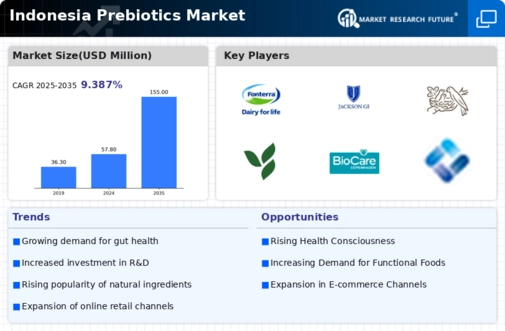
Indonesia Prebiotics Market Infographic
Purchase Options

Indonesia Prebiotics Market Summary

As per Market Research Future analysis, the Indonesia prebiotics market Size was estimated at 57.77 USD Million in 2024. The Indonesia prebiotics market is projected to grow from 62.25 USD Million in 2025 to 131.42 USD Million by 2035, exhibiting a compound annual growth rate (CAGR) of 7.7% during the forecast period 2025 - 2035

Key Market Trends & Highlights

The Indonesia prebiotics market is experiencing robust growth driven by health trends and innovative product offerings.

  • Rising health consciousness among consumers is propelling the demand for prebiotic products across various segments.
  • The dietary supplements segment emerges as the largest, while the functional foods segment is recognized as the fastest-growing in the market.
  • E-commerce growth is facilitating wider access to prebiotic products, enhancing consumer purchasing options.
  • Key market drivers include increasing demand for functional foods and a rising interest in natural ingredients.

Market Size & Forecast

2024 Market Size 57.77 (USD Million)
2035 Market Size 131.42 (USD Million)
CAGR (2025 - 2035) 7.76%

Major Players

Bifodan (DK), DuPont (US), Kerry Group (IE), Nestle (CH), ProbioFerm (DE), Synlogic (US), Tate & Lyle (GB), Yakult Honsha (JP)

Our Impact
Enabled $4.3B Revenue Impact for Fortune 500 and Leading Multinationals
Partnering with 2000+ Global Organizations Each Year
30K+ Citations by Top-Tier Firms in the Industry

Indonesia Prebiotics Market Trends

The prebiotics market in Indonesia is experiencing notable growth, driven by increasing consumer awareness regarding gut health and the benefits of dietary fibers. As individuals become more health-conscious, there is a rising demand for products that promote digestive wellness. This trend is further supported by the growing prevalence of lifestyle-related health issues, which has led to a shift in dietary preferences towards functional foods. Manufacturers are responding to this demand by innovating and expanding their product lines to include prebiotic ingredients, thereby enhancing their market presence. Moreover, the regulatory environment in Indonesia appears to be evolving, with government initiatives aimed at promoting health and nutrition. This is likely to encourage the development of prebiotic products that meet safety and quality standards. Additionally, the increasing penetration of e-commerce platforms is facilitating access to a wider range of prebiotic products, making them more available to consumers. As a result, the prebiotics market is poised for sustained growth, reflecting broader trends in health and wellness within the region.

Rising Health Consciousness

There is a growing awareness among consumers regarding the importance of gut health, which is driving demand for prebiotic products. This trend is evident as more individuals seek dietary solutions that support digestive wellness.

Innovation in Product Development

Manufacturers are increasingly focusing on the development of innovative prebiotic products. This includes the incorporation of diverse prebiotic ingredients into food and beverage items, catering to the evolving preferences of health-conscious consumers.

E-commerce Growth

The expansion of e-commerce platforms is significantly impacting the prebiotics market. Consumers are now able to access a wider variety of prebiotic products online, enhancing convenience and availability.

Indonesia Prebiotics Market Drivers

Increasing Demand for Functional Foods

The prebiotics market in Indonesia is experiencing a notable surge in demand for functional foods. Consumers are increasingly seeking products that offer health benefits beyond basic nutrition. This trend is driven by a growing awareness of the importance of gut health and its connection to overall well-being. As a result, manufacturers are incorporating prebiotics into various food and beverage products, catering to health-conscious consumers. The market for functional foods is projected to grow at a CAGR of approximately 8% from 2025 to 2030, indicating a robust opportunity for prebiotic ingredients. This increasing demand is likely to propel the prebiotics market, as consumers prioritize products that support digestive health and enhance immunity.

Rising Interest in Natural Ingredients

In Indonesia, there is a marked shift towards natural and organic ingredients in food products, which significantly impacts the prebiotics market. Consumers are becoming more discerning, favoring products that are free from artificial additives and preservatives. This trend aligns with the broader movement towards clean label products, where transparency in ingredient sourcing is paramount. As a result, manufacturers are increasingly sourcing natural prebiotic ingredients, such as inulin and fructooligosaccharides, to meet consumer preferences. The market for natural ingredients is expected to grow by approximately 10% annually, further driving the demand for prebiotics. This inclination towards natural products is likely to enhance the growth trajectory of the prebiotics market in Indonesia.

Growth of the Dietary Supplements Sector

The dietary supplements sector in Indonesia is witnessing substantial growth, which is significantly impacting the prebiotics market. As more consumers turn to supplements to enhance their health, the demand for prebiotic supplements is on the rise. This trend is driven by an increasing awareness of the benefits of gut health and the desire for convenient health solutions. The dietary supplements market is projected to expand at a CAGR of around 9% over the next five years, indicating a robust opportunity for prebiotic products. This growth in the supplements sector is likely to bolster the prebiotics market, as consumers seek effective ways to improve their digestive health.

Emerging Trends in Personalized Nutrition

Personalized nutrition is emerging as a significant trend in Indonesia, influencing the prebiotics market. Consumers are increasingly seeking tailored dietary solutions that cater to their individual health needs. This trend is prompting manufacturers to develop prebiotic products that can be customized based on specific health goals, such as weight management or digestive health. The rise of technology in nutrition, including apps and online consultations, is facilitating this shift towards personalized dietary approaches. As the market for personalized nutrition continues to grow, it is likely to create new opportunities for prebiotic products, enhancing their appeal among health-conscious consumers in Indonesia.

Government Initiatives Promoting Health Awareness

The Indonesian government is actively promoting health awareness initiatives, which are positively influencing the prebiotics market. Campaigns aimed at educating the public about nutrition and healthy eating habits are gaining traction. These initiatives often emphasize the importance of gut health and the role of prebiotics in maintaining a balanced diet. As a result, consumers are becoming more informed about the benefits of prebiotic consumption, leading to increased demand for products containing these ingredients. The government's focus on improving public health is likely to create a favorable environment for the prebiotics market, as more individuals seek to incorporate prebiotics into their diets.


Market Segment Insights

By Source: Plant-based (Largest) vs. Microbial-derived (Fastest-Growing)

The Indonesia prebiotics market exhibits a diverse distribution of sources, with plant-based sources holding the largest share. This segment has gained significant traction due to the increasing consumer preference for natural and organic ingredients. On the other hand, microbial-derived prebiotics are witnessing rapid growth, reflecting a shift towards more innovative and scientifically-backed sources that promise enhanced health benefits. The growth trend for these segments is primarily driven by rising health consciousness among consumers and a growing awareness of gut health's importance. The demand for plant-based prebiotics continues to be robust, fueled by the vegetarian and vegan movements. Conversely, the microbial-derived segment's swift expansion is attributed to advancements in fermentation technology and a growing acceptance of probiotics, indicating a dynamic shift towards personalized nutrition solutions.

Plant-based (Dominant) vs. Microbial-derived (Emerging)

In the Indonesia prebiotics market, plant-based sources are the dominant force due to their broad appeal and alignment with health trends, promoting wellness through natural means. These sources typically include ingredients such as inulin and fructooligosaccharides, which are well-known for their prebiotic effects. The consumer shift towards plant-based diets further solidifies this dominance. Meanwhile, microbial-derived prebiotics are classified as emerging due to their rapid acceptance and innovation in formulations. This category leverages the benefits of fermentation-derived products and is supported by increasing research into gut microbiota, revealing the potential effectiveness of these products in enhancing digestive health. Both segments exhibit strong growth potentials, catering to evolving consumer demands.

By Form: Powder (Largest) vs. Liquid (Fastest-Growing)

In the Indonesia prebiotics market, the current segmentation by form reveals that the powder format holds the largest share. It has become the preferred choice among consumers due to its versatility, ease of use, and efficacy in delivering prebiotic benefits. Conversely, the liquid form is rapidly gaining traction, appealing to those looking for convenience and immediate consumption. This growing preference is reshaping market dynamics as consumers increasingly opt for liquid formats in their dietary regimens. Driving the growth of these segments are factors such as increasing awareness of gut health, the rising trend of functional foods, and the demand for convenient health solutions. The emergence of innovative formulations and flavors in the liquid segment also contributes to its appeal, further driving its rapid expansion. The evolving consumer preferences highlight a distinct shift towards more accessible and diverse prebiotic offerings in the market.

Powder (Dominant) vs. Liquid (Emerging)

The powder segment in the Indonesia prebiotics market is characterized by its dominant position, with a well-established consumer base. Powders are typically recognized for their flexibility in formulation, allowing manufacturers to create a variety of product types, from protein supplements to functional foods. This format appeals to health-conscious individuals who prioritize customization of their diet. On the other hand, the liquid category is emerging as a key player, reflecting a shift towards ready-to-drink solutions. Liquid prebiotics cater to the on-the-go lifestyle, often infused with additional nutrients or flavors to enhance taste and appeal. As both segments target health-conscious consumers, the competition between them is intensifying as manufacturers innovate to capture market interest.

By Application: Functional Foods (Largest) vs. Dietary Supplements (Fastest-Growing)

The Indonesia prebiotics market showcases a diverse range of applications, with functional foods holding the largest share. This segment is crucial as it integrates prebiotics into everyday food products, enhancing their appeal to health-conscious consumers. Dietary supplements follow closely, demonstrating significant growth due to increasing awareness about health benefits and preventive care solutions. Growth trends in this market are driven by changing consumer lifestyles and a rising preference for natural health solutions. As dietary supplements become more popular, manufacturers are expanding their offerings to include innovative prebiotic formulations. The animal feed segment is also gaining traction due to the growing demand for healthier livestock and sustainable farming practices, positioning nutraceuticals as a pivotal player in holistic health solutions.

Functional Foods (Dominant) vs. Dietary Supplements (Emerging)

Functional foods emerge as the dominant segment in the Indonesia prebiotics market, characterized by their ability to enhance overall health through the inclusion of prebiotic ingredients. This segment appeals to a broad consumer base, integrating health benefits into everyday food items like yogurt, cereals, and beverages. In contrast, dietary supplements are quickly becoming an emerging segment as consumers increasingly seek convenient health solutions. They offer concentrated doses of prebiotics in easy-to-consume forms like capsules and powders, catering to busy lifestyles. This shift reflects a broader trend towards wellness, with both segments poised for growth as they adapt to evolving consumer preferences and health trends.

By End Use: Food and Beverage (Largest) vs. Pharmaceuticals (Fastest-Growing)

The Indonesia prebiotics market exhibits a diverse distribution among its key end-use segments. The Food and Beverage sector dominates this space, capturing a significant portion of the market share due to increasing consumer demand for health-oriented products. This segment is fueled by the rising awareness of the benefits of prebiotics in enhancing digestive health and overall wellness. On the other hand, the Pharmaceuticals segment is emerging as the fastest-growing area within the market. The growth in this sector can be attributed to rising health consciousness, an increasing number of chronic diseases, and the resultant demand for preventive healthcare solutions. As pharmaceutical companies expand their product ranges to include prebiotic ingredients, the segment is expected to witness accelerated growth in the coming years.

Food and Beverage: Dominant vs. Pharmaceuticals: Emerging

The Food and Beverage segment stands as the dominant force within the Indonesia prebiotics market, characterized by a robust variety of applications in functional foods and beverages. This segment thrives on consumers' growing preference for healthier lifestyle choices and natural ingredients. Innovations in product formulations, such as the incorporation of prebiotics in dairy, snacks, and beverages, further solidify its market position. In contrast, the Pharmaceuticals segment is marked as an emerging domain, where the integration of prebiotics into health supplements and therapeutic products is a key trend. This shift reflects a broader movement towards holistic health, driving pharmaceutical companies to explore prebiotics for their potential health benefits. With increasing investments in R&D and product innovation, this segment is poised for significant expansion.

Get more detailed insights about Indonesia Prebiotics Market

Key Players and Competitive Insights

The prebiotics market in Indonesia is characterized by a dynamic competitive landscape, driven by increasing consumer awareness regarding gut health and the rising demand for functional foods. Key players such as DuPont (US), Nestle (CH), and Yakult Honsha (JP) are strategically positioned to leverage these trends. DuPont (US) focuses on innovation in product development, particularly in the area of dietary fibers, which are essential for prebiotic formulations. Nestle (CH) emphasizes regional expansion and partnerships with local distributors to enhance its market presence. Yakult Honsha (JP) is known for its strong brand loyalty and extensive distribution network, which allows it to maintain a competitive edge in the probiotic and prebiotic segments. Collectively, these strategies contribute to a competitive environment that is increasingly focused on product differentiation and consumer engagement.In terms of business tactics, companies are localizing manufacturing to reduce costs and optimize supply chains, which is particularly relevant in a market like Indonesia where logistics can be challenging. The competitive structure appears moderately fragmented, with several players vying for market share, yet the influence of major companies remains substantial. This duality fosters an environment where innovation and operational efficiency are paramount for success.

In October DuPont (US) announced a partnership with a local Indonesian health food company to co-develop a new line of prebiotic supplements tailored to local dietary preferences. This strategic move not only enhances DuPont's product offerings but also allows for deeper market penetration by leveraging local expertise. Such collaborations are likely to resonate well with consumers seeking products that align with their cultural and nutritional needs.

In September Nestle (CH) launched a new prebiotic yogurt product specifically designed for the Indonesian market, incorporating locally sourced ingredients. This initiative underscores Nestle's commitment to regional customization and highlights the importance of aligning product development with local tastes and health trends. By doing so, Nestle aims to strengthen its market position and appeal to health-conscious consumers.

In August Yakult Honsha (JP) expanded its distribution network in Indonesia by partnering with local e-commerce platforms, thereby enhancing accessibility to its prebiotic products. This strategic action reflects a broader trend towards digitalization in the market, as companies increasingly recognize the importance of online sales channels in reaching a wider audience. Such initiatives are likely to bolster Yakult's competitive stance in a rapidly evolving retail landscape.

As of November current competitive trends in the prebiotics market include a pronounced shift towards digitalization, sustainability, and the integration of AI technologies in product development and marketing strategies. Strategic alliances are becoming increasingly vital, as companies seek to pool resources and expertise to navigate the complexities of the market. Looking ahead, competitive differentiation is expected to evolve, with a greater emphasis on innovation and technology rather than solely on price. Companies that can effectively leverage these trends will likely secure a more robust market position, ensuring long-term sustainability and growth.

Key Companies in the Indonesia Prebiotics Market include

Industry Developments

The Indonesia Prebiotics Market has seen significant developments recently, reflecting a growing consumer awareness regarding the health benefits associated with prebiotics. Notably, in September 2023, Fonterra officially launched a new line of prebiotic products tailored to the Indonesian market, aiming to meet local preferences and dietary needs. In August 2023, Nestle expanded its range of fortified food products, incorporating prebiotics to enhance gut health among Indonesian consumers. The market has also gained momentum from increased investments in Research and Development by companies like Herbalife and Danone, aiming to innovate and diversify their offerings in the prebiotics segment.

Mergers and acquisitions have been evident; for instance, in July 2023, Abbott Laboratories acquired a significant stake in a local health food company, solidifying its position in the prebiotic space. Furthermore, the market valuation of the Indonesia Prebiotics Market is anticipated to rise substantially, driven by expanding consumer demand and ethical consumerism trends. Over the past few years, Indonesia's larger population and rise in health consciousness have notably fueled growth in this sector, positioning the country as a key player in the Asia Pacific prebiotics landscape.

Future Outlook

Indonesia Prebiotics Market Future Outlook

The Prebiotics Market in Indonesia is projected to grow at a 7.76% CAGR from 2025 to 2035, driven by rising health awareness and demand for functional foods.

New opportunities lie in:

  • Development of innovative prebiotic supplements targeting specific health conditions.
  • Expansion of prebiotic ingredients in plant-based food products.
  • Strategic partnerships with health professionals to promote prebiotic benefits.

By 2035, the prebiotics market is expected to achieve substantial growth and diversification.

Market Segmentation

Indonesia Prebiotics Market Form Outlook

  • Powder
  • Liquid
  • Capsules
  • Tablets

Indonesia Prebiotics Market Source Outlook

  • Plant-based
  • Animal-based
  • Microbial-derived

Indonesia Prebiotics Market End Use Outlook

  • Food and Beverage
  • Pharmaceuticals
  • Personal Care

Indonesia Prebiotics Market Application Outlook

  • Functional Foods
  • Dietary Supplements
  • Nutraceuticals
  • Animal Feed

Report Scope

MARKET SIZE 2024 57.77(USD Million)
MARKET SIZE 2025 62.25(USD Million)
MARKET SIZE 2035 131.42(USD Million)
COMPOUND ANNUAL GROWTH RATE (CAGR) 7.76% (2025 - 2035)
REPORT COVERAGE Revenue Forecast, Competitive Landscape, Growth Factors, and Trends
BASE YEAR 2024
Market Forecast Period 2025 - 2035
Historical Data 2019 - 2024
Market Forecast Units USD Million
Key Companies Profiled Bifodan (DK), DuPont (US), Kerry Group (IE), Nestle (CH), ProbioFerm (DE), Synlogic (US), Tate & Lyle (GB), Yakult Honsha (JP)
Segments Covered Source, Form, Application, End Use
Key Market Opportunities Growing consumer awareness of gut health drives demand for innovative prebiotic products in the prebiotics market.
Key Market Dynamics Rising consumer awareness of gut health drives demand for prebiotics, influencing market dynamics in Indonesia.
Countries Covered Indonesia
Leave a Comment

FAQs

What is the expected market size of the Indonesia Prebiotics Market in 2024?

The Indonesia Prebiotics Market is expected to be valued at 57.77 million USD in 2024.

What is the projected market size of the Indonesia Prebiotics Market by 2035?

The market is projected to reach 155.0 million USD by 2035.

What is the expected compound annual growth rate (CAGR) for the Indonesia Prebiotics Market from 2025 to 2035?

The expected CAGR for the Indonesia Prebiotics Market from 2025 to 2035 is 9.387%.

Which segment will dominate the Indonesia Prebiotics Market in 2024?

The functional food and beverage segment is expected to dominate with a value of 25.0 million USD in 2024.

What is the estimated market value of dietary supplements in the Indonesia Prebiotics Market for 2024?

The dietary supplements segment is expected to be valued at 20.0 million USD in 2024.

Which companies are the major players in the Indonesia Prebiotics Market?

Key players include Fonterra, Nestle, Herbalife, and Danone among others.

How much is the 'others' category valued in the Indonesia Prebiotics Market for 2024?

The 'others' category is valued at 12.77 million USD in 2024.

What will be the value of the functional food and beverage segment by 2035?

The functional food and beverage segment is projected to be valued at 65.0 million USD by 2035.

What is the expected market value of dietary supplements by 2035?

Dietary supplements are expected to reach a value of 70.0 million USD by 2035.

What growth opportunities exist in the Indonesia Prebiotics Market?

Growth opportunities include increasing consumer awareness and demand for health-enhancing products.

Download Free Sample

Kindly complete the form below to receive a free sample of this Report

Compare Licence

×
Features License Type
Single User Multiuser License Enterprise User
Price $4,950 $5,950 $7,250
Maximum User Access Limit 1 User Upto 10 Users Unrestricted Access Throughout the Organization
Free Customization
Direct Access to Analyst
Deliverable Format
Platform Access
Discount on Next Purchase 10% 15% 15%
Printable Versions