×
Request Free Sample ×

Kindly complete the form below to receive a free sample of this Report

* Please use a valid business email

Leading companies partner with us for data-driven Insights

clients tt-cursor
Hero Background

Indonesia Extreme Ultraviolet Lithography Market

ID: MRFR/SEM/55770-HCR
200 Pages
Aarti Dhapte
February 2026

Indonesia Extreme Ultraviolet (EUV) Lithography Market Size, Share and Research Report By Equipment (Light, Source, Optics, Mask, Others) and By End-user (Integrated Device Manufacturer (IDM), Foundries)-Forecast to 2035

Share:
Download PDF ×

We do not share your information with anyone. However, we may send you emails based on your report interest from time to time. You may contact us at any time to opt-out.

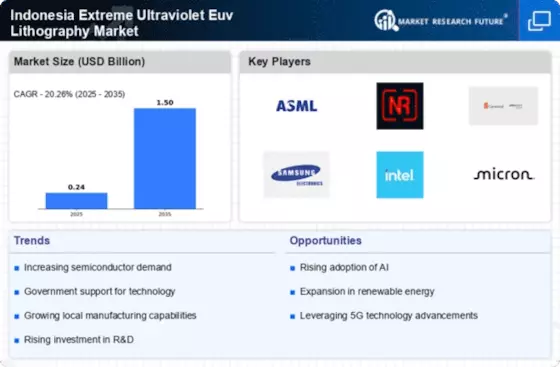
Indonesia Extreme Ultraviolet Lithography Market Infographic
Purchase Options

Indonesia Extreme Ultraviolet Lithography Market Summary

As per MRFR analysis, the Indonesia Extreme Ultraviolet Euv Lithography Market is projected to grow from USD 0.197 Billion in 2024 to USD 1.5 Billion by 2035, exhibiting a compound annual growth rate (CAGR) of 20.26% during the forecast period (2025 - 2035).

Key Market Trends & Highlights

The Indonesia Extreme Ultraviolet Euv Lithography Market is poised for substantial growth driven by technological advancements and government support.

  • The semiconductor manufacturing segment remains the largest contributor to the market, reflecting robust demand for advanced semiconductors.
  • Microelectronics fabrication is identified as the fastest-growing segment, indicating a shift towards more complex manufacturing processes.
  • In the consumer electronics sector, the market continues to thrive, driven by increasing consumer demand for innovative devices.
  • Key market drivers include government initiatives and support, alongside rising demand for advanced semiconductors, which are likely to propel market expansion.

Market Size & Forecast

2024 Market Size 0.197 (USD Billion)
2035 Market Size 1.5 (USD Billion)
CAGR (2025 - 2035) 20.26%

Major Players

ASML (NL), Nikon (JP), Canon (JP), Samsung Electronics (KR), Intel (US), Micron Technology (US), Taiwan Semiconductor Manufacturing Company (TW), GlobalFoundries (US)

Our Impact
Enabled $4.3B Revenue Impact for Fortune 500 and Leading Multinationals
Partnering with 2000+ Global Organizations Each Year
30K+ Citations by Top-Tier Firms in the Industry

Indonesia Extreme Ultraviolet Lithography Market Trends

The Indonesia Extreme Ultraviolet Euv Lithography Market is currently experiencing a notable evolution, driven by the increasing demand for advanced semiconductor manufacturing technologies. As the nation aims to enhance its position in the global electronics supply chain, investments in cutting-edge lithography techniques are becoming more prevalent. This shift is largely influenced by the growing need for smaller, more efficient chips that can support emerging technologies such as artificial intelligence and the Internet of Things. Furthermore, the Indonesian government is actively promoting initiatives to bolster the local semiconductor industry, which may further stimulate the adoption of EUV lithography in the country. In addition to governmental support, collaborations between local universities and international technology firms are fostering innovation in the Indonesia Extreme Ultraviolet Euv Lithography Market. These partnerships are likely to enhance research and development capabilities, enabling the country to produce more sophisticated semiconductor devices. As the market matures, it appears that the focus will shift towards not only increasing production capacity but also ensuring sustainability in manufacturing processes. This dual emphasis on innovation and environmental responsibility may shape the future landscape of the industry in Indonesia.

Government Initiatives and Support

The Indonesian government is actively promoting policies aimed at enhancing the local semiconductor industry. This support includes financial incentives and infrastructure development, which are likely to encourage the adoption of advanced lithography technologies, including EUV. Such initiatives may create a conducive environment for local manufacturers to invest in state-of-the-art equipment.

Collaborative Research and Development

Partnerships between Indonesian universities and international technology firms are emerging as a key trend in the Indonesia Extreme Ultraviolet Euv Lithography Market. These collaborations are expected to drive innovation and improve the country's capabilities in semiconductor manufacturing, potentially leading to the development of more advanced lithography techniques.

Focus on Sustainability

As the Indonesia Extreme Ultraviolet Euv Lithography Market evolves, there is a growing emphasis on sustainable manufacturing practices. Companies are likely to explore eco-friendly materials and processes, aligning with global trends towards environmental responsibility. This focus on sustainability may influence investment decisions and operational strategies within the market.

Indonesia Extreme Ultraviolet Lithography Market Drivers

Focus on Sustainability

Sustainability is emerging as a key driver in the Indonesia Extreme Ultraviolet Euv Lithography Market. As global awareness of environmental issues increases, semiconductor manufacturers in Indonesia are likely to adopt more sustainable practices in their production processes. This shift may involve the implementation of energy-efficient lithography systems and the reduction of hazardous materials used in manufacturing. The Indonesian government has also indicated a commitment to promoting green technologies, which could further incentivize companies to invest in sustainable EUV lithography solutions. By aligning with global sustainability trends, the Indonesia Extreme Ultraviolet Euv Lithography Market may attract investment and enhance its reputation on the international stage.

Government Initiatives and Support

The Indonesian government has been actively promoting the development of advanced manufacturing technologies, including the Indonesia Extreme Ultraviolet Euv Lithography Market. This support is evident through various initiatives aimed at enhancing the semiconductor ecosystem within the country. For instance, the government has allocated substantial funding to research institutions and universities to foster innovation in lithography technologies. Additionally, policies that encourage foreign direct investment in semiconductor manufacturing are likely to bolster the local market. As a result, the Indonesia Extreme Ultraviolet Euv Lithography Market is expected to benefit from increased governmental backing, which may lead to a more robust infrastructure and a skilled workforce, ultimately enhancing the competitiveness of local manufacturers.

Collaborative Research and Development

Collaboration between academia, industry, and government entities is becoming increasingly vital for the growth of the Indonesia Extreme Ultraviolet Euv Lithography Market. Joint research initiatives are being established to address the technical challenges associated with EUV lithography. For example, partnerships between local universities and international semiconductor firms could facilitate knowledge transfer and technology sharing. This collaborative approach may lead to the development of innovative solutions tailored to the specific needs of the Indonesian market. Furthermore, the establishment of research centers dedicated to EUV technology could enhance the capabilities of local firms, positioning them favorably within the global semiconductor supply chain.

Rising Demand for Advanced Semiconductors

The demand for advanced semiconductors in Indonesia is on the rise, driven by the increasing adoption of digital technologies across various sectors. The Indonesia Extreme Ultraviolet Euv Lithography Market is poised to benefit from this trend, as EUV lithography is essential for producing smaller, more powerful chips. Industries such as telecommunications, automotive, and consumer electronics are expected to drive this demand, with projections indicating a compound annual growth rate (CAGR) of over 10% in the semiconductor sector. As local manufacturers ramp up production to meet this demand, the Indonesia Extreme Ultraviolet Euv Lithography Market is likely to experience significant growth, attracting investments and fostering innovation.

Technological Advancements in Lithography

Technological advancements in lithography are playing a crucial role in shaping the Indonesia Extreme Ultraviolet Euv Lithography Market. Innovations in EUV technology, such as improved light sources and mask designs, are enabling manufacturers to produce chips with higher precision and efficiency. These advancements are essential for meeting the increasing demands for smaller and more complex semiconductor devices. As Indonesian companies invest in upgrading their lithography capabilities, they may enhance their competitiveness in the global market. Furthermore, the integration of automation and artificial intelligence in lithography processes could streamline operations, reduce costs, and improve yield rates, thereby benefiting the overall Indonesia Extreme Ultraviolet Euv Lithography Market.


Market Segment Insights

By Application: Semiconductor Manufacturing (Largest) vs. Microelectronics Fabrication (Fastest-Growing)

In the Indonesia Extreme Ultraviolet (EUV) Lithography Market, Semiconductor Manufacturing dominates as the largest application segment, reflecting its critical role in the production of advanced microchips. This sector's extensive reliance on EUV lithography technology drives capacity expansion and innovation, positioning it as the backbone of Indonesia's electronic ecosystem. Conversely, Microelectronics Fabrication has emerged as the fastest-growing segment due to the increasing demand for smaller, more efficient electronic components, fueled by advancements in mobile and computing technologies. The growth in Microelectronics Fabrication is propelled by surging investments in research and development, leading to innovative products and enhancements in existing technologies. As consumer electronics demand rises, the market is witnessing a shift towards more compact and powerful devices, thereby intensifying the need for cutting-edge lithography solutions. This trend, coupled with supportive government initiatives to elevate Indonesia's semiconductor sector, is expected to sustain the upward trajectory of this segment in the foreseeable future.

Semiconductor Manufacturing (Dominant) vs. Photonic Devices (Emerging)

Semiconductor Manufacturing holds a dominant position in the Indonesia EUV Lithography Market, primarily due to its foundational role in enabling the production of integrated circuits that power a wide array of consumer and industrial electronics. The sector benefits from established infrastructure and significant investments, ensuring robust production capabilities. In contrast, Photonic Devices are an emerging segment demonstrating strong potential, driven by increasing applications in telecommunications, imaging, and sensing technologies. As industries aim for greater efficiency and data transmission capabilities, photonic innovation becomes crucial. Companies focusing on integrating EUV lithography in the manufacturing of photonics are likely to contribute to the technological advancements needed to meet future demands, thus enhancing their competitive edge.

By End Use: Consumer Electronics (Largest) vs. Telecommunications (Fastest-Growing)

In the Indonesia Extreme Ultraviolet Euv Lithography Market, the Consumer Electronics sector holds the largest share, driven by the rising demand for advanced semiconductor technologies essential for products like smartphones, tablets, and smart appliances. This segment’s dominance is underpinned by constant innovations in consumer electronics and the increasing integration of electronics in every aspect of daily life, leading to higher demand for sophisticated manufacturing processes. Conversely, the Telecommunications segment is emerging as the fastest-growing sector within the market. With the surge in 5G technology and the demand for high-speed data transmission, the need for advanced lithography processes for chip production in telecommunications is propelling this segment forward. The ongoing digitalization and the expanding mobile user base in Indonesia are significant drivers for this growth, indicating a vibrant future for telecommunications in this market.

Consumer Electronics (Dominant) vs. Telecommunications (Emerging)

The Consumer Electronics segment is characterized by its extensive application of Extreme Ultraviolet Euv Lithography in the production of high-performance chips that power a multitude of devices. This segment benefits from a well-established infrastructure and a strong consumer base that consistently seeks cutting-edge technology. Companies operating in this sector are increasingly investing in research and development to innovate and enhance product offerings. On the other hand, the Telecommunications segment is marked by its rapid evolution, primarily influenced by the advent of 5G technology, where the demand for Euv lithography is surging due to the necessity for advanced semiconductor devices that facilitate faster and more efficient communication networks. The competitive landscape in telecommunications is fierce, as companies strive to implement new technologies that complement the growing need for higher data bandwidth and improved connectivity.

By Technology: Optical Lithography (Largest) vs. Maskless Lithography (Fastest-Growing)

In the Indonesia Extreme Ultraviolet (EUV) Lithography Market, Optical Lithography currently occupies the largest share, given its established technology and widespread adoption across various semiconductor applications. This segment is driven by its high precision and reliability, making it a preferred choice for manufacturers. Maskless Lithography, while newer and less prevalent at present, is gaining significant traction due to its flexibility and cost-effectiveness, especially for low-volume production runs and rapid prototyping.

Technology: Optical Lithography (Dominant) vs. Maskless Lithography (Emerging)

Optical Lithography is recognized as the dominant technology in the EUV Lithography market in Indonesia, catering to the needs of mass production in semiconductor manufacturing. Its ability to deliver high-resolution patterns while maintaining throughput has solidified its market position. In contrast, Maskless Lithography represents an emerging trend, poised for growth as it eliminates the need for photomasks, thereby reducing production costs and time. This technology is particularly appealing for R&D and specialized applications, allowing companies to adapt quickly to market changes and customer demands, ultimately enhancing innovation in the semiconductor landscape.

By Component Type: Light Source (Largest) vs. Photoresist (Fastest-Growing)

In the Indonesia Extreme Ultraviolet (EUV) lithography market, the component type segment demonstrates a diversified landscape. The light source dominates the market, capturing the largest share, owing to its critical role in enabling the high-resolution patterning necessary for advanced semiconductor fabrication. Following closely behind, the optical system and mask components also hold substantial shares, contributing effectively to the overall market dynamics. Photoresist, though currently a smaller segment, is experiencing rapid growth, driven by the increasing demand for high-performance materials in the semiconductor manufacturing process. The growth trends in this segment are indicative of a broader shift towards sophisticated manufacturing techniques within Indonesia's semiconductor industry. The rising investments in research and development are catalyzing advancements in photoresist technologies, making them the fastest-growing component type in the market. Additionally, the need for enhanced resolution and performance in lithography is propelling the demand for robust optical systems and innovative light sources, ensuring sustained growth in these areas. As semiconductor manufacturers in Indonesia strive for greater efficiency and precision, the component type segment is poised for significant evolution over the coming years.

Light Source (Dominant) vs. Photoresist (Emerging)

Within the Indonesia EUV lithography market, the light source stands as the dominant component, crucial for delivering the high-intensity radiation required for effective lithography processes. Its significance is underpinned by advancements in laser technology that enhance performance and reliability, making it indispensable for semiconductor production. Conversely, photoresist is regarded as an emerging component, witnessing rapid innovations and adaptations to meet increasingly stringent performance criteria. Its growth is fueled by a surge in demand for next-generation semiconductors which require more sophisticated materials capable of yielding finer patterns with greater fidelity. This dynamic is setting the stage for a critical evolution in the sector, as both components strive to align with the future demands of high-tech manufacturing.

Get more detailed insights about Indonesia Extreme Ultraviolet Lithography Market

Key Players and Competitive Insights

The Extreme Ultraviolet Euv Lithography Market in Indonesia is characterized by a dynamic competitive landscape, driven by rapid technological advancements and increasing demand for high-performance semiconductor manufacturing. Key players such as ASML (NL), Nikon (JP), and Samsung Electronics (KR) are at the forefront, each adopting distinct strategies to enhance their market positioning. ASML (NL) continues to lead with its cutting-edge EUV technology, focusing on innovation and expanding its production capabilities. Meanwhile, Nikon (JP) emphasizes strategic partnerships to bolster its technological offerings, while Samsung Electronics (KR) is heavily investing in R&D to maintain its competitive edge in the semiconductor space. Collectively, these strategies contribute to a competitive environment that is increasingly focused on technological superiority and operational efficiency.

In terms of business tactics, companies are localizing manufacturing and optimizing supply chains to enhance responsiveness to market demands. The market structure appears moderately fragmented, with several key players exerting considerable influence. This fragmentation allows for a variety of competitive strategies, as companies seek to differentiate themselves through innovation and localized production capabilities.

In December 2025, ASML (NL) announced a significant expansion of its manufacturing facility in Indonesia, aimed at increasing production capacity for its EUV lithography systems. This move is strategically important as it not only enhances ASML's ability to meet growing demand but also solidifies its presence in the Southeast Asian market, potentially leading to increased market share.

In November 2025, Nikon (JP) entered into a collaborative agreement with a local Indonesian semiconductor firm to develop advanced lithography solutions tailored for regional needs. This partnership is likely to enhance Nikon's technological capabilities while fostering local expertise, thereby strengthening its competitive position in the market.

In October 2025, Samsung Electronics (KR) unveiled a new initiative focused on integrating AI into its lithography processes, aimed at improving efficiency and precision. This strategic move underscores Samsung's commitment to innovation and positions it favorably against competitors, as AI integration is becoming increasingly critical in semiconductor manufacturing.

As of January 2026, the competitive trends in the Extreme Ultraviolet Euv Lithography Market are heavily influenced by digitalization, sustainability, and the integration of AI technologies. Strategic alliances are playing a pivotal role in shaping the current landscape, enabling companies to leverage shared expertise and resources. Looking ahead, competitive differentiation is expected to evolve, with a pronounced shift from price-based competition to a focus on innovation, technological advancements, and supply chain reliability. This transition may redefine market dynamics, as companies strive to establish themselves as leaders in a rapidly changing technological environment.

Key Companies in the Indonesia Extreme Ultraviolet Lithography Market include

Industry Developments

In recent months, the Indonesia Extreme Ultraviolet (EUV) Lithography Market has witnessed significant developments. Semiconductor fabrication companies like Taiwan Semiconductor Manufacturing Company and Samsung Electronics have ramped up their investments in Indonesia, aiming to enhance local manufacturing capabilities and establish supply chain resilience.

Following trends noted in 2022, where the market's growth was fueled by increased demand for advanced chips, the ongoing investments reflect a commitment to meeting local and regional electronic market needs.

Additionally, Qualcomm and MediaTek are actively engaging in partnerships with local firms to promote Research and Development, focusing on next-generation technology in chip manufacturing, particularly in the automotive and telecommunications sectors.

In terms of mergers and acquisitions, there have been notable activities, including a reported collaboration in early 2023 between GlobalFoundries and a prominent local electronics firm aimed at sharing technologiesbolstering Indonesia's position as a competitive player in the semiconductor sector.

Efforts from companies like Canon, Nikon, and ASML continue to bolster the country’s lithography capabilities, enhancing the potential for high-end semiconductor production. Overall, these strategic moves highlight a progressive growth trajectory for the Indonesia Extreme Ultraviolet (EUV) Lithography Market, showcasing its importance in the region’s technology landscape.

Indonesia Extreme Ultraviolet (EUV)

Future Outlook

Indonesia Extreme Ultraviolet Lithography Market Future Outlook

The Indonesia Extreme Ultraviolet Euv Lithography Market is poised for growth at 20.26% CAGR from 2025 to 2035, driven by technological advancements and increasing semiconductor demand.

New opportunities lie in:

  • Establishing local manufacturing facilities for EUV components
  • Developing advanced training programs for EUV technology specialists
  • Forming strategic partnerships with semiconductor firms for joint ventures

By 2035, the market is expected to achieve substantial growth, solidifying its position in the global landscape.

Market Segmentation

Indonesia Extreme Ultraviolet Lithography Market End Use Outlook

  • Consumer Electronics
  • Telecommunications
  • Automotive
  • Aerospace

Indonesia Extreme Ultraviolet Lithography Market Technology Outlook

  • Maskless Lithography
  • Optical Lithography
  • Electron Beam Lithography
  • X-ray Lithography

Indonesia Extreme Ultraviolet Lithography Market Application Outlook

  • Semiconductor Manufacturing
  • Microelectronics Fabrication
  • Photonic Devices
  • Nanotechnology Research

Indonesia Extreme Ultraviolet Lithography Market Component Type Outlook

  • Light Source
  • Optical System
  • Photoresist
  • Mask

Report Scope

MARKET SIZE 20240.197(USD Billion)
MARKET SIZE 20250.241(USD Billion)
MARKET SIZE 20351.5(USD Billion)
COMPOUND ANNUAL GROWTH RATE (CAGR)20.26% (2024 - 2035)
REPORT COVERAGERevenue Forecast, Competitive Landscape, Growth Factors, and Trends
BASE YEAR2024
Market Forecast Period2025 - 2035
Historical Data2019 - 2024
Market Forecast UnitsUSD Billion
Key Companies ProfiledASML (NL), Nikon (JP), Canon (JP), Samsung Electronics (KR), Intel (US), Micron Technology (US), Taiwan Semiconductor Manufacturing Company (TW), GlobalFoundries (US)
Segments CoveredApplication, End Use, Technology, Component Type
Key Market OpportunitiesGrowing demand for advanced semiconductor manufacturing technologies in Indonesia presents opportunities in the Extreme Ultraviolet Euv Lithography Market.
Key Market DynamicsEmerging local semiconductor firms drive demand for Extreme Ultraviolet Lithography technology in Indonesia's evolving market.
Countries CoveredIndonesia
Leave a Comment

FAQs

What is the current valuation of the Indonesia Extreme Ultraviolet Euv Lithography Market?

As of 2024, the market valuation was 0.197 USD Billion.

What is the projected market size for the Indonesia Extreme Ultraviolet Euv Lithography Market by 2035?

The market is projected to reach 1.5 USD Billion by 2035.

What is the expected CAGR for the Indonesia Extreme Ultraviolet Euv Lithography Market during the forecast period?

The expected CAGR for the market from 2025 to 2035 is 20.26%.

Which companies are considered key players in the Indonesia Extreme Ultraviolet Euv Lithography Market?

Key players include ASML, Nikon, Canon, Samsung Electronics, Intel, Micron Technology, Taiwan Semiconductor Manufacturing Company, and GlobalFoundries.

What are the main application segments of the Indonesia Extreme Ultraviolet Euv Lithography Market?

The main application segments include Semiconductor Manufacturing, Microelectronics Fabrication, Photonic Devices, and Nanotechnology Research.

How does the Semiconductor Manufacturing segment perform in terms of valuation?

The Semiconductor Manufacturing segment was valued at 0.079 USD Billion in 2024 and is expected to grow significantly.

What are the end-use segments in the Indonesia Extreme Ultraviolet Euv Lithography Market?

End-use segments include Consumer Electronics, Telecommunications, Automotive, and Aerospace.

What is the valuation of the Consumer Electronics segment in the market?

The Consumer Electronics segment was valued at 0.05 USD Billion in 2024.

Which technology segments are present in the Indonesia Extreme Ultraviolet Euv Lithography Market?

Technology segments include Maskless Lithography, Optical Lithography, Electron Beam Lithography, and X-ray Lithography.

What components are included in the Indonesia Extreme Ultraviolet Euv Lithography Market?

Key components include Light Source, Optical System, Photoresist, and Mask.

Download Free Sample

Kindly complete the form below to receive a free sample of this Report

Compare Licence

×
Features License Type
Single User Multiuser License Enterprise User
Price $4,950 $5,950 $7,250
Maximum User Access Limit 1 User Upto 10 Users Unrestricted Access Throughout the Organization
Free Customization
Direct Access to Analyst
Deliverable Format
Platform Access
Discount on Next Purchase 10% 15% 15%
Printable Versions