×
Request Free Sample ×

Kindly complete the form below to receive a free sample of this Report

* Please use a valid business email

Leading companies partner with us for data-driven Insights

clients tt-cursor
Hero Background

India Virtual Engineering Market

ID: MRFR/ICT/63491-HCR
200 Pages
Aarti Dhapte
February 2026

India Virtual Engineering Market Size, Share and Trends Analysis Report By Software Type (Computer-Aided Designing (CAD), Computer-Aided Manufacturing (CAM), Computer-Aided Engineering (CAE), Architecture, Engineering and Construction (AEC), Electronic Design Automation (EDA)Others), By Deployment Type (On-premises, Cloud), By Organization Size (SME’s, Large Enterprises), By Application (Automation Design, Plant Design, Product Design, 3D MODELLING, Others) and By Industry Vertical (Commercial Industry Vertical, Defense Industry Vertical)- Forecast to 2035

Share:
Download PDF ×

We do not share your information with anyone. However, we may send you emails based on your report interest from time to time. You may contact us at any time to opt-out.

India Virtual Engineering Market Infographic
Purchase Options

India Virtual Engineering Market Summary

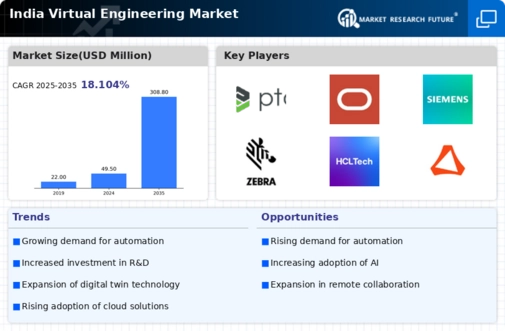
As per analysis, the India virtual engineering market is projected to grow from USD 39.61 Million in 2024 to USD 171.74 Million by 2035, exhibiting a compound annual growth rate (CAGR) of 14.27% during the forecast period (2025 - 2035).

Key Market Trends & Highlights

The India virtual engineering market is poised for substantial growth driven by technological advancements and evolving industry needs.

  • The Product Design segment remains the largest contributor to the virtual engineering market in India.
  • The Simulation segment is currently the fastest-growing area, reflecting a shift towards more complex engineering solutions.
  • In the automotive sector, demand for virtual engineering tools is robust, while the aerospace sector is experiencing rapid growth.
  • Government initiatives and the rising demand for automation are key drivers propelling the market forward.

Market Size & Forecast

2024 Market Size 39.61 (USD Million)
2035 Market Size 171.74 (USD Million)
CAGR (2025 - 2035) 14.27%

Major Players

Tata Consultancy Services (IN), Wipro (IN), Infosys (IN), HCL Technologies (IN), Tech Mahindra (IN), Larsen & Toubro (IN), Cognizant Technology Solutions (US), Accenture (IE), Siemens (DE)

Our Impact
Enabled $4.3B Revenue Impact for Fortune 500 and Leading Multinationals
Partnering with 2000+ Global Organizations Each Year
30K+ Citations by Top-Tier Firms in the Industry

India Virtual Engineering Market Trends

The India virtual engineering market is currently experiencing a transformative phase, driven by advancements in technology and increasing demand for innovative solutions across various sectors. The integration of virtual engineering practices is becoming more prevalent, as organizations seek to enhance efficiency and reduce costs. This shift is largely influenced by the growing emphasis on digitalization and automation, which are reshaping traditional engineering processes. As a result, companies are increasingly adopting virtual engineering tools to streamline operations and improve collaboration among teams. Furthermore, the rise of remote work has accelerated the need for virtual solutions, allowing engineers to collaborate seamlessly regardless of geographical constraints. In addition, the government of India is actively promoting initiatives that support the development of the india virtual engineering market. Policies aimed at fostering innovation and encouraging investment in technology are likely to bolster the growth of this sector. The focus on skill development and education in engineering disciplines is also expected to contribute positively to the market landscape. As organizations continue to embrace virtual engineering methodologies, the potential for enhanced productivity and innovation appears promising, suggesting a robust future for this market in India.

Increased Adoption of Digital Tools

Organizations in the india virtual engineering market are increasingly embracing digital tools to enhance their engineering processes. This trend reflects a broader shift towards automation and efficiency, as companies seek to optimize workflows and reduce operational costs.

Focus on Sustainability

There is a growing emphasis on sustainable practices within the india virtual engineering market. Companies are exploring virtual engineering solutions that minimize environmental impact, aligning with global sustainability goals and regulatory requirements.

Collaboration and Remote Work Solutions

The demand for collaboration tools is rising within the india virtual engineering market. As remote work becomes more common, organizations are investing in virtual platforms that facilitate teamwork and communication among engineers, regardless of location.

India Virtual Engineering Market Drivers

Rising Demand for Automation

The increasing demand for automation in various industries is a key driver for the India virtual engineering market. As companies seek to enhance efficiency and reduce operational costs, the integration of virtual engineering solutions becomes essential. Industries such as manufacturing, automotive, and aerospace are increasingly adopting automation technologies, which often rely on virtual engineering for design, testing, and optimization. According to recent data, the automation market in India is projected to grow at a CAGR of over 10% in the coming years, indicating a robust demand for virtual engineering services. This trend suggests that the india virtual engineering market will likely experience significant growth as businesses invest in automation to remain competitive.

Emergence of Advanced Technologies

The rapid emergence of advanced technologies such as artificial intelligence, machine learning, and the Internet of Things (IoT) is transforming the landscape of the India virtual engineering market. These technologies enable more sophisticated simulations and analyses, allowing engineers to create more accurate models and predictions. For instance, AI-driven design tools can optimize engineering processes, leading to faster product development cycles. The integration of IoT in virtual engineering allows for real-time data collection and analysis, enhancing decision-making processes. As these technologies continue to evolve, they are expected to drive innovation within the india virtual engineering market, creating new opportunities for growth and development.

Growing Focus on Skill Development

The increasing emphasis on skill development in India is a significant driver for the India virtual engineering market. With the rise of digital technologies, there is a pressing need for a skilled workforce capable of leveraging virtual engineering tools effectively. Government initiatives, such as the Skill India Mission, aim to equip individuals with the necessary skills to thrive in the digital economy. Educational institutions are also adapting their curricula to include virtual engineering concepts, ensuring that graduates are well-prepared for the job market. This focus on skill development is likely to enhance the talent pool available to the india virtual engineering market, fostering innovation and competitiveness.

Government Initiatives and Policies

The Indian government has been actively promoting the adoption of digital technologies across various sectors, which significantly impacts the India virtual engineering market. Initiatives such as the Digital India program aim to enhance the country's digital infrastructure, thereby facilitating the growth of virtual engineering solutions. The government has also introduced policies that encourage innovation and investment in technology, which could lead to increased funding for virtual engineering projects. For instance, the Make in India initiative aims to boost manufacturing capabilities, which may require advanced virtual engineering tools for design and simulation. As a result, the india virtual engineering market is likely to benefit from these supportive policies, fostering an environment conducive to growth and development.

Expansion of the Manufacturing Sector

The expansion of the manufacturing sector in India is a crucial driver for the India virtual engineering market. As the country aims to become a global manufacturing hub, there is an increasing need for advanced engineering solutions to streamline production processes. The government's initiatives, such as the Production Linked Incentive (PLI) scheme, are designed to boost manufacturing capabilities across various sectors, including electronics, textiles, and automotive. This growth in manufacturing is expected to drive demand for virtual engineering services, as companies seek to optimize their design and production processes. Consequently, the india virtual engineering market is poised for growth as manufacturers increasingly adopt virtual engineering tools to enhance efficiency and reduce costs.


Market Segment Insights

By Application: Product Design (Largest) vs. Simulation (Fastest-Growing)

In the India virtual engineering market, the application segment is diverse, comprising product design, simulation, prototyping, testing, and manufacturing. Product design holds the largest market share due to the rising demand for innovative design solutions across various industries like automotive, aerospace, and consumer goods. Meanwhile, simulation is capturing increasing attention, leveraging advanced computing capabilities to predict performance outcomes, thus marking it as the fastest-growing area within the segment.

Product Design (Dominant) vs. Simulation (Emerging)

Product design has established itself as the dominant application in the India virtual engineering market, driven by a growing emphasis on customization and efficiency in product development. Organizations are increasingly prioritizing targeted design processes to reduce time-to-market, which enhances competitiveness. On the other hand, simulation is making its mark as an emerging application, with companies adopting high-fidelity simulation tools to test complex systems virtually. This emerging trend is propelled by the need for accurate predictive analytics to inform decision-making, enabling quicker iterations and reduced risk in design processes.

By End Use: Automotive (Largest) vs. Aerospace (Fastest-Growing)

In the India virtual engineering market, the end-use segments are primarily divided among automotive, aerospace, consumer electronics, industrial equipment, and healthcare. The automotive sector holds the largest share due to the increasing adoption of advanced technologies to enhance vehicle design and manufacturing processes. This leads the segment in market dominance, driven by the need for innovation and efficiency in production methodologies. Conversely, the aerospace segment is emerging as the fastest-growing area within the market, driven by rising demand for innovative solutions to cater to complex design challenges and regulatory requirements. The rapid advancements in simulation and modeling tools are encouraging growth in this sector, contributing to its notable performance as a key driver in virtual engineering.

Automotive: Dominant vs. Aerospace: Emerging

The automotive segment is characterized by its substantial investments in virtual engineering technologies aimed at enhancing vehicle design, safety, and performance. As the segment continues to innovate, manufacturers leverage tools such as computer-aided design (CAD) and virtual prototyping to streamline workflows, reduce costs, and improve product quality. On the other hand, the aerospace segment is emerging as a significant player, spurred by an increasing focus on efficiency, sustainability, and compliance with stringent safety norms. Aerospace industries utilize virtual engineering for predictive maintenance, design validation, and operational optimization, positioning themselves as leaders in innovation and technology integration. Together, these segments represent a dynamic interaction between established dominance and emerging opportunities in the Indian virtual engineering landscape.

By Technology: Computer-Aided Design (Largest) vs. Virtual Reality (Fastest-Growing)

In the India virtual engineering market, Computer-Aided Design (CAD) holds the largest market share, being the backbone of design processes across various industries. Following CAD, Finite Element Analysis (FEA) and Computational Fluid Dynamics (CFD) are also significant, driving innovation in product development. Virtual Reality (VR) and Augmented Reality (AR) are emerging technologies gaining traction, though currently with smaller shares, they show immense potential due to their increasing adoption in sectors like education and training. The growth trends in this segment are driven by technological advancements and increased demand for innovative design solutions. CAD remains dominant due to its extensive application in engineering and architecture, while VR and AR are experiencing accelerated growth as industries seek immersive experiences for training and product visualization. The shift towards remote collaboration tools in engineering is further propelling the adoption of these technologies, indicating a robust future for the India virtual engineering market.

Technology: Computer-Aided Design (Dominant) vs. Virtual Reality (Emerging)

Computer-Aided Design (CAD) is the dominant technology in the India virtual engineering market, providing essential tools for drafting, modeling, and visualization across various sectors. Its extensive usage in architecture, manufacturing, and engineering allows for precise design and efficient project management. On the other hand, Virtual Reality (VR) is an emerging technology that offers immersive experiences, significantly transforming how products are visualized and designed. While CAD focuses on traditional design methodologies, VR introduces interactive simulations that enhance understanding and engagement. The growing interest in VR for purposes like simulations and virtual prototyping indicates its significant potential. As industries increasingly adopt VR solutions, the contrasting dynamics between CAD's established role and VR's innovative approach shape the market landscape.

By Service Type: Consulting (Largest) vs. Training (Fastest-Growing)

In the India virtual engineering market, the service type segment showcases a diverse distribution among various service offerings. Consulting emerges as the largest segment, capturing significant attention from enterprises seeking expert guidance in integrating virtual engineering practices. Training, on the other hand, is seeing robust demand as companies prioritize skill development to keep pace with technological advancements. The increasing complexity of engineering tasks drives both segments to explore innovative solutions to meet diverse client needs. Growth trends in the service type segment are compelling, with training services witnessing the fastest expansion. Organizations are focusing on upskilling their workforce to enhance efficiency and productivity within engineering processes. The rise of digital transformation initiatives further propels the demand for consulting services, as businesses look to harness the potential of virtual engineering technologies effectively.

Consulting (Dominant) vs. Support (Emerging)

Consulting services represent the dominant force within the India virtual engineering market, providing essential insights and strategic direction for organizations venturing into virtual engineering. These services typically encompass a broad range of expertise, from process optimization to technology integration, making them invaluable for businesses aiming to stay competitive. As the market evolves, support services are emerging as significant complements, offering ongoing assistance and maintenance for virtual engineering tools and processes. This dual approach enhances operational efficiency and sustains performance, ensuring that businesses can adapt to new challenges while harnessing the full potential of their technological investments.

Get more detailed insights about India Virtual Engineering Market

Key Players and Competitive Insights

The competitive dynamics within the virtual engineering market in India are characterized by a blend of innovation, strategic partnerships, and a focus on digital transformation. Key players such as Tata Consultancy Services (India), Infosys (India), and HCL Technologies (India) are at the forefront, leveraging their extensive expertise in engineering services to enhance operational efficiencies and drive growth. These companies are increasingly investing in advanced technologies, including AI and machine learning, to optimize their service offerings and meet the evolving demands of clients across various sectors. Their collective strategies not only foster a competitive environment but also contribute to the overall growth trajectory of the market.

In terms of business tactics, companies are localizing their operations and optimizing supply chains to enhance responsiveness and reduce costs. The market structure appears moderately fragmented, with several players vying for market share. However, the influence of major companies is substantial, as they set benchmarks for quality and innovation, thereby shaping the competitive landscape. The interplay between established firms and emerging players creates a dynamic environment that encourages continuous improvement and adaptation.

In December 2025, Tata Consultancy Services (India) announced a strategic partnership with a leading automotive manufacturer to develop next-generation electric vehicle (EV) technologies. This collaboration is poised to enhance TCS's capabilities in the automotive sector, aligning with global trends towards sustainability and innovation. The partnership underscores TCS's commitment to leveraging its engineering expertise to drive advancements in the EV market, which is expected to grow significantly in the coming years.

In November 2025, Infosys (India) launched a new suite of digital engineering services aimed at enhancing product development cycles for its clients. This initiative reflects Infosys's focus on integrating digital technologies into traditional engineering processes, thereby improving efficiency and reducing time-to-market. The introduction of these services is likely to strengthen Infosys's position in the competitive landscape, as companies increasingly seek to adopt digital solutions to remain competitive.

In October 2025, HCL Technologies (India) expanded its engineering services portfolio by acquiring a niche player specializing in IoT solutions. This acquisition is strategically significant as it allows HCL to enhance its offerings in the rapidly growing IoT market, which is becoming increasingly integral to virtual engineering. By integrating IoT capabilities, HCL is well-positioned to provide comprehensive solutions that meet the complex needs of modern engineering projects.

As of January 2026, the competitive trends in the virtual engineering market are heavily influenced by digitalization, sustainability, and the integration of AI technologies. Strategic alliances are becoming increasingly vital, as companies recognize the need to collaborate to enhance their service offerings and market reach. The shift from price-based competition to a focus on innovation, technology, and supply chain reliability is evident, suggesting that future competitive differentiation will hinge on the ability to deliver cutting-edge solutions that address the challenges of a rapidly evolving market.

Key Companies in the India Virtual Engineering Market include

Industry Developments

Volvo Cars designated Tata Technologies as a strategic supplier in June 2025. This collaboration concentrates on embedded software, product lifecycle management (PLM) solutions, vehicle system and component engineering, and product engineering. 

The partnership is designed to improve Volvo Cars' global engineering capabilities by leveraging Tata Technologies' scalable delivery models and extensive domain expertise.HCL Technologies announced in July 2023 that it had acquired a 100% equity stake in ASAP Group, a German-based provider of automotive engineering services. This acquisition expands HCL Technologies' capabilities in the automotive engineering sector. 

Siemens declared its intention to acquire Altair Engineering for $10.6 billion in October 2024. By integrating Altair's simulation software with Siemens's hardware offerings, this acquisition is intended to strengthen Siemens' position in the swiftly expanding industrial software market, thereby improving digital and real-world product projections.

Future Outlook

India Virtual Engineering Market Future Outlook

The India virtual engineering market is poised for growth at 14.27% CAGR from 2025 to 2035, driven by technological advancements, increased demand for automation, and enhanced collaboration tools.

New opportunities lie in:

  • Development of AI-driven simulation software for real-time engineering analysis.
  • Expansion of virtual prototyping services for rapid product development.
  • Integration of IoT solutions in engineering processes for improved efficiency.

By 2035, the market is expected to achieve substantial growth, reflecting its strategic importance in engineering.

Market Segmentation

India Virtual Engineering Market End Use Outlook

  • Automotive
  • Aerospace
  • Consumer Electronics
  • Industrial Equipment
  • Healthcare

India Virtual Engineering Market Technology Outlook

  • Computer-Aided Design
  • Finite Element Analysis
  • Computational Fluid Dynamics
  • Virtual Reality
  • Augmented Reality

India Virtual Engineering Market Application Outlook

  • Product Design
  • Simulation
  • Prototyping
  • Testing
  • Manufacturing

India Virtual Engineering Market Service Type Outlook

  • Consulting
  • Training
  • Support
  • Maintenance
  • Customization

Report Scope

MARKET SIZE 202439.61(USD Million)
MARKET SIZE 202545.17(USD Million)
MARKET SIZE 2035171.74(USD Million)
COMPOUND ANNUAL GROWTH RATE (CAGR)14.27% (2024 - 2035)
REPORT COVERAGERevenue Forecast, Competitive Landscape, Growth Factors, and Trends
BASE YEAR2024
Market Forecast Period2025 - 2035
Historical Data2019 - 2024
Market Forecast UnitsUSD Million
Key Companies ProfiledTata Consultancy Services (IN), Wipro (IN), Infosys (IN), HCL Technologies (IN), Tech Mahindra (IN), Larsen & Toubro (IN), Cognizant Technology Solutions (US), Accenture (IE), Siemens (DE)
Segments CoveredApplication, End Use, Technology, Service Type
Key Market OpportunitiesGrowing demand for advanced simulation tools in manufacturing enhances the india virtual engineering market potential.
Key Market DynamicsRising demand for digital twin technology drives innovation in India's virtual engineering sector.
Countries CoveredIndia
Leave a Comment

FAQs

What is the current valuation of the India virtual engineering market?

As of 2024, the India virtual engineering market was valued at 39.61 USD Million.

What is the projected market size for the India virtual engineering market by 2035?

The market is projected to reach a valuation of 171.74 USD Million by 2035.

What is the expected CAGR for the India virtual engineering market during the forecast period?

The expected CAGR for the India virtual engineering market from 2025 to 2035 is 14.27%.

Which companies are considered key players in the India virtual engineering market?

Key players include Tata Consultancy Services, Wipro, Infosys, HCL Technologies, and Tech Mahindra.

What are the main application segments in the India virtual engineering market?

The main application segments include Product Design, Simulation, Prototyping, Testing, and Manufacturing.

How does the automotive sector contribute to the India virtual engineering market?

In 2024, the automotive sector was valued at 8.0 USD Million and is expected to grow significantly by 2035.

What technologies are driving the India virtual engineering market?

Key technologies include Computer-Aided Design, Finite Element Analysis, and Virtual Reality.

What services are offered within the India virtual engineering market?

Services include Consulting, Training, Support, Maintenance, and Customization.

How does the healthcare sector impact the India virtual engineering market?

The healthcare sector was valued at 8.61 USD Million in 2024 and is projected to expand by 2035.

What is the significance of the consumer electronics segment in the India virtual engineering market?

The consumer electronics segment was valued at 10.0 USD Million in 2024 and is anticipated to grow to 40.0 USD Million by 2035.

Download Free Sample

Kindly complete the form below to receive a free sample of this Report

Compare Licence

×
Features License Type
Single User Multiuser License Enterprise User
Price $4,950 $5,950 $7,250
Maximum User Access Limit 1 User Upto 10 Users Unrestricted Access Throughout the Organization
Free Customization
Direct Access to Analyst
Deliverable Format
Platform Access
Discount on Next Purchase 10% 15% 15%
Printable Versions