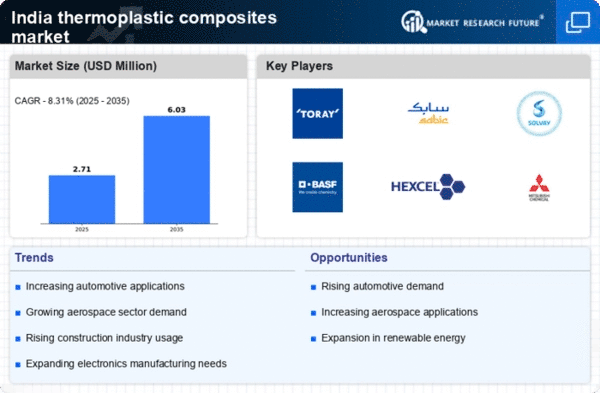
The thermoplastic composites market in India is characterized by a dynamic competitive landscape, driven by increasing demand across various sectors such as automotive, aerospace, and construction. Key players are actively engaging in strategies that emphasize innovation, sustainability, and regional expansion. Companies like Toray Industries (Japan) and SABIC (Saudi Arabia) are focusing on enhancing their product portfolios through advanced materials technology, while BASF (Germany) is leveraging its extensive research capabilities to develop eco-friendly composites. These strategic initiatives collectively foster a competitive environment that is increasingly oriented towards meeting the evolving needs of end-users.In terms of business tactics, localizing manufacturing and optimizing supply chains are pivotal for companies operating in this market. The competitive structure appears moderately fragmented, with several players vying for market share. However, the influence of major companies is substantial, as they set benchmarks for quality and innovation. This competitive dynamic encourages smaller firms to adopt similar strategies, thereby enhancing overall market competitiveness.
In October Toray Industries (Japan) announced the launch of a new line of high-performance thermoplastic composites aimed at the automotive sector. This strategic move is significant as it aligns with the growing trend towards lightweight materials that enhance fuel efficiency and reduce emissions. By focusing on the automotive industry, Toray positions itself to capitalize on the increasing demand for sustainable solutions in vehicle manufacturing.
In September SABIC (Saudi Arabia) expanded its production capacity for thermoplastic composites in India, reflecting its commitment to meeting local demand. This expansion is crucial as it not only strengthens SABIC's market presence but also enhances its ability to provide tailored solutions to regional customers. Such capacity increases are indicative of a broader trend where companies are localizing operations to better serve their markets.
In August BASF (Germany) entered into a strategic partnership with a leading Indian automotive manufacturer to co-develop innovative thermoplastic composite materials. This collaboration is particularly noteworthy as it underscores the importance of partnerships in driving technological advancements and meeting specific industry needs. By aligning with local manufacturers, BASF enhances its competitive edge and fosters innovation in product development.
As of November current trends in the thermoplastic composites market are increasingly defined by digitalization, sustainability, and the integration of AI technologies. Strategic alliances are becoming more prevalent, as companies recognize the value of collaboration in enhancing their competitive positioning. Looking ahead, it is likely that competitive differentiation will evolve, shifting from traditional price-based competition to a focus on innovation, technological advancements, and supply chain reliability. This transition suggests that companies that prioritize these aspects will be better positioned to thrive in an increasingly competitive landscape.