×
Request Free Sample ×

Kindly complete the form below to receive a free sample of this Report

* Please use a valid business email

Leading companies partner with us for data-driven Insights

clients tt-cursor
Hero Background

India Telerehabilitation Market

ID: MRFR/HC/50190-HCR
200 Pages
Rahul Gotadki
February 2026

India Telerehabilitation Market Research Report: Size, Share, Trend Analysis By Component (Hardware, Software), By Services (Clinical Assessment, Clinical Therapy), By Therapy (Physical Therapy, Occupational Therapy, Others) and By Applications (Cardiovascular, Orthopedic, Neurology, Pediatric, Others) - Growth Outlook & Industry Forecast 2025 To 2035

Share:
Download PDF ×

We do not share your information with anyone. However, we may send you emails based on your report interest from time to time. You may contact us at any time to opt-out.

India Telerehabilitation Market Infographic
Purchase Options

India Telerehabilitation Market Summary

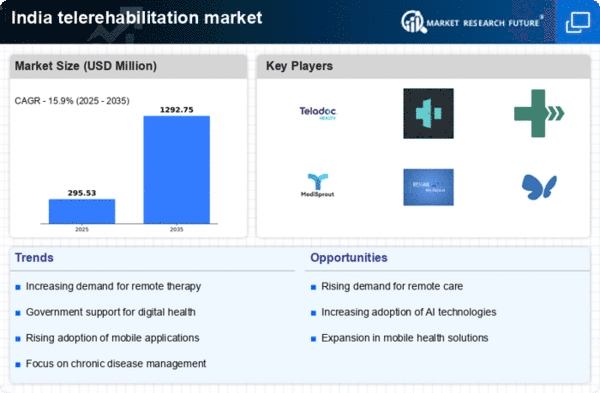
As per Market Research Future analysis, the India Telerehabilitation Market size was estimated at 254.99 USD Million in 2024. The Telerehabilitation market is projected to grow from 295.53 USD Million in 2025 to 1292.75 USD Million by 2035, exhibiting a compound annual growth rate (CAGR) of 15% during the forecast period 2025 - 2035

Key Market Trends & Highlights

The India telerehabilitation market is experiencing robust growth driven by technological advancements and increasing demand for accessible healthcare services.

  • The market is witnessing increased adoption of digital health technologies, enhancing patient engagement and outcomes.
  • Personalized rehabilitation programs are becoming a focal point, catering to individual patient needs and preferences.
  • Integration of telehealth into traditional healthcare systems is facilitating seamless service delivery and improving access.
  • Key market drivers include rising demand for accessible healthcare and government initiatives supporting telehealth.

Market Size & Forecast

2024 Market Size 254.99 (USD Million)
2035 Market Size 1292.75 (USD Million)
CAGR (2025 - 2035) 15.9%

Major Players

Teladoc Health (US), Doxy.me (US), Physitrack (GB), MediSprout (US), Rehab My Patient (GB), SimplePractice (US), Kareo (US), Hinge Health (US)

Our Impact
Enabled $4.3B Revenue Impact for Fortune 500 and Leading Multinationals
Partnering with 2000+ Global Organizations Each Year
30K+ Citations by Top-Tier Firms in the Industry

India Telerehabilitation Market Trends

The India Telerehabilitation Market is experiencing notable growth, driven by advancements in technology and increasing demand for remote healthcare services. This sector encompasses a range of therapeutic services delivered through digital platforms, allowing patients to receive care from the comfort of their homes. The integration of telecommunication technologies into rehabilitation practices appears to enhance accessibility, particularly for individuals in rural or underserved areas. Furthermore, the ongoing development of user-friendly applications and devices suggests a shift towards more personalized and effective rehabilitation experiences. In addition, the telerehabilitation market is likely to benefit from supportive government policies aimed at promoting digital health initiatives. These policies may include funding for telehealth infrastructure and training programs for healthcare professionals. As awareness of the benefits of telerehabilitation continues to grow, it seems that both patients and providers are increasingly embracing this innovative approach to healthcare. The potential for improved patient outcomes and reduced healthcare costs further underscores the relevance of this market in the evolving landscape of healthcare delivery.

Increased Adoption of Digital Health Technologies

The telerehabilitation market is witnessing a surge in the adoption of digital health technologies. This trend is characterized by the growing use of mobile applications and wearable devices that facilitate remote monitoring and therapy. Patients are increasingly utilizing these tools to engage in rehabilitation exercises, track their progress, and communicate with healthcare providers. This shift towards digital solutions indicates a broader acceptance of technology in healthcare, enhancing patient engagement and adherence to treatment plans.

Focus on Personalized Rehabilitation Programs

There is a noticeable trend towards the development of personalized rehabilitation programs within the telerehabilitation market. Healthcare providers are leveraging data analytics and artificial intelligence to tailor rehabilitation plans to individual patient needs. This customization not only improves the effectiveness of treatment but also fosters a more patient-centered approach. As a result, patients are likely to experience better outcomes and higher satisfaction levels, reinforcing the value of personalized care.

Integration of Telehealth into Traditional Healthcare Systems

The integration of telehealth services into traditional healthcare systems is becoming increasingly prevalent in the telerehabilitation market. This trend reflects a growing recognition of the importance of combining in-person and remote care to optimize patient outcomes. Healthcare institutions are beginning to incorporate telerehabilitation services into their existing frameworks, allowing for a more seamless transition between different modes of care. This integration may enhance the overall efficiency of healthcare delivery and improve access to rehabilitation services.

India Telerehabilitation Market Drivers

Rising Demand for Accessible Healthcare

The telerehabilitation market in India is experiencing a notable surge in demand for accessible healthcare solutions. With a significant portion of the population residing in rural areas, access to traditional rehabilitation services remains a challenge. Telerehabilitation offers a viable alternative, enabling patients to receive care from the comfort of their homes. According to recent data, approximately 70% of India's population lives in rural regions, where healthcare facilities are limited. This growing demand for accessible services is likely to drive the telerehabilitation market, as it provides a solution to bridge the gap between patients and healthcare providers. Furthermore, the increasing awareness of rehabilitation services among the population is expected to contribute to the market's expansion, as more individuals seek out these innovative solutions.

Integration of Health Insurance Coverage

The integration of health insurance coverage for telerehabilitation services is emerging as a crucial driver for the telerehabilitation market in India. As insurance companies begin to recognize the value of telehealth services, more policies are being developed to include coverage for telerehabilitation. This shift is likely to alleviate financial barriers for patients, making these services more accessible. Recent reports indicate that approximately 30% of health insurance plans in India now offer some form of telehealth coverage, which is expected to increase in the coming years. As patients become more aware of their insurance options, the demand for telerehabilitation services is likely to rise, further propelling the market's growth. This integration not only benefits patients but also encourages healthcare providers to adopt telerehabilitation as a standard practice.

Technological Advancements in Communication

Technological advancements in communication are playing a pivotal role in shaping the telerehabilitation market in India. The proliferation of smartphones and high-speed internet connectivity has made it easier for patients to access rehabilitation services remotely. As of November 2025, mobile internet penetration in India stands at approximately 50%, facilitating the use of telehealth applications. These advancements not only enhance the quality of care but also improve patient engagement and adherence to rehabilitation programs. The integration of artificial intelligence and machine learning into telerehabilitation platforms further personalizes the patient experience, making it more effective. Consequently, these technological innovations are likely to propel the growth of the telerehabilitation market, as they provide efficient and user-friendly solutions for both patients and healthcare providers.

Government Initiatives Supporting Telehealth

Government initiatives aimed at promoting telehealth services are significantly influencing the telerehabilitation market in India. The Indian government has recognized the potential of telehealth in improving healthcare access and has implemented various policies to support its growth. For instance, the National Digital Health Mission aims to create a digital health ecosystem that facilitates the delivery of healthcare services through technology. Such initiatives are expected to enhance the infrastructure necessary for telerehabilitation services, thereby increasing their adoption among healthcare providers. Additionally, funding and incentives for telehealth startups are likely to foster innovation within the telerehabilitation market, encouraging the development of new solutions that cater to diverse patient needs.

Growing Awareness of Rehabilitation Benefits

There is a growing awareness of the benefits of rehabilitation services among the Indian population, which is positively impacting the telerehabilitation market. As more individuals recognize the importance of rehabilitation in recovery and overall health, the demand for these services is expected to rise. Educational campaigns and outreach programs by healthcare organizations have contributed to this increased awareness, highlighting the effectiveness of telerehabilitation in managing chronic conditions and post-surgical recovery. This shift in perception is likely to drive more patients to seek telerehabilitation services, thereby expanding the market. Furthermore, as healthcare providers increasingly incorporate telerehabilitation into their offerings, the overall acceptance and utilization of these services are anticipated to grow.


Market Segment Insights

By Component: Hardware (Largest) vs. Software (Fastest-Growing)

The India telerehabilitation market showcases a diverse distribution of components, with Hardware holding the largest share. This segment is predominantly relied upon for its tangible aspects, such as devices and equipment essential for effective rehabilitation processes. On the other hand, the Software segment is gaining traction rapidly, reflecting a significant shift towards digital solutions that facilitate remote care and enhance patient engagement. Growth trends within the components segment are largely driven by technological advancements and increasing demand for remote healthcare solutions. The hardware segment's dominance is supported by the necessity for physical devices in therapy, while the software portion benefits from an expanding ecosystem of applications designed to improve remote monitoring and interaction. As consumer preferences evolve, the overall landscape indicates a promising trajectory for both segments in the coming years.

Hardware (Dominant) vs. Software (Emerging)

Hardware in the India telerehabilitation market stands out as the dominant force, primarily due to its critical role in delivering effective rehabilitation solutions through various physical devices. This includes essential tools such as sensors, communication devices, and rehabilitation equipment designed for various therapies. In contrast, Software represents the emerging segment, capitalizing on the increasing trend towards digital health and personalized care. Software applications enhance the effectiveness of rehabilitation through interactive platforms and patient monitoring systems, enabling a more connected approach. As both segments evolve, Hardware is likely to maintain its stronghold while Software continues to innovate and expand, catering to the growing needs of telehealth and rehabilitation.

By Services: Clinical Assessment (Largest) vs. Clinical Therapy (Fastest-Growing)

In the India telerehabilitation market, the services segment is primarily divided between Clinical Assessment and Clinical Therapy. Clinical Assessment holds the largest share owing to its crucial role in diagnosing and evaluating patients' health conditions remotely. It facilitates healthcare professionals in capturing essential patient data which forms the backbone of effective treatment plans. On the other hand, Clinical Therapy, while smaller in market share, is gaining traction rapidly due to the increasing acceptance of virtual therapy sessions, allowing patients to receive care at home. Growth trends in this segment are heavily influenced by the rising adoption of telehealth solutions driven by technological advancements and the need for continuous care models. The pandemic has accelerated the integration of these services into everyday healthcare practices. Accessibility and convenience offered by these services have prompted healthcare providers to innovate, thus enhancing patient engagement in their rehabilitation journey. As awareness and demand increase, both Clinical Assessment and Clinical Therapy are poised for significant expansion, shaping the future landscape of healthcare delivery.

Clinical Assessment (Dominant) vs. Clinical Therapy (Emerging)

Clinical Assessment is the dominant force within the services sector of the India telerehabilitation market, characterized by its fundamental role in patient evaluation and treatment planning. This segment emphasizes the delivery of high-quality assessment tools that ensure accurate patient evaluations, which are essential for tailored therapeutic interventions. Meanwhile, Clinical Therapy is emerging as a strong competitor, driven by innovations in teletherapy solutions that allow therapists to provide effective treatment remotely. This segment is evolving to include various therapeutic modalities, appealing to a broader audience. As patient preferences shift toward more personalized and flexible care options, the synergy between these segments is crucial for enhancing overall patient outcomes and satisfaction.

By Therapy: Physical Therapy (Largest) vs. Occupational Therapy (Fastest-Growing)

In the India telerehabilitation market, the distribution of market share among different therapy segments is distinct. Physical Therapy leads the landscape, capturing the largest share due to its well-established practice and broad acceptance among patients. The robustness of physical therapy services and their critical role in rehabilitation post-injury drive their dominance. On the other hand, Occupational Therapy is experiencing rapid growth, positioning itself as the fastest-growing segment within this market. The increasing recognition of the importance of occupational therapy in aiding individuals to return to daily activities after illness or injury fuels this expansion. Advancements in telehealth technology further support and enhance the accessibility of occupational therapy services, contributing to its rapid trajectory in the market.

Physical Therapy: Dominant vs. Occupational Therapy: Emerging

Physical Therapy is characterized by its extensive applications, catering to a wide range of conditions from orthopedic to neurological issues. It has a strong foundation in both urban and rural healthcare settings, consistently supported by a network of trained professionals. In contrast, Occupational Therapy is emerging as a vital component of rehabilitative care, particularly for those needing assistance in reclaiming functional independence. It focuses on aiding patients in resuming everyday tasks. This segment is gaining traction due to the increasing awareness of holistic recovery approaches, and its integration with modern technology makes services more accessible and flexible for patients.

By Application: Cardiovascular (Largest) vs. Neurology (Fastest-Growing)

In the India telerehabilitation market, cardiovascular applications hold the largest share, dominating the sector due to the high prevalence of cardiovascular diseases. Following this, orthopedic and neurology applications also have significant market representation, reflecting the diverse needs for rehabilitation. Pediatric and other segments occupy smaller shares but contribute to the overall growth by catering to specific needs in the rehabilitation spectrum. Growth trends in the application segment are driven by advancements in technology and increased awareness regarding telehealth services. Neurology is emerging as the fastest-growing segment, propelled by the rising incidence of neurological disorders and the demand for innovative rehabilitation solutions. The continued investment in telemedicine infrastructure further supports the expansion of these applications, particularly in rural and underserved areas.

Cardiovascular (Dominant) vs. Neurology (Emerging)

The cardiovascular application in the India telerehabilitation market is characterized by its established presence, driven by a large population affected by heart-related conditions requiring consistent monitoring and rehabilitation. This segment leverages technologies such as mobile apps and virtual coaching, ensuring patient engagement and adherence. Conversely, the neurology segment is gaining traction as an emerging force, capitalizing on the growing acknowledgment of the role of telerehabilitation in managing conditions such as stroke and Parkinson's disease. This emerging sector is characterized by innovative solutions tailored for neurological disorders, with a focus on personalized rehabilitation plans and the integration of advanced monitoring technologies that enhance patient outcomes.

Get more detailed insights about India Telerehabilitation Market

Key Players and Competitive Insights

The telerehabilitation market exhibits a dynamic competitive landscape, characterized by rapid technological advancements and an increasing demand for remote healthcare solutions. Key players such as Teladoc Health (US), Doxy.me (US), and Hinge Health (US) are at the forefront, leveraging innovative strategies to enhance their service offerings. Teladoc Health (US) focuses on expanding its digital health platform through strategic partnerships, aiming to integrate comprehensive care solutions that encompass both physical and mental health. Meanwhile, Doxy.me (US) emphasizes user-friendly telehealth solutions, positioning itself as a leader in accessibility and ease of use, which is crucial in attracting a diverse patient demographic. Hinge Health (US) is particularly noted for its commitment to musculoskeletal care, utilizing data analytics to personalize rehabilitation programs, thereby enhancing patient outcomes and engagement. Collectively, these strategies contribute to a competitive environment that prioritizes innovation and patient-centric solutions.The business tactics employed by these companies reflect a nuanced understanding of market demands. For instance, localizing services to cater to regional healthcare needs and optimizing supply chains for efficiency are prevalent strategies. The market structure appears moderately fragmented, with several players vying for market share, yet the influence of major companies is substantial. This competitive structure fosters an environment where innovation is paramount, as companies strive to differentiate themselves through unique service offerings and technological advancements.

In October Teladoc Health (US) announced a strategic partnership with a leading AI firm to enhance its telehealth platform's capabilities. This collaboration aims to integrate advanced AI-driven analytics into patient care, potentially revolutionizing how healthcare providers deliver personalized rehabilitation services. The strategic importance of this move lies in its potential to improve patient outcomes through data-driven insights, thereby solidifying Teladoc's position as a market leader.

In September Doxy.me (US) launched a new feature that allows for real-time patient feedback during telehealth sessions. This initiative is designed to enhance the user experience and improve service delivery. By prioritizing patient feedback, Doxy.me (US) demonstrates a commitment to continuous improvement, which is likely to foster greater patient loyalty and satisfaction in a competitive market.

In August Hinge Health (US) expanded its offerings by introducing a new digital program specifically targeting chronic pain management. This strategic move not only broadens its service portfolio but also addresses a significant gap in the market for effective pain management solutions. The introduction of this program is indicative of Hinge Health's proactive approach to meeting evolving patient needs, thereby reinforcing its competitive edge.

As of November the telerehabilitation market is increasingly defined by trends such as digitalization, AI integration, and a focus on sustainability. Strategic alliances among key players are shaping the competitive landscape, fostering innovation and enhancing service delivery. Looking ahead, it is likely that competitive differentiation will evolve, shifting from traditional price-based competition to a focus on technological innovation, service reliability, and patient engagement. This transition underscores the importance of adaptability and forward-thinking strategies in maintaining a competitive advantage in the telerehabilitation market.

Key Companies in the India Telerehabilitation Market include

Industry Developments

The India Telerehabilitation Market has witnessed significant developments recently, with an increase in demand for digital health solutions driven by the COVID-19 pandemic. Companies like Innara Health and MediSprout have expanded their platforms to offer remote rehabilitation services to cater to patients recovering from surgeries and chronic illnesses. In November 2023, Tata Consultancy Services partnered with Qure.ai to integrate AI-driven diagnostic tools to enhance the efficiency of tele-rehabilitation services. Additionally, MediBuddy has been scaling its operational capabilities to support remote healthcare services. 

Recent funding rounds have seen substantial growth in companies like CureMetrix and HealthifyMe, enhancing their valuation and expanding their service offerings. In the past two years, Portea has made strides in integrating diverse rehabilitation therapies through its digital platform. Notably, Tricog announced a collaboration with government hospitals to implement tele-rehabilitation programs aimed at improving patient outcomes. Despite the surge in the market valuation, challenges remain, including regulatory concerns and the need for standardized practices. The emphasis on tele-rehabilitation is anticipated to shape the future landscape of healthcare delivery in India, fostering wider access to necessary rehabilitation services.

Future Outlook

India Telerehabilitation Market Future Outlook

The Telerehabilitation Market in India is projected to grow at a 15.9% CAGR from 2025 to 2035, driven by technological advancements, increasing healthcare accessibility, and rising demand for remote patient monitoring.

New opportunities lie in:

  • Development of AI-driven rehabilitation software solutions
  • Expansion of telehealth partnerships with local clinics
  • Integration of wearable technology for real-time patient monitoring

By 2035, the telerehabilitation market is expected to be robust, reflecting substantial growth and innovation.

Market Segmentation

India Telerehabilitation Market Therapy Outlook

  • Physical Therapy
  • Occupational Therapy
  • Others

India Telerehabilitation Market Services Outlook

  • Clinical Assessment
  • Clinical Therapy

India Telerehabilitation Market Component Outlook

  • Hardware
  • Software

India Telerehabilitation Market Application Outlook

  • Cardiovascular
  • Orthopedic
  • Neurology
  • Pediatric
  • Others

Report Scope

MARKET SIZE 2024 254.99(USD Million)
MARKET SIZE 2025 295.53(USD Million)
MARKET SIZE 2035 1292.75(USD Million)
COMPOUND ANNUAL GROWTH RATE (CAGR) 15.9% (2025 - 2035)
REPORT COVERAGE Revenue Forecast, Competitive Landscape, Growth Factors, and Trends
BASE YEAR 2024
Market Forecast Period 2025 - 2035
Historical Data 2019 - 2024
Market Forecast Units USD Million
Key Companies Profiled Teladoc Health (US), Doxy.me (US), Physitrack (GB), MediSprout (US), Rehab My Patient (GB), SimplePractice (US), Kareo (US), Hinge Health (US)
Segments Covered Component, Services, Therapy, Application
Key Market Opportunities Integration of advanced digital health technologies enhances accessibility in the telerehabilitation market.
Key Market Dynamics Rising demand for remote rehabilitation services drives innovation and competition in the telerehabilitation market.
Countries Covered India
Leave a Comment

FAQs

What is the projected market size of the India Telerehabilitation Market in 2024?

The India Telerehabilitation Market is expected to be valued at approximately 305.0 USD Million in 2024.

What is the expected market size of the India Telerehabilitation Market by 2035?

By 2035, the India Telerehabilitation Market is projected to reach a value of around 2140.0 USD Million.

What is the expected CAGR for the India Telerehabilitation Market from 2025 to 2035?

The expected compound annual growth rate for the India Telerehabilitation Market during this period is approximately 19.377%.

Which segment is expected to dominate the India Telerehabilitation Market by 2035?

By 2035, the hardware segment is projected to grow to about 840.0 USD Million, showing significant dominance.

What is the market value of the software component in the India Telerehabilitation Market by 2035?

The software component is expected to reach a market value of around 1300.0 USD Million by 2035.

Who are some of the key players in the India Telerehabilitation Market?

Major players in the market include Innara Health, MediSprout, Tata Consultancy Services, and Qure.ai among others.

What are the key applications driving growth in the India Telerehabilitation Market?

Key applications include remote patient monitoring, rehabilitation exercises, and teleconsultation services.

How has the current global scenario impacted the India Telerehabilitation Market?

The current global scenario has accelerated the adoption of telerehabilitation services due to the increasing need for remote healthcare solutions.

What opportunities exist for growth in the India Telerehabilitation Market?

There are significant opportunities for growth driven by technological advancements and increasing demand for remote health services.

What challenges may impact the India Telerehabilitation Market?

Challenges such as regulatory hurdles and concerns regarding data privacy may impact the market growth.

Download Free Sample

Kindly complete the form below to receive a free sample of this Report

Compare Licence

×
Features License Type
Single User Multiuser License Enterprise User
Price $4,950 $5,950 $7,250
Maximum User Access Limit 1 User Upto 10 Users Unrestricted Access Throughout the Organization
Free Customization
Direct Access to Analyst
Deliverable Format
Platform Access
Discount on Next Purchase 10% 15% 15%
Printable Versions