×
Request Free Sample ×

Kindly complete the form below to receive a free sample of this Report

* Please use a valid business email

Leading companies partner with us for data-driven Insights

clients tt-cursor
Hero Background

Italy Telerehabilitation Market

ID: MRFR/HC/50188-HCR
200 Pages
Rahul Gotadki
February 2026

Italy Telerehabilitation Market Research Report: Size, Share, Trend Analysis By Component (Hardware, Software), By Services (Clinical Assessment, Clinical Therapy), By Therapy (Physical Therapy, Occupational Therapy, Others) and By Applications (Cardiovascular, Orthopedic, Neurology, Pediatric, Others) - Growth Outlook & Industry Forecast 2025 To 2035

Share:
Download PDF ×

We do not share your information with anyone. However, we may send you emails based on your report interest from time to time. You may contact us at any time to opt-out.

Italy Telerehabilitation Market Infographic
Purchase Options

Italy Telerehabilitation Market Summary

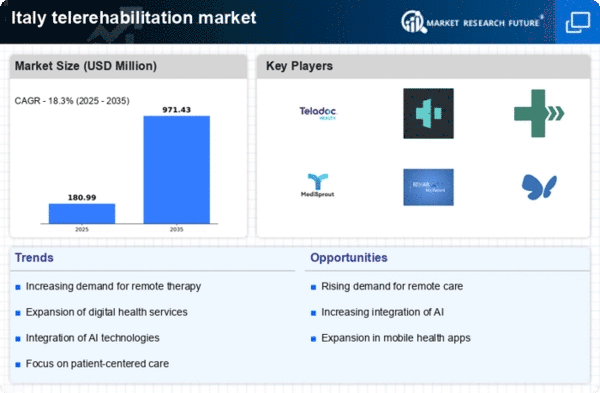
As per Market Research Future analysis, the Italy Telerehabilitation Market size was estimated at 152.99 USD Million in 2024. The Telerehabilitation market is projected to grow from 180.99 USD Million in 2025 to 971.43 USD Million by 2035, exhibiting a compound annual growth rate (CAGR) of 18% during the forecast period 2025 - 2035

Key Market Trends & Highlights

The Italy telerehabilitation market is experiencing robust growth driven by technological advancements and increasing demand for remote services.

  • The market is witnessing increased adoption of digital health technologies, enhancing accessibility and efficiency in rehabilitation services.
  • Regulatory support for telehealth services is fostering a conducive environment for the expansion of telerehabilitation solutions.
  • Patient-centric care models are gaining traction, emphasizing personalized treatment plans and improved patient engagement.
  • Key market drivers include the rising demand for remote rehabilitation services and the growing aging population with chronic conditions.

Market Size & Forecast

2024 Market Size 152.99 (USD Million)
2035 Market Size 971.43 (USD Million)
CAGR (2025 - 2035) 18.3%

Major Players

Teladoc Health (US), Doxy.me (US), Physitrack (GB), MediSprout (US), Rehab My Patient (GB), SimplePractice (US), Kareo (US), Hinge Health (US)

Our Impact
Enabled $4.3B Revenue Impact for Fortune 500 and Leading Multinationals
Partnering with 2000+ Global Organizations Each Year
30K+ Citations by Top-Tier Firms in the Industry

Italy Telerehabilitation Market Trends

The Italy Telerehabilitation Market in Italy is currently experiencing a notable transformation, driven by advancements in technology and a growing acceptance of remote healthcare solutions. This shift appears to be influenced by the increasing demand for accessible rehabilitation services, particularly for patients with mobility challenges or those residing in remote areas. The integration of telecommunication technologies into rehabilitation practices seems to enhance patient engagement and adherence to treatment plans, potentially leading to improved health outcomes. Furthermore, the Italian healthcare system is gradually adapting to these innovations, suggesting a promising future for telerehabilitation services. In addition, the regulatory environment in Italy appears to be evolving to support the expansion of telerehabilitation. Government initiatives aimed at promoting digital health solutions may facilitate the integration of these services into standard care practices. As healthcare providers and patients alike become more familiar with the benefits of remote rehabilitation, the market is likely to witness sustained growth. This trend indicates a shift towards more patient-centered care, where convenience and accessibility are prioritized, ultimately enhancing the overall healthcare experience for individuals in need of rehabilitation services.

Increased Adoption of Digital Health Technologies

The telerehabilitation market is witnessing a surge in the adoption of digital health technologies. This trend is characterized by the integration of mobile applications and wearable devices that facilitate remote monitoring and communication between healthcare providers and patients. Such technologies enable real-time feedback and personalized treatment plans, enhancing the effectiveness of rehabilitation.

Regulatory Support for Telehealth Services

There appears to be a growing regulatory framework in Italy that supports the implementation of telehealth services, including telerehabilitation. Government policies are increasingly recognizing the importance of digital health solutions, which may lead to more streamlined processes for healthcare providers to offer remote rehabilitation services.

Focus on Patient-Centric Care Models

The telerehabilitation market is shifting towards patient-centric care models, emphasizing the importance of personalized treatment and patient engagement. This trend suggests that healthcare providers are increasingly prioritizing the needs and preferences of patients, leading to more tailored rehabilitation experiences that can be delivered remotely.

Italy Telerehabilitation Market Drivers

Growing Aging Population and Chronic Conditions

Italy's aging population is a significant driver of the telerehabilitation market. As the demographic landscape shifts, the prevalence of chronic conditions such as arthritis, cardiovascular diseases, and neurological disorders is increasing. This demographic trend necessitates innovative rehabilitation solutions that can cater to the needs of older adults. It is projected that by 2030, over 25% of the Italian population will be aged 65 and above, creating a substantial demand for accessible rehabilitation services. Telerehabilitation offers a viable solution, allowing elderly patients to receive necessary care from the comfort of their homes. This growing need for tailored rehabilitation services is likely to propel the telerehabilitation market forward, as healthcare providers seek to address the unique challenges faced by this demographic.

Rising Demand for Remote Rehabilitation Services

The telerehabilitation market in Italy is experiencing a notable increase in demand for remote rehabilitation services. This trend is driven by a growing awareness of the benefits of accessing rehabilitation from home, particularly for patients with mobility issues or those living in rural areas. According to recent data, approximately 30% of patients in Italy express a preference for remote rehabilitation options, indicating a shift in patient expectations. The convenience and flexibility offered by telerehabilitation services are appealing, as they allow patients to engage in therapy without the need for travel. This rising demand is likely to propel the growth of the telerehabilitation market, as healthcare providers adapt to meet the needs of their patients and enhance service delivery.

Technological Advancements in Telehealth Solutions

Technological advancements are playing a crucial role in shaping the telerehabilitation market in Italy. Innovations in telecommunication technologies, such as high-speed internet and mobile applications, facilitate seamless communication between healthcare providers and patients. The integration of artificial intelligence and machine learning into rehabilitation platforms enhances the personalization of treatment plans, potentially improving patient outcomes. As of November 2025, it is estimated that the adoption of advanced telehealth solutions could increase the efficiency of rehabilitation services by up to 25%. This technological evolution not only streamlines the rehabilitation process but also attracts more healthcare professionals to the telerehabilitation market, thereby expanding its reach and effectiveness.

Increased Focus on Cost-Effective Healthcare Solutions

The telerehabilitation market in Italy is witnessing a shift towards cost-effective healthcare solutions. With rising healthcare costs, both patients and providers are seeking alternatives that offer quality care without the associated expenses of traditional rehabilitation settings. Telerehabilitation services can reduce costs related to transportation, facility overhead, and time off work for patients. A study indicates that implementing telerehabilitation can lower overall rehabilitation costs by approximately 20%. This financial incentive is likely to encourage more healthcare systems to invest in telerehabilitation, thereby fostering growth in the market. As stakeholders recognize the economic benefits, the telerehabilitation market is expected to expand significantly in the coming years.

Supportive Policy Framework for Telehealth Initiatives

The telerehabilitation market in Italy benefits from a supportive policy framework that encourages the adoption of telehealth initiatives. Government policies aimed at enhancing digital health infrastructure and promoting telehealth services are crucial for market growth. Recent legislative measures have been introduced to streamline the reimbursement processes for telerehabilitation services, making them more accessible to patients. As of November 2025, it is estimated that approximately 40% of healthcare providers in Italy are now offering some form of telerehabilitation, largely due to favorable policy changes. This supportive environment not only fosters innovation but also instills confidence among healthcare providers and patients alike, thereby driving the expansion of the telerehabilitation market.


Market Segment Insights

By Component: Hardware (Largest) vs. Software (Fastest-Growing)

In the Italy telerehabilitation market, the distribution of market share between hardware and software is significant, with hardware holding the largest share. This segment includes essential tools such as devices and equipment used for remote rehabilitation, catering to various patient needs. Contrastingly, the software segment, while smaller, is experiencing rapid adoption and growth. Innovations in telehealth applications and data management solutions are driving its uptake. The growth trends within this segment highlight a shift towards integrated solutions that combine both hardware and software components. Increased demand for remote patient monitoring, coupled with advancements in AI and connectivity technologies, are key drivers. These trends reflect a growing recognition of the importance of comprehensive solutions in enhancing patient care and improving healthcare outcomes.

Hardware (Dominant) vs. Software (Emerging)

The hardware segment in the Italy telerehabilitation market is characterized by a diverse range of devices, including wearable sensors, therapeutic equipment, and interactive tools that facilitate rehabilitation processes. These tools are widely adopted in clinical settings due to their proven effectiveness in enhancing patient engagement and recovery. On the other hand, the software segment represents an emerging area with robust potential, offering telehealth platforms and mobile applications that support remote therapy management. The integration of machine learning algorithms and patient data analytics within software solutions is significantly enhancing their appeal and marketability, positioning them as vital components of future telerehabilitation strategies.

By Services: Clinical Assessment (Largest) vs. Clinical Therapy (Fastest-Growing)

In the Italy telerehabilitation market, the segment values for services present a dynamic distribution. Clinical Assessment holds the largest share, driven by increasing demand for remote evaluation tools among healthcare providers. On the other hand, Clinical Therapy is demonstrating significant growth, fueled by advancements in technology that enhance virtual treatment capabilities. The shift towards telehealth solutions has further accelerated the adoption of both service types, highlighting their importance in delivering efficient care. Emerging trends indicate that Clinical Therapy is gaining traction as healthcare facilities embrace virtual rehabilitation options. Factors such as an aging population and the need for continuous treatment accessibility are contributing to this rapid growth. Additionally, the integration of artificial intelligence and machine learning in therapy solutions is enhancing patient engagement and outcomes. As a result, both Clinical Assessment and Clinical Therapy are vital in shaping the future of healthcare services in this market.

Clinical Assessment (Dominant) vs. Clinical Therapy (Emerging)

Clinical Assessment functions as the dominant service in the Italy telerehabilitation market, offering essential tools for diagnosing and monitoring patients remotely. It plays a crucial role in ensuring timely interventions and effective treatment planning. Its established market presence is supported by robust regulatory frameworks and the growing acceptance of telemedicine among patients and providers. In contrast, Clinical Therapy is an emerging service that focuses on delivering personalized rehabilitation programs through virtual platforms. This segment is rapidly evolving, characterized by enhanced interaction between therapists and patients, enabling real-time feedback and adjustments to treatment plans. Both segments are complementary, with Clinical Assessment paving the way for the successful implementation of Clinical Therapy.

By Therapy: Physical Therapy (Largest) vs. Occupational Therapy (Fastest-Growing)

In the Italy telerehabilitation market, Physical Therapy holds the largest market share, fueled by its broad acceptance among patients requiring rehabilitation after surgeries or injuries. This segment benefits from a well-established network of healthcare professionals and an increasing number of patients seeking convenient home-based therapy options. Occupational Therapy follows closely, gradually increasing its share as it addresses a diverse range of conditions that interfere with daily activities, thereby attracting a wider patient demographic. The growth trends in the Italy telerehabilitation market indicate that Occupational Therapy is emerging as the fastest-growing segment. The increasing awareness of mental health and its connection to physical rehabilitation is driving demand. Additionally, advancements in telehealth technology and the growing acceptance of remote services, especially post-pandemic, contribute to the rapid expansion of these therapy modalities, reflecting changing consumer preferences and healthcare delivery methods.

Physical Therapy (Dominant) vs. Occupational Therapy (Emerging)

Physical Therapy is the dominant force in the Italy telerehabilitation market, characterized by its extensive service offerings and a widespread network of qualified therapists. This segment is crucial for individuals recovering from injuries or surgeries, emphasizing exercises and physical interventions. In contrast, Occupational Therapy is emerging as a vital component, focusing on rehabilitation that enables individuals to engage in meaningful daily activities. This segment caters to a broader range of conditions, including mental health issues, making it versatile and increasingly relevant in today's healthcare landscape. Both segments are essential, with Physical Therapy serving as the backbone and Occupational Therapy rapidly gaining prominence.

By Application: Neurology (Largest) vs. Orthopedic (Fastest-Growing)

The Italy telerehabilitation market exhibits a diverse distribution across various application segments, with Neurology taking the lead as the largest segment. This segment benefits from a growing patient population requiring remote therapy solutions for chronic conditions such as stroke and multiple sclerosis. In contrast, the Orthopedic segment has emerged as the fastest-growing category, driven by an increasing focus on rehabilitation following surgeries and injuries. A range of healthcare providers are adopting telerehabilitation to enhance recovery processes and patient engagement. Growth trends in the Italy telerehabilitation market are primarily influenced by advancements in digital health technologies and increased consumer acceptance of remote care solutions. Telehealth adoption has accelerated due to the COVID-19 pandemic, highlighting the need for accessible rehabilitation services. Additionally, the integration of wearable devices and mobile applications is facilitating real-time monitoring and personalized care plans, further propelling the market forward as patients and clinicians alike embrace these innovative approaches to rehabilitation.

Neurology (Dominant) vs. Pediatric (Emerging)

The Neurology segment stands out as the dominant force in the Italy telerehabilitation market, catering to patients with neurological disorders that require intensive rehabilitation strategies. With a robust infrastructure supporting remote consultations and assessments, Neurology providers are leveraging innovative technologies to deliver cognitive and physical therapy. In contrast, the Pediatric segment represents an emerging category, gaining traction as healthcare providers recognize the unique rehabilitation needs of children with developmental disorders and injuries. This segment is characterized by tailored therapeutic approaches that engage young patients, ensuring effective communication and interaction. As these segments evolve, the focus is on enhancing therapy outcomes, with Neurology offering extensive experience and Pediatric services rapidly adapting to meet new challenges.

Get more detailed insights about Italy Telerehabilitation Market

Key Players and Competitive Insights

The telerehabilitation market in Italy is currently characterized by a dynamic competitive landscape, driven by technological advancements and an increasing demand for remote healthcare solutions. Key players such as Teladoc Health (US), Doxy.me (US), and Physitrack (GB) are strategically positioning themselves through innovation and partnerships. Teladoc Health (US) focuses on expanding its service offerings, while Doxy.me (US) emphasizes user-friendly platforms that enhance patient engagement. Physitrack (GB) is leveraging its digital tools to improve rehabilitation outcomes, collectively shaping a competitive environment that prioritizes accessibility and efficiency.The market structure appears moderately fragmented, with numerous players vying for market share. Key business tactics include localizing services to meet regional needs and optimizing supply chains to enhance service delivery. The collective influence of these companies fosters a competitive atmosphere where differentiation is increasingly based on technological capabilities and customer experience rather than solely on pricing.

In October Teladoc Health (US) announced a partnership with a leading Italian healthcare provider to integrate its telehealth services into the provider's existing infrastructure. This strategic move is likely to enhance Teladoc's market presence in Italy, allowing for a more seamless patient experience and potentially increasing its user base significantly. Such partnerships may also facilitate the sharing of best practices and resources, further solidifying Teladoc's competitive edge.

In September Doxy.me (US) launched a new feature aimed at improving the user experience for both patients and healthcare providers. This enhancement, which includes advanced analytics and customizable interfaces, is expected to attract more users and improve retention rates. By focusing on user-centric design, Doxy.me (US) appears to be positioning itself as a leader in the telerehabilitation space, emphasizing the importance of technology in enhancing patient care.

In August Physitrack (GB) expanded its operations in Italy by introducing a localized version of its platform, tailored to meet the specific needs of Italian healthcare professionals. This strategic localization is indicative of a broader trend where companies are recognizing the importance of cultural and regional nuances in service delivery. By adapting its offerings, Physitrack (GB) is likely to enhance its appeal to local practitioners and patients alike, thereby strengthening its market position.

As of November current trends in the telerehabilitation market include a pronounced shift towards digitalization, with an emphasis on AI integration and sustainability. Strategic alliances are increasingly shaping the competitive landscape, as companies recognize the value of collaboration in enhancing service offerings. Looking ahead, competitive differentiation is expected to evolve, with a greater focus on innovation and technology rather than price-based competition. This shift underscores the importance of reliable supply chains and advanced technological solutions in maintaining a competitive advantage.

Key Companies in the Italy Telerehabilitation Market include

Industry Developments

The Italy Telerehabilitation Market has witnessed notable developments in recent months, particularly as healthcare continues to adapt to the digital landscape. Companies such as Zebra Medical Vision and Teladoc Health are making strides by integrating advanced algorithms and telehealth technologies, facilitating remote patient monitoring and treatment. Recent statistics indicate a significant increase in the adoption of telehealth services, sparking growth in market valuation as healthcare providers aim to enhance accessibility and efficiency in treatment delivery.In June 2023, DarioHealth reported a strategic partnership with MediSprout to expand its digital health solutions across Italy, enhancing remote rehabilitation services. 

Additionally, LIVI has gained traction in the market through collaborations with various healthcare institutions to improve patient engagement and treatment adherence. The rise of Telemedicine Technologies is also noteworthy, as they expand their teletherapy offerings, meeting the demands of a growing patient population seeking remote rehabilitation options.The Italian government has shown support for digital health initiatives, aiming to ensure that 80% of healthcare facilities offer telehealth services by 2025. This policy shift is further propelling investment in the sector and improving care delivery across the country.

Future Outlook

Italy Telerehabilitation Market Future Outlook

The Telerehabilitation Market in Italy is projected to grow at an 18.3% CAGR from 2025 to 2035, driven by technological advancements, increasing demand for remote care, and a growing aging population.

New opportunities lie in:

  • Development of AI-driven rehabilitation platforms for personalized patient care.
  • Expansion of telehealth partnerships with insurance providers for broader coverage.
  • Integration of wearable technology for real-time patient monitoring and feedback.

By 2035, the telerehabilitation market is expected to be a robust sector, reflecting substantial growth and innovation.

Market Segmentation

Italy Telerehabilitation Market Therapy Outlook

  • Physical Therapy
  • Occupational Therapy
  • Others

Italy Telerehabilitation Market Services Outlook

  • Clinical Assessment
  • Clinical Therapy

Italy Telerehabilitation Market Component Outlook

  • Hardware
  • Software

Italy Telerehabilitation Market Application Outlook

  • Cardiovascular
  • Orthopedic
  • Neurology
  • Pediatric
  • Others

Report Scope

MARKET SIZE 2024 152.99(USD Million)
MARKET SIZE 2025 180.99(USD Million)
MARKET SIZE 2035 971.43(USD Million)
COMPOUND ANNUAL GROWTH RATE (CAGR) 18.3% (2025 - 2035)
REPORT COVERAGE Revenue Forecast, Competitive Landscape, Growth Factors, and Trends
BASE YEAR 2024
Market Forecast Period 2025 - 2035
Historical Data 2019 - 2024
Market Forecast Units USD Million
Key Companies Profiled Teladoc Health (US), Doxy.me (US), Physitrack (GB), MediSprout (US), Rehab My Patient (GB), SimplePractice (US), Kareo (US), Hinge Health (US)
Segments Covered Component, Services, Therapy, Application
Key Market Opportunities Integration of advanced digital platforms enhances accessibility and personalization in the telerehabilitation market.
Key Market Dynamics Rising demand for remote rehabilitation services drives innovation and competition in the telerehabilitation market.

Countries Covered Italy
Leave a Comment

FAQs

What is the expected market size of the Italy Telerehabilitation Market in 2024?

The Italy Telerehabilitation Market is expected to be valued at 183.6 million USD in 2024.

What will be the projected market size of the Italy Telerehabilitation Market by 2035?

By 2035, the Italy Telerehabilitation Market is projected to reach a value of 751.5 million USD.

What is the expected compound annual growth rate (CAGR) for the Italy Telerehabilitation Market from 2025 to 2035?

The anticipated CAGR for the Italy Telerehabilitation Market from 2025 to 2035 is 13.669%.

Which segment of the Italy Telerehabilitation Market is expected to have the highest value in 2024?

In 2024, the Software segment of the Italy Telerehabilitation Market is expected to be valued at 110.1 million USD.

What will be the value of the Hardware segment in the Italy Telerehabilitation Market by 2035?

The Hardware segment in the Italy Telerehabilitation Market is expected to reach a value of 306.0 million USD by 2035.

Who are the key players in the Italy Telerehabilitation Market?

Major players in the Italy Telerehabilitation Market include companies such as Zebra Medical Vision, Telemedicine Technologies, and Teladoc Health.

What is driving the growth of the Italy Telerehabilitation Market?

The growth of the Italy Telerehabilitation Market is driven by technological advancements and an increasing demand for accessible healthcare solutions.

What are the emerging trends in the Italy Telerehabilitation Market?

Emerging trends in the Italy Telerehabilitation Market include the integration of artificial intelligence and the expansion of remote patient monitoring services.

How does the competitive landscape look for the Italy Telerehabilitation Market?

The competitive landscape of the Italy Telerehabilitation Market is robust with various innovative providers contributing to growth.

What challenges does the Italy Telerehabilitation Market face?

Challenges faced by the Italy Telerehabilitation Market include regulatory hurdles and the need for enhanced data security in telehealth services.

Download Free Sample

Kindly complete the form below to receive a free sample of this Report

Compare Licence

×
Features License Type
Single User Multiuser License Enterprise User
Price $4,950 $5,950 $7,250
Maximum User Access Limit 1 User Upto 10 Users Unrestricted Access Throughout the Organization
Free Customization
Direct Access to Analyst
Deliverable Format
Platform Access
Discount on Next Purchase 10% 15% 15%
Printable Versions