×
Request Free Sample ×

Kindly complete the form below to receive a free sample of this Report

* Please use a valid business email

Leading companies partner with us for data-driven Insights

clients tt-cursor
Hero Background

India Self Service Technologies Market

ID: MRFR/ICT/61216-HCR
200 Pages
Aarti Dhapte
February 2026

India Self-Service Technologies Market Research Report By Machine Type (ATM, Kiosk, Beverage Vending Machine), By Application (Banking, Entertainment, Food & Beverage, Healthcare) and By Interface (Online / Internet, Telephone / IVR)-Forecast to 2035

Share:
Download PDF ×

We do not share your information with anyone. However, we may send you emails based on your report interest from time to time. You may contact us at any time to opt-out.

India Self Service Technologies Market Infographic
Purchase Options

India Self Service Technologies Market Summary

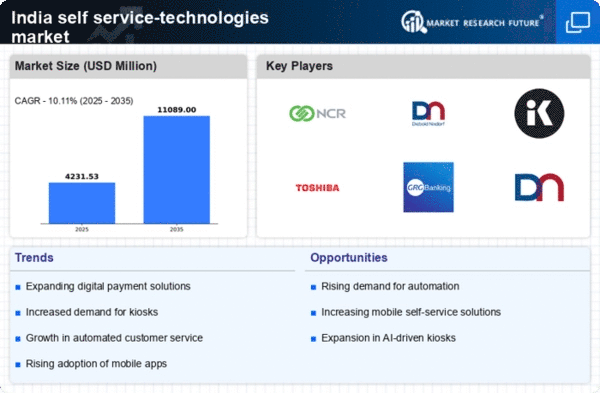
As per Market Research Future analysis, the India Self Service Technologies Market size was estimated at 3843.0 USD Million in 2024. The Self Service-technologies market is projected to grow from 4231.53 USD Million in 2025 to 11089.0 USD Million by 2035, exhibiting a compound annual growth rate (CAGR) of 10.1% during the forecast period 2025 - 2035

Key Market Trends & Highlights

The India self service-technologies market is experiencing robust growth driven by technological advancements and changing consumer preferences.

  • The adoption of kiosks is increasing as businesses seek to enhance customer engagement and streamline operations.
  • Mobile self service applications are witnessing significant growth, catering to the rising demand for convenience among consumers.
  • Integration of AI in self service solutions is becoming prevalent, enabling personalized customer experiences and operational efficiency.
  • Key market drivers include the rising demand for contactless solutions and government initiatives supporting digitalization.

Market Size & Forecast

2024 Market Size 3843.0 (USD Million)
2035 Market Size 11089.0 (USD Million)
CAGR (2025 - 2035) 10.11%

Major Players

NCR Corporation (US), Diebold Nixdorf (US), KIOSK Information Systems (US), Toshiba Global Commerce Solutions (US), GRG Banking (CN), Wincor Nixdorf (DE), SZZT Electronics (CN), Fujitsu (JP)

Our Impact
Enabled $4.3B Revenue Impact for Fortune 500 and Leading Multinationals
Partnering with 2000+ Global Organizations Each Year
30K+ Citations by Top-Tier Firms in the Industry

India Self Service Technologies Market Trends

The India Self Service Technologies Market is experiencing notable growth, driven by increasing consumer demand for convenience and efficiency. Various sectors, including retail, banking, and hospitality, are adopting these technologies to enhance customer experiences. Innovations such as kiosks, mobile applications, and automated payment systems are becoming commonplace, allowing users to complete transactions independently. This shift not only streamlines operations but also reduces wait times, thereby improving overall satisfaction. Furthermore, the integration of artificial intelligence and machine learning into self service solutions is expected to further personalize user interactions, making them more intuitive and responsive to individual needs. In addition, the self service-technologies market is likely to benefit from the rising penetration of smartphones and internet connectivity across the country. As more individuals gain access to digital platforms, the demand for self service options is anticipated to increase. This trend suggests a shift in consumer behavior, where users prefer to engage with technology rather than traditional service methods. Consequently, businesses are compelled to adapt and innovate, ensuring they remain competitive in a rapidly evolving landscape. The future of this market appears promising, with ongoing advancements poised to reshape how services are delivered and consumed.

Increased Adoption of Kiosks

Kiosks are becoming increasingly prevalent in various sectors, including retail and food services. These self service machines allow customers to place orders, make payments, and access information without the need for staff assistance. This trend indicates a shift towards automation, enhancing operational efficiency and customer satisfaction.

Growth of Mobile Self Service Applications

Mobile applications designed for self service are gaining traction among consumers. These apps enable users to perform transactions, access services, and receive support directly from their smartphones. This trend reflects a broader movement towards digital solutions, catering to the preferences of tech-savvy customers.

Integration of AI in Self Service Solutions

The incorporation of artificial intelligence into self service technologies is transforming user experiences. AI-driven systems can analyze customer behavior, providing personalized recommendations and support. This trend suggests a future where self service interactions are not only efficient but also tailored to individual preferences.

India Self Service Technologies Market Drivers

Increased Focus on Customer Experience

Enhancing customer experience remains a pivotal driver for the self service-technologies market. In India, businesses are increasingly recognizing the importance of providing seamless and efficient service to retain customers. A recent survey indicated that 65% of consumers are more likely to engage with brands that offer self-service options. This trend is prompting companies to invest in advanced self-service technologies, such as interactive kiosks and mobile applications, to meet customer expectations. By prioritizing customer experience, organizations are not only improving satisfaction but also driving operational efficiency. Consequently, the self service-technologies market is likely to expand as businesses strive to create more engaging and user-friendly service environments.

Rising Demand for Contactless Solutions

The self service-technologies market is experiencing a notable surge in demand for contactless solutions, particularly in the wake of evolving consumer preferences. In India, the shift towards contactless transactions is driven by the need for convenience and safety. According to recent data, approximately 70% of consumers prefer contactless payment methods, which has led to an increase in the deployment of self-service kiosks and mobile applications. This trend is likely to continue as businesses seek to enhance customer experiences while minimizing physical interactions. The self service-technologies market is thus positioned to benefit from this growing inclination towards contactless solutions, as organizations invest in technology that aligns with consumer expectations.

Technological Advancements in Automation

Technological advancements in automation are playing a crucial role in shaping the self service-technologies market. In India, innovations such as artificial intelligence and machine learning are being integrated into self-service solutions, enhancing their functionality and user experience. For example, AI-driven chatbots are increasingly being utilized in customer service applications, allowing for 24/7 support and reducing wait times. This integration of advanced technologies is expected to attract more businesses to adopt self-service solutions, as they seek to improve efficiency and reduce operational costs. The self service-technologies market is thus likely to witness significant growth as automation continues to evolve and reshape service delivery.

Growing Urbanization and Consumer Expectations

The rapid pace of urbanization in India is significantly impacting the self service-technologies market. As urban populations grow, so do consumer expectations for quick and efficient service. Urban consumers are increasingly seeking self-service options that provide convenience and speed, leading to a rise in the deployment of self-service kiosks in retail, banking, and hospitality sectors. Data suggests that urban areas are witnessing a 40% increase in the installation of self-service technologies to cater to this demand. This trend indicates that the self service-technologies market is likely to expand as businesses adapt to the changing landscape and strive to meet the needs of a more demanding urban consumer base.

Government Initiatives Supporting Digitalization

Government initiatives aimed at promoting digitalization are significantly influencing the self service-technologies market. In India, programs such as Digital India are encouraging businesses to adopt self-service solutions to streamline operations and improve service delivery. The government has allocated substantial funds to enhance digital infrastructure, which is expected to boost the adoption of self-service technologies across various sectors. For instance, the implementation of e-governance initiatives has led to a rise in self-service kiosks in public services, facilitating easier access for citizens. This supportive regulatory environment is likely to propel the self service-technologies market forward, as more organizations recognize the benefits of digital transformation.

Market Segment Insights

By Machine Type: ATM (Largest) vs. Kiosk (Fastest-Growing)

In the India self service-technologies market, the segment values reveal that ATMs hold the largest market share, highlighting their integral role in providing banking services across urban and rural areas. Kiosks are emerging strongly, gaining attention as they cater to various functionalities from informational to transactional services, significantly enhancing customer engagement. Growth trends indicate that the ATM segment continues to thrive, driven by increasing demand for cash withdrawals and banking services. In contrast, kiosks are experiencing rapid growth, fueled by technological advancements and changing consumer preferences towards self-service solutions. As consumers seek quicker, more efficient service, the adoption of kiosks is expected to rise, solidifying their position in the market.

ATM (Dominant) vs. Kiosk (Emerging)

The ATM segment is dominant in the India self service-technologies market, primarily due to its established presence and wide-ranging utility in banking services. ATMs are equipped with advanced features, catering to a diverse customer base that values accessibility and convenience. On the other hand, kiosks represent an emerging force, providing versatile service options such as bill payments, ticket bookings, and product vending. Their adaptability and the increasing public willingness to engage with self-service technology position kiosks as a growing segment, making them a focal point for future innovations and customer experience enhancements.

By Application: Banking (Largest) vs. Food & Beverage (Fastest-Growing)

In the India self service-technologies market, the Banking segment holds the largest share, benefiting from the increasing adoption of automated services that enhance customer convenience and operational efficiency. This segment is characterized by a robust presence of ATMs, mobile banking applications, and self-service kiosks that streamline banking processes for consumers. Conversely, the Food & Beverage sector is emerging as the fastest-growing segment, driven by the rising demand for contactless payment systems and self-ordering kiosks in restaurants and cafes. Consumer preferences are shifting towards quick-service models, aided by technological advancements in the sector. This growth is also accelerated by the expansion of food delivery services and an increasing emphasis on hygiene and safety in customer interactions.

Banking (Dominant) vs. Food & Beverage (Emerging)

The Banking segment reigns as the dominant force in the India self service-technologies market, characterized by a wide array of products that facilitate cash transactions, account management, and customer service through self-service channels. This segment boasts a strong infrastructure of ATMs and internet banking solutions that cater to a tech-savvy population. In contrast, the Food & Beverage segment is an emerging player, marked by a surge in self-service platforms that allow for rapid transactions and enhanced customer experience. Innovations such as mobile apps for ordering and payment reflect a growing trend towards automation in dining experiences, making it increasingly competitive. As consumer behavior evolves, both segments showcase unique strengths that cater to the diverse needs of their customer bases.

By Interface: Online/Internet (Largest) vs. Telephone/IVR (Fastest-Growing)

In the India self service-technologies market, the Online/Internet interface holds a significant share, dominating the segment due to its widespread adoption and preference among consumers. This shift towards digital self-service options has been accelerated by the increasing penetration of the internet and smartphone usage, enabling users to access services conveniently from anywhere at any time. Conversely, the Telephone/IVR segment is emerging rapidly as the fastest-growing interface category. This growth is driven by the need for accessible customer support solutions, especially for users who may not be tech-savvy or have limited internet access. As organizations aim to cater to diverse consumer preferences, enhancing Telephone/IVR systems becomes essential for maintaining competitive advantage.

Online/Internet (Dominant) vs. Telephone/IVR (Emerging)

The Online/Internet interface is characterized by its user-friendly platforms that facilitate seamless transactions and interactions, making it the dominant force in the India self service-technologies market. Consumers are increasingly gravitating towards digital solutions for their versatility and efficiency. On the other hand, the Telephone/IVR segment is classified as emerging and is gaining traction as businesses seek to enhance customer engagement through voice-based solutions. This interface offers an alternative for users who prefer speaking to a representative or require assistance without relying on internet access. Together, these segments represent a balanced blend of traditional and modern approaches in the self-service landscape.

Get more detailed insights about India Self Service Technologies Market

Key Players and Competitive Insights

The self service-technologies market in India is characterized by a dynamic competitive landscape, driven by rapid technological advancements and increasing consumer demand for automation. Key players such as NCR Corporation (US), Diebold Nixdorf (US), and GRG Banking (CN) are strategically positioned to leverage innovation and digital transformation. NCR Corporation (US) focuses on enhancing customer experiences through integrated solutions, while Diebold Nixdorf (US) emphasizes security and operational efficiency in its offerings. GRG Banking (CN) is expanding its footprint in India, aiming to capture market share through localized solutions tailored to regional needs. Collectively, these strategies contribute to a competitive environment that is increasingly focused on technological differentiation and customer-centric solutions.In terms of business tactics, companies are localizing manufacturing and optimizing supply chains to enhance operational efficiency. The market structure appears moderately fragmented, with several players vying for dominance. However, the influence of major companies is significant, as they set benchmarks for innovation and service quality. This competitive structure encourages smaller firms to adopt advanced technologies and improve their offerings to remain relevant in the market.

In October NCR Corporation (US) announced a partnership with a leading Indian fintech firm to develop advanced self-service kiosks aimed at enhancing digital payment solutions. This strategic move is likely to bolster NCR's presence in the rapidly evolving digital payments landscape, aligning with the growing consumer preference for contactless transactions. The collaboration may also facilitate the integration of AI-driven analytics, further enhancing customer engagement and operational efficiency.

In September Diebold Nixdorf (US) launched a new line of ATMs equipped with biometric authentication features in India. This initiative is significant as it addresses rising security concerns among consumers and financial institutions alike. By incorporating biometric technology, Diebold Nixdorf (US) not only enhances the security of transactions but also positions itself as a leader in innovative banking solutions, potentially increasing its market share in the self service-technologies sector.

In August GRG Banking (CN) expanded its manufacturing capabilities in India by establishing a new production facility in Pune. This strategic investment is indicative of GRG's commitment to localizing its operations and reducing lead times for product delivery. By enhancing its manufacturing footprint, GRG Banking (CN) is likely to improve its competitive edge, enabling it to respond more swiftly to market demands and customer preferences.

As of November the competitive trends in the self service-technologies market are increasingly defined by digitalization, sustainability, and the integration of AI technologies. Strategic alliances among key players are shaping the landscape, fostering innovation and enhancing service delivery. Looking ahead, competitive differentiation is expected to evolve, with a shift from price-based competition to a focus on technological innovation, reliability in supply chains, and enhanced customer experiences. This transition underscores the importance of adaptability and forward-thinking strategies in maintaining a competitive advantage.

Key Companies in the India Self Service Technologies Market include

Industry Developments

Recent developments in the India Self-Service Technologies Market have showcased significant advancements and trends. Notably, the market has seen an increasing adoption of self-service kiosks by retailers and banking institutions as they enhance customer experience and operational efficiency. Companies such as NCR Corporation and Diebold Nixdorf are expanding their offerings, catering to the rising demand for touchless payment solutions, especially in response to health concerns over the COVID-19 pandemic.

Furthermore, in December 2022, Mahanagar Telephone Nigam Limited entered a strategic partnership with Zebra Technologies to enhance their self-service solutions in the telecommunications sector, a move indicative of growing synergies in technological innovation. Additionally, as of January 2023, Toshiba has seen a notable increase in market valuation as organizations increasingly invest in self-service technology to maximize productivity.

This followed major upgrades in Wayfinding Solutions that support better navigation through public spaces, reflecting an increase in urban infrastructure investments. The Indian self-service technologies landscape continues to evolve with a focus on automation, customer engagement, and integrated solutions, driven by both private sector initiatives and government support through various digitalization projects.

Future Outlook

India Self Service Technologies Market Future Outlook

The Self Service Technologies Market in India is projected to grow at a 10.11% CAGR from 2025 to 2035, driven by technological advancements and increasing consumer demand.

New opportunities lie in:

  • Integration of AI-driven kiosks for personalized customer experiences.
  • Expansion of mobile self-service applications in retail environments.
  • Development of automated payment solutions for enhanced transaction efficiency.

By 2035, the market is expected to achieve substantial growth, reflecting evolving consumer preferences and technological innovations.

Market Segmentation

India Self Service Technologies Market Interface Outlook

  • Online/Internet
  • Telephone/IVR

India Self Service Technologies Market Application Outlook

  • Banking
  • Entertainment
  • Food & Beverage

India Self Service Technologies Market Machine Type Outlook

  • ATM
  • Kiosk
  • Beverage Vending Machine

Report Scope

MARKET SIZE 2024 3843.0(USD Million)
MARKET SIZE 2025 4231.53(USD Million)
MARKET SIZE 2035 11089.0(USD Million)
COMPOUND ANNUAL GROWTH RATE (CAGR) 10.11% (2025 - 2035)
REPORT COVERAGE Revenue Forecast, Competitive Landscape, Growth Factors, and Trends
BASE YEAR 2024
Market Forecast Period 2025 - 2035
Historical Data 2019 - 2024
Market Forecast Units USD Million
Key Companies Profiled NCR Corporation (US), Diebold Nixdorf (US), KIOSK Information Systems (US), Toshiba Global Commerce Solutions (US), GRG Banking (CN), Wincor Nixdorf (DE), SZZT Electronics (CN), Fujitsu (JP)
Segments Covered Machine Type, Application, Interface
Key Market Opportunities Integration of artificial intelligence enhances user experience in the self service-technologies market.
Key Market Dynamics Rising consumer preference for contactless transactions drives innovation in self service-technologies across various sectors.
Countries Covered India
Leave a Comment

FAQs

What is the expected market size of the India Self-Service Technologies Market by 2024?

By 2024, the India Self-Service Technologies Market is expected to be valued at 3.5 billion USD.

What will be the market value of India Self-Service Technologies Market in 2035?

In 2035, the market is projected to reach a value of 11.5 billion USD.

What is the compound annual growth rate (CAGR) for the India Self-Service Technologies Market from 2025 to 2035?

The market is expected to grow at a CAGR of 11.421% during the period from 2025 to 2035.

Which companies are considered major players in the India Self-Service Technologies Market?

Key players in the market include NCR Corporation, Kiosk Information Systems, and Diebold Nixdorf among others.

What is the projected market size for ATMs in the India Self-Service Technologies Market by 2035?

The market size for ATMs is expected to grow to 5.0 billion USD by 2035.

How much is the Kiosk segment expected to be valued in 2035?

The Kiosk segment is projected to reach a market value of 3.8 billion USD by 2035.

What will be the market size of Beverage Vending Machines in 2035?

The Beverage Vending Machine segment is anticipated to be valued at 2.7 billion USD by 2035.

What trends are expected to drive growth in the India Self-Service Technologies Market?

Key growth drivers include increased demand for automation and enhanced customer service experiences.

What challenges might affect the growth of the India Self-Service Technologies Market?

Potential challenges include cybersecurity threats and the need for significant initial investments.

How is the market expected to evolve in terms of technological advancements?

Technological advancements are expected to enhance the functionality and usability of self-service technologies significantly.

Download Free Sample

Kindly complete the form below to receive a free sample of this Report

Compare Licence

×
Features License Type
Single User Multiuser License Enterprise User
Price $4,950 $5,950 $7,250
Maximum User Access Limit 1 User Upto 10 Users Unrestricted Access Throughout the Organization
Free Customization
Direct Access to Analyst
Deliverable Format
Platform Access
Discount on Next Purchase 10% 15% 15%
Printable Versions