×
Request Free Sample ×

Kindly complete the form below to receive a free sample of this Report

* Please use a valid business email

Leading companies partner with us for data-driven Insights

clients tt-cursor
Hero Background

Germany Self Service Technologies Market

ID: MRFR/ICT/60220-HCR
200 Pages
Aarti Dhapte
February 2026

Germany Self-Service Technologies Market Size, Share and Trends Analysis Report By Machine Type (ATM, Kiosk, Beverage Vending Machine), By Application (Banking, Entertainment, Food & Beverage, Healthcare) and By Interface (Online / Internet, Telephone / IVR)- Forecast to 2035

Share:
Download PDF ×

We do not share your information with anyone. However, we may send you emails based on your report interest from time to time. You may contact us at any time to opt-out.

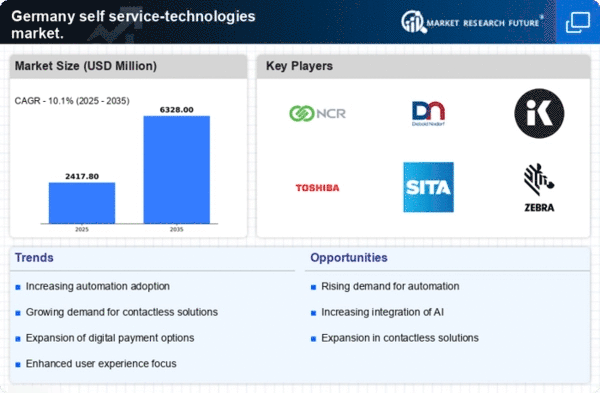
Germany Self Service Technologies Market Infographic
Purchase Options

Germany Self Service Technologies Market Summary

As per Market Research Future analysis, the Germany Self Service Technologies Market size was estimated at 2196.0 USD Million in 2024. The Self Service-technologies market is projected to grow from 2417.8 USD Million in 2025 to 6328.0 USD Million by 2035, exhibiting a compound annual growth rate (CAGR) of 10% during the forecast period 2025 - 2035

Key Market Trends & Highlights

The Germany self service-technologies market is experiencing robust growth driven by technological advancements and changing consumer preferences.

  • The market is witnessing increased adoption of AI-driven solutions, enhancing user experiences and operational efficiency.
  • Contactless transactions are becoming a focal point, reflecting a shift in consumer behavior towards convenience and safety.
  • Omnichannel experiences are being integrated, allowing seamless interactions across various platforms and devices.
  • Rising consumer demand for convenience and government initiatives supporting digital transformation are key drivers of market growth.

Market Size & Forecast

2024 Market Size 2196.0 (USD Million)
2035 Market Size 6328.0 (USD Million)
CAGR (2025 - 2035) 10.1%

Major Players

NCR Corporation (US), Diebold Nixdorf (US), KIOSK Information Systems (US), Toshiba Global Commerce Solutions (US), SITA (GB), Zebra Technologies (US), Ingenico Group (FR), Verifone (US)

Our Impact
Enabled $4.3B Revenue Impact for Fortune 500 and Leading Multinationals
Partnering with 2000+ Global Organizations Each Year
30K+ Citations by Top-Tier Firms in the Industry

Germany Self Service Technologies Market Trends

The Germany Self Service Technologies Market is currently experiencing notable growth, driven by advancements in technology and changing consumer preferences. In Germany, there is a marked shift towards automation and self-service solutions across various sectors, including retail, banking, and hospitality. This trend reflects a broader desire for efficiency and convenience, as consumers increasingly seek to manage transactions independently. The integration of artificial intelligence and machine learning into self-service platforms enhances user experience, making these technologies more appealing to businesses and customers alike. Moreover, the regulatory environment in Germany supports innovation in the self service-technologies market. Government initiatives aimed at promoting digitalization and improving infrastructure are likely to bolster the adoption of self-service solutions. As businesses adapt to these changes, they may find opportunities to streamline operations and reduce costs. The emphasis on sustainability also plays a role, as companies look for ways to minimize their environmental impact through efficient resource management. Overall, the self service-technologies market appears poised for continued expansion in Germany, driven by technological advancements and evolving consumer expectations.

Increased Adoption of AI-Driven Solutions

The self service-technologies market is witnessing a surge in the adoption of AI-driven solutions. Businesses are increasingly integrating artificial intelligence into their self-service platforms to enhance user experience. This trend suggests that companies are prioritizing personalized interactions and efficient service delivery, which may lead to higher customer satisfaction and loyalty.

Focus on Contactless Transactions

There is a growing emphasis on contactless transactions within the self service-technologies market. This trend indicates a shift towards solutions that minimize physical contact, appealing to consumers who prioritize safety and convenience. Businesses are likely to invest in technologies that facilitate seamless, contactless interactions, thereby enhancing operational efficiency.

Integration of Omnichannel Experiences

The self service-technologies market is evolving towards the integration of omnichannel experiences. This trend suggests that businesses are recognizing the importance of providing a cohesive customer journey across various platforms. By offering self-service options that are accessible through multiple channels, companies may improve customer engagement and retention.

Germany Self Service Technologies Market Drivers

Increased Focus on Data Security

In the context of the self service-technologies market in Germany, data security has emerged as a critical driver. With the rise of digital transactions and self-service solutions, concerns regarding data privacy and security have intensified. Consumers are increasingly aware of the risks associated with sharing personal information, prompting businesses to prioritize robust security measures. According to recent surveys, over 70% of German consumers express concerns about data breaches when using self-service technologies. As a result, companies are investing in advanced encryption and security protocols to build trust and ensure compliance with stringent regulations. This heightened focus on data security is likely to influence the self service-technologies market, as businesses strive to create secure environments for their customers.

Shift Towards Sustainable Practices

The self service-technologies market in Germany is witnessing a shift towards sustainable practices, driven by increasing environmental awareness among consumers and businesses alike. Companies are increasingly adopting eco-friendly technologies and practices to align with consumer expectations for sustainability. For example, the use of energy-efficient kiosks and recyclable materials in self-service solutions is becoming more prevalent. Recent studies indicate that approximately 55% of German consumers prefer brands that demonstrate a commitment to sustainability. This trend is likely to influence the self service-technologies market, as businesses seek to differentiate themselves by integrating sustainable practices into their operations. As a result, the market may see a rise in innovative solutions that not only enhance user experience but also contribute to environmental conservation.

Rising Consumer Demand for Convenience

The self service-technologies market in Germany is experiencing a notable surge in consumer demand for convenience. As lifestyles become increasingly fast-paced, individuals seek solutions that minimize time spent on routine tasks. This trend is reflected in the growing adoption of self-service kiosks and automated checkout systems across various sectors, including retail and hospitality. According to recent data, approximately 60% of consumers in Germany express a preference for self-service options, indicating a shift in expectations. This demand is likely to drive innovation within the self service-technologies market, as businesses strive to enhance user experiences and streamline operations. Consequently, companies are investing in advanced technologies to meet these evolving consumer preferences, thereby fostering growth in the self service-technologies market.

Technological Advancements in Automation

Technological advancements play a pivotal role in shaping the self service-technologies market in Germany. Innovations in automation, such as artificial intelligence and machine learning, are enhancing the capabilities of self-service solutions. For instance, the integration of AI-driven chatbots in customer service applications is becoming increasingly prevalent, allowing businesses to provide 24/7 support without human intervention. This shift not only improves efficiency but also reduces operational costs. Recent statistics indicate that the automation of customer interactions could lead to a potential reduction in service costs by up to 30% for businesses. As these technologies continue to evolve, they are expected to further transform the self service-technologies market, enabling more sophisticated and user-friendly solutions.

Government Initiatives Supporting Digital Transformation

Government initiatives aimed at promoting digital transformation are significantly impacting the self service-technologies market in Germany. The German government has launched various programs to encourage the adoption of digital solutions across industries, including funding for technology startups and incentives for businesses to implement self-service systems. These initiatives are designed to enhance efficiency and competitiveness in the market. For instance, the Digital Strategy 2025 outlines plans to invest €10 billion in digital infrastructure, which is expected to facilitate the growth of self service-technologies. As these government efforts continue to unfold, they are likely to create a favorable environment for innovation and expansion within the self service-technologies market.

Market Segment Insights

By Machine Type: ATM (Largest) vs. Kiosk (Fastest-Growing)

The market share distribution in the segment shows ATMs as the leading machine type within the Germany self service-technologies market, capturing a significant portion of the total market. Kiosks, while smaller in share compared to ATMs, are gaining traction rapidly and are becoming increasingly relevant due to their versatility and the growing demand for self-service options across various sectors. Growth trends indicate that kiosks are becoming the fastest-growing segment due to a surge in customer preferences for contactless transactions and convenience. The shifting consumer behavior towards self-service technologies further drives this growth, with various industries adopting kiosks to streamline operations and enhance user experiences, reflecting a broad acceptance of automated services.

ATM (Dominant) vs. Kiosk (Emerging)

ATMs represent a dominant force in the machine type segment of the Germany self service-technologies market, offering traditional banking services such as cash withdrawals, deposits, and account information. With their established presence, ATMs cater to a wide demographic and provide essential functionalities that are integral to daily banking needs. Kiosks, on the other hand, are emerging as a versatile alternative, capable of serving various applications from food service to ticketing. Their flexibility and adaptability make them appealing to businesses looking to innovate customer engagement strategies, positioning kiosks as a critical component of the evolving self-service landscape.

By Application: Banking (Largest) vs. Food & Beverage (Fastest-Growing)

In the Germany self service-technologies market, the application segment is notably led by banking, which commands the largest market share among various applications. Banking self service technologies, such as ATMs and kiosks, have deeply integrated into consumer habits, making banking services more accessible and efficient. In contrast, the food and beverage application is experiencing rapid growth, driven by changing consumer preferences for convenience and speed in service delivery. The growth trends observed in the Germany self service-technologies market are significantly influenced by technological advancements and shifting consumer demands. The increasing adoption of mobile payment systems within the banking sector is enhancing customer experience and driving market expansion. Conversely, the food and beverage sector is emerging rapidly, fueled by the rise of on-demand services and smart vending solutions, which cater to the evolving preferences of tech-savvy consumers looking for quick and easy meal options.

Banking (Dominant) vs. Food & Beverage (Emerging)

In the Germany self service-technologies market, the banking application stands out as the dominant force, characterized by a vast infrastructure of ATMs and digital kiosks that continuously evolve to meet consumer needs for convenience. Its established presence is further bolstered by the integration of advanced technologies like biometrics and contactless transactions, enhancing both security and user experience. On the other hand, the food and beverage application represents an emerging trend, characterized by innovative solutions like automated kiosks and self-checkout systems that cater to the fast-paced lifestyle of modern consumers. This segment is rapidly adopting technological advancements, such as AI-driven inventory management and personalized offerings, which are driving significant growth in this area.

By Interface: Online/Internet (Largest) vs. Telephone/IVR (Fastest-Growing)

In the Germany self service-technologies market, the Online/Internet segment accounts for a significant share of the overall interface usage, dominating the landscape due to its convenience and accessibility. Companies increasingly leverage online platforms to enhance customer experience, leading to a higher market share for Internet-based solutions compared to traditional methods. On the other hand, the Telephone/IVR segment, while smaller in market share, is experiencing rapid growth fueled by advancements in interaction technology and an increased focus on customer support efficiency. The growth trends for these segments indicate a shift towards digitalization, where self-service technologies via the Internet are quickly becoming the norm. Factors driving this transition include a surge in smartphone usage, high-speed internet accessibility, and consumer preference for online interactions. Meanwhile, the Telephone/IVR segment is capitalizing on the need for personalized customer service and quick responses, positioning itself as a vital alternative for consumers who prefer speaking directly to a system for assistance.

Online/Internet (Dominant) vs. Telephone/IVR (Emerging)

The Online/Internet interface segment is characterized by its dominance in the Germany self service-technologies market, offering a wide range of self-service options such as e-commerce platforms, chatbots, and mobile applications. This segment appeals to consumers seeking efficiency and ease of use, making it the preferred choice among many users. Conversely, the Telephone/IVR segment, while emerging, serves an essential role by providing a traditional yet effective means for users who may not be as comfortable with online technology. As businesses continue to invest in developing intuitive IVR systems, this segment is gaining traction, reflecting a balanced approach in catering to diverse consumer needs.

Get more detailed insights about Germany Self Service Technologies Market

Key Players and Competitive Insights

The self service-technologies market in Germany is characterized by a dynamic competitive landscape, driven by rapid technological advancements and evolving consumer preferences. Key players such as NCR Corporation (US), Diebold Nixdorf (US), and Ingenico Group (FR) are strategically positioned to leverage innovation and digital transformation. NCR Corporation (US) focuses on enhancing customer experiences through integrated solutions, while Diebold Nixdorf (US) emphasizes operational efficiency and security in its offerings. Ingenico Group (FR) is committed to expanding its payment solutions, indicating a collective shift towards more comprehensive service offerings that cater to diverse consumer needs.The market structure appears moderately fragmented, with several players vying for market share. Key business tactics include localizing manufacturing to reduce costs and optimize supply chains, which is crucial in maintaining competitive pricing. The influence of major companies is significant, as they not only set industry standards but also drive technological advancements that shape consumer expectations and market dynamics.

In October NCR Corporation (US) announced a partnership with a leading retail chain to implement advanced self-service kiosks aimed at enhancing customer engagement. This strategic move underscores NCR's commitment to innovation and its focus on providing tailored solutions that meet the specific needs of retail clients. The partnership is likely to bolster NCR's market presence and reinforce its reputation as a leader in customer-centric technology.

In September Diebold Nixdorf (US) launched a new line of automated teller machines (ATMs) equipped with advanced security features and contactless payment options. This initiative reflects Diebold Nixdorf's proactive approach to addressing security concerns while enhancing user convenience. The introduction of these ATMs is expected to strengthen the company's competitive edge in the financial services sector, particularly as consumers increasingly prioritize security in their transactions.

In August Ingenico Group (FR) expanded its operations in Germany by acquiring a local payment solutions provider. This acquisition is indicative of Ingenico's strategy to enhance its service portfolio and strengthen its foothold in the European market. By integrating local expertise, Ingenico aims to offer more customized solutions, thereby increasing its competitiveness in a rapidly evolving landscape.

As of November current trends in the self service-technologies market include a pronounced focus on digitalization, sustainability, and the integration of artificial intelligence (AI). Strategic alliances among key players are shaping the competitive landscape, fostering innovation and collaboration. The shift from price-based competition to a focus on technological advancement and supply chain reliability is evident, suggesting that future differentiation will hinge on the ability to innovate and adapt to changing consumer demands.

Key Companies in the Germany Self Service Technologies Market include

Industry Developments

The Germany Self-Service Technologies Market has seen significant developments recently, driven by innovations and increased demand for contactless payment solutions. Companies like Glory Ltd, NCR Corporation, and Diebold Nixdorf have been expanding their self-service kiosks across various retail and banking sectors, focusing on enhancing customer experiences. In September 2023, Alphabet Inc. announced plans to invest in advancements with Samsung and Verifone to develop integrated payment solutions tailored for the German market, thereby boosting digital transaction capabilities. 

The market valuation is projected to grow substantially as companies adapt to consumer preferences for convenience and safety, particularly in the wake of the COVID-19 pandemic. There have been noteworthy mergers and acquisitions as well; in July 2023, Harbortouch acquired assets of KIOSK Information Systems to strengthen its product offerings and expand its market footprint in Germany. Additionally, Ingenico has made strides in partnering with local German banks to provide innovative financial technologies. Overall, the self-service technology landscape is evolving rapidly, influenced by market demands and strategic collaborations among leading firms in Germany.

Future Outlook

Germany Self Service Technologies Market Future Outlook

The Self Service Technologies Market in Germany is projected to grow at a 10.1% CAGR from 2025 to 2035, driven by technological advancements and increasing consumer demand.

New opportunities lie in:

  • Integration of AI-driven kiosks for personalized customer experiences.
  • Expansion of mobile self-service applications in retail environments.
  • Development of automated payment solutions for enhanced transaction efficiency.

By 2035, the market is expected to achieve substantial growth, reflecting evolving consumer preferences and technological innovations.

Market Segmentation

Germany Self Service Technologies Market Interface Outlook

  • Online/Internet
  • Telephone/IVR

Germany Self Service Technologies Market Application Outlook

  • Banking
  • Entertainment
  • Food & Beverage

Germany Self Service Technologies Market Machine Type Outlook

  • ATM
  • Kiosk
  • Beverage Vending Machine

Report Scope

MARKET SIZE 2024 2196.0(USD Million)
MARKET SIZE 2025 2417.8(USD Million)
MARKET SIZE 2035 6328.0(USD Million)
COMPOUND ANNUAL GROWTH RATE (CAGR) 10.1% (2025 - 2035)
REPORT COVERAGE Revenue Forecast, Competitive Landscape, Growth Factors, and Trends
BASE YEAR 2024
Market Forecast Period 2025 - 2035
Historical Data 2019 - 2024
Market Forecast Units USD Million
Key Companies Profiled NCR Corporation (US), Diebold Nixdorf (US), KIOSK Information Systems (US), Toshiba Global Commerce Solutions (US), SITA (GB), Zebra Technologies (US), Ingenico Group (FR), Verifone (US)
Segments Covered Machine Type, Application, Interface
Key Market Opportunities Integration of artificial intelligence in self service-technologies enhances user experience and operational efficiency.
Key Market Dynamics Growing consumer preference for contactless transactions drives innovation in self service-technologies across various sectors.
Countries Covered Germany
Leave a Comment

FAQs

What is the expected market size of the Germany Self-Service Technologies Market in 2024?

The Germany Self-Service Technologies Market is expected to be valued at 1.77 USD Billion in 2024.

What is the projected market size of the Germany Self-Service Technologies Market by 2035?

By 2035, the market is projected to reach a valuation of 5.51 USD Billion.

What is the expected compound annual growth rate (CAGR) for the Germany Self-Service Technologies Market from 2025 to 2035?

The market is expected to grow at a CAGR of 10.874% during the forecast period from 2025 to 2035.

Which segment of the Germany Self-Service Technologies Market is expected to have the largest market share in 2035?

The Kiosk segment is projected to have a significant market share, valued at 2.14 USD Billion in 2035.

What is the market value of ATMs in the Germany Self-Service Technologies Market in 2024?

In 2024, the ATM segment is valued at 0.57 USD Billion.

How much is the Beverage Vending Machine segment expected to grow by 2035?

The Beverage Vending Machine segment is expected to grow to a market size of 1.58 USD Billion by 2035.

Who are the major players in the Germany Self-Service Technologies Market?

Key players include Glory Ltd, NCR Corporation, Toshiba, Verifone, and Ingenico, among others.

What are the key applications driving the growth of the Germany Self-Service Technologies Market?

Key applications include ATMs, kiosks, and vending machines, contributing to the market's overall growth.

What are the growth drivers impacting the Germany Self-Service Technologies Market?

Growth drivers include increased automation, demand for self-service solutions, and advancements in technology.

What challenges does the Germany Self-Service Technologies Market face currently?

Challenges include competition among key players and the need for continuous innovation to meet evolving consumer demands.

Download Free Sample

Kindly complete the form below to receive a free sample of this Report

Compare Licence

×
Features License Type
Single User Multiuser License Enterprise User
Price $4,950 $5,950 $7,250
Maximum User Access Limit 1 User Upto 10 Users Unrestricted Access Throughout the Organization
Free Customization
Direct Access to Analyst
Deliverable Format
Platform Access
Discount on Next Purchase 10% 15% 15%
Printable Versions