×
Request Free Sample ×

Kindly complete the form below to receive a free sample of this Report

* Please use a valid business email

Leading companies partner with us for data-driven Insights

clients tt-cursor
Hero Background

India Sachet Packaging Market

ID: MRFR/PCM/47233-HCR
111 Pages
Snehal Singh
February 2026

India Sachet Packaging Market Research Report: By Size (1ml - 20ml, 21ml - 30ml, Above 30 ml), By Material (Plastic, Non-Plastic) andBy Application (Cosmetic and Personal Care, Food and Beverage, Pharmaceuticals, Others)- Forecast to 2035

Share:
Download PDF ×

We do not share your information with anyone. However, we may send you emails based on your report interest from time to time. You may contact us at any time to opt-out.

India Sachet Packaging Market Infographic
Purchase Options

India Sachet Packaging Market Summary

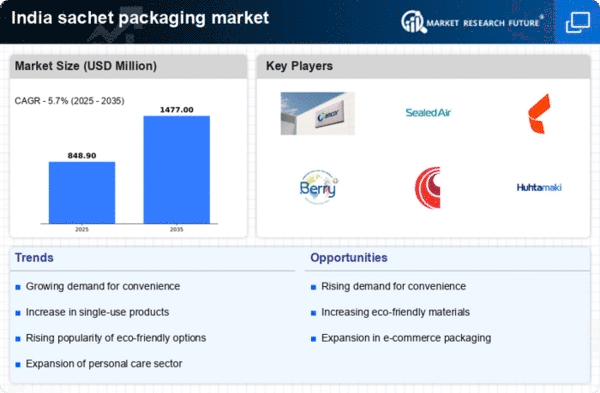
As per Market Research Future analysis, the India Sachet Packaging Market size was estimated at 803.12 USD Million in 2024. The Sachet Packaging market is projected to grow from 848.9 USD Million in 2025 to 1477.0 USD Million by 2035, exhibiting a compound annual growth rate (CAGR) of 5% during the forecast period 2025 - 2035

Key Market Trends & Highlights

The India sachet packaging market is experiencing robust growth driven by evolving consumer preferences and sustainability initiatives.

  • The market is witnessing a rising demand for convenience, particularly in the food and beverage segment, which remains the largest.
  • Sustainability initiatives are gaining traction, with consumers increasingly favoring eco-friendly packaging solutions.
  • Technological advancements are enhancing the efficiency and customization of sachet packaging, contributing to market dynamism.
  • Key drivers such as growing urbanization and consumer preference for single-serve products are propelling market expansion.

Market Size & Forecast

2024 Market Size 803.12 (USD Million)
2035 Market Size 1477.0 (USD Million)
CAGR (2025 - 2035) 5.7%

Major Players

Amcor (AU), Sealed Air (US), Mondi Group (GB), Berry Global (US), Constantia Flexibles (AT), Huhtamaki (FI), Smurfit Kappa (IE), Sonoco Products (US), Glenroy (US)

Our Impact
Enabled $4.3B Revenue Impact for Fortune 500 and Leading Multinationals
Partnering with 2000+ Global Organizations Each Year
30K+ Citations by Top-Tier Firms in the Industry

India Sachet Packaging Market Trends

The India Sachet Packaging Market is experiencing notable growth, driven by various factors including consumer preferences and advancements in technology. The convenience offered by sachet packaging appeals to a wide range of consumers, particularly in urban areas where on-the-go consumption is prevalent. This format allows for portion control, reducing waste and enhancing product accessibility. Additionally, the rise of e-commerce has further propelled the demand for sachet packaging, as it provides an efficient solution for shipping smaller quantities of products. As a result, manufacturers are increasingly investing in innovative designs and materials to cater to this evolving market. Moreover, sustainability has emerged as a critical consideration within the sachet packaging market. With growing awareness regarding environmental issues, consumers are increasingly seeking eco-friendly packaging options. This shift is prompting companies to explore biodegradable and recyclable materials, aligning their products with consumer values. Furthermore, regulatory frameworks are evolving to support sustainable practices, which may influence packaging choices in the future. Overall, the sachet packaging market is poised for continued expansion, driven by consumer demand for convenience and sustainability, alongside technological advancements that enhance product offerings.

Rising Demand for Convenience

The sachet packaging market is witnessing a surge in demand for convenient packaging solutions. Consumers are increasingly favoring single-use formats that allow for easy portability and portion control. This trend is particularly evident in urban areas, where busy lifestyles necessitate quick and accessible product options.

Sustainability Initiatives

Sustainability is becoming a focal point in the sachet packaging market. Companies are exploring eco-friendly materials and designs to meet consumer expectations for environmentally responsible products. This shift is likely to influence packaging strategies and product development in the coming years.

Technological Advancements

Technological innovations are playing a crucial role in shaping the sachet packaging market. Advances in materials and production techniques are enabling manufacturers to create more efficient and visually appealing packaging solutions. This trend may enhance product differentiation and attract a broader consumer base.

India Sachet Packaging Market Drivers

Growing Urbanization

The rapid urbanization in India is a pivotal driver for the sachet packaging market. As more individuals migrate to urban areas, the demand for convenient and portable products increases. Urban consumers often seek products that fit their fast-paced lifestyles, leading to a surge in the use of sachet packaging across various sectors, including food, personal care, and household items. The sachet packaging market is witnessing a notable shift, with an estimated growth rate of 15% annually in urban regions. This trend is likely to continue as urban populations expand, further propelling the demand for single-use packaging solutions that cater to the needs of city dwellers.

Rising E-commerce Sales

The surge in e-commerce sales in India is significantly impacting the sachet packaging market. With the increasing number of online shoppers, there is a growing need for efficient and protective packaging solutions. Sachets are particularly advantageous for e-commerce businesses, as they provide lightweight and compact packaging that reduces shipping costs. The sachet packaging market is likely to see a boost as online retailers adopt sachet solutions to enhance customer experience and minimize product damage during transit. Reports indicate that e-commerce sales in India are projected to reach $200 billion by 2026, further driving the demand for innovative packaging solutions that cater to this expanding market.

Cost-Effectiveness of Sachets

The cost-effectiveness of sachet packaging is a significant factor influencing its adoption in India. Manufacturers are increasingly recognizing that sachets allow for lower production costs and reduced material waste. This is particularly relevant in a price-sensitive market where consumers often prefer smaller, affordable product sizes. The sachet packaging market benefits from this trend, as it enables companies to offer products at competitive prices while maintaining profit margins. Furthermore, the ability to package products in smaller quantities appeals to a broader consumer base, potentially increasing market penetration. It is estimated that sachet packaging can reduce packaging costs by up to 30%, making it an attractive option for businesses.

Regulatory Support for Sustainable Packaging

Regulatory support for sustainable packaging practices is emerging as a key driver for the sachet packaging market in India. The government is increasingly promoting initiatives aimed at reducing plastic waste and encouraging the use of eco-friendly materials. This regulatory environment is likely to stimulate innovation within the sachet packaging market, as companies seek to develop biodegradable and recyclable packaging solutions. The potential for growth in this sector is substantial, with estimates suggesting that the market for sustainable packaging could reach $10 billion by 2027. As businesses adapt to these regulations, the demand for sustainable sachet packaging is expected to rise, aligning with both consumer preferences and governmental policies.

Consumer Preference for Single-Serve Products

Consumer preferences in India are shifting towards single-serve products, which is a crucial driver for the sachet packaging market. This trend is particularly evident in the food and beverage sector, where consumers favor smaller, ready-to-use portions that align with their busy lifestyles. The sachet packaging market is responding to this demand by offering a variety of products in single-serve formats, which not only enhance convenience but also reduce food waste. As more consumers prioritize portion control and convenience, the market for sachet packaging is expected to grow, with an estimated increase of 20% in single-serve product offerings over the next few years.


Market Segment Insights

By Size: 21ml - 30ml (Largest) vs. Above 30 ml (Fastest-Growing)

In the India sachet packaging market, the size segment showcases a diverse distribution among various volume ranges. The 21ml - 30ml segment holds a significant share as it caters effectively to various consumer needs, while the 1ml - 20ml segment also garners attention due to its convenience and cost-effectiveness. However, the above 30 ml segment is emerging rapidly as it appeals to a more extensive customer base seeking value in larger quantities, thus reflecting a shift in consumer preferences. Growth trends within the size segment indicate a robust increase in demand for the above 30 ml range. This rise can be attributed to the growing preference for larger packaging solutions among consumers, driven by various sectors including personal care and food & beverages. As consumers seek value-for-money options, manufacturers are increasingly focusing on innovative designs and sustainable materials to meet market demands, fostering growth in this segment.

1ml - 20ml (Dominant) vs. Above 30 ml (Emerging)

The 1ml - 20ml segment in the India sachet packaging market is dominant due to its widespread popularity, especially in personal care and cosmetic products. This size range is ideal for trial versions and single-use applications, catering to budget-conscious consumers who prefer lower quantities. In contrast, the above 30 ml segment is emerging as a viable alternative, driven by the trend towards larger size packaging that offers better value and convenience. As brands aim to attract a broader audience, they are investing in this segment, focusing on unique packaging solutions that retain product integrity while appealing to consumers looking for multipurpose uses. Both segments complement each other in catering to diverse market demands.

By Material: Plastic (Largest) vs. Non-Plastic (Fastest-Growing)

In the India sachet packaging market, the distribution of materials highlights the dominance of plastic, which holds the largest share among packaging options. The convenience, lightweight nature, and cost-effectiveness of plastic materials contribute to their continued prevalence in this market segment. Conversely, non-plastic materials are emerging as significant contenders as environmental concerns prompt brand owners to seek sustainable alternatives. The growth trends in the material segment indicate a significant shift towards non-plastic options, driven by increasing consumer awareness about sustainability. Regulatory pressures and changing consumer preferences are also accelerating the adoption of eco-friendly sachet packaging solutions. This segment is likely to witness robust growth as companies respond to the rising demand for environmentally responsible packaging, making non-plastic materials a key focus for innovation and investment.

Plastic (Dominant) vs. Non-Plastic (Emerging)

Plastic materials in the sachet packaging market are characterized by their versatility and wide-ranging applications, cementing their position as the dominant choice for many manufacturers. Their ability to provide moisture protection and barrier features has made plastic sachets particularly popular in food and personal care applications. However, the emerging non-plastic segment is gradually gaining traction as brands explore biodegradable and recyclable alternatives that align with sustainability goals. These non-plastic options are often seen as innovative solutions that cater to environmentally conscious consumers, driving demand in sectors eager to reduce their ecological footprint. As the market evolves, both segments will be pivotal, influencing packaging trends and consumer choices in the coming years.

By Application: Food and Beverage (Largest) vs. Cosmetics and Personal Care (Fastest-Growing)

The India sachet packaging market showcases a diverse application landscape, with the Food and Beverage segment holding the largest share. This segment is driven by the increasing demand for convenient packaging solutions that cater to on-the-go lifestyles, particularly in urban areas. In contrast, the Cosmetic and Personal Care sector, while smaller in overall market share, is emerging rapidly due to rising consumer awareness about personal grooming and beauty products. Growth trends in this market are influenced by shifting consumer preferences towards sustainable packaging solutions and the increasing popularity of single-use sachets for promotional purposes. Additionally, the rise of e-commerce has facilitated the distribution of sachet packaged products, further spurring growth in segments like Pharmaceuticals and Others, as brands look to tap into the trend towards smaller, more affordable packaging options.

Food and Beverage: Dominant vs. Cosmetics and Personal Care: Emerging

In the India sachet packaging market, the Food and Beverage segment stands out as the dominant force due to its widespread applications in various food items, including snacks, sauces, and beverages. This segment thrives on convenience and portion control, appealing to a fast-paced consumer culture. Meanwhile, the Cosmetics and Personal Care segment is emerging as a significant player, driven by the growing trend of trial-sized products that encourage consumers to try new brands without committing to full-sized items. Both segments focus on innovative design and functionality to attract consumers, ensuring their sustained growth within the overall market landscape.

Get more detailed insights about India Sachet Packaging Market

Key Players and Competitive Insights

The sachet packaging market in India is characterized by a dynamic competitive landscape, driven by increasing consumer demand for convenience and portion control. Key players are actively engaging in strategies that emphasize innovation, sustainability, and regional expansion. For instance, Amcor (AU) has positioned itself as a leader in sustainable packaging solutions, focusing on developing recyclable and biodegradable materials. Similarly, Sealed Air (US) is enhancing its operational focus on automation and digital transformation, which allows for more efficient production processes and improved supply chain management. These strategies collectively contribute to a competitive environment that is increasingly focused on meeting consumer preferences while addressing environmental concerns.In terms of business tactics, companies are localizing manufacturing to reduce costs and improve responsiveness to market demands. This approach is particularly relevant in a moderately fragmented market where numerous players vie for market share. The collective influence of key players, such as Mondi Group (GB) and Berry Global (US), is shaping the market structure, as they leverage their extensive distribution networks and technological capabilities to optimize supply chains and enhance product offerings.

In October Mondi Group (GB) announced the launch of a new line of eco-friendly sachet packaging aimed at the food sector. This strategic move underscores the company's commitment to sustainability and positions it to capture a growing segment of environmentally conscious consumers. The introduction of this product line is likely to enhance Mondi's competitive edge, as it aligns with the increasing regulatory pressures and consumer preferences for sustainable packaging solutions.

In September Berry Global (US) expanded its manufacturing capabilities in India by investing in a new facility dedicated to producing high-performance sachet packaging. This investment not only signifies Berry's commitment to the Indian market but also reflects a broader trend of companies enhancing their production capacities to meet rising demand. The strategic importance of this expansion lies in its potential to improve supply chain efficiencies and reduce lead times, thereby strengthening Berry's market position.

In August Huhtamaki (FI) entered into a strategic partnership with a local Indian firm to co-develop innovative packaging solutions tailored to regional preferences. This collaboration is indicative of a growing trend where companies seek to leverage local expertise to enhance product relevance and market penetration. Such partnerships are likely to foster innovation and adaptability, allowing Huhtamaki to respond more effectively to the unique demands of the Indian market.

As of November the competitive trends in the sachet packaging market are increasingly defined by digitalization, sustainability, and the integration of advanced technologies such as AI. Strategic alliances are becoming more prevalent, enabling companies to pool resources and expertise to drive innovation. The competitive differentiation is expected to evolve from traditional price-based competition towards a focus on technological advancements, sustainable practices, and reliable supply chains. This shift suggests that companies that prioritize innovation and adaptability will likely emerge as leaders in the market.

Key Companies in the India Sachet Packaging Market include

Industry Developments

The India Sachet Packaging Market has seen significant developments recently, particularly among leading companies. In September 2023, Marico expanded its product offerings, enhancing its sachet range to cater to evolving consumer preferences in personal care and food segments.

Meanwhile, Parle Agro launched new environmentally friendly sachets that aim to reduce plastic waste, reflecting a growing trend in sustainable packaging. PepsiCo India has focused on product innovation with tailored sachet sizes for emerging markets to improve affordability.

In terms of mergers and acquisitions, Hindustan Unilever announced the acquisition of a local personal care brand in August 2023, enhancing its portfolio within the sachet segment. Additionally, the market has experienced growth due to rising demand for single-use packaging, attributed to urbanization and changing lifestyles.

Companies like Britannia Industries and Dabur India are investing in advanced manufacturing technologies to improve production capabilities. Over the last two to three years, there has been a consistent shift towards small-sized packages, especially in FMCG, which has significantly influenced consumer purchasing behavior, highlighting the ongoing transformation in the Indian market landscape.

Future Outlook

India Sachet Packaging Market Future Outlook

The sachet packaging market in India is projected to grow at a 5.7% CAGR from 2025 to 2035, driven by increasing consumer demand and sustainability initiatives.

New opportunities lie in:

  • Expansion of biodegradable sachet materials for eco-conscious consumers.
  • Development of smart sachets with QR codes for enhanced customer engagement.
  • Investment in automated packaging lines to improve production efficiency.

By 2035, the sachet packaging market is expected to achieve substantial growth and innovation.

Market Segmentation

India Sachet Packaging Market Size Outlook

  • 1ml - 20ml
  • 21ml - 30ml
  • Above 30 ml

India Sachet Packaging Market Material Outlook

  • Plastic
  • Non-Plastic

India Sachet Packaging Market Application Outlook

  • Cosmetic and Personal Care
  • Food and Beverage
  • Pharmaceuticals
  • Others

Report Scope

MARKET SIZE 2024 803.12(USD Million)
MARKET SIZE 2025 848.9(USD Million)
MARKET SIZE 2035 1477.0(USD Million)
COMPOUND ANNUAL GROWTH RATE (CAGR) 5.7% (2025 - 2035)
REPORT COVERAGE Revenue Forecast, Competitive Landscape, Growth Factors, and Trends
BASE YEAR 2024
Market Forecast Period 2025 - 2035
Historical Data 2019 - 2024
Market Forecast Units USD Million
Key Companies Profiled Amcor (AU), Sealed Air (US), Mondi Group (GB), Berry Global (US), Constantia Flexibles (AT), Huhtamaki (FI), Smurfit Kappa (IE), Sonoco Products (US), Glenroy (US)
Segments Covered Size, Material, Application
Key Market Opportunities Growing demand for sustainable materials in the sachet packaging market presents significant opportunities for innovation.
Key Market Dynamics Rising demand for sustainable materials drives innovation in the sachet packaging market.
Countries Covered India
Leave a Comment

FAQs

What is the projected market size of the India Sachet Packaging Market by 2035?

The India Sachet Packaging Market is expected to reach a valuation of 2000.0 USD Million by the year 2035.

What was the market value of the India Sachet Packaging Market in 2024?

In 2024, the market value of the India Sachet Packaging Market is estimated to be 878.5 USD Million.

What is the expected Compound Annual Growth Rate (CAGR) for the India Sachet Packaging Market from 2025 to 2035?

The expected CAGR for the India Sachet Packaging Market from 2025 to 2035 is 7.766%.

Which segment of the India Sachet Packaging Market is expected to be the largest by 2035?

The 1ml - 20ml segment is projected to have the largest share, reaching 900.0 USD Million by 2035.

What is the market size of the 21ml - 30ml segment in 2024?

The 21ml - 30ml segment of the India Sachet Packaging Market is valued at 300.0 USD Million in 2024.

Who are the key players in the India Sachet Packaging Market?

Major players in the India Sachet Packaging Market include Marico, PepsiCo India, and Hindustan Unilever among others.

What is the anticipated market size for the Above 30 ml segment by 2035?

The Above 30 ml segment is expected to grow to a market size of 350.0 USD Million by 2035.

What applications are driving growth in the India Sachet Packaging Market?

Key applications driving growth include personal care, food and beverages, and household products.

How has the regional distribution affected the growth of the India Sachet Packaging Market?

The regional distribution has positively impacted market growth by catering to diverse consumer needs across urban and rural areas.

What challenges are faced by the India Sachet Packaging Market?

Challenges include competition from alternative packaging solutions and environmental concerns regarding waste management.

Download Free Sample

Kindly complete the form below to receive a free sample of this Report

Compare Licence

×
Features License Type
Single User Multiuser License Enterprise User
Price $4,950 $5,950 $7,250
Maximum User Access Limit 1 User Upto 10 Users Unrestricted Access Throughout the Organization
Free Customization
Direct Access to Analyst
Deliverable Format
Platform Access
Discount on Next Purchase 10% 15% 15%
Printable Versions