×
Request Free Sample ×

Kindly complete the form below to receive a free sample of this Report

* Please use a valid business email

Leading companies partner with us for data-driven Insights

clients tt-cursor
Hero Background

India Positron Emission Tomography Devices Market

ID: MRFR/HC/51806-HCR
200 Pages
Rahul Gotadki
February 2026

India Positron Emission Tomography Devices Market Research Report: Size, Share, Trend Analysis By Applications (Oncology, Cardiology, Neurology, Infectious Diseases), By Product Type (Integrated PET-CT Systems, Standalone PET Systems, PET-MRI Systems), By End Users (Hospitals, Diagnostic Imaging Centers, Research Institutes) andBy Technology (Time-of-Flight PET, Digital PET, Analog PET) - Growth Outlook & Industry Forecast 2025 To 2035

Share:
Download PDF ×

We do not share your information with anyone. However, we may send you emails based on your report interest from time to time. You may contact us at any time to opt-out.

India Positron Emission Tomography Devices Market Infographic
Purchase Options

India Positron Emission Tomography Devices Market Summary

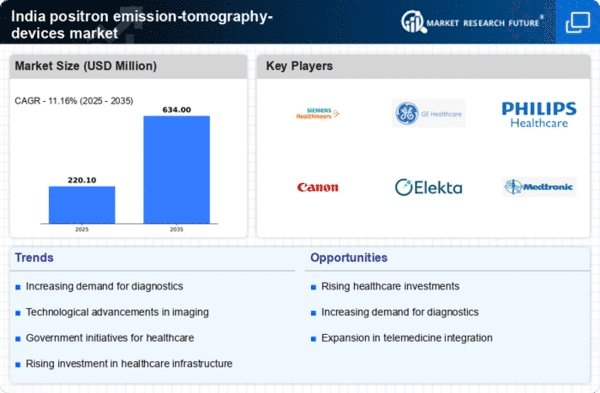
As per Market Research Future analysis, the Positron Emission-tomography-devices market was estimated at 198.0 USD Million in 2024. The positron emission-tomography-devices market is projected to grow from 220.1 USD Million in 2025 to 634.0 USD Million by 2035, exhibiting a compound annual growth rate (CAGR) of 11.1% during the forecast period 2025 - 2035

Key Market Trends & Highlights

The India positron emission-tomography-devices market is poised for substantial growth driven by technological advancements and increasing healthcare demands.

  • Technological advancements in imaging are enhancing the capabilities of positron emission tomography devices.
  • The rising demand for diagnostics is propelling the adoption of PET devices across various healthcare settings.
  • Personalized medicine is gaining traction, leading to an increased focus on tailored diagnostic solutions.
  • Key market drivers include increasing healthcare expenditure and a growing incidence of cancer, which are likely to boost market growth.

Market Size & Forecast

2024 Market Size 198.0 (USD Million)
2035 Market Size 634.0 (USD Million)
CAGR (2025 - 2035) 11.16%

Major Players

Siemens Healthineers (DE), GE Healthcare (US), Philips Healthcare (NL), Canon Medical Systems (JP), Elekta (SE), Medtronic (US), Hitachi Medical Corporation (JP), Nuclear Imaging (US)

Our Impact
Enabled $4.3B Revenue Impact for Fortune 500 and Leading Multinationals
Partnering with 2000+ Global Organizations Each Year
30K+ Citations by Top-Tier Firms in the Industry

India Positron Emission Tomography Devices Market Trends

The positron emission-tomography-devices market is currently experiencing notable advancements, driven by technological innovations and increasing healthcare demands. The integration of artificial intelligence and machine learning into imaging technologies appears to enhance diagnostic accuracy and efficiency. Furthermore, the growing prevalence of chronic diseases necessitates improved imaging solutions, which positron emission tomography provides. This market is also influenced by rising healthcare expenditures and government initiatives aimed at enhancing medical infrastructure. As a result, stakeholders are likely to invest in advanced imaging technologies to meet the evolving needs of healthcare providers and patients alike. In addition, the focus on personalized medicine is shaping the landscape of the positron emission-tomography-devices market. Tailored treatment plans, supported by precise imaging, are becoming increasingly important in patient care. The collaboration between research institutions and healthcare providers is fostering innovation, leading to the development of novel imaging agents and techniques. Overall, the positron emission-tomography-devices market is poised for growth, driven by technological advancements and a commitment to improving patient outcomes.

Technological Advancements

Recent innovations in imaging technology are transforming the positron emission-tomography-devices market. Enhanced resolution and faster scanning capabilities are becoming standard, allowing for more accurate diagnoses. The incorporation of artificial intelligence is also streamlining workflows and improving image analysis, which may lead to better patient outcomes.

Rising Demand for Diagnostics

The increasing prevalence of chronic diseases is driving demand for advanced diagnostic tools, including positron emission tomography. As healthcare providers seek to improve diagnostic accuracy, the market is likely to expand. This trend is further supported by government initiatives aimed at enhancing healthcare access and quality.

Focus on Personalized Medicine

The shift towards personalized medicine is influencing the positron emission-tomography-devices market. Tailored treatment plans, supported by precise imaging, are becoming essential in patient care. This trend is fostering collaboration between research institutions and healthcare providers, leading to the development of innovative imaging agents.

India Positron Emission Tomography Devices Market Drivers

Growing Incidence of Cancer

The escalating incidence of cancer in India serves as a significant driver for the positron emission-tomography-devices market. With cancer cases projected to rise by 12% annually, the need for effective diagnostic tools becomes paramount. PET scans are increasingly recognized for their ability to detect cancer at early stages, facilitating timely treatment. In 2025, it is estimated that over 1 million new cancer cases will be diagnosed in India, further underscoring the demand for advanced imaging technologies. The positron emission-tomography-devices market is likely to benefit from this trend, as healthcare providers seek to enhance their diagnostic capabilities to address the growing burden of cancer.

Increasing Healthcare Expenditure

The rising healthcare expenditure in India is a crucial driver for the positron emission-tomography-devices market. As the government and private sectors allocate more funds towards healthcare, the demand for advanced diagnostic tools, including PET devices, is likely to increase. In 2025, healthcare spending in India is projected to reach approximately $370 billion, reflecting a growth rate of around 12% annually. This increase in funding enables hospitals and diagnostic centers to invest in state-of-the-art technologies, enhancing the capabilities of the positron emission-tomography-devices market. Furthermore, the emphasis on improving healthcare infrastructure and accessibility in rural areas may lead to a broader adoption of PET devices, thereby expanding the market's reach and potential.

Government Initiatives and Support

Government initiatives aimed at enhancing healthcare services in India are likely to propel the positron emission-tomography-devices market. Programs focused on improving diagnostic capabilities and increasing access to advanced medical technologies are being implemented. For instance, the National Health Mission has allocated substantial funds to upgrade healthcare facilities, which may include the procurement of PET devices. Additionally, the Make in India initiative encourages domestic manufacturing of medical equipment, potentially reducing costs and increasing availability. These supportive measures could lead to a more robust positron emission-tomography-devices market, as healthcare providers are empowered to invest in advanced diagnostic solutions.

Rising Awareness of Early Diagnosis

There is a growing awareness among the Indian population regarding the importance of early diagnosis in managing health conditions, particularly cancer. This heightened awareness is driving demand for advanced diagnostic tools, including those in the positron emission-tomography-devices market. Educational campaigns and health initiatives are increasingly emphasizing the benefits of early detection, which may lead to a surge in PET scan utilization. As patients become more informed about their health options, healthcare providers are likely to respond by integrating PET technology into their diagnostic offerings. This trend could significantly enhance the market's growth trajectory in the coming years.

Technological Innovations in Imaging

Technological innovations in imaging techniques are transforming the landscape of the positron emission-tomography-devices market. Advances in detector technology, image processing, and software applications are enhancing the accuracy and efficiency of PET scans. In 2025, the introduction of hybrid imaging systems, which combine PET with CT or MRI, is expected to gain traction, providing comprehensive diagnostic information. These innovations not only improve patient outcomes but also increase the appeal of PET devices among healthcare providers. As the market evolves, the integration of cutting-edge technology is likely to drive further investment and adoption of positron emission-tomography-devices in India.


Market Segment Insights

By Product Type: PET/CT Systems (Largest) vs. PET/MRI Systems (Fastest-Growing)

In the India positron emission-tomography-devices market, the distribution of market share among the various product types reveals that PET/CT Systems hold the largest share, favored for their robustness and versatility in diagnostic imaging. Integrated PET Systems also play a crucial role, but they tend to be overshadowed by the efficiency and comprehensive capabilities of PET/CT Systems. On the other hand, PET/MRI Systems, while currently having a smaller share, are rapidly gaining traction due to advancements in MRI technology and their ability to provide superior imaging for specific applications. The growth trends within this segment are driven by several factors, including technological advancements, increasing demand for precise diagnostic tools, and the rising prevalence of cancer and cardiovascular diseases. PET/CT Systems are enjoying sustained demand because of their established position in the market, supported by investments in healthcare infrastructure. Conversely, PET/MRI Systems are emerging as the fastest-growing segment, appealing to hospitals and diagnostic centers due to their improved imaging capabilities and the growing emphasis on molecular imaging in healthcare practices.

PET/CT Systems (Dominant) vs. PET/MRI Systems (Emerging)

PET/CT Systems are regarded as the dominant product type within the India positron emission-tomography-devices market, primarily due to their established reputation for delivering accurate and comprehensive diagnostic imaging. These systems combine positron emission tomography and computed tomography, allowing healthcare professionals to visualize and assess various conditions effectively. Their adaptability across a broad range of applications, from oncology to neurology, enhances their market position. In contrast, PET/MRI Systems are considered the emerging technology, appealing to medical facilities looking for advanced imaging solutions that provide higher resolution and enhanced soft tissue characterization. Their growing adoption reflects the trend towards more sophisticated imaging techniques in clinical practice, driven by technological innovations and increasing awareness of the benefits of molecular imaging.

By Application: Oncology (Largest) vs. Cardiology (Fastest-Growing)

In the India positron emission-tomography-devices market, the application segment is predominantly led by oncology, significantly outpacing other applications such as cardiology, neurology, and infectious diseases. Oncology's robust share is bolstered by the rising incidence of cancer and the increasing adoption of advanced imaging technologies designed for accurate tumor detection and management. As healthcare facilities upgrade their diagnostic capabilities, oncology remains at the forefront of overall market dynamics. Cardiology, on the other hand, is emerging as the fastest-growing segment within this market. This rapid growth can be attributed to the rising prevalence of cardiovascular diseases, which necessitate enhanced diagnostic imaging solutions. Innovations in PET technology and increasing awareness about early diagnosis are driving investments in cardiology applications. As a result, this segment is expected to witness significant expansion as healthcare seeks more effective ways to address cardiac conditions.

Oncology (Dominant) vs. Cardiology (Emerging)

The oncology application in the India positron emission-tomography-devices market is characterized by its dominant position, fueled by increasing cancer cases and heightened focus on early detection. This segment benefits from advancements in imaging technologies that enhance diagnostic accuracy and treatment planning. On the contrary, cardiology is labeled as an emerging segment, driven by the surge in cardiovascular ailments. The intersection of technological innovation and growing public health initiatives supports cardiology's rapid advancement. While oncology remains the cornerstone due to its established presence, cardiology is poised for significant growth, leveraging new PET devices that cater specifically to heart-related diagnostics.

By End User: Hospitals (Largest) vs. Diagnostic Imaging Centers (Fastest-Growing)

In the India positron emission-tomography-devices market, hospitals are the largest end user segment, capturing a significant share due to their extensive patient bases and advanced diagnostic capabilities. Diagnostic imaging centers also represent a growing segment, offering specialized services that have attracted increasing investments and technologies, enhancing their market position. Looking ahead, the growth trends for these segments indicate strong demand driven by factors such as an aging population, increasing prevalence of chronic diseases, and advancements in imaging technology. Hospitals are expanding their capabilities, while diagnostic imaging centers are rapidly adopting PET technology to improve diagnostic accuracy and patient outcomes, suggesting a competitive landscape where both segments are set to thrive.

Hospitals (Dominant) vs. Research Institutes (Emerging)

The hospitals segment in the India positron emission-tomography-devices market remains dominant, primarily due to their comprehensive healthcare delivery systems and integration of advanced imaging technologies. They provide a wide range of diagnostic and therapeutic procedures, supported by a steady influx of patients needing accurate diagnostics. On the other hand, research institutes are emerging as significant players, driven by the growing focus on medical research and the development of innovative diagnostic methodologies. These institutes are crucial for training professionals and fostering advancements in PET technology, which is expected to enhance their standing in the market, even as hospitals continue to hold a more substantial overall share.

By Technology: Digital PET (Largest) vs. Time-of-Flight PET (Fastest-Growing)

In the India positron emission-tomography-devices market, Digital PET currently holds the largest market share among the technology segment values, benefiting from advancements in image clarity and diagnostic capabilities. It is preferred for its superior resolution, leading to more accurate diagnostics and treatment planning, while Analog PET accounts for a smaller yet significant portion of the market. Time-of-Flight PET, though appearing less prevalent, is gaining traction rapidly due to its innovative imaging techniques and shorter scan times. Growth trends in the India positron emission-tomography-devices market are significantly influenced by technological advancements and increasing healthcare investments. The rise in Lifestyle-related diseases and a growing elderly population are prompting healthcare providers to adopt advanced imaging technologies like Time-of-Flight PET. Moreover, government initiatives supporting healthcare infrastructure development are propelling the demand for Digital PET, thus, shaping a positive outlook for the market.

Technology: Digital PET (Dominant) vs. Time-of-Flight PET (Emerging)

Digital PET is characterized by its high-resolution imaging and exceptional diagnostic capabilities, making it a preferred choice in oncology and cardiology. It offers quicker scan times and enhanced patient comfort, leading to its dominant market position. In contrast, Time-of-Flight PET is emerging as a competitive alternative due to its ability to provide more precise imaging by measuring the time it takes for photons to travel, reducing the impact of motion and improving diagnostic accuracy. This technology, while still growing, is recognized for its potential to revolutionize the imaging process, particularly in detecting small tumors and monitoring treatment efficacy.

Get more detailed insights about India Positron Emission Tomography Devices Market

Key Players and Competitive Insights

The positron emission-tomography-devices market in India is characterized by a dynamic competitive landscape, driven by technological advancements and increasing demand for precise diagnostic tools. Major players such as Siemens Healthineers (Germany), GE Healthcare (US), and Philips Healthcare (Netherlands) are at the forefront, each adopting distinct strategies to enhance their market presence. Siemens Healthineers (Germany) focuses on innovation, particularly in developing advanced imaging technologies that improve diagnostic accuracy. GE Healthcare (US) emphasizes partnerships with local healthcare providers to expand its reach, while Philips Healthcare (Netherlands) is investing in digital transformation initiatives to streamline operations and enhance patient care. Collectively, these strategies contribute to a competitive environment that is increasingly centered around technological innovation and strategic collaborations.
Key business tactics employed by these companies include localizing manufacturing and optimizing supply chains to reduce costs and improve service delivery. The market appears moderately fragmented, with several key players exerting influence over various segments. This fragmentation allows for a diverse range of products and services, catering to the specific needs of the Indian healthcare sector, while also fostering competition that drives innovation.
In October 2025, Siemens Healthineers (Germany) announced the launch of a new line of PET scanners designed to enhance imaging capabilities and reduce radiation exposure for patients. This strategic move is likely to strengthen Siemens' position in the market by addressing growing concerns regarding patient safety and the demand for high-quality imaging solutions. The introduction of these advanced scanners may also attract new partnerships with hospitals and diagnostic centers looking to upgrade their imaging technology.
In September 2025, GE Healthcare (US) expanded its collaboration with a leading Indian hospital chain to implement AI-driven analytics in their PET imaging processes. This initiative aims to improve diagnostic accuracy and operational efficiency, reflecting GE's commitment to integrating cutting-edge technology into healthcare. Such collaborations not only enhance GE's product offerings but also position the company as a leader in the digital transformation of medical imaging.
In August 2025, Philips Healthcare (Netherlands) unveiled a new software platform that integrates PET imaging with other diagnostic modalities, facilitating a more comprehensive approach to patient care. This strategic development underscores Philips' focus on creating interconnected healthcare solutions that enhance clinical workflows. By offering integrated systems, Philips is likely to differentiate itself in a competitive market increasingly focused on holistic patient management.
As of November 2025, current trends in the positron emission-tomography-devices market include a strong emphasis on digitalization, sustainability, and the integration of artificial intelligence. Strategic alliances among key players are shaping the landscape, fostering innovation and enhancing service delivery. Looking ahead, competitive differentiation is expected to evolve, with a shift from price-based competition to a focus on technological advancements, reliability in supply chains, and the ability to deliver superior patient outcomes. This transition may redefine market dynamics, compelling companies to innovate continuously and adapt to the changing needs of the healthcare sector.

Key Companies in the India Positron Emission Tomography Devices Market include

Industry Developments

The India Positron Emission Tomography Devices Market has witnessed significant developments recently, with notable advancements in technology and increasing demand for advanced imaging solutions. Companies such as Siemens and Philips Healthcare have introduced new PET systems focused on enhancing diagnostic accuracy and patient safety. The market has also seen growth in valuations, with GE Healthcare and Canon Medical Systems reporting increased sales due to rising healthcare investments in India.

In terms of mergers and acquisitions, Bracco Imaging announced its acquisition of a minority stake in a local imaging firm in August 2023 to bolster its presence in the Indian market, a move aimed at enhancing its product offerings and distribution channels. Additionally, in April 2022, Stryker and Nihon Kohden partnered to integrate advanced imaging technologies, reflecting a trend towards collaboration among key players in the industry. Over the past few years, the Indian government has stepped up initiatives to improve healthcare infrastructure, further driving demand for advanced diagnostic technologies like PET.

As a result, the market is expected to continue evolving, driven by technological advancements and a growing focus on early disease detection.


Future Outlook

India Positron Emission Tomography Devices Market Future Outlook

The Positron Emission Tomography Devices Market is projected to grow at 11.16% CAGR from 2025 to 2035, driven by technological advancements and increasing healthcare investments.

New opportunities lie in:

  • Development of portable PET imaging systems for remote diagnostics.
  • Expansion of PET-CT hybrid systems in oncology treatment planning.
  • Partnerships with pharmaceutical companies for radiopharmaceutical development.

By 2035, the market is expected to achieve substantial growth, driven by innovation and strategic collaborations.

Market Segmentation

India Positron Emission Tomography Devices Market End User Outlook

  • Hospitals
  • Diagnostic Imaging Centers
  • Research Institutes

India Positron Emission Tomography Devices Market Technology Outlook

  • Time-of-Flight PET
  • Digital PET
  • Analog PET

India Positron Emission Tomography Devices Market Application Outlook

  • Oncology
  • Cardiology
  • Neurology
  • Infectious Diseases

India Positron Emission Tomography Devices Market Product Type Outlook

  • Integrated PET Systems
  • PET/CT Systems
  • PET/MRI Systems

Report Scope

MARKET SIZE 2024 198.0(USD Million)
MARKET SIZE 2025 220.1(USD Million)
MARKET SIZE 2035 634.0(USD Million)
COMPOUND ANNUAL GROWTH RATE (CAGR) 11.16% (2025 - 2035)
REPORT COVERAGE Revenue Forecast, Competitive Landscape, Growth Factors, and Trends
BASE YEAR 2024
Market Forecast Period 2025 - 2035
Historical Data 2019 - 2024
Market Forecast Units USD Million
Key Companies Profiled Siemens Healthineers (DE), GE Healthcare (US), Philips Healthcare (NL), Canon Medical Systems (JP), Elekta (SE), Medtronic (US), Hitachi Medical Corporation (JP), Nuclear Imaging (US)
Segments Covered Product Type, Application, End User, Technology
Key Market Opportunities Advancements in imaging technology enhance diagnostic accuracy in the positron emission-tomography-devices market.
Key Market Dynamics Technological advancements and regulatory changes drive growth in the positron emission-tomography-devices market.
Countries Covered India
Leave a Comment

FAQs

What is the expected market size of the India Positron Emission Tomography Devices Market in 2024?

The India Positron Emission Tomography Devices Market is expected to be valued at 138.5 million USD in 2024.

What will be the market size of the India Positron Emission Tomography Devices Market by 2035?

The market is projected to reach a value of 689.0 million USD by 2035.

What is the estimated compound annual growth rate (CAGR) for the India Positron Emission Tomography Devices Market from 2025 to 2035?

The estimated CAGR for the market is 15.702% during the period from 2025 to 2035.

Which application within the India Positron Emission Tomography Devices Market is expected to have the largest value by 2035?

Oncology is expected to hold the largest market value of 270.0 million USD by 2035.

What is the market size for the Cardiology application in 2024?

The market size for the Cardiology application is valued at 35.0 million USD in 2024.

Who are the major competitors within the India Positron Emission Tomography Devices Market?

Key players in the market include Siemens, Philips Healthcare, GE Healthcare, Bracco Imaging, and Canon Medical Systems.

What is the projected market value for the Neurology application by 2035?

The Neurology application is projected to reach a market value of 125.0 million USD by 2035.

How much is the Infectious Diseases application valued at in 2024?

The Infectious Diseases application is valued at 23.5 million USD in 2024.

What region is showing significant growth potential in the India Positron Emission Tomography Devices Market?

The entire India region is showing significant growth potential driven by advancements in healthcare technologies.

What growth factors are contributing to the expansion of the India Positron Emission Tomography Devices Market?

Factors contributing to growth include increasing prevalence of chronic diseases and technological advancements in imaging devices.

Download Free Sample

Kindly complete the form below to receive a free sample of this Report

Compare Licence

×
Features License Type
Single User Multiuser License Enterprise User
Price $4,950 $5,950 $7,250
Maximum User Access Limit 1 User Upto 10 Users Unrestricted Access Throughout the Organization
Free Customization
Direct Access to Analyst
Deliverable Format
Platform Access
Discount on Next Purchase 10% 15% 15%
Printable Versions