×
Request Free Sample ×

Kindly complete the form below to receive a free sample of this Report

* Please use a valid business email

Leading companies partner with us for data-driven Insights

clients tt-cursor
Hero Background

India Open IoT Platform Market

ID: MRFR/ICT/60417-HCR
200 Pages
Aarti Dhapte
February 2026

India Open IoT Platform Market Size, Share and Trends Analysis Report By Deployment Model (Cloud-based, On-premises, Hybrid), By Application (Smart Cities, Industrial Automation, Healthcare, Agriculture), By End Use Industry (Retail, Manufacturing, Transportation, Energy and Utilities) and By Component (Platform, Software, Services) - Forecast to 2035

Share:
Download PDF ×

We do not share your information with anyone. However, we may send you emails based on your report interest from time to time. You may contact us at any time to opt-out.

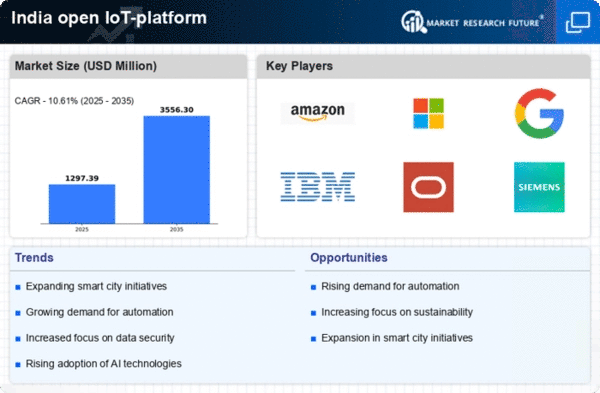
India Open IoT Platform Market Infographic
Purchase Options

India Open IoT Platform Market Summary

As per Market Research Future analysis, the India open IoT-platform size was estimated at 1172.94 USD Million in 2024. The India open iot-platform market is projected to grow from 1297.39 USD Million in 2025 to 3556.3 USD Million by 2035, exhibiting a compound annual growth rate (CAGR) of 10.6% during the forecast period 2025 - 2035

Key Market Trends & Highlights

The India open IoT-platform market is experiencing robust growth driven by technological advancements and increasing demand for smart solutions.

  • Interoperability and integration are becoming crucial as businesses seek seamless connectivity across devices and platforms.
  • Investment in research and development is on the rise, particularly in the largest segment of smart home solutions.
  • Sustainability and energy efficiency are gaining traction, with the fastest-growing segment being industrial IoT applications.
  • Government initiatives and support, along with rising demand for smart solutions, are key drivers propelling market expansion.

Market Size & Forecast

2024 Market Size 1172.94 (USD Million)
2035 Market Size 3556.3 (USD Million)
CAGR (2025 - 2035) 10.61%

Major Players

Amazon (US), Microsoft (US), Google (US), IBM (US), Oracle (US), Siemens (DE), Cisco (US), GE (US)

Our Impact
Enabled $4.3B Revenue Impact for Fortune 500 and Leading Multinationals
Partnering with 2000+ Global Organizations Each Year
30K+ Citations by Top-Tier Firms in the Industry

India Open IoT Platform Market Trends

The open iot-platform market is currently experiencing a transformative phase, driven by the increasing demand for interconnected devices and smart solutions. As industries across various sectors adopt IoT technologies, the need for open platforms that facilitate seamless integration and interoperability becomes more pronounced. This trend is particularly evident in sectors such as agriculture, healthcare, and manufacturing, where the ability to collect and analyze data in real-time is crucial for enhancing operational efficiency and decision-making. Furthermore, the government's initiatives to promote digitalization and smart city projects are likely to bolster the growth of this market, as they encourage the development of innovative solutions that leverage IoT capabilities. In addition, the open iot-platform market is witnessing a surge in investments from both public and private sectors. This influx of capital is aimed at fostering research and development, which is essential for creating advanced platforms that can support a wide range of applications. The emphasis on sustainability and energy efficiency is also shaping the market landscape, as organizations seek to implement IoT solutions that minimize environmental impact. Overall, the open iot-platform market appears poised for substantial growth, driven by technological advancements and a supportive regulatory environment.

Interoperability and Integration

The demand for interoperability among devices is a key trend in the open iot-platform market. Organizations are increasingly seeking platforms that allow diverse devices to communicate effectively, ensuring seamless data exchange. This trend is crucial for maximizing the potential of IoT applications across various sectors.

Investment in Research and Development

There is a notable increase in investments directed towards research and development within the open iot-platform market. This focus on innovation is essential for creating advanced platforms that can cater to evolving technological needs and support a wide array of applications.

Sustainability and Energy Efficiency

The emphasis on sustainability is shaping the open iot-platform market. Organizations are prioritizing IoT solutions that not only enhance operational efficiency but also contribute to environmental conservation. This trend reflects a growing awareness of the need for energy-efficient technologies.

India Open IoT Platform Market Drivers

Collaboration and Partnerships

Collaboration among various stakeholders is emerging as a key driver for the open iot-platform market in India. Partnerships between technology providers, government agencies, and academic institutions are fostering innovation and knowledge sharing. These collaborations can lead to the development of new applications and services that leverage IoT technologies. For instance, joint ventures between startups and established firms may result in the creation of tailored solutions for specific industries. This collaborative approach not only enhances the capabilities of the open iot-platform market but also accelerates the pace of technological advancement, positioning India as a hub for IoT innovation.

Rising Demand for Smart Solutions

There is a growing demand for smart solutions across various sectors in India, including agriculture, healthcare, and manufacturing. The open iot-platform market is positioned to cater to this demand by providing integrated solutions that enhance operational efficiency and data management. For instance, the agriculture sector is increasingly adopting IoT technologies to optimize resource usage and improve yield. According to recent estimates, the smart agriculture market in India is projected to grow at a CAGR of 20% over the next five years. This trend indicates a robust opportunity for the open iot-platform market to expand its offerings and address the specific needs of diverse industries.

Focus on Data Security and Privacy

As the open iot-platform market expands, concerns regarding data security and privacy are becoming increasingly prominent. In India, regulatory frameworks are evolving to address these issues, which could drive the adoption of secure IoT solutions. Companies are likely to invest in robust security measures to protect sensitive data and comply with regulations. This focus on security may lead to the development of innovative solutions within the open iot-platform market, enhancing trust among users. Furthermore, organizations that prioritize data protection could gain a competitive edge, attracting more clients who are concerned about privacy and security in their IoT deployments.

Government Initiatives and Support

The Indian government has been actively promoting the adoption of digital technologies, including the open iot-platform market, through various initiatives. Programs such as Digital India aim to enhance connectivity and encourage innovation in technology. The government's push for smart cities and the Internet of Things (IoT) infrastructure is likely to create a conducive environment for the open iot-platform market. Furthermore, financial incentives and grants for startups in the technology sector may stimulate growth. As a result, the open iot-platform market could witness increased participation from both established companies and new entrants, fostering a competitive landscape that drives innovation and development.

Increased Connectivity and Internet Penetration

India has witnessed a significant increase in internet penetration, with over 700 million active internet users as of 2025. This surge in connectivity is a crucial driver for the open iot-platform market, as it enables seamless communication between devices and systems. Enhanced internet access facilitates the deployment of IoT solutions across urban and rural areas, allowing businesses to leverage data for better decision-making. The proliferation of affordable smartphones and IoT devices further supports this trend, making it easier for consumers and enterprises to adopt open iot-platform solutions. Consequently, the open iot-platform market is likely to experience accelerated growth as more users engage with connected technologies.


Market Segment Insights

By Deployment Model: Cloud-based (Largest) vs. Hybrid (Fastest-Growing)

The market share distribution among deployment models in the India open iot-platform market shows that cloud-based solutions hold the largest segment share due to their scalability and flexibility. Many organizations prefer cloud models as they provide easier access to advanced technologies and lower upfront costs, appealing to businesses of all sizes. In contrast, on-premises solutions cater to organizations with specific security needs but have a smaller market share as businesses increasingly lean towards cloud solutions. Recent trends indicate that hybrid deployment models are gaining traction, recognized for their ability to combine the benefits of both cloud and on-premises solutions. This segment is emerging rapidly as businesses seek to harness the advantages of cloud while maintaining control over sensitive data. The growth drivers include the increasing demand for scalability, cost efficiency, and the rising adoption of IoT technologies across various industries, leading to a shift towards hybrid models in the market.

Cloud-based (Dominant) vs. On-premises (Emerging)

In the India open iot-platform market, cloud-based deployments dominate due to their ability to provide scalable solutions and reduced IT overhead. These solutions allow businesses to access IoT applications without needing extensive on-site infrastructure, promoting faster implementation and lower costs. On-premises solutions, while emerging and tailored for organizations with strict regulatory requirements, are often seen as less flexible compared to their cloud counterparts. However, there remains a niche demand for on-premises models, especially among enterprises prioritizing data privacy and security. As organizations evolve in their IoT adoption, combining on-premises with cloud-based solutions is becoming a popular strategy, leading to the rise of hybrid models.

By Application: Smart Cities (Largest) vs. Healthcare (Fastest-Growing)

The market share distribution within the application segment of the India open iot-platform market reveals Smart Cities as the largest contributor, dominating with significant adoption across urban areas. This segment benefits from extensive government initiatives aimed at urban modernization, leading to efficient resource management and enhanced citizen services. In contrast, Healthcare has emerged as a rapidly expanding application, driven by the increasing need for digital health solutions and remote patient monitoring systems in response to the growing healthcare demands. Growth trends within the segment are significantly influenced by technology advancements and shifting consumer demands. Smart Cities continue to grow as cities seek to utilize IoT for improving infrastructure and service delivery. Meanwhile, Healthcare's rapid growth is attributed to the COVID-19 pandemic highlighting the importance of telemedicine and smart health devices, making it an essential aspect of the overall market expansion.

Smart Cities (Dominant) vs. Agriculture (Emerging)

Smart Cities represent the dominant application in the India open iot-platform market, characterized by the integration of IoT technologies to enhance urban living through smart lighting, waste management, and traffic management solutions. The focus on sustainable city planning and enhanced citizen engagement fosters continuous investment in Smart City initiatives. On the other hand, Agriculture is emerging as a pivotal segment, leveraging IoT for precision farming, enhancing yield, managing resources efficiently, and ensuring sustainable practices. With the rising population and the need for food security, this application is expected to receive substantial attention and investment, indicating its promising growth potential in the coming years.

By End Use Industry: Retail (Largest) vs. Manufacturing (Fastest-Growing)

In the India open iot-platform market, the major end use industries include retail, manufacturing, transportation, and energy and utilities. Among these, retail commands the largest share due to the increasing adoption of IoT solutions for enhancing customer experiences and operational efficiencies. Manufacturing follows, with its significant utilization of smart devices and automation for productivity improvements. The growth trends in the sector are propelled by the rapid digital transformation across all industries. With advancements in technology and an increasing focus on automation, manufacturing is emerging as the fastest-growing segment, leveraging IoT for monitoring equipment and predictive maintenance. In contrast, retail continues to thrive as a dominant force, driven by the need for personalized customer engagement and supply chain efficiency.

Retail (Dominant) vs. Manufacturing (Emerging)

Retail, as the dominant end use industry, exemplifies the successful integration of IoT technologies, focusing on improving customer experiences and optimizing operational performance. It thrives on data analytics to understand consumer behavior, enabling personalized marketing and efficient inventory management. Meanwhile, manufacturing is an emerging segment, increasingly adopting IoT for automation and enhanced production processes. This industry focuses on smart factories and industrial IoT applications that provide real-time visibility and control over manufacturing operations. Both segments reflect distinct yet interlinked characteristics, showcasing how IoT is shaping the future of industry practices in the marketplace.

By Component: Software (Largest) vs. Platform (Fastest-Growing)

In the India open iot-platform market, the Component segment is characterized by diverse offerings including Software, Platform, and Services. Among these, Software holds the largest share, driven by the increasing demand for comprehensive solutions that facilitate seamless integration and intelligence across various devices. Meanwhile, the Platform segment is experiencing rapid growth, fueled by the rise in IoT device adoption and the need for scalable infrastructure that can support innovative applications. The growth trends in the Component segment reflect a shift towards more sophisticated technologies that enhance connectivity and data analytics. As businesses increasingly seek to leverage IoT capabilities, the demand for platforms that can provide robust development environments continues to expand. Additionally, both Software and Platform solutions are being adopted in various sectors, including smart cities and industrial automation, emphasizing their crucial role in the evolving digital landscape.

Software: Dominant vs. Platform: Emerging

In the context of the India open iot-platform market, Software emerges as the dominant value, providing critical capabilities that enable data management, device interoperability, and analytics. Its comprehensive functionalities address the need for efficient operations across various industries. In contrast, the Platform segment, while currently emerging, showcases extensive potential due to the burgeoning IoT ecosystem. As industries embrace digital transformation, platforms that facilitate real-time data exchange and application development are gaining traction. The interplay between these two segments highlights a trend where Software enhances the efficacy of Platforms, ultimately driving growth and innovation across the market.

Get more detailed insights about India Open IoT Platform Market

Key Players and Competitive Insights

The open iot-platform market in India is characterized by a dynamic competitive landscape, driven by rapid technological advancements and increasing demand for interconnected devices. Major players such as Amazon (US), Microsoft (US), and Siemens (DE) are strategically positioning themselves through innovation and regional expansion. Amazon (US) focuses on enhancing its cloud services, while Microsoft (US) emphasizes its Azure platform to facilitate seamless integration of IoT solutions. Siemens (DE) is leveraging its expertise in industrial automation to offer tailored IoT solutions, thereby shaping a competitive environment that prioritizes technological differentiation and customer-centric approaches.Key business tactics within this market include localizing manufacturing and optimizing supply chains to enhance operational efficiency. The competitive structure appears moderately fragmented, with several key players exerting influence over various segments. This fragmentation allows for niche players to emerge, fostering innovation and competition. The collective influence of these major companies is significant, as they drive market trends and set benchmarks for quality and service delivery.

In October Amazon (US) announced the launch of its new IoT device management service, aimed at simplifying the deployment and management of connected devices. This strategic move is likely to enhance customer engagement and streamline operations for businesses adopting IoT solutions. By providing a comprehensive management platform, Amazon (US) positions itself as a leader in the IoT space, potentially increasing its market share and reinforcing its competitive edge.

In September Microsoft (US) unveiled a partnership with a leading Indian telecommunications provider to enhance IoT connectivity across urban areas. This collaboration is strategically important as it not only expands Microsoft's reach but also addresses the growing demand for reliable IoT infrastructure in densely populated regions. Such partnerships are indicative of a broader trend where technology companies align with local players to leverage regional expertise and resources.

In August Siemens (DE) launched a new initiative focused on sustainability within its IoT offerings, emphasizing energy efficiency and reduced carbon footprints. This initiative reflects a growing trend towards sustainable practices in technology, appealing to environmentally conscious consumers and businesses. Siemens (DE) is likely to gain a competitive advantage by aligning its products with global sustainability goals, thus enhancing its brand reputation and market positioning.

As of November current trends in the open iot-platform market include a strong emphasis on digitalization, sustainability, and the integration of artificial intelligence (AI). Strategic alliances are increasingly shaping the competitive landscape, enabling companies to pool resources and expertise. The shift from price-based competition to a focus on innovation, technology, and supply chain reliability is evident, suggesting that future competitive differentiation will hinge on the ability to deliver cutting-edge solutions that meet evolving customer needs.

Key Companies in the India Open IoT Platform Market include

Industry Developments

Recent developments in the India Open IoT Platform Market indicate significant advancements and an increase in adoption across various sectors. Companies like Tata Consultancy Services and Infosys are actively expanding their IoT capabilities, focusing on integrating artificial intelligence and machine learning to enhance operational efficiencies. In September 2023, Tech Mahindra announced a partnership with Amazon Web Services to leverage cloud services for developing innovative IoT solutions for smart cities, enhancing connectivity and urban infrastructure. 

Following this, in August 2023, HCL Technologies acquired a startup specializing in IoT security to strengthen its portfolio in providing secure IoT frameworks. Additionally, Wipro has been investing heavily in Research and Development to create robust IoT solutions that cater to the manufacturing and healthcare sectors. 

Growth in the market valuation of these companies reflects positively on overall adoption rates in India, with reports indicating a more than 15% growth year-on-year. Over the last two years, significant policy backing from the Indian government promoting digital transformation initiatives has led to an optimistic outlook for IoT deployments, further involving key players like Siemens and Microsoft in developmental projects.

Future Outlook

India Open IoT Platform Market Future Outlook

The Open IoT Platform Market in India is projected to grow at a 10.61% CAGR from 2025 to 2035, driven by increased connectivity, smart city initiatives, and industrial automation.

New opportunities lie in:

  • Development of customized IoT solutions for agriculture monitoring systems.
  • Integration of AI-driven analytics for predictive maintenance in manufacturing.
  • Expansion of IoT-enabled smart home devices targeting urban consumers.

By 2035, the market is expected to achieve substantial growth, driven by innovation and strategic investments.

Market Segmentation

India Open IoT Platform Market Component Outlook

  • Platform
  • Software
  • Services

India Open IoT Platform Market Application Outlook

  • Smart Cities
  • Industrial Automation
  • Healthcare
  • Agriculture

India Open IoT Platform Market Deployment Model Outlook

  • Cloud-based
  • On-premises
  • Hybrid

India Open IoT Platform Market End Use Industry Outlook

  • Retail
  • Manufacturing
  • Transportation
  • Energy and Utilities

Report Scope

MARKET SIZE 2024 1172.94(USD Million)
MARKET SIZE 2025 1297.39(USD Million)
MARKET SIZE 2035 3556.3(USD Million)
COMPOUND ANNUAL GROWTH RATE (CAGR) 10.61% (2025 - 2035)
REPORT COVERAGE Revenue Forecast, Competitive Landscape, Growth Factors, and Trends
BASE YEAR 2024
Market Forecast Period 2025 - 2035
Historical Data 2019 - 2024
Market Forecast Units USD Million
Key Companies Profiled Amazon (US), Microsoft (US), Google (US), IBM (US), Oracle (US), Siemens (DE), Cisco (US), GE (US)
Segments Covered Deployment Model, Application, End Use Industry, Component
Key Market Opportunities Integration of advanced analytics and AI enhances functionality in the open iot-platform market.
Key Market Dynamics Rising demand for interoperability drives innovation in open IoT-platforms amid evolving regulatory frameworks.
Countries Covered India
Leave a Comment

FAQs

What is the projected market value of the India Open IoT Platform Market in 2024?

The projected market value of the India Open IoT Platform Market in 2024 is expected to be 672.5 million USD.

What is the expected market value of the India Open IoT Platform Market by 2035?

By 2035, the India Open IoT Platform Market is expected to reach a value of 3,380.0 million USD.

What is the forecasted CAGR for the India Open IoT Platform Market from 2025 to 2035?

The expected CAGR for the India Open IoT Platform Market from 2025 to 2035 is 15.81%.

Which deployment model is projected to dominate the market in 2035?

The cloud-based deployment model is projected to dominate the market with a value of 1,500.0 million USD in 2035.

What is the value of the hybrid deployment model in the India Open IoT Platform Market for 2024?

The hybrid deployment model is valued at 172.5 million USD in the India Open IoT Platform Market for the year 2024.

Who are the major players in the India Open IoT Platform Market?

Key players in the market include Oracle, Microsoft, Amazon Web Services, and Tech Mahindra among others.

What is the expected market value for the on-premises model in 2035?

The on-premises model is expected to reach a market value of 1,000.0 million USD by the year 2035.

What are the anticipated growth drivers for the India Open IoT Platform Market?

Anticipated growth drivers include increasing adoption of smart devices and enhanced connectivity solutions.

How will emerging technologies impact the India Open IoT Platform Market?

Emerging technologies are expected to enhance interoperability and drive innovation in the India Open IoT Platform Market.

What challenges does the India Open IoT Platform Market face?

Challenges include data security concerns and the need for standardization in IoT protocols.

Download Free Sample

Kindly complete the form below to receive a free sample of this Report

Compare Licence

×
Features License Type
Single User Multiuser License Enterprise User
Price $4,950 $5,950 $7,250
Maximum User Access Limit 1 User Upto 10 Users Unrestricted Access Throughout the Organization
Free Customization
Direct Access to Analyst
Deliverable Format
Platform Access
Discount on Next Purchase 10% 15% 15%
Printable Versions