×
Request Free Sample ×

Kindly complete the form below to receive a free sample of this Report

* Please use a valid business email

Leading companies partner with us for data-driven Insights

clients tt-cursor
Hero Background

Germany Open Iot Platform Market

ID: MRFR/ICT/60593-HCR
200 Pages
Aarti Dhapte
February 2026

Germany Open IoT Platform Market Research Report By Deployment Model (Cloud-based, On-premises, Hybrid), By Application (Smart Cities, Industrial Automation, Healthcare, Agriculture), By End Use Industry (Retail, Manufacturing, Transportation, Energy and Utilities) and By Component (Platform, Software, Services)- Forecast to 2035

Share:
Download PDF ×

We do not share your information with anyone. However, we may send you emails based on your report interest from time to time. You may contact us at any time to opt-out.

Germany Open Iot Platform Market Infographic
Purchase Options

Germany Open Iot Platform Market Summary

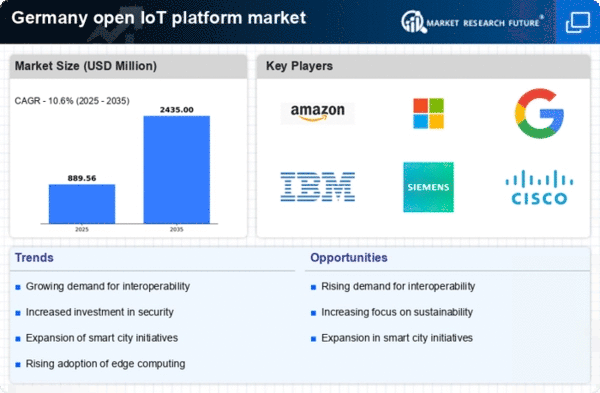
As per Market Research Future analysis, the Germany open iot-platform market Size was estimated at 804.3 USD Million in 2024. The Germany open iot-platform market is projected to grow from 889.56 USD Million in 2025 to 2435.0 USD Million by 2035, exhibiting a compound annual growth rate (CAGR) of 10% during the forecast period 2025 - 2035

Key Market Trends & Highlights

The Germany open IoT-platform market is poised for substantial growth driven by technological advancements and increasing demand for smart solutions.

  • The market is witnessing increased interoperability among various IoT devices, enhancing overall system efficiency.
  • Data security remains a focal point as organizations prioritize safeguarding sensitive information in IoT applications.
  • Edge computing is on the rise, enabling faster data processing and reduced latency for real-time applications.
  • The growing demand for smart infrastructure and regulatory support for IoT innovations are key drivers propelling market expansion.

Market Size & Forecast

2024 Market Size 804.3 (USD Million)
2035 Market Size 2435.0 (USD Million)
CAGR (2025 - 2035) 10.6%

Major Players

Amazon (US), Microsoft (US), Google (US), IBM (US), Siemens (DE), Cisco (US), Oracle (US), SAP (DE), Bosch (DE)

Our Impact
Enabled $4.3B Revenue Impact for Fortune 500 and Leading Multinationals
Partnering with 2000+ Global Organizations Each Year
30K+ Citations by Top-Tier Firms in the Industry

Germany Open Iot Platform Market Trends

The open iot-platform market is currently experiencing a transformative phase, characterized by rapid technological advancements and increasing adoption across various sectors. In Germany, the integration of IoT solutions into industrial processes is becoming more prevalent, driven by the need for enhanced efficiency and data-driven decision-making. This trend is further supported by government initiatives aimed at fostering innovation and digitalization within the economy. As organizations seek to leverage the benefits of interconnected devices, the demand for open platforms that facilitate interoperability and scalability is likely to grow. Moreover, the emphasis on sustainability and energy efficiency is shaping the landscape of the open iot-platform market. Companies are increasingly focusing on solutions that not only optimize operations but also contribute to environmental goals. This shift is evident in the rise of smart city projects and initiatives aimed at reducing carbon footprints. As the market evolves, collaboration among stakeholders, including technology providers, regulatory bodies, and end-users, appears essential for driving growth and ensuring the successful implementation of IoT solutions.

Increased Interoperability

The open iot-platform market is witnessing a trend towards enhanced interoperability among devices and systems. This development is crucial as organizations seek to integrate diverse technologies seamlessly. By adopting open standards, companies can ensure that their IoT solutions communicate effectively, leading to improved operational efficiency and reduced costs.

Focus on Data Security

As the open iot-platform market expands, concerns regarding data security are becoming more pronounced. Organizations are prioritizing the implementation of robust security measures to protect sensitive information. This focus on safeguarding data is likely to drive the development of advanced security protocols and solutions within the market.

Rise of Edge Computing

The emergence of edge computing is significantly influencing the open iot-platform market. By processing data closer to the source, organizations can reduce latency and enhance real-time decision-making capabilities. This trend is particularly relevant for applications requiring immediate responses, such as industrial automation and smart transportation.

Germany Open Iot Platform Market Drivers

Regulatory Support for IoT Innovations

In Germany, regulatory frameworks are increasingly supportive of IoT innovations, which is a crucial driver for the open iot-platform market. The government has implemented policies aimed at fostering technological advancements and ensuring data protection. For instance, the Digital Strategy 2025 outlines initiatives to promote IoT adoption across various sectors, including manufacturing and healthcare. This regulatory environment encourages businesses to invest in open iot-platform solutions, as compliance with regulations becomes more manageable. The open iot-platform market stands to gain from this supportive landscape, as it facilitates the development of innovative applications that align with regulatory standards.

Growing Demand for Smart Infrastructure

The open iot-platform market in Germany is experiencing a notable surge in demand for smart infrastructure solutions. This trend is driven by the increasing need for efficient energy management and urban planning. As cities evolve into smart cities, the integration of IoT platforms becomes essential for managing resources effectively. According to recent data, investments in smart infrastructure are projected to reach €50 billion by 2026, indicating a robust growth trajectory. The open iot-platform market is positioned to benefit significantly from this trend, as it enables seamless connectivity and data exchange among various smart devices, enhancing operational efficiency and sustainability.

Rising Adoption of Industry 4.0 Practices

The open iot-platform market is significantly influenced by the rising adoption of Industry 4.0 practices in Germany. As manufacturers increasingly embrace automation and data exchange, the demand for open IoT solutions is expected to grow. Industry 4.0 emphasizes the interconnectivity of machines and systems, which necessitates robust IoT platforms for real-time data analytics and decision-making. Recent statistics indicate that over 70% of German manufacturers are investing in IoT technologies to enhance productivity and reduce operational costs. This trend presents a substantial opportunity for the open iot-platform market, as it provides the necessary infrastructure for seamless integration and communication among devices.

Increased Focus on Sustainability Initiatives

Sustainability has become a pivotal concern in Germany, driving the open iot-platform market towards innovative solutions that promote environmental responsibility. The German government has set ambitious targets for reducing carbon emissions, which necessitates the adoption of smart technologies. Open IoT platforms play a vital role in monitoring and managing energy consumption, waste management, and resource allocation. As organizations strive to meet sustainability goals, the market for open IoT solutions is expected to expand. The open iot-platform market is likely to see increased investments, as businesses recognize the potential for IoT technologies to contribute to their sustainability initiatives.

Emergence of Advanced Analytics and AI Integration

The integration of advanced analytics and artificial intelligence (AI) into open IoT platforms is emerging as a key driver in Germany. Businesses are increasingly leveraging data analytics to derive actionable insights from IoT-generated data. This trend enhances operational efficiency and enables predictive maintenance, which is particularly valuable in manufacturing and logistics sectors. The open iot-platform market is poised to benefit from this technological evolution, as companies seek platforms that can support AI capabilities. With the potential to improve decision-making processes and reduce downtime, the demand for such integrated solutions is likely to rise, further propelling the growth of the open iot-platform market.


Market Segment Insights

By Deployment Model: Cloud-based (Largest) vs. On-premises (Fastest-Growing)

In the Germany open iot-platform market, the deployment model segment is experiencing a significant distribution among cloud-based, on-premises, and hybrid solutions. Cloud-based platforms currently hold the largest share, appealing to businesses seeking scalability and flexibility. On-premises solutions, however, are gaining traction due to their capability for secure and localized data processing, attracting enterprises concerned with data privacy and compliance. Hybrid models are also present, catering to organizations needing the advantages of both deployment types. The growth trends in the deployment model segment are driven by the increasing demand for cloud technologies alongside a resurgence in on-premises solutions as data security becomes paramount. Cloud-based platforms are expected to continue their dominance, supported by continual advancements in cloud infrastructure. Meanwhile, on-premises deployment is projected to be the fastest-growing segment as more enterprises transition to solutions that prioritize data sovereignty and governance, reflecting shifting priorities in the technological landscape.

Cloud-based (Dominant) vs. On-premises (Emerging)

Cloud-based deployment models are viewed as dominant in the Germany open iot-platform market thanks to their extensive scalability and accessibility. They facilitate rapid deployment and continuous updates, making it easier for businesses to innovate and expand their operations. Additionally, as organizations increasingly embrace digital transformation, cloud solutions are pivotal in enabling IoT functionalities across various sectors. On the other hand, on-premises deployment is emerging as a significant option due to rising concerns over privacy and data protection regulations. This model provides organizations with greater control over their data and systems, leading to cautious adoption as companies weigh the trade-offs between local infrastructure and cloud flexibility.

By Application: Smart Cities (Largest) vs. Agriculture (Fastest-Growing)

In the Germany open iot-platform market, Smart Cities emerged as the largest segment, capturing a significant portion of the total application share. This segment benefits from rapid urbanization and a growing emphasis on sustainability and efficient resource management. Conversely, Agriculture has shown remarkable growth potential, driven by innovations in IoT technology aimed at enhancing farm productivity and sustainability. These sectors highlight the diverse applications of IoT solutions across different industries. The growth trends in the Germany open iot-platform market indicate a robust expansion in the Smart Cities segment, fueled by government initiatives and investments in digital infrastructure. Meanwhile, the Agriculture segment is experiencing heightened interest due to the increasing adoption of precision farming techniques, which leverage IoT for real-time data analytics, improving yields and reducing waste. Both segments are poised for continuous growth, addressing the evolving needs of urban and rural communities.

Smart Cities (Dominant) vs. Agriculture (Emerging)

Smart Cities represent the dominant application segment, characterized by comprehensive infrastructure developments, smart governance, and integrated services that enhance urban living. This segment leverages IoT technologies for traffic management, energy efficiency, and enhanced public safety, thus attracting significant investment from both government and private entities. On the other hand, Agriculture is an emerging segment where IoT applications are innovatively used for monitoring soil conditions, managing crop health, and optimizing resource consumption. This segment appeals to farmers looking to increase productivity through data-driven decisions. While Smart Cities continue to lead, Agriculture is quickly gaining traction, driven by technological advancements and a growing need for sustainable farming practices.

By End Use Industry: Retail (Largest) vs. Manufacturing (Fastest-Growing)

In the Germany open iot-platform market, the Retail sector commands a significant share, driven by the increasing adoption of smart technologies and automation solutions. Retail contributes substantially to the market dynamics, leveraging IoT applications to strengthen operational efficiency and enhance customer experiences. Conversely, the Manufacturing segment is rapidly gaining traction, showcasing a robust growth trajectory as industries seek to integrate IoT solutions for optimized production processes and predictive maintenance, marking it as an emerging powerhouse in the market. The growth trends within these segments are propelled by various factors, including the rising demand for smart inventory management in Retail and the push for Industry 4.0 initiatives in Manufacturing. Retailers are increasingly focusing on customer engagement and supply chain optimizations through IoT applications, while manufacturers are turning towards IoT to enhance productivity and reduce costs. Furthermore, innovations in data analytics and connectivity solutions are expected to bolster the growth of these segments in the coming years.

Retail: Dominant vs. Manufacturing: Emerging

The Retail sector is recognized as the dominant player in the Germany open iot-platform market, characterized by its extensive utilization of IoT technologies to enhance customer engagement and streamline operations. Retailers are investing in smart shelves, IoT-enabled payment systems, and inventory management solutions to stay competitive. In contrast, the Manufacturing sector, while currently emerging, is accelerating its adoption of IoT to embrace automation and improve efficiency. Manufacturers are implementing IoT for real-time monitoring, equipment diagnostics, and supply chain management, making significant strides towards smart factory concepts. This juxtaposition of the dominant Retail segment with the burgeoning Manufacturing segment exemplifies the diverse applications of IoT across industries, highlighting both stability and growth potential.

By Component: Software (Largest) vs. Services (Fastest-Growing)

In the Germany open iot-platform market, Software holds the largest market share among the component values, driven by the rapid adoption of digital solutions across various industries. Its robustness and flexibility make it a preferred choice for enterprises aiming to enhance their operational efficiency. Meanwhile, Services are emerging as a critical component, showcasing considerable growth owing to the rising demand for expert implementation and maintenance support, which complements existing software solutions. Growth drivers for the component segment include the ongoing digital transformation, increased investments in IoT technologies, and a growing emphasis on data analytics. Organizations are prioritizing seamless integration of platforms with robust software offerings to harness data effectively. As more businesses recognize the value of tailored services for IoT systems, this segment is set to witness accelerated growth, especially as customer expectations evolve toward more personalized and value-driven solutions.

Software (Dominant) vs. Services (Emerging)

Software is characterized by its capability to allow businesses to build customized IoT solutions that integrate seamlessly with existing systems. This dominance stems from its ability to cater to various sectors and its continuous evolution to meet customer needs. Services, on the other hand, are rapidly gaining traction as an emerging value, focusing on providing support in deployment, integration, and maintenance of IoT platforms. The demand for such services is fueled by the need for businesses to leverage their software investments fully and ensure optimal performance. As organizations increasingly turn towards comprehensive IoT solutions, the interplay between these two components will play a pivotal role in shaping the market landscape.

Get more detailed insights about Germany Open Iot Platform Market

Key Players and Competitive Insights

The open IoT-platform market in Germany is characterized by a dynamic competitive landscape, driven by rapid technological advancements and increasing demand for interconnected devices. Major players such as Amazon (US), Microsoft (US), and Siemens (DE) are strategically positioned to leverage their extensive resources and expertise. Amazon (US) focuses on enhancing its cloud services, which are integral to IoT solutions, while Microsoft (US) emphasizes its Azure platform, aiming to provide robust data analytics and AI capabilities. Siemens (DE), with its strong industrial background, is concentrating on integrating IoT solutions into manufacturing processes, thereby enhancing operational efficiency. Collectively, these strategies foster a competitive environment that prioritizes innovation and technological integration, shaping the future of the market.Key business tactics within this market include localizing manufacturing and optimizing supply chains to enhance responsiveness to customer needs. The competitive structure appears moderately fragmented, with a mix of established tech giants and emerging startups. This fragmentation allows for diverse offerings and innovation, although the influence of key players remains substantial, as they set industry standards and drive technological advancements.

In October Siemens (DE) announced a partnership with a leading automotive manufacturer to develop smart factory solutions that utilize IoT technologies. This collaboration is significant as it not only enhances Siemens' portfolio but also positions it as a leader in the automotive sector's digital transformation. By integrating IoT into manufacturing, Siemens (DE) aims to streamline production processes and reduce operational costs, thereby reinforcing its competitive edge.

In September Amazon (US) launched a new suite of IoT services aimed at small and medium-sized enterprises (SMEs). This strategic move is noteworthy as it expands Amazon's reach into a previously underserved market segment, potentially increasing its market share. By providing tailored IoT solutions, Amazon (US) seeks to empower SMEs to adopt digital technologies, thereby fostering innovation and growth within this sector.

In August Microsoft (US) unveiled a new AI-driven analytics tool integrated into its Azure IoT platform. This tool is designed to enhance data processing capabilities for businesses, allowing for real-time insights and improved decision-making. The introduction of such advanced analytics tools indicates Microsoft's commitment to maintaining its competitive advantage through continuous innovation and responsiveness to market demands.

As of November current trends in the open IoT-platform market are heavily influenced by digitalization, sustainability, and AI integration. Strategic alliances among key players are increasingly shaping the competitive landscape, fostering collaboration that enhances technological capabilities. Looking ahead, it appears that competitive differentiation will evolve from traditional price-based competition to a focus on innovation, technology, and supply chain reliability. Companies that prioritize these aspects are likely to thrive in an increasingly interconnected and technology-driven market.

Key Companies in the Germany Open Iot Platform Market include

Industry Developments

In recent developments within the Germany Open Internet of Things (IoT) Platform Market, notable advancements have been made by leading companies such as SAP, , focusing on enhancing connectivity and interoperability among devices. In October 2023, SAP launched an innovative cloud-based application aimed at improving data integration for IoT solutions, further solidifying its market positioning. Moreover, in August 2023, Oracle announced a collaboration to deliver next-generation IoT solutions, leveraging both companies' expertise to streamline data management and improve operational efficiency.

Mergers and acquisitions have also shaped the landscape, with Microsoft acquiring a Berlin-based IoT startup in September 2023, enhancing its capabilities in smart manufacturing. Additionally, in June 2022, Siemens announced a strategic partnership to strengthen IoT deployments in Germany. The overall market is experiencing a significant valuation growth, with increased investments in infrastructure and technology expected to enhance innovation and drive competitive advantages across various sectors. The German government's commitment to digital transformation continues to foster advancements, illustrating a proactive approach towards a connected future.

Future Outlook

Germany Open Iot Platform Market Future Outlook

The Open IoT Platform Market in Germany is projected to grow at a 10.6% CAGR from 2025 to 2035, driven by increased connectivity, data analytics, and automation.

New opportunities lie in:

  • Development of integrated smart city solutions for urban management.
  • Expansion of IoT security services to protect connected devices.
  • Creation of industry-specific IoT platforms for manufacturing optimization.

By 2035, the market is expected to be robust, driven by innovation and strategic partnerships.

Market Segmentation

Germany Open Iot Platform Market Component Outlook

  • Platform
  • Software
  • Services

Germany Open Iot Platform Market Application Outlook

  • Smart Cities
  • Industrial Automation
  • Healthcare
  • Agriculture

Germany Open Iot Platform Market Deployment Model Outlook

  • Cloud-based
  • On-premises
  • Hybrid

Germany Open Iot Platform Market End Use Industry Outlook

  • Retail
  • Manufacturing
  • Transportation
  • Energy and Utilities

Report Scope

MARKET SIZE 2024 804.3(USD Million)
MARKET SIZE 2025 889.56(USD Million)
MARKET SIZE 2035 2435.0(USD Million)
COMPOUND ANNUAL GROWTH RATE (CAGR) 10.6% (2025 - 2035)
REPORT COVERAGE Revenue Forecast, Competitive Landscape, Growth Factors, and Trends
BASE YEAR 2024
Market Forecast Period 2025 - 2035
Historical Data 2019 - 2024
Market Forecast Units USD Million
Key Companies Profiled Amazon (US), Microsoft (US), Google (US), IBM (US), Siemens (DE), Cisco (US), Oracle (US), SAP (DE), Bosch (DE)
Segments Covered Deployment Model, Application, End Use Industry, Component
Key Market Opportunities Integration of advanced analytics and AI capabilities enhances functionality in the open iot-platform market.

Key Market Dynamics Rising demand for interoperability drives innovation in open IoT-platforms amid evolving regulatory frameworks.
Countries Covered Germany
Leave a Comment

FAQs

What is the projected market size of the Germany Open IoT Platform Market in 2024?

In 2024, the Germany Open IoT Platform Market is expected to be valued at 807.0 million USD.

What will be the estimated market size of the Germany Open IoT Platform Market by 2035?

By 2035, the market is projected to reach approximately 2193.0 million USD.

What is the expected CAGR for the Germany Open IoT Platform Market from 2025 to 2035?

The expected CAGR for the Germany Open IoT Platform Market from 2025 to 2035 is 9.514%.

Which deployment model holds the largest market share in the Germany Open IoT Platform Market?

The Cloud-based deployment model is anticipated to hold the largest market share by reaching 998.0 million USD in 2035.

What are the expected market values for the On-premises deployment model in 2024 and 2035?

The On-premises deployment model is expected to be valued at 233.0 million USD in 2024, increasing to 669.0 million USD in 2035.

What market size is projected for the Hybrid deployment model by 2035?

The Hybrid deployment model is forecasted to reach a market value of 526.0 million USD by 2035.

Who are the key players in the Germany Open IoT Platform Market?

Major players in the market include Cisco, Bosch, Microsoft, Oracle, SAP, Siemens, Google Cloud, and Amazon Web Services.

What are some key applications driving the growth of the Germany Open IoT Platform Market?

Key applications driving market growth include smart cities, industrial automation, and connected vehicles.

What are the emerging trends in the Germany Open IoT Platform Market?

Emerging trends include increased adoption of AI-driven IoT solutions and the integration of IoT with edge computing technologies.

How do current global technological advancements influence the Germany Open IoT Platform Market?

Current advancements in technology are fostering innovation and enhancing interoperability in the Germany Open IoT Platform Market.

Download Free Sample

Kindly complete the form below to receive a free sample of this Report

Compare Licence

×
Features License Type
Single User Multiuser License Enterprise User
Price $4,950 $5,950 $7,250
Maximum User Access Limit 1 User Upto 10 Users Unrestricted Access Throughout the Organization
Free Customization
Direct Access to Analyst
Deliverable Format
Platform Access
Discount on Next Purchase 10% 15% 15%
Printable Versions