×
Request Free Sample ×

Kindly complete the form below to receive a free sample of this Report

* Please use a valid business email

Leading companies partner with us for data-driven Insights

clients tt-cursor
Hero Background

India Human Capital Management Market

ID: MRFR/ICT/58343-HCR
200 Pages
Aarti Dhapte
February 2026

India Human Capital Management Market Size, Share and Research Report: By Component (Service, Software Solution), By Size (SMEs, Large Enterprises), By Deployment (Cloud, On Premise), and By End User (Manufacturing, BFSI, IT/ITES, Healthcare, Transportation, Government)-Forecast to 2035

Share:
Download PDF ×

We do not share your information with anyone. However, we may send you emails based on your report interest from time to time. You may contact us at any time to opt-out.

India Human Capital Management Market Infographic
Purchase Options

India Human Capital Management Market Summary

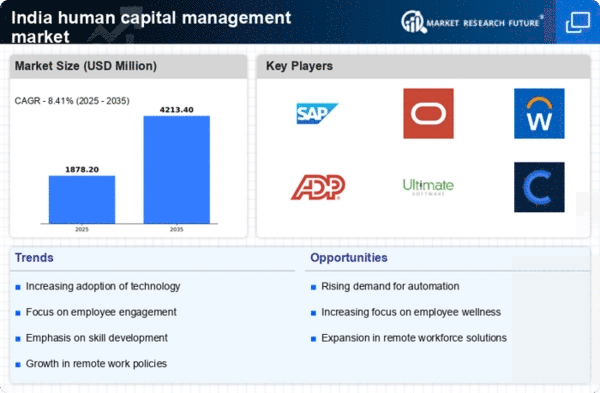
As per Market Research Future analysis, the India human capital management market size was estimated at 1732.5 USD Million in 2024. The India human capital-management market is projected to grow from 1878.2 USD Million in 2025 to 4213.4 USD Million by 2035, exhibiting a compound annual growth rate (CAGR) of 8.4% during the forecast period 2025 - 2035

Key Market Trends & Highlights

The India human capital-management market is experiencing a transformative shift towards enhanced employee engagement and technological integration.

  • The largest segment in the India human capital-management market is the talent acquisition sector, which continues to expand rapidly.
  • The fastest-growing segment is the employee experience management sector, reflecting a heightened focus on workplace satisfaction.
  • There is a notable trend towards the integration of technology in HR processes, enhancing efficiency and data-driven decision-making.
  • Key market drivers include the growing demand for a skilled workforce and the rise of remote work culture, which are reshaping HR strategies.

Market Size & Forecast

2024 Market Size 1732.5 (USD Million)
2035 Market Size 4213.4 (USD Million)
CAGR (2025 - 2035) 8.41%

Major Players

SAP (DE), Oracle (US), Workday (US), ADP (US), Ultimate Software (US), Ceridian (CA), Paychex (US), Cornerstone OnDemand (US), SuccessFactors (DE)

Our Impact
Enabled $4.3B Revenue Impact for Fortune 500 and Leading Multinationals
Partnering with 2000+ Global Organizations Each Year
30K+ Citations by Top-Tier Firms in the Industry

India Human Capital Management Market Trends

The human capital-management market is currently experiencing a transformative phase, driven by the increasing recognition of human resources as a vital asset for organizational success. Companies are increasingly investing in advanced technologies and innovative practices to enhance employee engagement, streamline recruitment processes, and improve overall workforce productivity. This shift is largely influenced by the growing emphasis on data-driven decision-making, which allows organizations to better understand their workforce dynamics and tailor their strategies accordingly. Furthermore, the integration of artificial intelligence and machine learning into human capital-management solutions is reshaping traditional practices, enabling more efficient talent acquisition and retention strategies. In addition, the focus on employee well-being and development is becoming more pronounced. Organizations are adopting holistic approaches that prioritize mental health, skill enhancement, and work-life balance. This trend reflects a broader societal shift towards valuing employee satisfaction and retention as key components of business success. As the human capital-management market evolves, it appears poised to play a crucial role in shaping the future of work, fostering environments that not only attract top talent but also nurture and retain them effectively. The ongoing advancements in technology and changing workforce expectations suggest that the market will continue to adapt and innovate in response to emerging challenges and opportunities.

Emphasis on Employee Experience

Organizations are increasingly prioritizing employee experience as a core component of their human capital-management strategies. This trend involves creating a supportive work environment that fosters engagement, satisfaction, and productivity. Companies are implementing feedback mechanisms and personalized development plans to enhance the overall employee journey.

Integration of Technology

The integration of technology into human capital-management practices is becoming more prevalent. Organizations are leveraging advanced software solutions to automate processes, analyze workforce data, and improve decision-making. This technological shift is expected to enhance efficiency and effectiveness in managing human resources.

Focus on Diversity and Inclusion

There is a growing emphasis on diversity and inclusion within the human capital-management market. Organizations are recognizing the value of diverse teams and are implementing strategies to promote inclusivity. This trend aims to create a more equitable workplace, which can lead to improved innovation and performance.

India Human Capital Management Market Drivers

Rise of Remote Work Culture

The human capital-management market in India is witnessing a transformation due to the rise of remote work culture. As organizations embrace flexible work arrangements, there is a growing need for effective management of remote teams. This shift is prompting companies to invest in human capital-management solutions that facilitate communication, performance tracking, and employee engagement in a virtual environment. Data suggests that organizations implementing remote work policies have reported a 20% increase in employee satisfaction. Consequently, the demand for tools that support remote workforce management is likely to grow, reshaping the landscape of human capital-management in India.

Focus on Employee Well-being

The human capital-management market in India is increasingly prioritizing employee well-being as a core component of organizational strategy. Companies are recognizing that a healthy workforce is essential for productivity and retention. Initiatives aimed at mental health support, work-life balance, and wellness programs are becoming integral to human capital-management practices. Research indicates that organizations investing in employee well-being programs can experience a 25% reduction in turnover rates. This trend is likely to drive the development of human capital-management solutions that incorporate well-being metrics and support systems, reflecting a holistic approach to talent management.

Growing Demand for Skilled Workforce

The human capital-management market in India is experiencing a notable surge in demand for skilled professionals. As industries evolve, the need for specialized skills becomes increasingly critical. Reports indicate that by 2025, approximately 60% of employers in India are expected to prioritize hiring candidates with advanced technical skills. This shift is likely to drive investments in training and development programs, thereby enhancing the overall talent pool. Companies are recognizing that a skilled workforce is essential for maintaining competitiveness in a rapidly changing market. Consequently, organizations are investing in human capital-management solutions that facilitate effective recruitment, training, and retention strategies, ensuring they attract and retain top talent.

Regulatory Compliance and Labor Laws

The human capital-management market in India is significantly influenced by the evolving landscape of labor laws and regulatory compliance. Recent reforms have introduced new requirements for employee benefits, workplace safety, and fair labor practices. Organizations are compelled to adapt their human capital-management strategies to ensure compliance with these regulations. This necessity is driving the adoption of sophisticated human capital-management systems that streamline compliance processes and reduce the risk of legal penalties. It is estimated that companies investing in compliance-focused human capital-management solutions could see a reduction in legal costs by up to 30%. As such, the market is likely to expand as businesses seek to navigate these complexities.

Technological Advancements in HR Processes

The human capital-management market in India is being propelled by rapid technological advancements that enhance HR processes. Innovations such as artificial intelligence, machine learning, and data analytics are transforming how organizations manage their workforce. These technologies enable more efficient recruitment, performance evaluation, and employee engagement strategies. It is projected that by 2026, the adoption of AI-driven human capital-management solutions could increase operational efficiency by up to 40%. As businesses seek to leverage technology for better decision-making and streamlined processes, the demand for advanced human capital-management systems is expected to rise, shaping the future of workforce management in India.


Market Segment Insights

By Solution Type: Core HCM (Largest) vs. Talent Management (Fastest-Growing)

The distribution of market share within the solution types reveals that Core HCM holds the largest portion, dominating the India human capital-management market. Meanwhile, Talent Management, while smaller in comparison, shows a promising trajectory as organizations increasingly recognize the importance of strategic talent development. This shift indicates a burgeoning interest in specialized solutions that enhance workforce capabilities. Growth trends in this sector are driven by technological advancements and an evolving workforce. Companies are investing in solutions that improve employee engagement and streamline HR processes. The emphasis on data-driven decision-making and predictive analytics further propels the demand for Workforce Management and Recruitment solutions. As organizations continue to prioritize human capital, Learning Management systems are also gaining traction to support continuous employee development.

Core HCM (Dominant) vs. Talent Management (Emerging)

Core HCM stands out as the dominant solution in the India human capital-management market, providing essential functionalities such as payroll, employee records management, and compliance, which are crucial for organizations of all sizes. Its integral role in laying the foundation for HR operations ensures sustained demand. In contrast, Talent Management, an emerging segment, focuses on attracting, developing, and retaining talent, responding to the dynamic needs of modern workplaces. With the rise of remote work and the gig economy, organizations are increasingly adopting Talent Management solutions to build agile teams. Both segments showcase their unique strengths, with Core HCM serving as a backbone and Talent Management driving strategic growth.

By Deployment Type: Cloud-Based (Largest) vs. On-Premises (Fastest-Growing)

In the India human capital-management market, the deployment type segment showcases a significant share distribution among Cloud-Based, On-Premises, and Hybrid solutions. Currently, Cloud-Based solutions hold the largest market share, appealing to organizations for their scalability and cost-effectiveness. In contrast, the On-Premises model is witnessing rapid adoption, particularly among large enterprises that prioritize data security and control. The growth trends in this segment are primarily driven by the increasing demand for flexible and efficient HR solutions. The surge in remote work has further accelerated the preference for Cloud-Based systems, as they offer seamless access and collaboration. Meanwhile, On-Premises solutions are gaining traction due to regulatory compliance needs and organizations' desire for in-house data management, fueling their growth in the market.

Cloud-Based (Dominant) vs. On-Premises (Emerging)

Cloud-Based deployment is viewed as the dominant choice within the India human capital-management market, providing organizations with enhanced accessibility, scalability, and lower upfront costs. It enables remote workforce management and real-time data analysis, which are crucial in today's dynamic business environment. On the other hand, the On-Premises deployment model, while emerging, is favored by businesses that require stringent data privacy and compliance adherence. This model allows companies more control over their systems and data but comes with higher upfront infrastructure investments and maintenance costs. The contrasting characteristics of these deployment types reflect varying organizational priorities, with Cloud-Based solutions continuing to gain preference for their modern capabilities.

By Organization Size: SMEs (Largest) vs. Large Enterprises (Fastest-Growing)

The India human capital-management market shows a significant distribution of market share between SMEs and Large Enterprises, with SMEs holding the largest portion. This dominance is attributed to the increasing number of small and medium-sized businesses in the region, which are increasingly recognizing the importance of effective human capital management solutions to enhance their operational effectiveness. Large Enterprises, however, are emerging as the fastest-growing segment within the market. These organizations are adopting advanced HCM solutions to streamline their HR processes and support a larger workforce. Factors driving this growth include the need for scalability, improved compliance, and the integration of data analytics into HR functions, making these solutions more attractive to larger businesses as they evolve in an increasingly competitive market.

SMEs (Dominant) vs. Large Enterprises (Emerging)

SMEs play a dominant role in the India human capital-management market due to their sheer number and focus on tailored HR solutions that meet their specific needs. These businesses often seek cost-effective solutions that provide essential functionalities, making them a critical segment for HCM providers. In contrast, Large Enterprises are categorized as an emerging segment, driven by their demand for comprehensive and scalable HR solutions. They tend to invest more heavily in advanced technologies like AI and analytics to enhance employee engagement and optimize administrative processes, showcasing a shift towards more sophisticated human capital management practices.

By Industry Vertical: Healthcare (Largest) vs. IT and Telecom (Fastest-Growing)

In the India human capital-management market, the distribution of market share across various industry verticals is notably diverse. Healthcare emerges as the largest segment, driven by an increasing need for compliance and regulatory training, alongside workforce management solutions. Following closely are sectors like Retail and IT and Telecom, which also hold significant portions of the market share, but less than that of Healthcare. Manufacturing and Education are steadily capturing attention due to transformations in skill development and training processes. The growth trends within these segments highlight significant demand drivers, especially in Healthcare and IT and Telecom, where technological advancements and a shift towards digital solutions are prevalent. The IT and Telecom sector is witnessing a rapid expansion, commonly referred to as the fastest-growing segment, fueled by increasing investments in technology and the need for customized human capital solutions. Furthermore, the Manufacturing sector is increasingly adopting integrated systems that enhance productivity and employee engagement through tailored HR solutions.

Healthcare: Largest vs. IT and Telecom: Fastest-Growing

The Healthcare sector remains the dominant player in the India human capital-management market, characterized by its extensive demand for regulatory compliance, employee training, and performance management systems. This segment leverages advanced technologies such as AI and analytics to improve workforce efficiency and patient care. On the other hand, IT and Telecom, labeled as the fastest-growing segment, is rapidly evolving due to technological innovations and the digitalization of HR functions. Organizations within this sector are investing in data-driven HR processes to attract and retain top talent, necessitating innovative HR solutions that cater specifically to their dynamic needs. Both segments demonstrate unique attributes, yet their growth trajectories indicate a robust demand for sophisticated HCM solutions.

Get more detailed insights about India Human Capital Management Market

Key Players and Competitive Insights

The human capital-management market in India is currently characterized by a dynamic competitive landscape, driven by the increasing demand for integrated HR solutions and the ongoing digital transformation across various sectors. Major players such as SAP (DE), Oracle (US), and Workday (US) are strategically positioning themselves through innovation and partnerships, thereby enhancing their operational focus. SAP (DE) emphasizes its cloud-based solutions, which cater to the growing need for scalable HR systems, while Oracle (US) leverages its extensive database capabilities to offer comprehensive analytics tools. Workday (US) continues to innovate with its user-friendly interface and AI-driven functionalities, which collectively shape a competitive environment that prioritizes technological advancement and customer-centric solutions.Key business tactics within this market include localizing services to meet regional demands and optimizing supply chains to enhance service delivery. The competitive structure appears moderately fragmented, with several key players exerting influence over market dynamics. This fragmentation allows for a diverse range of offerings, enabling companies to cater to specific client needs while fostering a competitive atmosphere that encourages innovation and efficiency.

In October SAP (DE) announced a strategic partnership with a leading Indian tech firm to enhance its cloud offerings tailored for local businesses. This collaboration is likely to strengthen SAP's market presence by providing customized solutions that address the unique challenges faced by Indian enterprises. Such partnerships not only expand SAP's reach but also signify a commitment to understanding and integrating local market nuances into their service offerings.

In September Oracle (US) launched a new AI-driven recruitment tool aimed at streamlining the hiring process for Indian companies. This tool is expected to significantly reduce time-to-hire metrics, thereby enhancing operational efficiency for HR departments. The introduction of such innovative solutions indicates Oracle's focus on leveraging technology to meet evolving market demands, positioning itself as a leader in the HR tech space.

In August Workday (US) expanded its operations in India by opening a new regional office dedicated to customer support and training. This move underscores Workday's commitment to providing localized support and enhancing customer experience, which is crucial in a market where personalized service can differentiate a company from its competitors. By investing in local infrastructure, Workday is likely to strengthen its relationships with clients and improve service delivery.

As of November current trends in the human capital-management market are heavily influenced by digitalization, sustainability, and the integration of AI technologies. Strategic alliances are increasingly shaping the competitive landscape, as companies recognize the value of collaboration in driving innovation. The shift from price-based competition to a focus on technological advancement and supply chain reliability is evident, suggesting that future competitive differentiation will hinge on the ability to innovate and adapt to changing market conditions.

Key Companies in the India Human Capital Management Market include

Industry Developments

The India Human Capital Management Market has witnessed significant developments recently. In September 2023, SAP announced enhancements in its HCM solutions, focusing on artificial intelligence to improve workforce management efficiency.

Meanwhile, Workday's latest features, launched in August 2023, emphasize employee experience, leveraging analytics to drive decision-making in talent management. In terms of acquisitions, Freshworks acquired a regional HR software provider in July 2023 to bolster its presence in India’s HR technology landscape.

The market is growing, driven by increased adoption of cloud-based solutions among Indian companies looking to enhance their Human Resource capabilities. Companies like Naukri are expanding their service offerings to include integrated solutions for recruitment and talent management. Furthermore, the valuation of major industry players such as Oracle has increased significantly over the past two years due to rising demand for automated human resources solutions and digital transformation initiatives across enterprises in India.

Additionally, in 2022, Zoho expanded its operations significantly in India, focusing on offering comprehensive HCM services, which has also contributed to the overall market growth. These developments highlight a trend towards integrating advanced technology in HR practices within India's robust business environment.

Future Outlook

India Human Capital Management Market Future Outlook

The human capital-management market in India is projected to grow at 8.41% CAGR from 2025 to 2035, driven by technological advancements and increasing workforce demands.

New opportunities lie in:

  • Integration of AI-driven recruitment platforms
  • Development of personalized employee training programs
  • Expansion of cloud-based HR management solutions

By 2035, the market is expected to achieve substantial growth and innovation.

Market Segmentation

India Human Capital Management Market Solution Type Outlook

  • Core HCM
  • Talent Management
  • Workforce Management
  • Recruitment
  • Learning Management

India Human Capital Management Market Deployment Type Outlook

  • Cloud-Based
  • On-Premises
  • Hybrid

India Human Capital Management Market Industry Vertical Outlook

  • Healthcare
  • Retail
  • IT and Telecom
  • Manufacturing
  • Education

India Human Capital Management Market Organization Size Outlook

  • SMEs
  • Large Enterprises

Report Scope

MARKET SIZE 2024 1732.5(USD Million)
MARKET SIZE 2025 1878.2(USD Million)
MARKET SIZE 2035 4213.4(USD Million)
COMPOUND ANNUAL GROWTH RATE (CAGR) 8.41% (2025 - 2035)
REPORT COVERAGE Revenue Forecast, Competitive Landscape, Growth Factors, and Trends
BASE YEAR 2024
Market Forecast Period 2025 - 2035
Historical Data 2019 - 2024
Market Forecast Units USD Million
Key Companies Profiled SAP (DE), Oracle (US), Workday (US), ADP (US), Ultimate Software (US), Ceridian (CA), Paychex (US), Cornerstone OnDemand (US), SuccessFactors (DE)
Segments Covered Solution Type, Deployment Type, Organization Size, Industry Vertical
Key Market Opportunities Integration of artificial intelligence in talent acquisition and employee engagement processes.
Key Market Dynamics Growing emphasis on digital transformation drives innovation in human capital-management solutions across diverse industries.
Countries Covered India
Leave a Comment

FAQs

What is the expected market size of the India Human Capital Management Market in 2024?

The India Human Capital Management Market is expected to be valued at 1.8 billion USD in 2024.

What will be the projected market size of the India Human Capital Management Market by 2035?

By 2035, the market is projected to reach a value of 4.0 billion USD.

What is the expected CAGR for the India Human Capital Management Market from 2025 to 2035?

The expected CAGR for the market from 2025 to 2035 is 7.523 percent.

Which segment of the India Human Capital Management Market is expected to have a higher valuation in 2035?

The Software Solution segment is expected to reach 2.42 billion USD in 2035, surpassing the Service segment.

What will be the estimated market value of the Service segment in 2035?

The Service segment is estimated to be valued at 1.58 billion USD in 2035.

Who are the major players dominating the India Human Capital Management Market?

Major players in the market include Workday, ADP, SAP, Naukri, and PeopleSoft.

How is the growth trend for the India Human Capital Management Market influenced by technological advancements?

Technological advancements are driving growth by improving efficiency and enhancing user experience in human capital management.

What are the key applications driving the growth of the Human Capital Management Market in India?

Key applications include recruitment, performance management, payroll processing, and employee engagement.

What challenges does the India Human Capital Management Market face for achieving its growth targets?

The market faces challenges like data privacy concerns and the need for integration with existing systems.

How do regional dynamics impact the growth of the India Human Capital Management Market?

Regional dynamics such as economic growth and increasing workforce mobility are positively influencing market expansion.

Download Free Sample

Kindly complete the form below to receive a free sample of this Report

Compare Licence

×
Features License Type
Single User Multiuser License Enterprise User
Price $4,950 $5,950 $7,250
Maximum User Access Limit 1 User Upto 10 Users Unrestricted Access Throughout the Organization
Free Customization
Direct Access to Analyst
Deliverable Format
Platform Access
Discount on Next Purchase 10% 15% 15%
Printable Versions