×
Request Free Sample ×

Kindly complete the form below to receive a free sample of this Report

* Please use a valid business email

Leading companies partner with us for data-driven Insights

clients tt-cursor
Hero Background

India Biometric As A Service Market

ID: MRFR/ICT/57307-HCR
200 Pages
Aarti Dhapte
February 2026

India Biometric as a Service Market Size, Share and Trends Analysis Report By Component (Solution, Service), By Deployment (On-Premise, Cloud-based) and By Application (Configuration Management, Patch Management, Credentials Management, Threat Intelligence, Others) - Forecast to 2035

Share:
Download PDF ×

We do not share your information with anyone. However, we may send you emails based on your report interest from time to time. You may contact us at any time to opt-out.

India Biometric As A Service Market Infographic
Purchase Options

India Biometric As A Service Market Summary

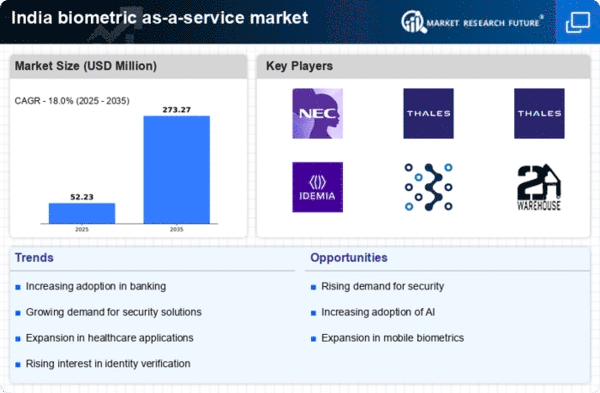
As per Market Research Future analysis, the India biometric as-a-service market size was estimated at 44.26 USD Million in 2024. The India biometric as-a-service market is projected to grow from 52.23 USD Million in 2025 to 273.27 USD Million by 2035, exhibiting a compound annual growth rate (CAGR) of 18% during the forecast period 2025 - 2035

Key Market Trends & Highlights

The India biometric as-a-service market is experiencing robust growth driven by technological advancements and increasing demand for security.

  • The financial services segment represents the largest share of the India biometric as-a-service market, reflecting a strong trend towards secure transactions.
  • Integration with IoT devices is emerging as a key trend, enhancing the functionality and accessibility of biometric solutions.
  • Compliance and data security are becoming focal points for organizations, as they seek to protect sensitive information amidst rising cyber threats.
  • Major market drivers include increasing demand for secure transactions and government initiatives aimed at promoting biometric technology adoption.

Market Size & Forecast

2024 Market Size 44.26 (USD Million)
2035 Market Size 273.27 (USD Million)
CAGR (2025 - 2035) 18.0%

Major Players

NEC Corporation (JP), Gemalto (NL), Thales Group (FR), IDEMIA (FR), BioCatch (US), Aware Inc. (US), Veridium (US), Fingerprint Cards AB (SE), SecuGen Corporation (US)

Our Impact
Enabled $4.3B Revenue Impact for Fortune 500 and Leading Multinationals
Partnering with 2000+ Global Organizations Each Year
30K+ Citations by Top-Tier Firms in the Industry

India Biometric As A Service Market Trends

The The market is experiencing notable growth, driven by increasing demand for secure authentication solutions across various sectors. Organizations are increasingly adopting biometric technologies to enhance security measures, streamline operations, and improve user experiences. This trend is particularly evident in sectors such as banking, healthcare, and government services, where the need for reliable identity verification is paramount. The integration of advanced technologies, such as artificial intelligence and machine learning, further enhances the capabilities of biometric systems, making them more efficient and user-friendly. Moreover, the regulatory landscape is evolving, with governments implementing stricter data protection laws and guidelines. This shift compels businesses to adopt biometric solutions that comply with these regulations, thereby fostering trust among consumers. As a result, the The market is likely to witness increased investment and innovation., as companies seek to differentiate themselves in a competitive environment. The focus on privacy and data security will continue to shape the development of biometric technologies, ensuring that they meet the expectations of both businesses and end-users.

Rising Adoption in Financial Services

The biometric as-a-service market is witnessing heightened interest from financial institutions. Banks and fintech companies are increasingly implementing biometric authentication methods to enhance security and reduce fraud. This trend is driven by the need for secure transactions and the growing prevalence of digital banking services.

Integration with IoT Devices

There is a noticeable trend towards integrating biometric solutions with Internet of Things (IoT) devices. This convergence allows for seamless user experiences and enhanced security across various applications, from smart homes to wearable technology. The synergy between these technologies is expected to drive further innovation.

Focus on Compliance and Data Security

As regulations surrounding data protection become more stringent, businesses are prioritizing compliance in their biometric implementations. The biometric as-a-service market is adapting to these changes by offering solutions that not only enhance security but also ensure adherence to legal requirements, thereby building consumer trust.

India Biometric As A Service Market Drivers

Rising Cybersecurity Threats

The escalating cybersecurity threats in India are driving the biometric as-a-service market towards rapid growth. With cyberattacks becoming more sophisticated, organizations are compelled to adopt robust security measures to protect sensitive data. Biometric authentication offers a unique advantage by providing a higher level of security compared to traditional methods. Reports indicate that cybercrime costs in India could reach $1 trillion by 2025, underscoring the urgency for businesses to invest in advanced security solutions. As companies seek to mitigate risks associated with data breaches, the The market is likely to flourish., offering innovative solutions that address the pressing need for enhanced cybersecurity.

Government Initiatives and Regulations

Government initiatives in India are playing a pivotal role in shaping the biometric as-a-service market. The implementation of the Aadhaar system has set a precedent for biometric identification, leading to increased acceptance of biometric technologies across various sectors. Regulatory frameworks are being established to ensure compliance with data protection laws, which further encourages businesses to adopt biometric solutions. The government's push for digital transformation and smart city projects is likely to create a conducive environment for the growth of the biometric as-a-service market. As public and private sectors collaborate to enhance security and streamline services, the market is expected to witness significant advancements in technology and service offerings.

Growing Awareness of Biometric Solutions

There is a growing awareness of biometric solutions among businesses and consumers in India, which is positively impacting the biometric as-a-service market. As more organizations recognize the benefits of biometric authentication, such as improved security and user convenience, the demand for these services is likely to increase. Educational initiatives and marketing campaigns are helping to inform stakeholders about the advantages of biometric technologies. Additionally, as consumers become more tech-savvy, their expectations for secure and efficient services are rising. This shift in perception is likely to drive the adoption of biometric solutions across various sectors, further propelling the growth of the biometric as-a-service market.

Increasing Demand for Secure Transactions

The biometric as-a-service market is experiencing a surge in demand driven by the need for secure transactions across various sectors in India. With the rise of digital payments, financial institutions are increasingly adopting biometric solutions to enhance security measures. According to recent data, the digital payment market in India is projected to reach $1 trillion by 2025, indicating a substantial opportunity for biometric services. This trend is further fueled by the growing concerns over identity theft and fraud, prompting businesses to seek advanced authentication methods. As organizations prioritize customer trust and data protection, the biometric as-a-service market is likely to expand, offering innovative solutions that cater to the evolving security landscape.

Technological Advancements in Biometric Solutions

Technological advancements are significantly influencing the biometric as-a-service market in India. Innovations in artificial intelligence and machine learning are enhancing the accuracy and efficiency of biometric systems, making them more appealing to businesses. The integration of advanced algorithms and real-time data processing capabilities is likely to improve user experience and reduce operational costs. As organizations increasingly recognize the benefits of adopting cutting-edge biometric technologies, the market is expected to expand. Furthermore, the proliferation of mobile devices and applications is facilitating the adoption of biometric solutions, allowing for seamless integration into existing systems and processes.


Market Segment Insights

By Components: Solutions (Largest) vs. Services (Fastest-Growing)

In the India biometric as-a-service market, the distribution of market share among segment values reveals that Solutions holds the largest share, reflecting the market's preference for comprehensive, integrated options. Meanwhile, Services, which encompass maintenance, support, and consultation for biometric systems, are rapidly gaining traction as businesses seek to optimize their operations through outsourcing.

Solutions (Dominant) vs. Services (Emerging)

Solutions are characterized by their robust features, enabling organizations to deploy biometric systems effectively. This segment dominates the market due to its all-encompassing nature, appealing to various sectors. In contrast, Services are emerging, focusing on flexibility and tailored support. They empower clients to leverage biometric technologies without significant initial investment, thus paving the way for wider adoption in sectors not traditionally associated with high-tech security.

By Deployment: Cloud-Based (Largest) vs. On-Premise (Fastest-Growing)

In the India biometric as-a-service market, the deployment segment is primarily dominated by cloud-based solutions, which hold a significant market share due to their scalability, flexibility, and reduced maintenance costs. Conversely, on-premise solutions remain relevant, appealing to organizations that prioritize security and control over their data, representing a growing slice of the market as more enterprises consider the need for hybrid infrastructures to meet specific operational requirements. Growth trends indicate that while cloud-based deployments continue to expand, driven by the increasing adoption of remote services and digital transformation initiatives, on-premise solutions are experiencing rapid growth. This is largely fueled by regulatory compliance requirements and the need for enhanced data security measures among certain industries. As such, organizations are gravitating towards a balanced approach that incorporates both deployment types, tailoring solutions to fit their unique needs.

Cloud-Based (Dominant) vs. On-Premise (Emerging)

Cloud-based deployment stands out as the dominant force in the market, enabling organizations to leverage advanced biometric technologies without the heavy investment in hardware and infrastructure. This model facilitates rapid deployment and easy upgrades, appealing especially to startups and small businesses looking to implement cost-effective solutions. In contrast, on-premise solutions, while considered emerging, are gaining traction among larger enterprises that require stringent data governance and security measures. These organizations often opt for on-premise systems to maintain full control over sensitive biometric data, thereby mitigating risks associated with cloud vulnerabilities. The distinct advantages of both deployment models cater to varying enterprise needs, contributing to a dynamically evolving marketplace.

By Organization Size: Large Enterprises (Largest) vs. Small and Medium Enterprises (Fastest-Growing)

In the India biometric as-a-service market, Large Enterprises hold a significant market share, making them the dominant players. The overwhelming demand for robust security solutions among these enterprises has solidified their position. Conversely, Small and Medium Enterprises are emerging rapidly, capturing a growing share of the market as they increasingly adopt biometric technologies to enhance their security and operational efficiency. The growth trends indicate that while Large Enterprises continue to drive substantial revenue, Small and Medium Enterprises are experiencing the fastest growth due to increasing digital transformation initiatives. The push for cost-effective security measures and user-friendly biometric solutions is attracting SMEs, allowing them to enhance productivity while ensuring secure access. Investment in technology and the need for compliance are key growth drivers for both segments.

Large Enterprises (Dominant) vs. Small and Medium Enterprises (Emerging)

Large Enterprises tend to have more resources and infrastructure, enabling them to implement sophisticated biometric as-a-service solutions that cater to their extensive operational needs. Their focus on scalability and integration with existing systems ensures a seamless transition to biometric technologies. Meanwhile, Small and Medium Enterprises are characterized by their agility and rapid adoption of biometric solutions, often driven by the necessity to protect sensitive data and streamline processes. As these SMEs embrace biometric as-a-service, they benefit from reduced operational risks and increased efficiency, positioning them as a significant segment in the market with an upward trajectory.

By Vertical: BFSI (Largest) vs. Healthcare (Fastest-Growing)

In the India biometric as-a-service market, the segment distribution showcases BFSI as the largest sector, driven by its need for secure and efficient identity verification. Alongside, the healthcare sector is emerging as a vital area, seeking innovative solutions to enhance patient security and streamline operations. As these technologies mature, other sectors like IT & Telecom and Hospitality & Travel are also carving out significant shares. Growth trends indicate that the healthcare sector is rapidly adopting biometric solutions to improve operational efficiency and enhance patient experiences. BFSI continues to lead, but the advent of regulations and the need for enhanced security in healthcare are propelling its growth. Moreover, the increasing demand for mobile and remote biometrics further supports expansion, suggesting a dynamic shift in sector priorities within this market.

BFSI: Dominant vs. Healthcare: Emerging

The BFSI segment is characterized by its robust adoption of biometric solutions, primary due to stringent regulatory requirements and a focus on reducing fraud. This sector leverages advanced biometric technologies for secure transactions and identity authentication, creating a trusted environment for customers. Conversely, the healthcare segment is emerging strongly, emphasizing the need for secure patient identification and data integrity. Innovations like biometric patient ID management are gaining traction, as healthcare providers seek to streamline services while ensuring compliance with data protection regulations. The contrasting priorities between these segments reflect their unique challenges and the opportunities that biometric solutions present in enhancing security and efficiency.

Get more detailed insights about India Biometric As A Service Market

Key Players and Competitive Insights

The biometric as-a-service market in India is characterized by a rapidly evolving competitive landscape, driven by technological advancements and increasing demand for secure authentication solutions. Key players such as NEC Corporation (Japan), IDEMIA (France), and Thales Group (France) are strategically positioning themselves through innovation and partnerships. NEC Corporation (Japan) focuses on integrating AI capabilities into its biometric solutions, enhancing user experience and security. IDEMIA (France) emphasizes regional expansion, particularly in the financial sector, to capture a larger market share. Thales Group (France) is leveraging its expertise in cybersecurity to offer comprehensive biometric solutions, thereby shaping a competitive environment that prioritizes security and user trust.The market structure appears moderately fragmented, with several players vying for dominance. Key business tactics include localizing manufacturing to reduce costs and optimize supply chains, which is crucial in a price-sensitive market like India. The collective influence of these major players fosters a competitive atmosphere where innovation and operational efficiency are paramount, allowing them to respond swiftly to market demands and regulatory changes.

In October IDEMIA (France) announced a strategic partnership with a leading Indian bank to enhance its biometric authentication services. This collaboration aims to streamline customer onboarding processes and improve security measures, reflecting IDEMIA's commitment to innovation in the financial sector. Such partnerships are likely to bolster IDEMIA's market presence and reinforce its reputation as a leader in biometric solutions.

In September Thales Group (France) launched a new biometric identity verification platform tailored for the Indian market. This platform integrates advanced AI algorithms to enhance accuracy and speed in identity verification processes. The introduction of this platform signifies Thales's strategic focus on leveraging technology to meet the specific needs of Indian consumers, potentially setting a new standard in the biometric as-a-service sector.

In August NEC Corporation (Japan) expanded its biometric service offerings by acquiring a local tech startup specializing in facial recognition technology. This acquisition is expected to enhance NEC's capabilities in delivering cutting-edge biometric solutions, indicating a trend towards consolidation in the market. Such strategic moves may enable NEC to better compete against other major players by offering more comprehensive and innovative services.

As of November current trends in the biometric as-a-service market include a strong emphasis on digitalization, sustainability, and the integration of AI technologies. Strategic alliances are increasingly shaping the competitive landscape, allowing companies to pool resources and expertise. Looking ahead, competitive differentiation is likely to evolve from traditional price-based competition to a focus on innovation, technological advancements, and supply chain reliability. This shift underscores the importance of adaptability and forward-thinking strategies in maintaining a competitive edge in the biometric as-a-service market.

Key Companies in the India Biometric As A Service Market include

Industry Developments

The India Biometric as a Service Market has seen significant developments recently, particularly with the surge in demand for security and identity verification solutions. Companies such as NEC Corporation and IDEMIA are expanding their services to cater to increasing needs from sectors like banking, finance, and government initiatives, spurred by the push for digital transformation. Notably, in August 2023, Xtreme Technologies launched an innovative biometric identity management platform aimed at enhancing security protocols in public services.

Additionally, there has been a marked increase in market valuations, with companies like Veridos gaining traction in critical infrastructure projects, thereby positively impacting overall market dynamics. Mergers and acquisitions have also been notable, such as AccuTec Blending's acquisition of a controlling stake in a regional technology firm in July 2023, which aims to bolster its capabilities in biometric solutions. 

Major advancements in biometric technologies are leading to updated regulatory frameworks by the Indian government to ensure user privacy and data protection, which was a topic of focus in January 2022 when the Ministry of Electronics and Information Technology released new guidelines addressing biometric data handling. This evolving landscape reflects the growing integration of biometric solutions across various sectors in India.

Future Outlook

India Biometric As A Service Market Future Outlook

The biometric as-a-service market in India is poised for growth at 18.0% CAGR from 2025 to 2035, driven by increasing security needs and technological advancements.

New opportunities lie in:

  • Integration of biometric solutions in e-commerce platforms
  • Development of mobile biometric authentication apps
  • Partnerships with government for identity verification services

By 2035, the market is expected to achieve substantial growth and innovation.

Market Segmentation

India Biometric As A Service Market Vertical Outlook

  • BFSI
  • IT & Telecom
  • Hospitality & Travel
  • Media & Entertainment
  • Healthcare

India Biometric As A Service Market Components Outlook

  • Solutions
  • Services

India Biometric As A Service Market Deployment Outlook

  • Cloud-Based
  • On-Premise

India Biometric As A Service Market Organization Size Outlook

  • Large Enterprises
  • Small and Medium Enterprises

Report Scope

MARKET SIZE 2024 44.26(USD Million)
MARKET SIZE 2025 52.23(USD Million)
MARKET SIZE 2035 273.27(USD Million)
COMPOUND ANNUAL GROWTH RATE (CAGR) 18.0% (2025 - 2035)
REPORT COVERAGE Revenue Forecast, Competitive Landscape, Growth Factors, and Trends
BASE YEAR 2024
Market Forecast Period 2025 - 2035
Historical Data 2019 - 2024
Market Forecast Units USD Million
Key Companies Profiled NEC Corporation (JP), Gemalto (NL), Thales Group (FR), IDEMIA (FR), BioCatch (US), Aware Inc. (US), Veridium (US), Fingerprint Cards AB (SE), SecuGen Corporation (US)
Segments Covered Components, Deployment, Organization Size, Vertical
Key Market Opportunities Growing demand for secure authentication solutions drives innovation in the biometric as-a-service market.
Key Market Dynamics Rising demand for secure authentication drives growth in biometric as-a-service solutions across various sectors.
Countries Covered India
Leave a Comment

FAQs

What is the expected market size of the India Biometric as a Service Market in 2024?

The India Biometric as a Service Market is expected to be valued at 45.0 million USD in 2024.

What is the projected market size of the India Biometric as a Service Market by 2035?

By 2035, the market is projected to reach a value of 280.0 million USD.

What is the expected compound annual growth rate (CAGR) for the India Biometric as a Service Market from 2025 to 2035?

The expected CAGR for the India Biometric as a Service Market during this period is 18.08%.

What market values are anticipated for the solution and service components in 2024?

In 2024, the solution component is valued at 20.0 million USD while the service component is valued at 25.0 million USD.

What will be the projected market values for solution and service components by 2035?

By 2035, the solution market is expected to reach 120.0 million USD and the service market is projected to hit 160.0 million USD.

What are the major players in the India Biometric as a Service Market?

Key players in the market include Xtreme Technologies, SecuGen, and NEC Corporation among others.

What are the key applications driving the growth of the India Biometric as a Service Market?

Key applications include security and surveillance, access control, and time and attendance management.

What are the emerging trends in the India Biometric as a Service Market?

Emerging trends include increased integration of biometrics in mobile devices and growing demand for identity verification solutions.

What are the challenges faced by the India Biometric as a Service Market?

Challenges include issues related to data privacy, technology integration, and high implementation costs.

How do current global scenarios and conflicts impact the India Biometric as a Service Market?

Current global scenarios and conflicts may affect supply chains and increase market volatility.

Download Free Sample

Kindly complete the form below to receive a free sample of this Report

Compare Licence

×
Features License Type
Single User Multiuser License Enterprise User
Price $4,950 $5,950 $7,250
Maximum User Access Limit 1 User Upto 10 Users Unrestricted Access Throughout the Organization
Free Customization
Direct Access to Analyst
Deliverable Format
Platform Access
Discount on Next Purchase 10% 15% 15%
Printable Versions