×
Request Free Sample ×

Kindly complete the form below to receive a free sample of this Report

* Please use a valid business email

Leading companies partner with us for data-driven Insights

clients tt-cursor
Hero Background

India 4G Lte Market

ID: MRFR/ICT/56852-HCR
200 Pages
Garvit Vyas
February 2026

India 4G LTE Market Size, Share and Trends Analysis Report By Device Type (Smartphone, Laptop, Tablets) and By Organization Size (SME, Large Enterprises) - Forecast to 2035.

Share:
Download PDF ×

We do not share your information with anyone. However, we may send you emails based on your report interest from time to time. You may contact us at any time to opt-out.

India 4G Lte Market Infographic
Purchase Options

India 4G Lte Market Summary

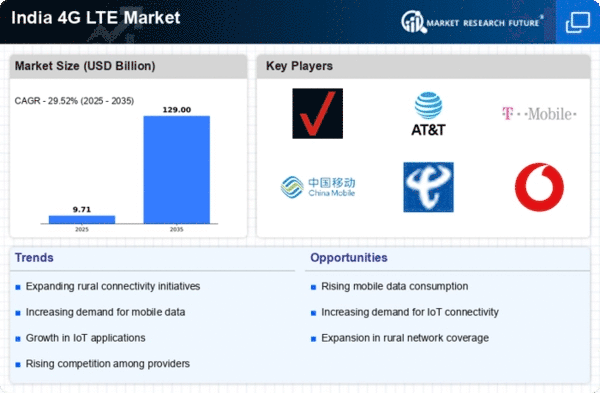
As per Market Research Future analysis, the India 4G Lte Market size was estimated at 7.5 USD Billion in 2024. The 4G Lte market is projected to grow from 9.71 USD Billion in 2025 to 129.0 USD Billion by 2035, exhibiting a compound annual growth rate (CAGR) of 29.5% during the forecast period 2025 - 2035

Key Market Trends & Highlights

The India 4G LTE market is experiencing robust growth driven by increasing demand for high-speed connectivity and expanding infrastructure.

  • The largest segment in the India 4G LTE market is the urban consumer segment, which is witnessing a surge in demand for high-speed internet services.
  • The fastest-growing segment is the enterprise segment, as businesses increasingly rely on mobile connectivity for operations.
  • The market is characterized by a rapid expansion of network infrastructure to accommodate rising data consumption and urbanization.
  • Key drivers include increased smartphone penetration and government initiatives aimed at enhancing digital connectivity.

Market Size & Forecast

2024 Market Size 7.5 (USD Billion)
2035 Market Size 129.0 (USD Billion)
CAGR (2025 - 2035) 29.52%

Major Players

Verizon (US), AT&T (US), T-Mobile (US), China Mobile (CN), China Telecom (CN), Vodafone (GB), Orange (FR), Deutsche Telekom (DE), NTT Docomo (JP)

Our Impact
Enabled $4.3B Revenue Impact for Fortune 500 and Leading Multinationals
Partnering with 2000+ Global Organizations Each Year
30K+ Citations by Top-Tier Firms in the Industry

India 4G Lte Market Trends

TheIndia 4G Lte Market is currently experiencing a dynamic phase characterized by rapid technological advancements and increasing consumer demand. The proliferation of smartphones and mobile devices has significantly contributed to the expansion of this market. As users seek faster and more reliable internet connectivity, service providers are compelled to enhance their infrastructure and offer competitive pricing. This competitive landscape fosters innovation, leading to the introduction of new services and improved user experiences. Furthermore, the growing reliance on mobile applications for various daily activities, such as banking, shopping, and entertainment, underscores the necessity for robust 4g lte networks. In addition, regulatory frameworks and government initiatives play a crucial role in shaping the 4g lte market. Policies aimed at promoting digital inclusion and expanding network coverage are likely to drive further growth. The emphasis on rural connectivity and the digital economy suggests that there is a substantial opportunity for service providers to tap into underserved regions. As the market evolves, it appears that collaboration between stakeholders, including telecom operators and technology providers, will be essential to meet the increasing demands of consumers and businesses alike.

Rising Demand for High-Speed Connectivity

The demand for high-speed internet access continues to surge, driven by the increasing use of data-intensive applications. Consumers are seeking seamless streaming, online gaming, and real-time communication, which necessitates robust 4g lte networks. This trend indicates that service providers must invest in enhancing their infrastructure to meet user expectations.

Expansion of Network Infrastructure

Telecom operators are actively expanding their network infrastructure to improve coverage and capacity. This expansion is particularly focused on rural and semi-urban areas, where access to reliable internet services remains limited. Such initiatives are likely to enhance digital inclusion and stimulate economic growth in these regions.

Emergence of Innovative Services

The 4g lte market is witnessing the emergence of innovative services that leverage high-speed connectivity. From mobile banking solutions to smart home applications, these services are transforming consumer behavior and creating new business opportunities. This trend suggests that companies must adapt to changing consumer preferences to remain competitive.

India 4G Lte Market Drivers

Rising Data Consumption

The exponential growth in data consumption is a significant driver of the 4g lte market in India. As of November 2025, the average data consumption per user has surged to approximately 15 GB per month, reflecting a growing reliance on mobile internet for various activities. This trend is driven by the increasing popularity of video streaming, online gaming, and social media platforms, which require high-speed connectivity. Consequently, telecom operators are compelled to invest in their 4g lte infrastructure to meet the rising demand for data services. The competitive landscape among service providers further accelerates this growth, as they strive to offer attractive data plans and packages. This dynamic environment is likely to sustain the momentum of the 4g lte market in the coming years.

Increased Smartphone Penetration

The proliferation of smartphones in India is a pivotal driver for the 4g lte market. As of November 2025, smartphone penetration in India has reached approximately 50%, with projections indicating further growth. This surge in smartphone adoption is largely attributed to affordable devices and competitive pricing strategies from manufacturers. Consequently, the demand for high-speed internet services has escalated, compelling telecom operators to enhance their 4g lte offerings. The increasing reliance on mobile applications for various services, including e-commerce, social media, and online banking, further fuels this demand. As users seek seamless connectivity, the 4g lte market is poised to benefit significantly from this trend, as it enables faster data transmission and improved user experiences.

Urbanization and Population Growth

Urbanization and population growth are critical factors influencing the 4g lte market in India. As urban areas continue to expand, the demand for reliable and high-speed internet connectivity intensifies. By November 2025, urbanization rates in India have reached approximately 35%, with projections indicating that this figure will continue to rise. This urban migration is accompanied by an influx of individuals seeking better employment opportunities and access to digital services. Consequently, telecom operators are focusing on enhancing their 4g lte networks to cater to the increasing population density in urban centers. This trend not only drives infrastructure development but also encourages innovation in service offerings, thereby propelling the growth of the 4g lte market.

Government Initiatives and Policies

Government initiatives aimed at enhancing digital infrastructure play a crucial role in driving the 4g lte market in India. The Digital India campaign, launched to transform India into a digitally empowered society, has led to substantial investments in telecommunications infrastructure. As of November 2025, the government has allocated over $10 billion towards expanding broadband connectivity, particularly in rural areas. This investment is expected to bridge the digital divide and increase the adoption of 4g lte services. Furthermore, regulatory support for spectrum allocation and the promotion of public-private partnerships are likely to stimulate growth in the 4g lte market. These initiatives not only enhance network coverage but also encourage competition among service providers, ultimately benefiting consumers.

Competitive Landscape Among Service Providers

The competitive landscape among telecom service providers is a significant driver of the 4g lte market in India. As of November 2025, the market is characterized by several key players vying for market share, leading to aggressive pricing strategies and innovative service offerings. This competition has resulted in a decline in average data prices, making 4g lte services more accessible to a broader audience. Additionally, service providers are increasingly investing in network upgrades and expansions to enhance service quality and coverage. The introduction of bundled services, such as data and voice packages, further attracts consumers. This competitive environment is likely to sustain the growth trajectory of the 4g lte market, as providers continuously seek to differentiate themselves in a crowded marketplace.


Market Segment Insights

By Device Type: Smartphone (Largest) vs. Tablet (Fastest-Growing)

The market share distribution in the India 4g lte market reveals that smartphones dominate the device type segment, capturing the largest share due to their widespread adoption and reliance for mobile internet access. Laptops and tablets hold smaller but significant shares, with laptops primarily serving professionals and tablets being popular among users seeking larger displays for browsing and streaming. The increasing penetration of smartphones contributes to the ongoing solidification of their leading position. In terms of growth trends, tablets are emerging rapidly as the fastest-growing segment fueled by increased demand for portable devices in education and remote work scenarios. Key drivers in this growth include advancements in tablet technology, making them more competitive with laptops, and the increasing availability of affordable 4g connectivity. The mobile-first approach in India is also driving smartphone growth, as consumers use these devices for various applications beyond traditional calls and texts.

Smartphone: Dominant vs. Tablet: Emerging

Smartphones are the dominant device type in the India 4g lte market. Their extensive functionality and accessibility make them the preferred choice for a large demographic, from students to professionals. The growth of mobile applications, social media, and streaming services has further solidified their position. In contrast, tablets are emerging as a strong alternative, especially for users who need larger screens for content consumption or work. With a growing focus on user-friendly features and educational applications, tablets are attracting users looking for versatility and portability. This juxtaposition highlights the competitive landscape where smartphones dominate, but tablets are rapidly gaining ground as more consumers recognize their potential.

By Technology: LTE-Advance (Largest) vs. LTE-FDD (Fastest-Growing)

In the India 4g lte market, the market share distribution reveals a clear dominance of LTE-Advance, which is leading due to its enhanced capabilities and widespread adoption. LTE-FDD also shows a significant presence, contributing to the competitive dynamics of the market. As users demand high-speed connectivity and reliable mobile services, these technologies are positioned well amidst growing competition from emerging alternatives. Growth trends indicate that LTE-FDD is on the path of becoming the fastest-growing technology within the segment. This shift is driven by increasing investments in network infrastructure and the escalating demand for robust data performance. The rise of mobile internet users in India further catalyzes the adoption of these advanced technologies, making them crucial components in meeting the evolving connectivity needs of consumers.

Technology: LTE-Advance (Dominant) vs. LTE-FDD (Emerging)

LTE-Advance has established itself as the dominant player in the India 4g lte market, primarily due to its superior speed and efficiency, which cater to the high data consumption patterns of users. Its ability to offer enhanced performance in dense urban areas makes it a preferred choice for operators. On the other hand, LTE-FDD is emerging rapidly, gaining traction due to its flexibility and cost-effectiveness. As service providers expand their offerings to meet the growing demand for mobile broadband, LTE-FDD is increasingly seen as a key player that complements existing infrastructure, poised for future growth amidst evolving consumer expectations.

By Organization Size: Large Enterprises (Largest) vs. SME (Fastest-Growing)

The market share distribution within the Organization Size segment of the India 4g lte market demonstrates that Large Enterprises hold a considerable portion of the overall market. This is largely due to their expansive infrastructure and demand for robust connectivity, facilitating a broad range of services and applications. On the other hand, SMEs are beginning to capture an increasingly significant share as they adopt 4G LTE solutions to enhance their competitiveness in the digital economy. This shift indicates a dynamic evolution in the market mechanics, where smaller players are gaining ground against larger counterparts. Growth trends within the Organization Size segment reveal a notable divergence between Large Enterprises and SMEs. Large Enterprises are focusing on leveraging high-capacity, high-speed 4G LTE networks to streamline operations and improve service delivery. Meanwhile, SMEs are emerging as the fastest-growing segment, driven by increasing mobile internet adoption and government initiatives to support digital infrastructure. The rise of e-commerce and digital services is crucial for SMEs, propelling their demand for 4G LTE connectivity and innovations tailored to their needs.

Large Enterprises (Dominant) vs. SME (Emerging)

Large Enterprises in the India 4g lte market are characterized by their substantial customer base and demand for consistent, high-quality connectivity. These organizations typically possess the resources to invest in cutting-edge technology and infrastructure, allowing them to optimize their operations and deliver superior services. In contrast, SMEs represent an emerging segment with growing significance in the market landscape. These enterprises often rely on flexible and cost-effective 4G LTE solutions to enhance their operational efficiency and customer engagement. As digital transformation accelerates, SMEs are increasingly adopting 4G LTE to support mobile applications, improve communication, and expand their market reach, positioning them as key players in the ongoing evolution of the telecommunications landscape.

By Connection Plan: Pre-paid (Largest) vs. Post-paid (Fastest-Growing)

In the India 4g lte market, the distribution of the connection plan segment reveals that pre-paid plans dominate the market, capturing a significant share compared to post-paid plans. The affordability and flexibility of pre-paid options have led to their broad appeal among consumers, particularly the younger demographics and urban residents. Conversely, while post-paid subscriptions represent a smaller share, they are gaining traction due to increasing data consumption and enhanced bundled services that attract users looking for dependable connectivity. The growth trends within this segment are notably driven by the ongoing digitalization and increasing demand for mobile internet services. As users seek better value, post-paid plans are evolving with competitive pricing and additional perks, making them an attractive choice. Furthermore, enhancements in customer service and service quality are influencing this shift, propelling post-paid subscriptions to emerge as a key growth area in the market.

Connection Plans: Pre-paid (Dominant) vs. Post-paid (Emerging)

Pre-paid plans currently hold a dominant position in the connection plan segment of the India 4g lte market, attracting users with their no-contract nature and ease of use. This segment is characterized by its vast user base, reflecting the preferences for flexibility and cost-effectiveness. On the other hand, post-paid plans, while being an emerging segment, are increasingly appealing to users who prioritize consistent connectivity and value-added features. The rise in digital content consumption is influencing the adoption of post-paid plans, as consumers seek higher data allowances. The merging of entertainment options with connectivity services is further stimulating growth within this segment, positioning post-paid plans as an attractive alternative to traditional pre-paid offerings.

Get more detailed insights about India 4G Lte Market

Key Players and Competitive Insights

The competitive dynamics within the 4G LTE market in India are characterized by a blend of aggressive strategies and technological advancements. Key growth drivers include the increasing demand for high-speed internet, the proliferation of smart devices, and the ongoing digital transformation across various sectors. Major players such as Verizon (US), Vodafone (GB), and China Mobile (CN) are strategically positioned to leverage these trends. Verizon (US) focuses on innovation through the deployment of advanced network technologies, while Vodafone (GB) emphasizes partnerships with local telecom providers to enhance service delivery. China Mobile (CN) is expanding its footprint through regional collaborations, thereby shaping a competitive environment that is both dynamic and multifaceted.
In terms of business tactics, companies are increasingly localizing manufacturing and optimizing supply chains to enhance operational efficiency. The market structure appears moderately fragmented, with several key players exerting influence over pricing and service offerings. This fragmentation allows for a diverse range of services, catering to varying consumer needs, while also fostering competition among established and emerging players.
In October 2025, Vodafone (GB) announced a strategic partnership with a leading Indian tech firm to enhance its 4G LTE infrastructure. This collaboration aims to integrate cutting-edge technologies, thereby improving network reliability and customer experience. The strategic importance of this move lies in Vodafone's commitment to maintaining a competitive edge in a rapidly evolving market, as it seeks to capitalize on the growing demand for seamless connectivity.
In September 2025, Verizon (US) launched a new initiative focused on expanding its 4G LTE coverage in rural areas of India. This initiative is particularly significant as it addresses the digital divide, ensuring that underserved regions gain access to high-speed internet. By prioritizing rural connectivity, Verizon not only enhances its market presence but also aligns with broader governmental objectives of digital inclusion.
In August 2025, China Mobile (CN) unveiled plans to invest approximately $500 million in upgrading its existing 4G LTE infrastructure across India. This investment is poised to bolster network capacity and improve service quality, reflecting China Mobile's long-term commitment to the Indian market. The strategic importance of this investment is underscored by the increasing competition in the sector, as enhanced infrastructure is likely to attract more customers and solidify market share.
As of November 2025, current trends in the competitive landscape are heavily influenced by digitalization, sustainability, and the integration of AI technologies. Strategic alliances are becoming increasingly pivotal, as companies recognize the need for collaborative approaches to navigate the complexities of the market. Looking ahead, competitive differentiation is expected to evolve, shifting from traditional price-based competition to a focus on innovation, technological advancements, and supply chain reliability. This transition suggests that companies that prioritize these elements will likely emerge as leaders in the 4G LTE market.

Key Companies in the India 4G Lte Market include

Industry Developments

The India 4G LTE market is witnessing significant developments, with key players actively expanding their services and infrastructure. In September 2023, Bharti Airtel announced plans to enhance its 4G network, incorporating new technologies to improve customer experience across urban and rural sectors. Meanwhile, Reliance Jio continues to lead the market with its aggressive rollout of 4G services, aiming to cover more remote areas. In October 2023, Vodafone Idea launched a campaign to boost 4G penetration in underserved regions, collaborating with local governments for seamless connectivity.

BSNL is also rolling out its 4G services in phases, targeting a wider audience by the end of 2023. 

In terms of mergers and acquisitions, ACT Fibernet is in talks for possible strategic partnerships to expand its service offerings to more regions, although specifics are yet to be finalized as of October 2023. The market valuation for companies such as Telenor India and You Broadband has shown positive growth trends over the past couple of years due to increasing demand for reliable internet services, fueled by the rise of digital consumption in India. The changing dynamics in technology and heightened competition among players are rapidly reshaping the landscape of the 4G LTE market in India.

Future Outlook

India 4G Lte Market Future Outlook

The 4G LTE market in India is projected to grow at a remarkable 29.52% CAGR from 2025 to 2035, driven by increasing mobile data consumption and technological advancements.

New opportunities lie in:

  • Expansion of IoT connectivity solutions for smart cities
  • Development of tailored enterprise mobile data plans
  • Investment in rural broadband infrastructure to enhance coverage

By 2035, the market is expected to achieve substantial growth and widespread adoption.

Market Segmentation

India 4G Lte Market Technology Outlook

  • LTE-advance
  • LTE-TDD
  • LTE-FDD
  • WiMax
  • HSPA+

India 4G Lte Market Device Type Outlook

  • Smartphone
  • Laptop
  • Tablets

India 4G Lte Market Connection Plan Outlook

  • Post-paid
  • Pre-paid

India 4G Lte Market Organization Size Outlook

  • SME
  • Large Enterprises

Report Scope

MARKET SIZE 2024 7.5(USD Billion)
MARKET SIZE 2025 9.71(USD Billion)
MARKET SIZE 2035 129.0(USD Billion)
COMPOUND ANNUAL GROWTH RATE (CAGR) 29.52% (2025 - 2035)
REPORT COVERAGE Revenue Forecast, Competitive Landscape, Growth Factors, and Trends
BASE YEAR 2024
Market Forecast Period 2025 - 2035
Historical Data 2019 - 2024
Market Forecast Units USD Billion
Key Companies Profiled Verizon (US), AT&T (US), T-Mobile (US), China Mobile (CN), China Telecom (CN), Vodafone (GB), Orange (FR), Deutsche Telekom (DE), NTT Docomo (JP)
Segments Covered Device Type, Technology, Organization Size, Connection Plan
Key Market Opportunities Expansion of 4g lte infrastructure to support increasing demand for mobile data services and IoT applications.
Key Market Dynamics Intensifying competition among telecom operators drives innovation and service enhancements in the 4G LTE market.
Countries Covered India
Leave a Comment

FAQs

What is the estimated market size of the India 4G LTE Market in 2024?

The India 4G LTE Market is estimated to be valued at 5.51 USD Billion in 2024.

What is the forecasted market size for the India 4G LTE Market by 2035?

By 2035, the India 4G LTE Market is expected to reach a valuation of 103.81 USD Billion.

What is the expected compound annual growth rate (CAGR) of the India 4G LTE Market between 2025 and 2035?

The expected CAGR for the India 4G LTE Market from 2025 to 2035 is 30.602 percentage.

Which device type holds the largest market share in the India 4G LTE Market by 2035?

Smartphones are projected to dominate the market, valued at 63.02 USD Billion by 2035.

What are the expected market values for laptops and tablets in the India 4G LTE Market in 2035?

Laptops are expected to be valued at 23.15 USD Billion and tablets at 17.64 USD Billion by 2035.

Who are the key players in the India 4G LTE Market?

Major players include BSNL, RailWire, Siti Networks, and Reliance Jio among others.

What are the growth drivers of the India 4G LTE Market?

The growth is driven by increased smartphone adoption and demand for high-speed internet.

What are the emerging trends in the India 4G LTE Market?

Emerging trends include the increasing demand for mobile data and advancements in technology.

How do current global scenarios impact the India 4G LTE Market?

Current global scenarios can influence investments and technological advancements in this market.

What regional dynamics affect the India 4G LTE Market's growth?

Urbanization and increasing digital connectivity in India significantly influence market growth.

Download Free Sample

Kindly complete the form below to receive a free sample of this Report

Compare Licence

×
Features License Type
Single User Multiuser License Enterprise User
Price $4,950 $5,950 $7,250
Maximum User Access Limit 1 User Upto 10 Users Unrestricted Access Throughout the Organization
Free Customization
Direct Access to Analyst
Deliverable Format
Platform Access
Discount on Next Purchase 10% 15% 15%
Printable Versions