×
Request Free Sample ×

Kindly complete the form below to receive a free sample of this Report

* Please use a valid business email

Leading companies partner with us for data-driven Insights

clients tt-cursor
Hero Background

Germany Video On Demand Market

ID: MRFR/ICT/63345-HCR
200 Pages
Aarti Dhapte
February 2026

Germany Video On Demand Market Size, Share and Research Report: By Revenue Model (Subscription Video on Demand (SVoD), Transactional Video On Demand (TVoD), Advertisement Based Video On Demand (AVoD)) and By Content Type (Sports, Music, TV Entertainment, Kids, Movies, Others)- Industry Forecast to 2035

Share:
Download PDF ×

We do not share your information with anyone. However, we may send you emails based on your report interest from time to time. You may contact us at any time to opt-out.

Germany Video On Demand Market Infographic
Purchase Options

Germany Video On Demand Market Summary

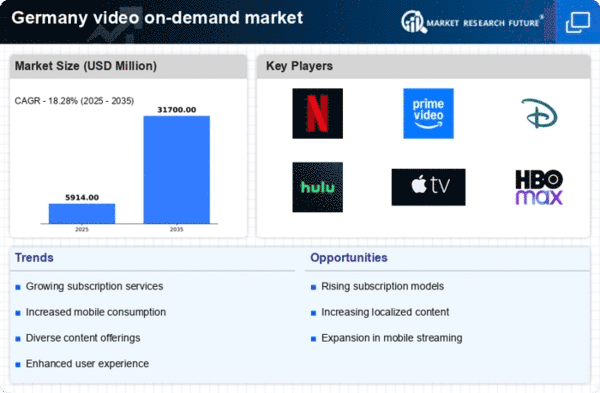
As per Market Research Future analysis, the Germany video on-demand market size was estimated at 5000.0 USD Million in 2024. The Germany video on-demand market is projected to grow from 5914.0 USD Million in 2025 to 31700.0 USD Million by 2035, exhibiting a compound annual growth rate (CAGR) of 18.2% during the forecast period 2025 - 2035

Key Market Trends & Highlights

The Germany video on-demand market is experiencing robust growth driven by evolving consumer preferences and technological advancements.

  • The subscription-based model continues to dominate the market, reflecting a shift in consumer preferences for predictable costs.
  • Local content production is gaining traction, catering to the increasing demand for culturally relevant programming.
  • Advanced technologies, such as AI and machine learning, are being integrated to enhance user experience and content recommendations.
  • Key market drivers include increasing internet penetration and a notable shift in consumer viewing habits, which are reshaping the landscape.

Market Size & Forecast

2024 Market Size 5000.0 (USD Million)
2035 Market Size 31700.0 (USD Million)
CAGR (2025 - 2035) 18.28%

Major Players

Netflix (US), Amazon Prime Video (US), Disney+ (US), Hulu (US), Apple TV+ (US), HBO Max (US), YouTube (US), Paramount+ (US)

Our Impact
Enabled $4.3B Revenue Impact for Fortune 500 and Leading Multinationals
Partnering with 2000+ Global Organizations Each Year
30K+ Citations by Top-Tier Firms in the Industry

Germany Video On Demand Market Trends

The video on-demand market in Germany is currently experiencing a dynamic evolution, characterized by a growing consumer preference for streaming services over traditional broadcasting. This shift is largely driven by the increasing availability of high-speed internet and the proliferation of smart devices, which facilitate easy access to a wide array of content. As consumers become more discerning, they seek personalized viewing experiences, prompting service providers to enhance their offerings. The competitive landscape is intensifying, with both established players and new entrants vying for market share. This competition fosters innovation, leading to the development of unique content and features that cater to diverse audience preferences. Moreover, the regulatory environment in Germany plays a crucial role in shaping the video on-demand market. Policies aimed at promoting local content and protecting consumer rights are influencing how platforms operate. The emphasis on data privacy and security is also paramount, as consumers become increasingly aware of their digital footprints. As the market continues to mature, it appears poised for further growth, with potential expansions into niche segments and the integration of advanced technologies such as artificial intelligence to enhance user engagement. Overall, the landscape is vibrant, reflecting a blend of consumer demand, regulatory frameworks, and technological advancements.

Rise of Subscription-Based Models

The video on-demand market is witnessing a notable shift towards subscription-based models. Consumers are increasingly favoring platforms that offer unlimited access to a vast library of content for a fixed monthly fee. This trend indicates a preference for predictable spending and convenience, as users can enjoy diverse programming without the constraints of traditional pay-per-view systems.

Emphasis on Local Content Production

There is a growing emphasis on the production of local content within the video on-demand market. Platforms are investing in original programming that resonates with German audiences, reflecting cultural nuances and regional storytelling. This trend not only enhances viewer engagement but also aligns with regulatory requirements promoting local productions.

Integration of Advanced Technologies

The integration of advanced technologies is transforming the video on-demand market. Innovations such as artificial intelligence and machine learning are being utilized to personalize user experiences, recommend content, and optimize streaming quality. This technological advancement is likely to enhance viewer satisfaction and retention, as platforms strive to meet evolving consumer expectations.

Germany Video On Demand Market Drivers

Diverse Content Offerings

The video on-demand market in Germany is characterized by a growing emphasis on diverse content offerings. Streaming platforms are increasingly investing in original programming, catering to various demographics and interests. As of 2025, it is estimated that over 40% of content available on these platforms is original, reflecting a commitment to providing unique viewing experiences. This trend not only attracts new subscribers but also retains existing ones, as audiences seek fresh and engaging content. Furthermore, the inclusion of localized content, such as German-language films and series, enhances the appeal of these platforms to domestic audiences. This focus on diversity in content suggests that the video on-demand market will continue to expand, as providers strive to meet the varied preferences of consumers.

Competitive Pricing Strategies

Pricing strategies within the video on-demand market in Germany are evolving as competition intensifies among service providers. Many platforms are adopting flexible pricing models, including tiered subscriptions and promotional offers, to attract a broader audience. As of 2025, it is observed that around 50% of consumers are more likely to subscribe to services that offer competitive pricing and value-added features. This trend indicates that providers are increasingly focused on delivering cost-effective solutions to retain and grow their subscriber base. Moreover, the introduction of ad-supported models allows users to access content at lower costs, further diversifying the market landscape. This competitive pricing environment suggests that the video on-demand market will continue to expand, as consumers seek affordable options without compromising on content quality.

Increasing Internet Penetration

The expansion of high-speed internet access in Germany plays a pivotal role in the growth of the video on-demand market. As of 2025, approximately 90% of households have access to broadband internet, facilitating seamless streaming experiences. This connectivity allows consumers to access a wide array of content from various platforms, thereby driving demand. The video on-demand market benefits from this trend, as more users are likely to subscribe to services that offer diverse content. Furthermore, the increasing adoption of smart devices, such as smartphones and smart TVs, enhances the viewing experience, making it more convenient for users to engage with video content. This trend suggests that as internet penetration continues to rise, the video on-demand market will likely see sustained growth in user engagement and subscription rates.

Shift in Consumer Viewing Habits

Consumer preferences in Germany are shifting towards on-demand viewing, as audiences increasingly favor flexibility over traditional broadcasting schedules. The video on-demand market is witnessing a significant transformation, with a reported 65% of viewers opting for on-demand services over linear television. This shift is driven by the desire for personalized content consumption, allowing users to watch what they want, when they want. Additionally, the rise of binge-watching culture has led to increased demand for entire seasons of shows, further propelling the market. As viewers become accustomed to this model, it is likely that traditional broadcasters will need to adapt their strategies to remain competitive. This evolving landscape indicates that the video on-demand market will continue to thrive as consumer habits evolve.

Technological Advancements in Streaming

Technological innovations are significantly impacting the video on-demand market in Germany. The integration of advanced streaming technologies, such as adaptive bitrate streaming and enhanced compression algorithms, allows for higher quality video delivery even in varying network conditions. As of 2025, approximately 75% of users report improved streaming experiences due to these advancements. Additionally, the rise of artificial intelligence in content recommendation systems enhances user engagement by providing personalized viewing suggestions. This technological evolution not only improves user satisfaction but also encourages longer viewing times, which is beneficial for service providers. As technology continues to advance, it is likely that the video on-demand market will experience further growth, driven by enhanced user experiences and increased content accessibility.


Market Segment Insights

By Content Type: Movies (Largest) vs. TV Shows (Fastest-Growing)

In the Germany video on-demand market, Movies hold significant market share, appealing to a wide audience with diverse genres ranging from action to romance. TV Shows, while slightly trailing behind in overall share, are rapidly gaining traction due to streaming services focusing on exclusive series and original content that foster viewer loyalty and engagement. The growth trends in this segment are primarily driven by the increasing demand for on-demand content tailored to viewer preferences. As technology advances and consumer behavior shifts toward flexible viewing schedules, the appetite for TV Shows is expanding. Additionally, the rising investment in local content production further fuels the popularity of TV Shows, positioning them as a formidable competitor in market dynamics.

Movies: Dominant vs. TV Shows: Emerging

Movies have long been the dominant force in the Germany video on-demand market, characterized by their widespread appeal and a robust library that caters to various demographics. The production of high-quality films, coupled with established franchises, has solidified Movies' strong market position. Conversely, TV Shows are emerging rapidly, capturing audience interest with innovative storytelling and binge-worthy seasons. Streaming platforms are investing significantly in original TV content, which has led to heightened competition among providers. This emerging status reflects changing consumer preferences, where viewers seek not only entertainment but also connection through serialized narratives, thus reshaping the landscape of on-demand content.

By Subscription Model: Subscription Video On Demand (Largest) vs. Ad-Supported Video On Demand (Fastest-Growing)

In the Germany video on-demand market, the Subscription Video On Demand segment commands the largest share, dominating the landscape with its user-friendly access to a plethora of content. This model caters to a wide audience, providing a steady revenue stream for providers while offering consumers flexible viewing options. Conversely, the Transactional Video On Demand and Ad-Supported Video On Demand segments are experiencing notable growth trends. The latter, in particular, has emerged as the fastest-growing category, driven by changes in consumer preferences and the increasing popularity of free content supported by advertisements, appealing to budget-conscious viewers.

Subscription Video On Demand (Dominant) vs. Ad-Supported Video On Demand (Emerging)

The Subscription Video On Demand segment is characterized by its subscription-based model that provides users with uninterrupted access to various titles for a fixed fee. This segment appeals to avid viewers seeking content variety and is seen as the backbone of video on-demand. In contrast, Ad-Supported Video On Demand is an emerging segment that is gaining traction, particularly among viewers looking for free access. These platforms rely on advertisements as their primary revenue source, enabling users to access content without upfront costs while also attracting a broader audience seeking economical viewing options.

By Device Type: Smart TVs (Largest) vs. Mobile Devices (Fastest-Growing)

In the Germany video on-demand market, the distribution of market share among device types reveals that Smart TVs command a significant portion of the viewership, making them the largest segment. Alongside Smart TVs, Mobile Devices follow closely, showcasing a strong presence as consumers increasingly engage with video content on the go. Tablets, Laptops, and Desktop Computers hold smaller shares but contribute to a diverse viewing landscape in this market. Growth trends indicate that Mobile Devices are quickly emerging as the fastest-growing segment, fueled by advancements in mobile technology and consumer behavior shifting towards on-demand accessibility. Smart TVs continue to dominate the market, driven by the popularity of large-screen viewing experiences. The combined influence of technological innovations and changing viewing preferences plays a pivotal role in shaping the dynamics of device usage in the Germany video on-demand market.

Smart TVs (Dominant) vs. Mobile Devices (Emerging)

Smart TVs are currently the dominant device type in the Germany video on-demand market, characterized by their integration with streaming services and enhanced viewing experiences. They offer high-resolution displays and user-friendly interfaces, making them highly favorable among consumers seeking immersive content. On the other hand, Mobile Devices are considered an emerging segment, reflecting a transformative shift in video consumption habits. These devices appeal especially to younger audiences and those with busy lifestyles, allowing instant access to video content anytime and anywhere. As connectivity improves and mobile data plans become more affordable, the adoption of Mobile Devices is expected to rise, creating a dynamic competition with Smart TVs for viewer attention.

By End User: Individual Users (Largest) vs. Corporate Users (Fastest-Growing)

The Germany video on-demand market showcases a distinct distribution of users among individual, corporate, and educational segments. Individual users hold the largest share, primarily driven by the widespread adoption of streaming services for entertainment and personal viewing preferences. This is followed by corporate users, who are increasingly embracing video on-demand for professional development and training purposes, fueling a robust segment of the market. Educational institutions represent a significant yet smaller segment, leveraging video content for an enriched learning experience. Growth trends in this market reflect a dynamic shift towards digital consumption, with individual users showcasing consistent engagement and demand for diverse content. Corporate users are rapidly emerging as a key driver, prioritizing innovative video solutions to enhance organizational training and communications. Educational institutions are also adopting video on-demand services to support hybrid learning environments, indicating a rise in the demand for educational content delivery, fostering an inclusive educational landscape that caters to diverse learning needs.

Individual Users (Dominant) vs. Corporate Users (Emerging)

In the Germany video on-demand market, individual users stand out as the dominant segment, characterized by a preference for diverse genres and subscription-based models. Their engagement is largely driven by a variety of content tailored to personal interests, enabling providers to cater to niche audiences effectively. In contrast, corporate users represent an emerging segment, leveraging video on-demand solutions to promote training, enhance internal communications, and improve employee engagement. This shift signifies a growing recognition of the importance of visual content in the workplace, with companies increasingly investing in video resources to drive productivity and facilitate collaboration. The balance between these segments underscores the evolving landscape of content consumption in both personal and professional environments.

Get more detailed insights about Germany Video On Demand Market

Key Players and Competitive Insights

The video on-demand market in Germany is characterized by a dynamic competitive landscape, driven by rapid technological advancements and shifting consumer preferences. Major players such as Netflix (US), Amazon Prime Video (US), and Disney+ (US) are at the forefront, each employing distinct strategies to capture market share. Netflix (US) continues to focus on original content production, enhancing its library with localized offerings to cater to German audiences. Meanwhile, Amazon Prime Video (US) emphasizes bundling services, integrating its video platform with other Amazon services to create a comprehensive ecosystem. Disney+ (US), on the other hand, leverages its extensive catalog of beloved franchises, positioning itself as a family-friendly option while expanding its reach through strategic partnerships with local telecom providers.The business tactics employed by these companies reflect a moderately fragmented market structure, where competition is fierce yet characterized by a few dominant players. Localizing content and optimizing supply chains are critical tactics that enhance customer engagement and operational efficiency. The collective influence of these key players shapes the market, as they continuously innovate to meet the evolving demands of consumers, thereby intensifying competitive pressures.

In October Netflix (US) announced a partnership with a leading German production company to co-create a series aimed at the local market. This strategic move not only strengthens Netflix's content library but also demonstrates its commitment to investing in regional storytelling, which is likely to resonate well with German viewers. Such collaborations may enhance brand loyalty and attract new subscribers, further solidifying Netflix's position in the market.

In September Amazon Prime Video (US) launched a new feature that allows users to access exclusive live sports events, including Bundesliga matches. This initiative is significant as it diversifies Amazon's content offerings and appeals to sports enthusiasts, potentially increasing subscriber numbers. By integrating live sports into its platform, Amazon Prime Video (US) positions itself as a more comprehensive entertainment service, which could lead to higher customer retention rates.

In August Disney+ (US) expanded its content library by acquiring rights to several popular German films and series. This acquisition is strategically important as it not only enriches Disney+'s offerings but also aligns with its goal of becoming a leading player in the European market. By catering to local tastes and preferences, Disney+ (US) enhances its competitive edge and attracts a broader audience base.

As of November current trends in the video on-demand market include a pronounced shift towards digitalization, sustainability, and the integration of AI technologies. Strategic alliances are increasingly shaping the competitive landscape, as companies seek to enhance their service offerings and operational efficiencies. Looking ahead, competitive differentiation is likely to evolve from traditional price-based strategies to a focus on innovation, technological advancements, and supply chain reliability. This shift underscores the importance of creating unique value propositions that resonate with consumers in an ever-evolving market.

Key Companies in the Germany Video On Demand Market include

Industry Developments

A curated "ZDF Films and Series" collection was introduced to Disney+ subscribers in Germany, Austria, and Switzerland in August 2025, following the completion of a multi-year licensing agreement between Disney+ and ZDF Studios. This roster will encompass more than 3,000 episodes and films by the end of the year, thereby cementing Disney+'s dedication to local German-language content. 

RTL Deutschland and Deutsche Telekom extended their streaming partnership through 2030 in January 2025, in which RTL+ Premium was automatically included in the majority of MagentaTV plans at no additional cost. The collaboration has allowed RTL+ to surpass 6 million paying subscribers by the end of 2024 and deliver over 649 million viewing hours, demonstrating robust engagement. 

In July 2024, RTL Group disclosed its intention to transition the RTL+ platform in Germany to the Bedrock streaming technology, with an initial completion date of early 2026. This action is intended to enhance efficiency and innovation by unifying technology across RTL's streaming services.

Future Outlook

Germany Video On Demand Market Future Outlook

The Video on Demand Market in Germany is projected to grow at an 18.28% CAGR from 2025 to 2035, driven by technological advancements and changing consumer preferences.

New opportunities lie in:

  • Development of localized content production hubs to enhance viewer engagement.
  • Integration of AI-driven recommendation systems for personalized viewing experiences.
  • Expansion of subscription models to include tiered pricing for diverse consumer segments.

By 2035, the market is expected to achieve substantial growth, reflecting evolving consumer demands.

Market Segmentation

Germany Video On Demand Market End User Outlook

  • Individual Users
  • Corporate Users
  • Educational Institutions

Germany Video On Demand Market Device Type Outlook

  • Smart TVs
  • Mobile Devices
  • Tablets
  • Laptops
  • Desktop Computers

Germany Video On Demand Market Content Type Outlook

  • Movies
  • TV Shows
  • Documentaries
  • Sports
  • Kid's Content

Germany Video On Demand Market Subscription Model Outlook

  • Subscription Video On Demand
  • Transactional Video On Demand
  • Ad-Supported Video On Demand

Report Scope

MARKET SIZE 2024 5000.0(USD Million)
MARKET SIZE 2025 5914.0(USD Million)
MARKET SIZE 2035 31700.0(USD Million)
COMPOUND ANNUAL GROWTH RATE (CAGR) 18.28% (2025 - 2035)
REPORT COVERAGE Revenue Forecast, Competitive Landscape, Growth Factors, and Trends
BASE YEAR 2024
Market Forecast Period 2025 - 2035
Historical Data 2019 - 2024
Market Forecast Units USD Million
Key Companies Profiled Netflix (US), Amazon Prime Video (US), Disney+ (US), Hulu (US), Apple TV+ (US), HBO Max (US), YouTube (US), Paramount+ (US)
Segments Covered Content Type, Subscription Model, Device Type, End User
Key Market Opportunities Integration of advanced streaming technologies enhances user experience in the video on-demand market.
Key Market Dynamics Rising consumer preference for personalized content drives competition among video on-demand providers in Germany.
Countries Covered Germany
Leave a Comment

FAQs

What is the projected market value of the Germany Video On Demand Market in 2024?

The Germany Video On Demand Market is projected to be valued at 4.6 billion USD in 2024.

What is the expected market value for the Germany Video On Demand Market by 2035?

By 2035, the Germany Video On Demand Market is expected to reach a value of 29.0 billion USD.

What is the expected compound annual growth rate (CAGR) for the Germany Video On Demand Market from 2025 to 2035?

The expected CAGR for the Germany Video On Demand Market from 2025 to 2035 is 18.221%.

How do the revenue models in the Germany Video On Demand Market compare?

In 2024, Subscription Video on Demand (SVoD) is valued at 2.3 billion USD, Transactional Video on Demand (TVoD) at 1.2 billion USD, and Advertisement Based Video On Demand (AVoD) at 1.1 billion USD.

What will be the revenue from Subscription Video on Demand (SVoD) by 2035?

By 2035, revenue from Subscription Video on Demand (SVoD) is expected to reach 16.4 billion USD.

What will be the expected revenue from Transactional Video on Demand (TVoD) by 2035?

By 2035, Revenue from Transactional Video on Demand (TVoD) is projected at 7.6 billion USD.

What market share do the major players hold in the Germany Video On Demand Market?

Major players like Disney, Amazon Prime Video, and Netflix dominate the market with significant shares.

How is Advertisement Based Video On Demand (AVoD) expected to perform by 2035?

By 2035, Advertisement Based Video On Demand (AVoD) is anticipated to reach a revenue of 5.0 billion USD.

What growth opportunities exist in the Germany Video On Demand Market?

Emerging trends like mobile streaming and content localization present significant growth opportunities in the market.

What challenges does the Germany Video On Demand Market currently face?

Challenges include intense competition and the need for constant content innovation amidst changing viewer preferences.

Download Free Sample

Kindly complete the form below to receive a free sample of this Report

Compare Licence

×
Features License Type
Single User Multiuser License Enterprise User
Price $4,950 $5,950 $7,250
Maximum User Access Limit 1 User Upto 10 Users Unrestricted Access Throughout the Organization
Free Customization
Direct Access to Analyst
Deliverable Format
Platform Access
Discount on Next Purchase 10% 15% 15%
Printable Versions