×
Request Free Sample ×

Kindly complete the form below to receive a free sample of this Report

* Please use a valid business email

Leading companies partner with us for data-driven Insights

clients tt-cursor
Hero Background

Germany Unified Endpoint Management Market

ID: MRFR/ICT/61358-HCR
200 Pages
Aarti Dhapte
February 2026

Germany Unified Endpoint Management Market Size, Share and Research Report: By Deployment Type (Cloud-based, On-premises, Hybrid), By Enterprise Size (Small Enterprises, Medium Enterprises, Large Enterprises), By Solution Type (Mobile Device Management, Application Management, Security Management, Content Management) and By End User Industry (IT and Telecommunications, Healthcare, Government, Education, Retail) - Industry Forecast to 2035

Share:
Download PDF ×

We do not share your information with anyone. However, we may send you emails based on your report interest from time to time. You may contact us at any time to opt-out.

Germany Unified Endpoint Management Market Infographic
Purchase Options

Germany Unified Endpoint Management Market Summary

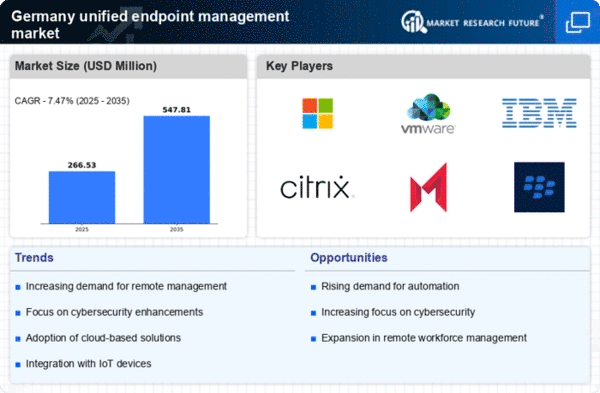
As per Market Research Future analysis, the Germany unified endpoint-management market size was estimated at 248.0 USD Million in 2024. The Germany unified endpoint-management market is projected to grow from 266.53 USD Million in 2025 to 547.81 USD Million by 2035, exhibiting a compound annual growth rate (CAGR) of 7.4% during the forecast period 2025 - 2035

Key Market Trends & Highlights

The Germany unified endpoint-management market is experiencing robust growth driven by technological advancements and evolving security needs.

  • The integration of AI and automation is transforming endpoint management practices across various sectors.
  • Security compliance remains a critical focus as organizations strive to protect sensitive data from increasing cyber threats.
  • The shift towards cloud-based solutions is gaining momentum, particularly among enterprises seeking flexibility and scalability.
  • Rising cybersecurity threats and regulatory compliance requirements are key drivers propelling the market forward.

Market Size & Forecast

2024 Market Size 248.0 (USD Million)
2035 Market Size 547.81 (USD Million)
CAGR (2025 - 2035) 7.47%

Major Players

Microsoft (US), VMware (US), IBM (US), Citrix (US), MobileIron (US), BlackBerry (CA), Sophos (GB), ManageEngine (IN), Jamf (US)

Our Impact
Enabled $4.3B Revenue Impact for Fortune 500 and Leading Multinationals
Partnering with 2000+ Global Organizations Each Year
30K+ Citations by Top-Tier Firms in the Industry

Germany Unified Endpoint Management Market Trends

The unified endpoint-management market in Germany is currently experiencing a notable evolution, driven by the increasing complexity of IT environments and the growing need for streamlined management solutions. Organizations are recognizing the necessity of integrating various devices, applications, and data into a cohesive management framework. This shift is largely influenced by the rise of remote work and the proliferation of mobile devices, which necessitate robust security measures and efficient management strategies. As a result, businesses are investing in advanced technologies that facilitate seamless endpoint management, ensuring that their operations remain secure and efficient. Moreover, the regulatory landscape in Germany, characterized by stringent data protection laws, further emphasizes the importance of effective endpoint management. Companies are compelled to adopt solutions that not only enhance operational efficiency but also comply with legal requirements. This dual focus on security and efficiency is shaping the market dynamics, leading to increased demand for innovative solutions that can address these challenges. The ongoing digital transformation across various sectors is likely to propel the growth of the unified endpoint-management market, as organizations seek to leverage technology to enhance productivity and maintain competitive advantage.

Integration of AI and Automation

The incorporation of artificial intelligence and automation technologies is becoming increasingly prevalent in the unified endpoint-management market. These advancements enable organizations to streamline processes, enhance decision-making, and improve overall efficiency. By automating routine tasks, businesses can allocate resources more effectively, allowing IT teams to focus on strategic initiatives.

Emphasis on Security Compliance

With the stringent data protection regulations in Germany, there is a heightened focus on security compliance within the unified endpoint-management market. Organizations are prioritizing solutions that not only manage endpoints effectively but also ensure adherence to legal standards. This trend reflects a growing awareness of the importance of safeguarding sensitive information.

Shift Towards Cloud-Based Solutions

The trend towards cloud-based solutions is reshaping the unified endpoint-management market. Organizations are increasingly adopting cloud technologies to enhance flexibility and scalability. This shift allows for more efficient management of endpoints, as businesses can leverage cloud resources to support remote work and diverse device environments.

Germany Unified Endpoint Management Market Drivers

Rising Cybersecurity Threats

The increasing frequency and sophistication of cyber threats in Germany is a primary driver for the unified endpoint-management market. Organizations are compelled to adopt comprehensive endpoint management solutions to safeguard sensitive data and ensure compliance with stringent regulations. In 2025, it is estimated that cybercrime could cost businesses globally over $10 trillion annually, highlighting the urgency for robust security measures. The unified endpoint-management market is witnessing a surge in demand as companies seek to mitigate risks associated with data breaches and ransomware attacks. This trend is particularly pronounced in sectors such as finance and healthcare, where data protection is paramount. As organizations prioritize cybersecurity, investments in unified endpoint management solutions are expected to grow, reflecting a proactive approach to safeguarding digital assets.

Increased Remote Work Adoption

The shift towards remote work in Germany has significantly influenced the unified endpoint-management market. As organizations adapt to flexible work arrangements, the need for effective management of diverse endpoints becomes critical. In 2025, it is projected that remote work will account for approximately 30% of the workforce in Germany, necessitating solutions that ensure seamless access to corporate resources while maintaining security. Unified endpoint management solutions enable IT departments to manage devices remotely, enforce security policies, and provide support to employees regardless of their location. This trend is likely to drive growth in the market as businesses seek to enhance productivity and maintain operational efficiency in a hybrid work environment. The unified endpoint-management market is thus positioned to benefit from the ongoing transformation of work dynamics.

Growing Demand for BYOD Policies

The rise of Bring Your Own Device (BYOD) policies in German organizations is a notable driver for the unified endpoint-management market. As employees increasingly use personal devices for work purposes, companies face challenges in managing security and compliance. In 2025, it is estimated that over 50% of organizations in Germany will implement BYOD policies, necessitating robust endpoint management solutions to protect corporate data. Unified endpoint management solutions provide the necessary tools to secure personal devices, enforce security protocols, and ensure that sensitive information remains protected. This trend is likely to propel growth in the unified endpoint-management market as organizations seek to balance employee flexibility with the need for stringent security measures.

Regulatory Compliance Requirements

Germany's stringent regulatory landscape, particularly in data protection and privacy, is a significant driver for the unified endpoint-management market. The implementation of the General Data Protection Regulation (GDPR) has heightened the need for organizations to ensure compliance across all endpoints. Failure to adhere to these regulations can result in substantial fines, reaching up to €20 million or 4% of annual global turnover, whichever is higher. As companies strive to meet these compliance requirements, the demand for unified endpoint management solutions is expected to rise. These solutions facilitate the monitoring and management of endpoints, ensuring that data handling practices align with legal standards. Consequently, the unified endpoint-management market is likely to experience growth as organizations invest in technologies that support compliance and mitigate legal risks.

Technological Advancements in Endpoint Management

The rapid evolution of technology is driving innovation within the unified endpoint-management market. Emerging technologies such as artificial intelligence, machine learning, and advanced analytics are enhancing the capabilities of endpoint management solutions. In 2025, it is anticipated that the market for AI-driven endpoint management tools will grow by over 25%, reflecting the increasing reliance on automation for efficiency and effectiveness. These advancements enable organizations to proactively identify vulnerabilities, automate routine tasks, and optimize resource allocation. As businesses in Germany seek to leverage these technologies, the unified endpoint-management market is poised for expansion. The integration of advanced features into endpoint management solutions is likely to attract more organizations, further fueling market growth.

Market Segment Insights

By Deployment Type: Cloud-based (Largest) vs. Hybrid (Fastest-Growing)

The deployment type segment in the Germany unified endpoint-management market reveals a diversified landscape. Cloud-based solutions continue to dominate the market, accounting for a significant share due to their flexibility, scalability, and lower upfront costs. On-premises solutions, while still present, are gradually losing their grip as organizations shift towards more adaptive models. Hybrid solutions, combining the strengths of both cloud and on-premises, are gaining traction among businesses seeking the best of both worlds. As enterprises grow in their digital transformation journeys, the demand for hybrid deployment types is accelerating. This is primarily driven by the need for enhanced data security and regulatory compliance, which on-premises solutions can offer while still leveraging the cloud's advantages. Consequently, the hybrid model is emerging as the fastest-growing segment in the Germany unified endpoint-management market, as organizations aspire for a balanced approach to endpoint management.

Cloud-based (Dominant) vs. Hybrid (Emerging)

Cloud-based deployment has established itself as the dominant force in the endpoint management landscape, preferred by organizations for its cost-effectiveness and ease of integration into existing IT infrastructures. This model allows companies to reduce operational overhead and enables remote management of devices, which is crucial in the current remote work environment. In contrast, the hybrid deployment model, which merges cloud services with on-premises infrastructure, is rapidly emerging as a favored option for businesses prioritizing data security and control. These organizations are increasingly recognizing the flexibility that hybrid solutions provide, facilitating a transitional strategy that can adapt to evolving technology needs while ensuring compliance with stringent regulatory frameworks.

By Enterprise Size: Medium Enterprises (Largest) vs. Large Enterprises (Fastest-Growing)

In the Germany unified endpoint-management market, the market share distribution among enterprise sizes shows that Medium Enterprises hold the largest portion, making them a dominant player. Small Enterprises, while present, occupy a smaller share, reflecting their limited resource capabilities in adopting broader endpoint-management solutions. Large Enterprises follow closely, signifying their strong adoption of advanced technologies and management frameworks, enabling comprehensive endpoint support. Growth trends in this segment indicate that while Medium Enterprises lead in market share, Large Enterprises are emerging as the fastest-growing segment. Factors such as the increasing complexity of IT environments and the rising demand for efficient remote management solutions are driving their growth. As organizations expand their digital ecosystems, the necessity for robust endpoint-management strategies becomes more pronounced, further boosting Large Enterprises’ growth potential.

Medium Enterprises: Dominant vs. Large Enterprises: Emerging

Medium Enterprises in the Germany unified endpoint-management market characterize a robust segment due to their adaptability and strategic investment in endpoint solutions. They possess the resources to implement comprehensive management tools while remaining agile in their operational strategies. This flexibility allows them to address specific needs effectively. On the other hand, Large Enterprises present an emerging force, focusing on extensive deployment of endpoint-management systems to oversee diverse and geographically dispersed workforces. Their investment in advanced technology not only enhances their management capabilities but also reflects their commitment to leveraging cutting-edge solutions to address workforce complexities and security challenges.

By Solution Type: Mobile Device Management (Largest) vs. Application Management (Fastest-Growing)

In the Germany unified endpoint-management market, Mobile Device Management (MDM) holds the largest share, reflecting the prioritization of comprehensive control over mobile devices by enterprises. MDM's extensive features include device tracking, security enforcement, and remote management capabilities, which make it indispensable for businesses managing a diverse range of mobile devices. On the other hand, Application Management is emerging as the fastest-growing segment, driven by the increasing demand for secure and efficient application deployment and monitoring solutions. The proliferation of cloud-based applications, coupled with the rise in remote work, has significantly boosted the need for robust application management tools that ensure optimal performance and security.

Mobile Device Management (Dominant) vs. Application Management (Emerging)

Mobile Device Management (MDM) is recognized as the dominant solution in the Germany unified endpoint-management market, providing organizations with essential tools to manage mobile devices effectively. Its primary advantages include centralized control over device settings, compliance management, and enhanced security protocols. In contrast, Application Management is identified as an emerging solution, focusing on application lifecycle management, which includes deployment, updates, and security assessments. As businesses increasingly rely on a remote workforce and diverse application portfolios, the significance of Application Management continues to rise, positioning it as a vital component of modern endpoint management strategies.

By End User Industry: IT and Telecommunications (Largest) vs. Healthcare (Fastest-Growing)

In the Germany unified endpoint-management market, the distribution of market share among end user industries reveals that IT and Telecommunications hold a significant portion, reflecting its dominance in the adoption of advanced endpoint management solutions. Following closely, the Healthcare sector shows robust engagement as organizations prioritize secure device management due to the sensitive nature of their data. Other industries like Government, Education, and Retail also contribute, but to a lesser extent. Looking at growth trends, the Healthcare segment is emerging as the fastest-growing sector within the market. This growth is driven by increasing regulations surrounding data security and patient privacy, compelling healthcare providers to invest in comprehensive endpoint management solutions. Meanwhile, the IT and Telecommunications sector continues to innovate, underpinning steady growth fed by the surge in remote work and the need for robust cybersecurity measures.

IT and Telecommunications: Dominant vs. Healthcare: Emerging

The IT and Telecommunications sector serves as the dominant player in the Germany unified endpoint-management market, characterized by its extensive adoption of technology and robust infrastructure. Companies in this sector emphasize the need for comprehensive endpoint management to streamline operations and enhance security. In contrast, the Healthcare industry, although currently smaller in market share, is recognized as an emerging force. This sector is marked by its urgent requirement for secure management solutions to safeguard sensitive health data, driven by regulatory compliance and the digital transformation of healthcare services. Both segments are poised for growth, with unique challenges and opportunities shaping their trajectories.

Get more detailed insights about Germany Unified Endpoint Management Market

Key Players and Competitive Insights

The unified endpoint-management market in Germany is characterized by a dynamic competitive landscape, driven by the increasing need for organizations to manage diverse devices and applications efficiently. Key players such as Microsoft (US), VMware (US), and IBM (US) are at the forefront, leveraging their technological prowess to enhance service offerings. Microsoft (US) focuses on integrating its solutions with cloud services, thereby facilitating seamless management across various endpoints. VMware (US) emphasizes virtualization technologies, which allow for greater flexibility and scalability in endpoint management. Meanwhile, IBM (US) is investing in AI-driven analytics to provide deeper insights into endpoint security and performance, indicating a trend towards data-driven decision-making in the sector.The market structure appears moderately fragmented, with numerous players vying for market share. Key business tactics include localizing services to meet regional compliance requirements and optimizing supply chains to enhance service delivery. This competitive environment is shaped by the collective influence of major companies, which often engage in strategic partnerships to bolster their market positions. Such collaborations enable them to pool resources and expertise, thereby enhancing their service capabilities and market reach.

In October Microsoft (US) announced a significant partnership with a leading German telecommunications provider to enhance its endpoint management solutions tailored for local enterprises. This collaboration is expected to streamline deployment processes and improve customer support, reflecting Microsoft's commitment to regional adaptation and customer-centric service. The strategic importance of this partnership lies in its potential to increase market penetration and foster customer loyalty in a competitive landscape.

In September VMware (US) launched a new version of its endpoint management platform, incorporating advanced AI features aimed at automating routine management tasks. This move is indicative of VMware's strategy to differentiate itself through innovation, enhancing user experience while reducing operational costs for businesses. The introduction of AI capabilities is likely to position VMware as a leader in efficiency and effectiveness in endpoint management.

In August IBM (US) unveiled a new suite of security features within its endpoint management solutions, designed to address the growing concerns around cybersecurity threats. This strategic enhancement not only strengthens IBM's product offering but also aligns with the increasing demand for robust security measures in endpoint management. The focus on security is crucial, as organizations prioritize safeguarding their data in an increasingly digital landscape.

As of November current trends in the unified endpoint-management market include a pronounced shift towards digitalization, sustainability, and the integration of AI technologies. Strategic alliances are becoming increasingly vital, as companies recognize the need to collaborate to enhance their technological capabilities and market presence. Looking ahead, competitive differentiation is likely to evolve from traditional price-based strategies to a focus on innovation, technological advancement, and supply chain reliability. This shift underscores the importance of agility and responsiveness in meeting the ever-changing demands of the market.

Key Companies in the Germany Unified Endpoint Management Market include

Industry Developments

The Germany Unified Endpoint Management Market has seen notable activity and developments recently. Companies like Sophos and Cisco are expanding their solutions, particularly focusing on security and device management, responding to a growing demand for remote work support and hybrid IT environments. In September 2023, Sophos released new features within its endpoint protection platform to enhance security for businesses operating remotely. 

Additionally, trends indicate a rising market valuation for firms such as Microsoft and VMware, driven by increased investments in IT infrastructure amid the shift towards cloud services and mobile device management, impacting overall market dynamics positively.Importantly, the market witnessed a significant acquisition in June 2023 when BlackBerry acquired a cybersecurity startup focused on endpoint management, strengthening its product offerings in the Germany market. 

The continuous innovation by companies like Jamf, ManageEngine, and Trend Micro demonstrates a strong commitment to providing advanced solutions tailored for German enterprises. Over the past few years, Kaspersky has also reported substantial growth, leveraging its expertise in cybersecurity to meet the evolving demands of users in Germany's dynamic digital landscape. Overall, the Unified Endpoint Management domain in Germany is characterized by technological advancements and strategic collaborations.

Future Outlook

Germany Unified Endpoint Management Market Future Outlook

The Unified Endpoint Management Market in Germany is projected to grow at a 7.47% CAGR from 2025 to 2035, driven by increasing cybersecurity needs and remote work trends.

New opportunities lie in:

  • Development of AI-driven endpoint security solutions
  • Expansion of managed services for SMEs
  • Integration of IoT devices into endpoint management frameworks

By 2035, the market is expected to achieve robust growth, reflecting evolving technological demands.

Market Segmentation

Germany Unified Endpoint Management Market Solution Type Outlook

  • Mobile Device Management
  • Application Management
  • Security Management
  • Content Management

Germany Unified Endpoint Management Market Deployment Type Outlook

  • Cloud-based
  • On-premises
  • Hybrid

Germany Unified Endpoint Management Market Enterprise Size Outlook

  • Small Enterprises
  • Medium Enterprises
  • Large Enterprises

Germany Unified Endpoint Management Market End User Industry Outlook

  • IT and Telecommunications
  • Healthcare
  • Government
  • Education
  • Retail

Report Scope

MARKET SIZE 2024 248.0(USD Million)
MARKET SIZE 2025 266.53(USD Million)
MARKET SIZE 2035 547.81(USD Million)
COMPOUND ANNUAL GROWTH RATE (CAGR) 7.47% (2025 - 2035)
REPORT COVERAGE Revenue Forecast, Competitive Landscape, Growth Factors, and Trends
BASE YEAR 2024
Market Forecast Period 2025 - 2035
Historical Data 2019 - 2024
Market Forecast Units USD Million
Key Companies Profiled Microsoft (US), VMware (US), IBM (US), Citrix (US), MobileIron (US), BlackBerry (CA), Sophos (GB), ManageEngine (IN), Jamf (US)
Segments Covered Deployment Type, Enterprise Size, Solution Type, End User Industry
Key Market Opportunities Integration of advanced security features in unified endpoint-management solutions enhances market competitiveness and user trust.
Key Market Dynamics Rising demand for integrated security solutions drives growth in the unified endpoint-management market.
Countries Covered Germany
Leave a Comment

FAQs

What is the expected market size of the Germany Unified Endpoint Management Market in 2024?

The Germany Unified Endpoint Management Market is expected to be valued at 240.0 million USD in 2024.

What is the projected market size for the Germany Unified Endpoint Management Market by 2035?

By 2035, the Germany Unified Endpoint Management Market is expected to reach a value of 750.0 million USD.

What is the expected compound annual growth rate (CAGR) from 2025 to 2035 for the Germany Unified Endpoint Management Market?

The expected CAGR for the Germany Unified Endpoint Management Market from 2025 to 2035 is 10.914%.

Which deployment type is projected to have the highest market value in 2035?

The cloud-based deployment type is projected to be valued at 300.0 million USD in 2035.

What is the market value of the on-premises segment in 2024?

The on-premises segment of the Germany Unified Endpoint Management Market is valued at 72.0 million USD in 2024.

What are some of the key players in the Germany Unified Endpoint Management Market?

Key players in the market include Sophos, Cisco, Microsoft, and VMware, among others.

What is the market value for the hybrid deployment type in 2024?

The hybrid deployment type is valued at 72.0 million USD in 2024.

How is the German Unified Endpoint Management Market expected to grow from 2025 to 2035?

The market is expected to grow significantly, reflecting a strong demand and increasing investments in technology.

What challenges might the Germany Unified Endpoint Management Market face in the coming years?

Challenges may include data security concerns and the fast pace of technological advancements.

What is the expected market value for the cloud-based segment in 2024?

The cloud-based segment of the Germany Unified Endpoint Management Market is valued at 96.0 million USD in 2024.

Download Free Sample

Kindly complete the form below to receive a free sample of this Report

Compare Licence

×
Features License Type
Single User Multiuser License Enterprise User
Price $4,950 $5,950 $7,250
Maximum User Access Limit 1 User Upto 10 Users Unrestricted Access Throughout the Organization
Free Customization
Direct Access to Analyst
Deliverable Format
Platform Access
Discount on Next Purchase 10% 15% 15%
Printable Versions