×
Request Free Sample ×

Kindly complete the form below to receive a free sample of this Report

* Please use a valid business email

Leading companies partner with us for data-driven Insights

clients tt-cursor
Hero Background

Germany Smart Grid Market

ID: MRFR/ICT/56030-HCR
200 Pages
Garvit Vyas
February 2026

Germany Smart Grid Market Size, Share and Research Report: By Components (Hardware, Software, Services), By Technology (Wired, Wireless), andBy End-User (Residential, Corporate, Government)- Industry Forecast to 2035

Share:
Download PDF ×

We do not share your information with anyone. However, we may send you emails based on your report interest from time to time. You may contact us at any time to opt-out.

Germany Smart Grid Market Infographic
Purchase Options

Germany Smart Grid Market Summary

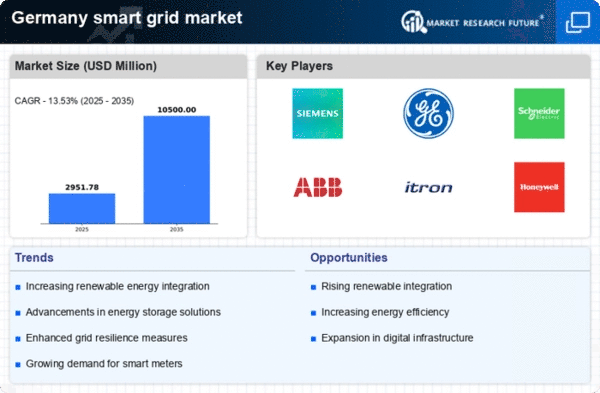
As per Market Research Future analysis, the Germany Smart Grid Market size was estimated at 2600.0 USD Million in 2024. The Smart Grid market is projected to grow from 2951.78 USD Million in 2025 to 10500.0 USD Million by 2035, exhibiting a compound annual growth rate (CAGR) of 13.5% during the forecast period 2025 - 2035

Key Market Trends & Highlights

The Germany smart grid market is poised for substantial growth driven by technological advancements and regulatory support.

  • The integration of renewable energy sources is transforming the energy landscape in Germany.
  • Advancements in digital technologies are enhancing grid management and operational efficiency.
  • The largest segment in the market is the residential sector, while the commercial sector is the fastest-growing segment.
  • Key market drivers include increased energy efficiency initiatives and rising demand for electric vehicles.

Market Size & Forecast

2024 Market Size 2600.0 (USD Million)
2035 Market Size 10500.0 (USD Million)
CAGR (2025 - 2035) 13.53%

Major Players

Siemens (DE), General Electric (US), Schneider Electric (FR), ABB (CH), Itron (US), Honeywell (US), Landis+Gyr (CH), Eaton (US), Cisco (US)

Our Impact
Enabled $4.3B Revenue Impact for Fortune 500 and Leading Multinationals
Partnering with 2000+ Global Organizations Each Year
30K+ Citations by Top-Tier Firms in the Industry

Germany Smart Grid Market Trends

The smart grid market in Germany is currently experiencing a transformative phase, driven by advancements in technology and a growing emphasis on sustainability. The integration of renewable energy sources, such as wind and solar, into the existing grid infrastructure is becoming increasingly prevalent. This shift not only enhances energy efficiency but also supports the country's ambitious climate goals. Furthermore, the implementation of smart meters and advanced communication technologies is facilitating real-time data exchange, which is essential for optimizing energy consumption and improving grid reliability. As a result, stakeholders are investing in innovative solutions that promote a more resilient and flexible energy system. In addition, regulatory frameworks are evolving to support the transition towards a smarter grid. The German government is actively promoting initiatives that encourage the adoption of smart grid technologies. This includes financial incentives for both consumers and businesses to invest in energy-efficient solutions. The focus on digitalization within the energy sector is also noteworthy, as it enables better management of energy resources and enhances consumer engagement. Overall, the Germany Smart Grid Market is poised for significant growth, with various factors contributing to its development and expansion in the coming years.

Integration of Renewable Energy Sources

The smart grid market is witnessing a notable trend towards the integration of renewable energy sources. This shift is largely driven by Germany's commitment to reducing carbon emissions and increasing the share of renewables in its energy mix. As more wind and solar installations come online, the need for a smart grid that can manage these variable energy sources becomes critical.

Advancements in Digital Technologies

Digital technologies are playing a pivotal role in the evolution of the smart grid market. Innovations such as IoT devices, artificial intelligence, and big data analytics are enhancing grid management and operational efficiency. These technologies enable real-time monitoring and control, which is essential for optimizing energy distribution and consumption.

Regulatory Support and Incentives

Regulatory frameworks are increasingly supportive of smart grid initiatives. The German government is implementing policies that provide financial incentives for the adoption of smart grid technologies. This regulatory environment encourages investments in infrastructure upgrades and promotes consumer participation in energy management.

Germany Smart Grid Market Drivers

Consumer Engagement and Awareness

The growing awareness among consumers regarding energy consumption and sustainability is driving the smart grid market in Germany. As individuals become more conscious of their energy usage, there is a rising demand for smart technologies that provide insights into consumption patterns. The smart grid market is responding by offering solutions that empower consumers to make informed decisions about their energy use. Initiatives such as energy management apps and home automation systems are gaining traction, enabling users to optimize their energy consumption. This trend is expected to lead to a 25% increase in the adoption of smart home technologies by 2026. Enhanced consumer engagement not only fosters energy efficiency but also supports the overall objectives of the smart grid market.

Rising Demand for Electric Vehicles

The increasing adoption of electric vehicles (EVs) in Germany is significantly influencing the smart grid market. With the government aiming for 10 million EVs on the road by 2030, the need for a robust charging infrastructure is paramount. Smart grids can facilitate the integration of EVs by enabling vehicle-to-grid (V2G) technologies, which allow EVs to return energy to the grid during peak demand. This not only stabilizes the grid but also provides financial incentives for EV owners. The smart grid market is poised to capitalize on this trend, as investments in charging stations and grid upgrades are projected to reach €5 billion by 2027. The interplay between EV growth and smart grid technology is likely to create a more resilient and efficient energy ecosystem.

Decentralization of Energy Production

The trend towards decentralized energy production in Germany is reshaping the smart grid market. With a growing number of households and businesses generating their own energy through solar panels and wind turbines, the traditional centralized grid model is becoming less viable. This shift necessitates the development of smart grid technologies that can manage distributed energy resources effectively. The smart grid market is expected to see increased demand for solutions that enable real-time monitoring and control of these decentralized systems. As of 2025, it is estimated that over 30% of Germany's electricity will be generated from decentralized sources, highlighting the need for advanced grid management solutions. This decentralization trend not only enhances energy security but also promotes sustainability, further driving the smart grid market.

Increased Energy Efficiency Initiatives

The push for enhanced energy efficiency in Germany is a pivotal driver for the smart grid market. The government has set ambitious targets to reduce energy consumption by 20% by 2025, which necessitates the adoption of smart grid technologies. These initiatives aim to optimize energy distribution and consumption, thereby reducing waste. The smart grid market is likely to benefit from investments in smart meters and demand response systems, which facilitate real-time energy management. Furthermore, the integration of energy-efficient appliances and systems into the grid can lead to substantial cost savings for consumers and utilities alike. As energy efficiency becomes a priority, the smart grid market is expected to expand, with projections indicating a growth rate of approximately 15% annually in the coming years.

Investment in Infrastructure Modernization

Germany's commitment to modernizing its energy infrastructure is a crucial driver for the smart grid market. The government has allocated substantial funding, approximately €10 billion, for the upgrade of aging electrical grids to accommodate new technologies. This investment aims to enhance grid reliability and resilience, which is essential for integrating renewable energy sources and managing demand fluctuations. The smart grid market stands to benefit from this modernization effort, as utilities seek to implement advanced technologies such as smart meters, automated distribution systems, and enhanced cybersecurity measures. As infrastructure improvements progress, the smart grid market is likely to experience accelerated growth, with an anticipated increase in market size by 20% over the next five years.


Market Segment Insights

By Components: Hardware (Largest) vs. Software (Fastest-Growing)

In the Germany smart grid market, the components segment is characterized by a diverse distribution of market share among hardware, software, and services. Hardware occupies the largest share, driven by the need for robust physical infrastructure to support smart grid operations. Software follows as a significant contributor, catering to increasing demand for data management and system optimization tools, while services play a crucial role in supporting both segments through installation and maintenance. Growth trends indicate a notable acceleration in software adoption, reflecting the transition towards digital solutions within the energy sector. The rise in renewable energy integration and smart metering technologies further fuels this trend, as utilities seek to enhance operational efficiency. Hardware remains essential but is challenged by the rapid evolution of cloud-based software solutions, highlighting a competitive landscape within the components segment.

Hardware (Dominant) vs. Software (Emerging)

In the Germany smart grid market, hardware serves as the dominant component, critical for establishing the necessary physical grid infrastructure. This includes transformers, sensors, and advanced metering devices that facilitate real-time data transmission and monitoring. On the other hand, software emerges as an essential enabler of smart grid functionalities, supporting analytics, control, and management systems that optimize grid performance. This software segment is rapidly evolving, driven by innovations in artificial intelligence and machine learning, making it crucial for utilities aiming to modernize their operations and enhance energy efficiency. As these software solutions continue to develop, they are expected to significantly influence market dynamics, driving competition and transforming how energy distribution and management are approached.

By Technology: Wired (Largest) vs. Wireless (Fastest-Growing)

The Germany smart grid market is experiencing a notable distribution of market share between wired and wireless technologies. Wired technology has established itself as the largest segment, primarily due to its reliability and established infrastructure. This segment is favored for critical applications where stable connections are essential. On the other hand, the wireless segment is gaining traction as it offers flexibility and ease of installation, appealing to a diverse range of applications in smart grid implementations. Growth trends in this segment are driven by the increasing demand for efficient energy management and the need for real-time data transmission. The wired segment is projected to maintain its dominance; however, the wireless segment is the fastest-growing due to advancements in communication technologies and the deployment of IoT devices. This growth is further fueled by the transition towards renewable energy sources, which require adaptable and scalable grid solutions.

Technology: Wired (Dominant) vs. Wireless (Emerging)

Wired technology in the Germany smart grid market is characterized by robust performance and high reliability, making it the dominant choice for critical grid applications. Its extensive infrastructure ensures consistent energy delivery, particularly in urban areas. In contrast, wireless technology is emerging rapidly as it provides significant advantages in terms of installation simplicity and scalability. With the rising adoption of IoT devices and the need for innovative grid solutions, wireless systems are increasingly being recognized for their potential to support decentralized energy management. As both segments evolve, collaboration between wired and wireless technologies is anticipated to enhance overall smart grid functionality.

By End-User: Residential (Largest) vs. Corporate (Fastest-Growing)

The distribution of market share among the end-user segments in the Germany smart grid market highlights the residential sector as the largest contributor, representing a significant portion of overall demand. Corporate users are also gaining traction, illustrating a dynamic shift as businesses increasingly adopt smart grid technologies to enhance energy efficiency and reduce operational costs. The government segment, while important, has a smaller share compared to these two primary categories. Growth trends are being driven by a combination of regulatory initiatives aimed at promoting sustainability and energy efficiency, technological advancements, and increasing environmental awareness among consumers and businesses alike. The corporate segment is expected to experience the fastest growth, fueled by investments in smart technologies and a push towards greener energy solutions. Meanwhile, the residential sector continues to thrive, supported by incentives for household energy management systems and smart appliances.

Residential (Dominant) vs. Corporate (Emerging)

In the context of the Germany smart grid market, the residential sector is recognized as the dominant end-user, characterized by a broad base of homeowners increasingly investing in smart technology such as advanced metering infrastructure, solar panel integrations, and energy storage solutions. This shift is augmented by government incentives aimed at reducing energy consumption and promoting renewable energy sources. Conversely, the corporate segment is emerging, marked by an escalating number of businesses adopting smart grid solutions to optimize energy use and minimize costs. This includes the integration of IoT devices and data analytics to improve efficiency and support sustainability goals, positioning this segment as a rapidly growing contender in the smart grid landscape.

Get more detailed insights about Germany Smart Grid Market

Key Players and Competitive Insights

The smart grid market in Germany is characterized by a dynamic competitive landscape, driven by the increasing demand for energy efficiency, renewable energy integration, and digital transformation. Key players such as Siemens (DE), General Electric (US), and Schneider Electric (FR) are at the forefront, each adopting distinct strategies to enhance their market positioning. Siemens (DE) focuses on innovation through its digital grid solutions, aiming to optimize energy management and enhance grid reliability. Meanwhile, General Electric (US) emphasizes partnerships with local utilities to expand its footprint in the region, leveraging its advanced analytics capabilities to improve grid performance. Schneider Electric (FR) is actively pursuing sustainability initiatives, integrating IoT technologies to facilitate smarter energy consumption, which collectively shapes a competitive environment that prioritizes technological advancement and sustainability.
The business tactics employed by these companies include localizing manufacturing and optimizing supply chains to enhance operational efficiency. The market structure appears moderately fragmented, with several players competing for market share while also collaborating on various projects. This collective influence of key players fosters a competitive atmosphere where innovation and strategic partnerships are paramount.
In October 2025, Siemens (DE) announced a collaboration with a leading German utility to deploy its latest smart grid technology, which is expected to enhance grid resilience and support the integration of renewable energy sources. This strategic move underscores Siemens' commitment to driving digital transformation in the energy sector, positioning itself as a leader in smart grid solutions. Similarly, in September 2025, Schneider Electric (FR) launched a new platform aimed at optimizing energy management for industrial clients, which is anticipated to significantly reduce operational costs and carbon emissions. This initiative reflects Schneider's focus on sustainability and its ability to adapt to evolving market demands.
In August 2025, General Electric (US) expanded its partnership with a regional energy provider to implement advanced grid analytics, enhancing predictive maintenance capabilities. This strategic action not only strengthens GE's market presence but also highlights the growing importance of data-driven decision-making in the smart grid sector. Furthermore, in July 2025, ABB (CH) unveiled a new suite of digital solutions designed to improve grid automation and efficiency, indicating a strong push towards integrating AI technologies into grid management.
As of November 2025, current competitive trends in the smart grid market are heavily influenced by digitalization, sustainability, and the integration of AI technologies. Strategic alliances among key players are shaping the landscape, fostering innovation and collaborative solutions. The shift from price-based competition to a focus on technological differentiation and supply chain reliability is evident, suggesting that future competitive dynamics will increasingly hinge on the ability to innovate and adapt to changing market conditions. Companies that prioritize these aspects are likely to emerge as leaders in the evolving smart grid market.

Key Companies in the Germany Smart Grid Market include

Industry Developments

The Germany Smart Grid Market has witnessed significant developments recently, marked by an increasing focus on enhancing energy efficiency and sustainability. E.ON announced collaborations aimed at integrating renewable energy sources into their grid, while Siemens has been actively upgrading smart grid technologies to improve infrastructure resilience.

RWE is expanding its smart meter rollout, supporting Germany's transition towards a decentralized energy supply. Avacon, a subsidiary of the E.ON Group, is leveraging digital solutions to enhance grid management. In terms of Mergers and Acquisitions, MVV Energie is reportedly exploring strategic partnerships to consolidate its position in the smart grid sector as of September 2023.

Additionally, Bosch has been investing in innovative energy storage technologies to support smart grid functionalities. Current affairs also highlight the role of Fraunhofer Institute, which has been involved in research initiatives aimed at optimizing grid operations.

In the past few years, significant regulations have been introduced, emphasizing the necessity of smart meter implementations and grid modernization, with government support aiding these initiatives to meet European Union energy directives. Prominent players like ABB and TenneT are focusing on enhancing cross-border electricity exchanges, thereby facilitating a more integrated European grid.

Future Outlook

Germany Smart Grid Market Future Outlook

The smart grid market in Germany is poised for growth at a 13.53% CAGR from 2025 to 2035, driven by technological advancements, regulatory support, and increasing energy demands.

New opportunities lie in:

  • Investment in advanced metering infrastructure solutions.
  • Development of AI-driven energy management systems.
  • Expansion of electric vehicle charging networks integrated with smart grids.

By 2035, the smart grid market is expected to achieve substantial growth and innovation.

Market Segmentation

Germany Smart Grid Market End-User Outlook

  • Residential
  • Corporate
  • Government

Germany Smart Grid Market Components Outlook

  • Hardware
  • Software
  • Services

Germany Smart Grid Market Technology Outlook

  • Wired
  • Wireless

Report Scope

MARKET SIZE 2024 2600.0(USD Million)
MARKET SIZE 2025 2951.78(USD Million)
MARKET SIZE 2035 10500.0(USD Million)
COMPOUND ANNUAL GROWTH RATE (CAGR) 13.53% (2025 - 2035)
REPORT COVERAGE Revenue Forecast, Competitive Landscape, Growth Factors, and Trends
BASE YEAR 2024
Market Forecast Period 2025 - 2035
Historical Data 2019 - 2024
Market Forecast Units USD Million
Key Companies Profiled Siemens (DE), General Electric (US), Schneider Electric (FR), ABB (CH), Itron (US), Honeywell (US), Landis+Gyr (CH), Eaton (US), Cisco (US)
Segments Covered Components, Technology, End-User
Key Market Opportunities Integration of renewable energy sources enhances efficiency in the smart grid market.
Key Market Dynamics Growing regulatory support and technological advancements drive innovation in the smart grid market.
Countries Covered Germany
Leave a Comment

FAQs

What is the expected market size of the Germany Smart Grid Market in 2024?

The Germany Smart Grid Market is expected to be valued at 2.7 billion USD in 2024.

What will the market size of the Germany Smart Grid Market be by 2035?

By 2035, the Germany Smart Grid Market is projected to reach a valuation of 10.1 billion USD.

What is the expected Compound Annual Growth Rate (CAGR) for the Germany Smart Grid Market from 2025 to 2035?

The Germany Smart Grid Market is expected to grow at a CAGR of 12.742% during the period from 2025 to 2035.

How much is the Hardware segment of the Germany Smart Grid Market expected to be worth in 2024?

The Hardware segment of the Germany Smart Grid Market is valued at 1.2 billion USD in 2024.

What will the valuation of the Software segment in the Germany Smart Grid Market be by 2035?

The Software segment is expected to be valued at 3.4 billion USD in 2035.

What is the expected market size of the Services segment in the Germany Smart Grid Market in 2024?

The Services segment is projected to reach a valuation of 0.6 billion USD in 2024.

Who are the major players in the Germany Smart Grid Market?

Key players in the market include E.ON, General Electric, RWE, Siemens, and ABB.

What are the primary drivers for growth in the Germany Smart Grid Market?

The primary growth drivers include technological advancements and the increasing demand for sustainable energy solutions.

What challenges does the Germany Smart Grid Market currently face?

Challenges include the high costs of implementation and the integration of renewable energy sources.

What are the emerging trends in the Germany Smart Grid Market?

Emerging trends include the integration of advanced data analytics and the rise of decentralized energy systems.

Download Free Sample

Kindly complete the form below to receive a free sample of this Report

Compare Licence

×
Features License Type
Single User Multiuser License Enterprise User
Price $4,950 $5,950 $7,250
Maximum User Access Limit 1 User Upto 10 Users Unrestricted Access Throughout the Organization
Free Customization
Direct Access to Analyst
Deliverable Format
Platform Access
Discount on Next Purchase 10% 15% 15%
Printable Versions