×
Request Free Sample ×

Kindly complete the form below to receive a free sample of this Report

* Please use a valid business email

Leading companies partner with us for data-driven Insights

clients tt-cursor
Hero Background

Germany Railway Cybersecurity Market

ID: MRFR/ICT/59352-HCR
200 Pages
Aarti Dhapte
February 2026

Germany Railway Cybersecurity Market Research Report By Application (Railway IT Infrastructure, Operational Technology, Passenger Information Systems, Command Control Systems), By Solution (Network Security, End-Point Security, Application Security, Data Protection), By Service (Consulting, Managed Security Services, Incident Response Services, Integration Services) and By End Use (Freight Rail, Passenger Rail, Urban Rail)- Forecast to 2035

Share:
Download PDF ×

We do not share your information with anyone. However, we may send you emails based on your report interest from time to time. You may contact us at any time to opt-out.

Germany Railway Cybersecurity Market Infographic
Purchase Options

Germany Railway Cybersecurity Market Summary

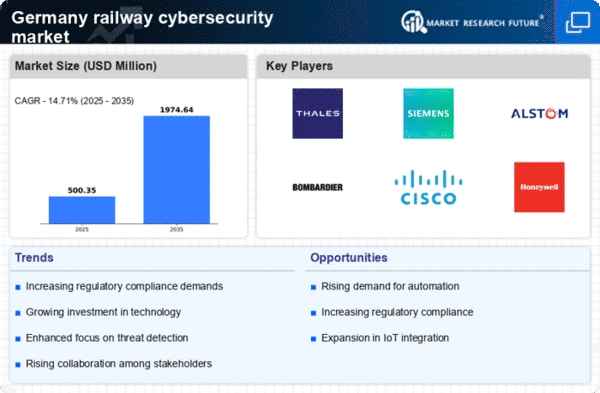
As per Market Research Future analysis, the Germany railway cybersecurity market size was estimated at 436.19 USD Million in 2024. The Germany railway cybersecurity market is projected to grow from 500.35 USD Million in 2025 to 1974.64 USD Million by 2035, exhibiting a compound annual growth rate (CAGR) of 14.7% during the forecast period 2025 - 2035

Key Market Trends & Highlights

The Germany railway cybersecurity market is experiencing robust growth driven by increasing investments and regulatory demands.

  • Investment in cybersecurity solutions is on the rise as rail operators seek to enhance their defenses against cyber threats.
  • Regulatory compliance and adherence to standards are becoming critical for railway operators to ensure safety and security.
  • Collaboration between public and private sectors is fostering innovation and improving the overall cybersecurity landscape in the railway sector.
  • The growing threat landscape and increased digitalization of railway operations are key drivers propelling market expansion.

Market Size & Forecast

2024 Market Size 436.19 (USD Million)
2035 Market Size 1974.64 (USD Million)
CAGR (2025 - 2035) 14.71%

Major Players

Thales (FR), Siemens (DE), Alstom (FR), Bombardier (CA), Cisco (US), Honeywell (US), Raytheon (US), Kaspersky (RU), McAfee (US)

Our Impact
Enabled $4.3B Revenue Impact for Fortune 500 and Leading Multinationals
Partnering with 2000+ Global Organizations Each Year
30K+ Citations by Top-Tier Firms in the Industry

Germany Railway Cybersecurity Market Trends

The railway cybersecurity market is currently experiencing a notable evolution, driven by the increasing reliance on digital technologies within the transportation sector. As rail systems become more interconnected, the potential for cyber threats escalates, prompting stakeholders to prioritize robust security measures. This shift is evident in the growing investments in advanced cybersecurity solutions, which aim to protect critical infrastructure from malicious attacks. Furthermore, regulatory frameworks are evolving to address these emerging challenges, ensuring that operators comply with stringent security standards. The emphasis on safeguarding sensitive data and maintaining operational integrity reshapes the railway cybersecurity market. In addition, the rising awareness of cybersecurity risks among rail operators and government entities is fostering collaboration between public and private sectors. This partnership is likely to enhance the development of innovative security technologies tailored to the unique needs of railway systems. As the market continues to mature, it appears that the focus will remain on integrating cutting-edge solutions that not only mitigate risks but also improve overall efficiency. The railway cybersecurity market is poised for significant growth, reflecting the critical importance of securing transportation networks in an increasingly digital world.

Increased Investment in Cybersecurity Solutions

Railway operators are allocating more resources towards advanced cybersecurity technologies. This trend indicates a proactive approach to safeguarding infrastructure against potential cyber threats, ensuring the resilience of operations.

Regulatory Compliance and Standards

The establishment of stringent regulations is shaping the railway cybersecurity market. Compliance with these standards is becoming essential for operators, driving the adoption of comprehensive security measures to protect critical assets.

Collaboration Between Public and Private Sectors

There is a growing trend of partnerships between government entities and private companies in the railway cybersecurity market. This collaboration aims to foster innovation and enhance the development of tailored security solutions.

Germany Railway Cybersecurity Market Drivers

Growing Threat Landscape

The railway cybersecurity market in Germany is experiencing heightened demand. This is due to an increasingly complex threat landscape. Cyberattacks targeting critical infrastructure have surged, with reports indicating a rise in incidents by over 30% in recent years. This alarming trend compels railway operators to invest in advanced cybersecurity measures to safeguard their systems. The integration of IoT devices and digital technologies in railway operations amplifies vulnerabilities. This makes robust cybersecurity solutions essential. As the reliance on technology grows, the railway cybersecurity market is likely to expand significantly, with projections suggesting a compound annual growth rate (CAGR) of around 12% through 2027. This growth reflects the urgent need for comprehensive security frameworks to protect against evolving cyber threats.

Technological Advancements

Technological advancements play a pivotal role in shaping the railway cybersecurity market in Germany. The adoption of artificial intelligence (AI) and machine learning (ML) technologies is transforming how railway operators detect and respond to cyber threats. These innovations enable real-time monitoring and predictive analytics, enhancing the overall security posture of railway systems. Furthermore, the integration of blockchain technology is emerging as a potential solution for securing data transactions within the railway ecosystem. As these technologies evolve, they are likely to drive the demand for advanced cybersecurity solutions, with market analysts estimating a growth rate of approximately 15% in the next five years. The railway cybersecurity market is thus positioned to benefit from these technological advancements, ensuring safer and more resilient operations.

Government Initiatives and Funding

In Germany, government initiatives aimed at enhancing cybersecurity in critical sectors are driving growth in the railway cybersecurity market. The federal government has allocated substantial funding to bolster cybersecurity infrastructure, with investments exceeding €100 million in recent years. These initiatives focus on developing advanced security protocols and fostering collaboration between public and private entities. The establishment of cybersecurity frameworks and guidelines by government agencies further supports the railway sector in implementing effective security measures. As a result, railway operators are increasingly adopting sophisticated cybersecurity solutions to comply with government mandates, thereby propelling the market forward. The emphasis on national security and infrastructure resilience underscores the importance of a robust cybersecurity posture in the railway industry.

Rising Public Awareness and Expectations

Public awareness regarding cybersecurity threats has risen significantly in Germany, influencing the railway cybersecurity market. As incidents of cyberattacks gain media attention, passengers and stakeholders are increasingly concerned about the safety and security of railway systems. This heightened awareness is prompting railway operators to prioritize cybersecurity investments to meet public expectations. Surveys indicate that over 60% of passengers consider cybersecurity a crucial factor in their travel decisions. In response, railway companies are enhancing their cybersecurity frameworks to build trust and ensure passenger safety. This shift in public perception is likely to drive growth in the railway cybersecurity market, as operators seek to align their security measures with the expectations of an informed and vigilant public.

Increased Digitalization of Railway Operations

The ongoing digitalization of railway operations in Germany is a significant driver of the railway cybersecurity market. As railway companies increasingly adopt digital platforms for ticketing, scheduling, and maintenance, the attack surface for cyber threats expands. This digital transformation necessitates the implementation of robust cybersecurity measures to protect sensitive data and ensure operational continuity. Reports indicate that over 70% of railway operators are prioritizing cybersecurity investments to mitigate risks associated with digitalization. Consequently, the railway cybersecurity market is expected to witness substantial growth, with estimates suggesting an increase in market size by approximately €200 million by 2028. This trend highlights the critical need for comprehensive cybersecurity strategies in the face of evolving digital threats.


Market Segment Insights

By Application: Operational Technology (Largest) vs. Railway IT Infrastructure (Fastest-Growing)

In the Germany railway cybersecurity market, Operational Technology commands the largest share due to its critical role in ensuring the safety and reliability of rail operations. This segment encompasses systems that control physical devices, which are essential for smooth railway functioning. Conversely, the Railway IT Infrastructure segment is quickly gaining traction, thanks to increasing digitalization efforts and the necessity for robust IT systems to support advanced cybersecurity measures. Growth in the Germany railway cybersecurity market is driven by the increasing frequency of cyberattacks targeting critical infrastructure, necessitating enhanced security protocols. Rail operators are investing heavily in both Operational Technology and IT Infrastructure to bolster defenses. Key trends include the integration of AI-driven security solutions and real-time monitoring systems, which are becoming mainstream to ensure safety and operational continuity in the railway sector.

Operational Technology (Dominant) vs. Railway IT Infrastructure (Emerging)

Operational Technology is pivotal in the cybersecurity landscape, as it concerns the systems that manage the physical operations of trains and related infrastructure. Its dominant position stems from the essential need for real-time data and control, ensuring the integrity of rail services. In contrast, Railway IT Infrastructure represents an emerging area that focuses on the software and data management systems requisite for modern cybersecurity solutions. As automation and IT converge, this segment is notably growing, driven by the demand for sophisticated data protection measures to counteract evolving threats. Thus, while Operational Technology retains its dominance, Railway IT Infrastructure is rapidly evolving, emphasizing the importance of both segments in securing railway operations.

By Solution: Network Security (Largest) vs. End-Point Security (Fastest-Growing)

In the Germany railway cybersecurity market, Network Security holds the largest market share due to its critical role in safeguarding communication systems and operational technologies. This segment dominates the landscape as stakeholders invest heavily in advanced security protocols to protect their infrastructure from increasing cyber threats. End-Point Security, while smaller in comparison, is rapidly gaining traction, highlighting a shift towards comprehensive protection strategies that also encompass individual devices within the network. The growth trends in this segment are driven by a heightened awareness of cyber risks among railway operators, prompting investments in innovative security technologies. Factors such as regulatory requirements and the rising sophistication of cyberattacks are propelling the demand for End-Point Security solutions. Additionally, the increasing digitization of railway operations fuels the need for robust security measures across all solutions to ensure safety and continuity of services.

Network Security (Dominant) vs. Application Security (Emerging)

Network Security serves as the backbone of the Germany railway cybersecurity market, providing crucial protections against vulnerabilities in communication networks and systems. This segment is characterized by solutions that encompass firewalls, intrusion detection systems, and advanced threat intelligence to protect the operational integrity of railway systems. In contrast, Application Security is emerging as a critical component, focusing on safeguarding software applications from vulnerabilities throughout their lifecycle. This segment is gaining momentum as more railway operations adopt digital platforms, making the security of applications essential in preventing breaches that could disrupt services. The interplay between these segments showcases the evolving landscape of cybersecurity in the railway sector, where both dominant and emerging technologies work together to enhance overall safety.

By Service: Managed Security Services (Largest) vs. Incident Response Services (Fastest-Growing)

In the Germany railway cybersecurity market, the service segment showcases a competitive distribution among Consulting, Managed Security Services, Incident Response Services, and Integration Services. Managed Security Services holds the largest share, primarily due to increasing demand for continuous protection against cyber threats. Incident Response Services, on the other hand, is gaining traction as organizations recognize the importance of swift response capabilities in the event of a cyber incident, thus enhancing their market visibility. The growth trends within the service segment are driven by the rising frequency of cyber-attacks targeting railway infrastructure and the need for compliance with stringent security regulations. Additionally, advancements in technology and increasing awareness about cybersecurity risks among railway operators are contributing to the market's expansion. Managed Security Services continue to dominate, while Incident Response Services is emerging as a critical area of investment for rail operators looking to enhance their security posture.

Consulting (Dominant) vs. Integration Services (Emerging)

Consulting services have established a dominant position in the Germany railway cybersecurity market, providing expertise that helps railway organizations develop comprehensive security strategies. These services include risk assessments, compliance guidance, and strategic planning tailored to the unique challenges of the railway sector. As companies strive to adopt robust cybersecurity measures, the demand for consulting services remains strong. Conversely, Integration Services are rapidly emerging as a significant contributor, focusing on the implementation of security solutions into existing railway systems. This segment benefits from the increasing integration of advanced security technologies, such as AI and machine learning, which enhance the overall effectiveness of cybersecurity measures in addressing evolving threats.

By End Use: Freight Rail (Largest) vs. Passenger Rail (Fastest-Growing)

In the Germany railway cybersecurity market, the market share distribution among the end use segments is notably varied. Freight rail represents the largest segment, benefiting from extensive logistics operations that require robust cybersecurity measures to safeguard data and infrastructure. This segment's established presence is complemented by significant investments aimed at enhancing security protocols against increasing cyber threats. On the other hand, the passenger rail segment is witnessing rapid growth due to the rising demand for secure and efficient passenger services. Factors driving this growth include the increasing integration of advanced technologies in rail operations and a heightened focus on passenger safety. As urbanization increases, urban rail systems are also contributing to this trend, necessitating a comprehensive approach to cybersecurity.

Freight Rail (Dominant) vs. Passenger Rail (Emerging)

Freight rail in the Germany railway cybersecurity market stands as the dominant player, primarily driven by its long-standing infrastructure and greater reliance on data exchange for track logistics. The need for protecting sensitive logistics data is paramount, and companies invest heavily in cybersecurity solutions to ensure operational continuity. Conversely, passenger rail represents an emerging segment, characterized by its rapid technological advancements and the adoption of smart ticketing systems. Passenger rail emphasizes user experience and safety, making cybersecurity a critical focus area. With an increase in passenger volume and real-time data requirements, the segment is evolving swiftly, pushing for innovative cybersecurity solutions that cater to this dynamic environment.

Get more detailed insights about Germany Railway Cybersecurity Market

Key Players and Competitive Insights

The railway cybersecurity market in Germany is characterized by a dynamic competitive landscape, driven by increasing digital threats and the need for robust security measures. Key players such as Thales (FR), Siemens (DE), and Cisco (US) are at the forefront, each adopting distinct strategies to enhance their market positioning. Thales (FR) focuses on innovation through advanced cybersecurity solutions tailored for rail systems, while Siemens (DE) emphasizes regional expansion and partnerships with local authorities to bolster infrastructure security. Cisco (US) leverages its expertise in network security to provide integrated solutions that address the unique challenges of railway systems. Collectively, these strategies contribute to a competitive environment that is increasingly focused on technological advancement and collaborative efforts.In terms of business tactics, companies are localizing manufacturing and optimizing supply chains to enhance operational efficiency. The market structure appears moderately fragmented, with several players vying for market share. However, the influence of major companies is significant, as they set industry standards and drive technological innovation. This competitive structure fosters an environment where smaller firms can thrive by specializing in niche areas of cybersecurity, while larger firms dominate through comprehensive service offerings.

In October Thales (FR) announced a strategic partnership with Deutsche Bahn (DE) to enhance cybersecurity measures across its rail networks. This collaboration aims to integrate advanced threat detection systems, thereby improving the resilience of critical infrastructure. The strategic importance of this partnership lies in its potential to set a benchmark for cybersecurity practices within the industry, showcasing Thales' commitment to safeguarding rail operations.

In September Siemens (DE) launched a new cybersecurity framework specifically designed for rail operators, which includes AI-driven analytics for real-time threat assessment. This initiative reflects Siemens' focus on digital transformation and its intent to lead in the integration of AI technologies within railway systems. The framework is expected to enhance operational efficiency and reduce response times to potential cyber threats, thereby reinforcing Siemens' competitive edge.

In August Cisco (US) expanded its cybersecurity offerings by introducing a dedicated rail cybersecurity solution that combines IoT security with advanced analytics. This move is indicative of Cisco's strategy to address the growing complexity of railway systems and the associated cybersecurity risks. By integrating IoT capabilities, Cisco positions itself as a leader in providing comprehensive security solutions tailored to the unique needs of the railway sector.

As of November current trends in the railway cybersecurity market include a strong emphasis on digitalization, sustainability, and the integration of AI technologies. Strategic alliances are increasingly shaping the competitive landscape, as companies recognize the value of collaboration in addressing complex cybersecurity challenges. Looking ahead, competitive differentiation is likely to evolve from traditional price-based competition to a focus on innovation, technological advancement, and supply chain reliability. This shift underscores the importance of developing cutting-edge solutions that not only meet regulatory requirements but also enhance the overall safety and efficiency of railway operations.

Key Companies in the Germany Railway Cybersecurity Market include

Industry Developments

The Germany Railway Cybersecurity Market has seen significant developments recently, with multiple companies enhancing their positions. In June 2023, Deutsche Bahn announced a collaboration with IBM to strengthen their cybersecurity infrastructure, responding to growing threats in the transportation sector. Siemens has also been active, investing in advanced cybersecurity measures for its rail systems, reflecting an increased focus on protecting critical infrastructure. In September 2023, Bombardier and Alstom were involved in a strategic partnership aimed at integrating robust cybersecurity capabilities into their existing rail solutions, further solidifying their foothold in the market. 

Additionally, regulatory bodies in Germany have introduced stringent guidelines, compelling companies like Cisco and Thales to elevate their cybersecurity protocols to comply with new standards. There have been no major mergers or acquisitions reported recently among the highlighted companies in this sector. The overall market valuation is expected to grow significantly as companies invest in advanced technologies like artificial intelligence and machine learning to combat emerging cyber threats. This accelerated investment underscores the increasing recognition of cybersecurity as a critical aspect of railway operations, particularly in the context of Germany's expansive rail network.

Future Outlook

Germany Railway Cybersecurity Market Future Outlook

The Railway Cybersecurity Market in Germany is poised for growth at 14.71% CAGR from 2025 to 2035, driven by increasing digitalization and regulatory compliance.

New opportunities lie in:

  • Development of AI-driven threat detection systems
  • Integration of blockchain for secure data transactions
  • Expansion of cybersecurity training programs for railway personnel

By 2035, the railway cybersecurity market is expected to achieve robust growth and enhanced security measures.

Market Segmentation

Germany Railway Cybersecurity Market End Use Outlook

  • Freight Rail
  • Passenger Rail
  • Urban Rail

Germany Railway Cybersecurity Market Service Outlook

  • Consulting
  • Managed Security Services
  • Incident Response Services
  • Integration Services

Germany Railway Cybersecurity Market Solution Outlook

  • Network Security
  • End-Point Security
  • Application Security
  • Data Protection

Germany Railway Cybersecurity Market Application Outlook

  • Railway IT Infrastructure
  • Operational Technology
  • Passenger Information Systems
  • Command Control Systems

Report Scope

MARKET SIZE 2024 436.19(USD Million)
MARKET SIZE 2025 500.35(USD Million)
MARKET SIZE 2035 1974.64(USD Million)
COMPOUND ANNUAL GROWTH RATE (CAGR) 14.71% (2025 - 2035)
REPORT COVERAGE Revenue Forecast, Competitive Landscape, Growth Factors, and Trends
BASE YEAR 2024
Market Forecast Period 2025 - 2035
Historical Data 2019 - 2024
Market Forecast Units USD Million
Key Companies Profiled Thales (FR), Siemens (DE), Alstom (FR), Bombardier (CA), Cisco (US), Honeywell (US), Raytheon (US), Kaspersky (RU), McAfee (US)
Segments Covered Application, Solution, Service, End Use
Key Market Opportunities Integration of advanced technologies enhances security measures in the railway cybersecurity market.
Key Market Dynamics Growing regulatory scrutiny drives investment in advanced cybersecurity solutions for railway infrastructure and operations.
Countries Covered Germany
Leave a Comment

FAQs

What is the expected market size of the Germany Railway Cybersecurity Market in 2024?

The Germany Railway Cybersecurity Market is expected to be valued at 362.5 million USD in 2024.

What is the projected market size for the Germany Railway Cybersecurity Market by 2035?

The market is projected to reach a value of 1,530.7 million USD by 2035.

What is the expected compound annual growth rate (CAGR) for the Germany Railway Cybersecurity Market from 2025 to 2035?

The expected CAGR for the market from 2025 to 2035 is 13.991 percent.

Which application within the Germany Railway Cybersecurity Market is expected to have the highest valuation in 2035?

The Railway IT Infrastructure application is expected to be valued at 425.0 million USD in 2035.

What is the expected market value of the Operational Technology segment in 2024?

The Operational Technology segment is expected to have a market value of 85.0 million USD in 2024.

Which key players are dominating the Germany Railway Cybersecurity Market?

Major players include Bombardier, Thales, Cisco, and Siemens, among others.

What is the projected value of the Passenger Information Systems application by 2035?

The Passenger Information Systems application is projected to reach a value of 300.0 million USD by 2035.

How much is the Command Control Systems application expected to be valued at in 2024?

The Command Control Systems application is expected to be valued at 102.5 million USD in 2024.

What challenges are currently facing the Germany Railway Cybersecurity Market?

Challenges include evolving cyber threats and the need for significant investments in cybersecurity technologies.

What growth opportunities exist in the Germany Railway Cybersecurity Market?

Opportunities include advancements in technology and increased regulatory requirements for cybersecurity.

Download Free Sample

Kindly complete the form below to receive a free sample of this Report

Compare Licence

×
Features License Type
Single User Multiuser License Enterprise User
Price $4,950 $5,950 $7,250
Maximum User Access Limit 1 User Upto 10 Users Unrestricted Access Throughout the Organization
Free Customization
Direct Access to Analyst
Deliverable Format
Platform Access
Discount on Next Purchase 10% 15% 15%
Printable Versions