×
Request Free Sample ×

Kindly complete the form below to receive a free sample of this Report

* Please use a valid business email

Leading companies partner with us for data-driven Insights

clients tt-cursor
Hero Background

Germany Micro Encapsulation Market

ID: MRFR/FnB/46052-HCR
200 Pages
Snehal Singh
February 2026

Germany Microencapsulation Market Size, Share, Industry Trend & Analysis Research Report: By Technology (Spray, Emulsion, Dripping, Others), By Coating Material (Lipids, Proteins, Polymers, Gums & Resins, Carbohydrates, Others) andBy Application (Pharmaceuticals & Healthcare, Food & Beverages, Household Items, Personal Care, Agrochemicals, Others)- Forecast to 2035

Share:
Download PDF ×

We do not share your information with anyone. However, we may send you emails based on your report interest from time to time. You may contact us at any time to opt-out.

Germany Micro Encapsulation Market Infographic
Purchase Options

Germany Micro Encapsulation Market Summary

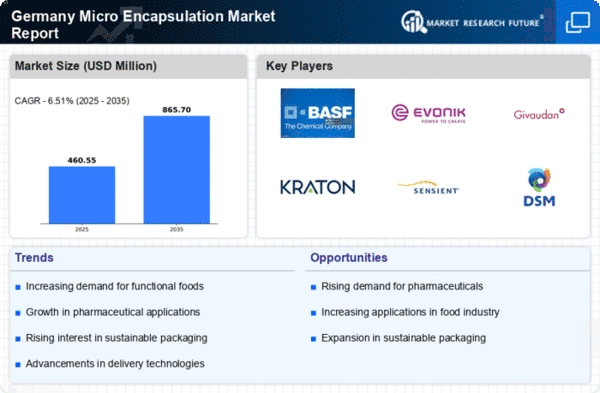
As per Market Research Future analysis, the Germany Micro Encapsulation Market size was estimated at 432.4 USD Million in 2024. The Germany micro encapsulation market is projected to grow from 460.55 USD Million in 2025 to 865.7 USD Million by 2035, exhibiting a compound annual growth rate (CAGR) of 6.5% during the forecast period 2025 - 2035

Key Market Trends & Highlights

The Germany micro encapsulation market is poised for growth driven by technological advancements and increasing demand across various sectors.

  • Technological advancements are enhancing the efficiency and effectiveness of micro encapsulation processes.
  • Sustainability initiatives are becoming a focal point, influencing product development and consumer preferences.
  • The pharmaceutical segment remains the largest, while the food industry is the fastest-growing segment in the micro encapsulation market.
  • Rising demand in pharmaceuticals and innovations in the food industry are key drivers propelling market expansion.

Market Size & Forecast

2024 Market Size 432.4 (USD Million)
2035 Market Size 865.7 (USD Million)
CAGR (2025 - 2035) 6.51%

Major Players

BASF SE (DE), Evonik Industries AG (DE), Givaudan SA (CH), Kraton Corporation (US), Sensient Technologies Corporation (US), Royal DSM N.V. (NL), Clariant AG (CH), Innospec Inc. (US), FMC Corporation (US)

Our Impact
Enabled $4.3B Revenue Impact for Fortune 500 and Leading Multinationals
Partnering with 2000+ Global Organizations Each Year
30K+ Citations by Top-Tier Firms in the Industry

Germany Micro Encapsulation Market Trends

The Germany Micro Encapsulation Market in Germany is currently experiencing notable growth. This growth is driven by advancements in technology and increasing demand across various sectors. This innovative process, which involves enclosing active substances within a protective coating, enhances the stability and controlled release of these substances. Industries such as food, pharmaceuticals, and cosmetics are particularly benefiting from these developments, as micro encapsulation allows for improved product performance and consumer appeal. Furthermore, the rising focus on sustainability and eco-friendly solutions is prompting manufacturers to explore biodegradable materials for encapsulation, aligning with broader environmental goals. In addition, the regulatory landscape in Germany is evolving, with stricter guidelines aimed at ensuring product safety and efficacy. This has led to increased investment in research and development, as companies strive to meet these standards while also catering to consumer preferences for natural and organic products. The interplay between innovation, regulation, and consumer demand is shaping the future of the micro encapsulation market, suggesting a dynamic environment where adaptability and forward-thinking strategies will be crucial for success.

Technological Advancements

Recent innovations in micro encapsulation techniques are enhancing the efficiency and effectiveness of the process. New methods, such as electrospinning and coacervation, are being adopted, allowing for better control over the size and release profiles of encapsulated materials. This trend is particularly relevant in the food and pharmaceutical sectors, where precision is paramount.

Sustainability Initiatives

There is a growing emphasis on sustainable practices within the micro encapsulation market. Companies are increasingly seeking biodegradable and environmentally friendly materials for encapsulation. This shift not only meets consumer demand for greener products but also aligns with Germany's commitment to sustainability and reducing environmental impact.

Regulatory Compliance

The regulatory framework governing the micro encapsulation market is becoming more stringent. Companies are investing in compliance measures to ensure that their products meet safety and efficacy standards. This trend is likely to drive innovation as businesses seek to develop new formulations that adhere to these regulations while still appealing to consumers.

Germany Micro Encapsulation Market Drivers

Food Industry Innovations

The micro encapsulation market sees significant growth due to innovations in the food industry in Germany. The demand for functional foods and nutraceuticals is on the rise, as consumers become more health-conscious. Micro encapsulation technology allows for the protection of sensitive ingredients, such as vitamins and probiotics, enhancing their stability and bioavailability. In 2025, the food sector is expected to represent around 25% of the micro encapsulation market. This trend suggests that manufacturers are increasingly adopting micro encapsulation to meet consumer preferences for healthier food options, thereby driving market expansion.

Increased Investment in R&D

Investment in research and development is a critical driver for the micro encapsulation market in Germany. Companies are increasingly focusing on developing advanced micro encapsulation techniques to enhance product performance across various sectors, including pharmaceuticals, food, and cosmetics. This trend is likely to foster innovation, leading to the introduction of new products and applications. In 2025, R&D spending in the micro encapsulation market is projected to rise by approximately 15%, reflecting the industry's commitment to improving technology and meeting evolving consumer demands. This investment could potentially reshape the competitive landscape.

Cosmetic Applications Expansion

The micro encapsulation market benefits from the expanding applications in the cosmetics industry in Germany. As consumers seek products with enhanced efficacy and longer-lasting effects, micro encapsulation technology offers a solution by protecting active ingredients from degradation. This trend is particularly evident in skincare and haircare products, where encapsulated ingredients can provide sustained release and improved performance. The cosmetics segment is anticipated to contribute approximately 20% to the micro encapsulation market by 2025. This growth indicates a shift towards more innovative formulations, which could lead to increased competition among manufacturers.

Rising Demand in Pharmaceuticals

The micro encapsulation market in Germany is experiencing a notable surge in demand from the pharmaceutical sector. This growth is primarily driven by the need for controlled drug release and improved bioavailability of active ingredients. As the population ages, the demand for innovative drug delivery systems increases, with micro encapsulation providing solutions that enhance therapeutic efficacy. In 2025, the pharmaceutical segment is projected to account for approximately 30% of the overall micro encapsulation market. This trend indicates a shift towards more sophisticated drug formulations, which could potentially lead to increased investments in research and development within the industry.

Growing Awareness of Health Benefits

The micro encapsulation market in Germany is significantly influenced by growing awareness of health benefits. This awareness is associated with encapsulated ingredients. Consumers are becoming more informed about the advantages of micro encapsulation, such as improved nutrient delivery and enhanced product stability. This trend is particularly relevant in the food and pharmaceutical sectors, where the efficacy of active ingredients is paramount. As awareness increases, the demand for micro encapsulated products is expected to rise, potentially leading to a market growth rate of around 10% by 2025. This shift indicates a broader acceptance of micro encapsulation technology among consumers.


Market Segment Insights

By Application: Pharmaceuticals (Largest) vs. Food and Beverage (Fastest-Growing)

The Germany micro encapsulation market exhibits a diverse range of applications across various sectors. Pharmaceuticals lead the market, holding the largest share due to the increasing demand for drug delivery systems that enhance bioavailability and stability. Following closely is the food and beverage sector, which is experiencing significant traction as consumers demand fortified products with enhanced flavors and nutritional profiles. Growth trends indicate that while pharmaceuticals dominate, the food and beverage segment is emerging as the fastest-growing area. This growth is driven by a rising awareness of health and wellness, along with innovations in food technology. Agriculture and cosmetics also show promise but are currently overshadowed by the rapid expansion of the food sector, fueled by consumer preferences for functional food items.

Pharmaceuticals: Dominant vs. Food and Beverage: Emerging

Pharmaceuticals stand as the dominant application in the Germany micro encapsulation market, characterized by its essential role in creating advanced drug formulations that offer improved therapeutic effects. The segment's robustness is attributed to ongoing research and development initiatives aimed at enhancing drug delivery systems. In contrast, the food and beverage segment, though emerging, is rapidly gaining attention due to the rising consumer demand for healthier, functional food products. This segment integrates encapsulation technologies to improve flavor retention and prolong shelf life, meeting both consumer preferences and regulatory standards. The evolution of these segments illustrates a dynamic landscape where pharmaceuticals maintain a lead while food and beverage applications are on an upward trajectory.

By Technology: Spray Drying (Largest) vs. Fluid Bed Coating (Fastest-Growing)

In the Germany micro encapsulation market, Spray Drying holds the largest market share due to its efficiency in producing microcapsules with uniform size and excellent stability. Following closely, Fluid Bed Coating is emerging as a significant player, capturing a notable share as companies increasingly adopt this technology for its cost-effectiveness and scalability. Other methods like Emulsion Deposition, Pan Coating, and Coacervation are also present but do not command the same level of market presence. The growth trends for the segment values indicate a dynamic shift towards more automated and precise encapsulation techniques. The demand for Spray Drying remains robust, while Fluid Bed Coating is gaining traction due to advancements in machinery and processing capabilities. Factors driving these technologies include the rising need for tailored release profiles in pharmaceuticals and food applications, along with an emphasis on clean and sustainable manufacturing processes.

Technology: Spray Drying (Dominant) vs. Fluid Bed Coating (Emerging)

Spray Drying is characterized by its ability to produce microcapsules rapidly, making it a dominant force in the market. It offers advantages such as uniform particle size and enhanced product stability, appealing to various industries including pharmaceuticals and food technology. Conversely, Fluid Bed Coating is considered an emerging technology, providing flexibility in encapsulation and a smoother coating process that minimizes waste. This method is particularly popular in the formulation of controlled release systems for pharmaceutical products. As the market evolves, both technologies are expected to adapt further, with ongoing innovations poised to enhance performance and durability of microcapsules.

By Core Material: Polymers (Largest) vs. Carbohydrates (Fastest-Growing)

The Germany micro encapsulation market exhibits a diverse share distribution among core materials, with Polymers holding the largest share due to their versatility and effectiveness in various applications. Carbohydrates, while smaller in market share, are quickly gaining traction due to their growing demand in food and pharmaceutical industries, driven by trends towards natural and health-focused products. In recent years, the growth of the Germany micro encapsulation market has been influenced by several key factors. An increased focus on drug delivery systems and functional foods has led to an emerging interest in alternative materials like Carbohydrates. Additionally, the rising trend towards sustainable and eco-friendly products has encouraged innovation in the use of natural polymers, solidifying their dominant market position.

Polymers (Dominant) vs. Carbohydrates (Emerging)

Polymers are widely regarded as the dominant core material in the micro encapsulation sector, primarily due to their excellent protective qualities and adaptability to various encapsulation processes. Their applications range from pharmaceuticals to agriculture, where they enhance stability and control over release mechanisms. On the other hand, Carbohydrates, categorized as an emerging segment, are gaining momentum, especially in food and nutrition applications. Their appeal lies in their biocompatibility and favorable regulatory status, which aligns well with current consumer demands for natural and clean-label products. This growing interest in Carbohydrates indicates a shift towards more sustainable and health-oriented encapsulation solutions in the market.

By End Use: Consumer Goods (Largest) vs. Healthcare (Fastest-Growing)

In the Germany micro encapsulation market, the Consumer Goods segment holds the largest share, driven by increasing demand for innovative packaging solutions that enhance product longevity and effectiveness. This segment has established itself as a front-runner within the market, supported by trends in cosmetics and home care products that prioritize stability and user experience. Conversely, the Healthcare segment is recognized as the fastest-growing area within the Germany micro encapsulation market. The rising emphasis on targeted drug delivery and smart pharmaceutical solutions fuels this growth. Increasing investments in healthcare R&D and the need for advanced therapeutic options are significant drivers pushing the demand for microencapsulation technologies in this sector.

Consumer Goods (Dominant) vs. Healthcare (Emerging)

The Consumer Goods segment, recognized for its extensive applications, dominates the Germany micro encapsulation market with a focus on enhancing product performance and extending shelf life. This segment leverages innovative packaging technologies that cater to consumer needs for premium and sustainable products. On the other hand, the Healthcare segment is emerging rapidly, characterized by its focus on precision delivery systems and encapsulated compounds aimed at improving therapeutic efficacy. The growing collaboration between pharmaceutical companies and microencapsulation technology providers is expected to further propel market advancements, creating a competitive landscape that emphasizes safety, effectiveness, and tailored healthcare solutions.

Get more detailed insights about Germany Micro Encapsulation Market

Key Players and Competitive Insights

The micro encapsulation market in Germany exhibits a dynamic competitive landscape characterized by innovation and strategic collaborations among key players. The market is primarily driven by the increasing demand for advanced delivery systems in pharmaceuticals, food, and cosmetics. Companies such as BASF SE (DE), Evonik Industries AG (DE), and Givaudan SA (CH) are at the forefront, leveraging their technological expertise to enhance product offerings. BASF SE (DE) focuses on sustainable solutions, while Evonik Industries AG (DE) emphasizes its capabilities in specialty chemicals, indicating a trend towards environmentally friendly and efficient micro encapsulation technologies.In terms of business tactics, companies are increasingly localizing manufacturing to reduce lead times and optimize supply chains. The competitive structure of the market appears moderately fragmented, with several players vying for market share. However, the collective influence of major companies like Clariant AG (CH) and Royal DSM N.V. (NL) suggests a trend towards consolidation, as these firms seek to enhance their competitive positioning through strategic partnerships and acquisitions.

In October BASF SE (DE) announced the launch of a new line of biodegradable microencapsulated products aimed at the agricultural sector. This strategic move not only aligns with the growing emphasis on sustainability but also positions BASF as a leader in eco-friendly solutions, potentially attracting environmentally conscious customers and enhancing its market share.

In September Evonik Industries AG (DE) expanded its production capabilities by investing €50 million in a new facility dedicated to microencapsulation technologies. This expansion is likely to bolster Evonik's capacity to meet rising demand, particularly in the pharmaceutical sector, where precision and reliability are paramount. Such investments indicate a commitment to innovation and responsiveness to market needs.

In August Givaudan SA (CH) entered into a strategic partnership with a leading biotechnology firm to develop novel microencapsulation techniques for flavor and fragrance applications. This collaboration is expected to enhance Givaudan's product portfolio and strengthen its competitive edge in the food and beverage industry, reflecting a broader trend of cross-industry partnerships aimed at technological advancement.

As of November the micro encapsulation market is increasingly defined by trends such as digitalization, sustainability, and the integration of artificial intelligence in production processes. Strategic alliances are becoming pivotal in shaping the competitive landscape, as companies seek to leverage complementary strengths. The shift from price-based competition to a focus on innovation, technology, and supply chain reliability is evident, suggesting that future competitive differentiation will hinge on the ability to deliver unique, high-quality solutions that meet evolving consumer demands.

Key Companies in the Germany Micro Encapsulation Market include

Industry Developments

Recent developments in the Germany Microencapsulation Market have shown significant activity, particularly with companies such as Sensient Technologies, Evonik Industries, and BASF. As of August 2023, Evonik launched its new line of microencapsulated products aimed at the cosmetics sector, emphasizing sustainability and efficiency. In the previous months, Givaudan expanded its microencapsulation capabilities to enhance flavor retention in food products, reflecting a growing demand for advanced food technologies. The current market is experiencing growth, attributed to an increase in demand for pharmaceuticals, food, and agricultural applications, with an estimated market valuation expected to rise significantly in the next few years.

Key companies like Clariant and FMC Corporation have been investing in Research and Development, contributing to innovative solutions in microencapsulation. Over the last two years, the market has seen heightened interest in sustainable microencapsulation techniques, addressing environmental concerns. Moreover, Syngenta announced a strategic partnership with Encapsys in early 2022 to develop advanced agricultural solutions through microencapsulation, reinforcing the collaborative nature of the industry. The ongoing trends indicate a robust future for the microencapsulation sector in Germany, driven by innovation and consumer demands.

Future Outlook

Germany Micro Encapsulation Market Future Outlook

The Micro Encapsulation Market is projected to grow at 6.51% CAGR from 2025 to 2035, driven by advancements in technology, increasing demand in pharmaceuticals, and food industries.

New opportunities lie in:

  • Development of biodegradable microcapsules for sustainable packaging solutions.
  • Integration of smart technology in microencapsulation for enhanced product tracking.
  • Expansion into emerging markets with tailored microencapsulation solutions for local industries.

By 2035, the micro encapsulation market is expected to achieve substantial growth and innovation.

Market Segmentation

Germany Micro Encapsulation Market End Use Outlook

  • Consumer Goods
  • Industrial
  • Healthcare
  • Food Production

Germany Micro Encapsulation Market Technology Outlook

  • Spray Drying
  • Fluid Bed Coating
  • Emulsion Deposition
  • Pan Coating
  • Coacervation

Germany Micro Encapsulation Market Application Outlook

  • Pharmaceuticals
  • Food and Beverage
  • Agriculture
  • Cosmetics
  • Nutraceuticals

Germany Micro Encapsulation Market Core Material Outlook

  • Polymers
  • Carbohydrates
  • Lipids
  • Proteins
  • Inorganic Compounds

Report Scope

MARKET SIZE 2024 432.4(USD Million)
MARKET SIZE 2025 460.55(USD Million)
MARKET SIZE 2035 865.7(USD Million)
COMPOUND ANNUAL GROWTH RATE (CAGR) 6.51% (2025 - 2035)
REPORT COVERAGE Revenue Forecast, Competitive Landscape, Growth Factors, and Trends
BASE YEAR 2024
Market Forecast Period 2025 - 2035
Historical Data 2019 - 2024
Market Forecast Units USD Million
Key Companies Profiled BASF SE (DE), Evonik Industries AG (DE), Givaudan SA (CH), Kraton Corporation (US), Sensient Technologies Corporation (US), Royal DSM N.V. (NL), Clariant AG (CH), Innospec Inc. (US), FMC Corporation (US)
Segments Covered Application, Technology, Core Material, End Use
Key Market Opportunities Growing demand for innovative food preservation techniques drives opportunities in the micro encapsulation market.
Key Market Dynamics Rising demand for innovative delivery systems drives growth in the micro encapsulation market amid evolving consumer preferences.
Countries Covered Germany
Leave a Comment

FAQs

What is the expected market size of the Germany Microencapsulation Market in 2024?

In 2024, the Germany Microencapsulation Market is expected to be valued at 583.0 million USD.

What is the projected market size for the Germany Microencapsulation Market by 2035?

By 2035, the market is expected to reach a valuation of 1450.0 million USD.

What is the expected compound annual growth rate (CAGR) for the Germany Microencapsulation Market from 2025 to 2035?

The expected CAGR for the Germany Microencapsulation Market from 2025 to 2035 is 8.636 percent.

Which technology segment of the Germany Microencapsulation Market is expected to have the highest value in 2035?

The 'Others' technology segment is expected to reach a value of 565.0 million USD by 2035.

What market share is contributed by the Spray technology segment in 2024?

In 2024, the Spray technology segment is valued at 120.0 million USD.

Who are the key players in the Germany Microencapsulation Market?

Major players in the market include Sensient Technologies, FMC Corporation, BASF, and Evonik Industries.

What is the projected market value of the Emulsion technology segment in 2035?

The Emulsion technology segment is projected to be valued at 385.0 million USD in 2035.

How much is the Dripping technology segment expected to be valued in 2024?

In 2024, the Dripping technology segment is expected to be valued at 80.0 million USD.

What are some of the key growth drivers for the Germany Microencapsulation Market?

Key growth drivers include increasing applications in food, pharmaceuticals, and personal care products.

What impact does the current global economic scenario have on the Germany Microencapsulation Market?

The global economic scenario affects supply chains and pricing strategies within the Germany Microencapsulation Market.

Download Free Sample

Kindly complete the form below to receive a free sample of this Report

Compare Licence

×
Features License Type
Single User Multiuser License Enterprise User
Price $4,950 $5,950 $7,250
Maximum User Access Limit 1 User Upto 10 Users Unrestricted Access Throughout the Organization
Free Customization
Direct Access to Analyst
Deliverable Format
Platform Access
Discount on Next Purchase 10% 15% 15%
Printable Versions