×
Request Free Sample ×

Kindly complete the form below to receive a free sample of this Report

* Please use a valid business email

Leading companies partner with us for data-driven Insights

clients tt-cursor
Hero Background

China Micro Encapsulation Market

ID: MRFR/FnB/46056-HCR
200 Pages
Snehal Singh
February 2026

China Microencapsulation Market Size, Share, Industry Trend & Analysis Research Report: By Technology (Spray, Emulsion, Dripping, Others), By Coating Material (Lipids, Proteins, Polymers, Gums & Resins, Carbohydrates, Others) and By Application (Pharmaceuticals & Healthcare, Food & Beverages, Household Items, Personal Care, Agrochemicals, Others)- Forecast to 2035

Share:
Download PDF ×

We do not share your information with anyone. However, we may send you emails based on your report interest from time to time. You may contact us at any time to opt-out.

China Micro Encapsulation Market Infographic
Purchase Options

China Micro Encapsulation Market Summary

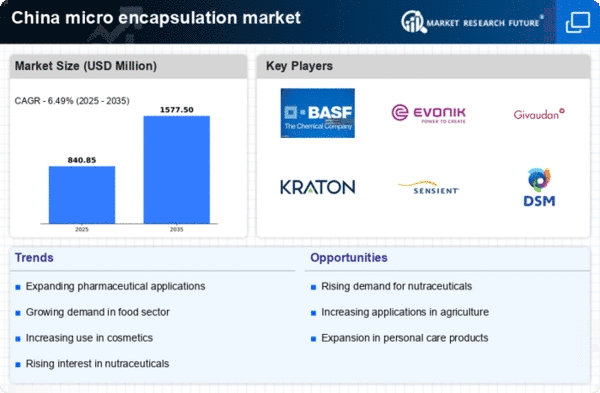
As per Market Research Future analysis, the China Micro Encapsulation Market size was estimated at 789.6 USD Million in 2024. The China micro encapsulation market is projected to grow from 840.85 USD Million in 2025 to 1577.5 USD Million by 2035, exhibiting a compound annual growth rate (CAGR) of 6.4% during the forecast period 2025 - 2035

Key Market Trends & Highlights

The China micro encapsulation market is poised for substantial growth driven by diverse applications and increasing consumer awareness.

  • The food industry emerges as the largest segment, reflecting a rising demand for enhanced flavor and shelf-life preservation.
  • Pharmaceutical innovations represent the fastest-growing segment, fueled by advancements in drug delivery systems.
  • Sustainability initiatives are gaining traction, with a notable shift towards eco-friendly packaging solutions.
  • Technological advancements in micro encapsulation and growing health consciousness among consumers are key drivers of market expansion.

Market Size & Forecast

2024 Market Size 789.6 (USD Million)
2035 Market Size 1577.5 (USD Million)
CAGR (2025 - 2035) 6.49%

Major Players

BASF SE (DE), Evonik Industries AG (DE), Givaudan SA (CH), Kraton Corporation (US), Sensient Technologies Corporation (US), Royal DSM N.V. (NL), Clariant AG (CH), Innospec Inc. (US), Encapsys LLC (US)

Our Impact
Enabled $4.3B Revenue Impact for Fortune 500 and Leading Multinationals
Partnering with 2000+ Global Organizations Each Year
30K+ Citations by Top-Tier Firms in the Industry

China Micro Encapsulation Market Trends

The China Micro Encapsulation Market is experiencing notable growth, driven by advancements in technology and increasing demand across various sectors. In China, the application of micro encapsulation techniques is becoming more prevalent in industries such as food, pharmaceuticals, and cosmetics. This trend is largely attributed to the need for improved product stability, controlled release of active ingredients, and enhanced sensory experiences. As consumers become more health-conscious and environmentally aware, the demand for innovative delivery systems is likely to rise, prompting manufacturers to invest in research and development. Moreover, the regulatory landscape in China is evolving, with stricter guidelines aimed at ensuring product safety and efficacy. This shift is encouraging companies to adopt micro encapsulation methods that not only comply with regulations but also meet consumer expectations for quality and sustainability. The integration of smart technologies, such as IoT and AI, into production processes may further enhance the efficiency and effectiveness of micro encapsulation techniques. Overall, the micro encapsulation market appears poised for continued expansion, driven by technological innovations and changing consumer preferences.

Rising Demand in Food Industry

The food sector is increasingly adopting micro encapsulation to enhance flavor retention and extend shelf life. This trend reflects a growing consumer preference for high-quality, fresh products that maintain their nutritional value over time.

Pharmaceutical Innovations

In pharmaceuticals, micro encapsulation is gaining traction for its ability to improve drug delivery systems. This method allows for targeted release and better absorption, which aligns with the industry's focus on personalized medicine.

Sustainability Initiatives

Sustainability is becoming a key driver in the micro encapsulation market. Companies are exploring eco-friendly materials and processes to meet consumer demand for environmentally responsible products, thereby enhancing their market competitiveness.

China Micro Encapsulation Market Drivers

Regulatory Support for Food Safety

The regulatory landscape in China is becoming increasingly supportive of food safety initiatives, which is positively influencing the micro encapsulation market. Government policies aimed at enhancing food safety standards are encouraging manufacturers to adopt advanced technologies, including microencapsulation. This technology not only helps in preserving the quality and safety of food products but also aids in extending their shelf life. As a result, the micro encapsulation market is likely to see a rise in demand from food manufacturers looking to comply with stringent regulations. The market is expected to grow as companies invest in microencapsulation solutions to ensure product safety and quality, aligning with government objectives to improve public health.

Expansion of the Pharmaceutical Sector

The pharmaceutical sector in China is undergoing rapid expansion, which is significantly impacting the micro encapsulation market. With the increasing focus on drug delivery systems, microencapsulation technology is being utilized to enhance the bioavailability and stability of pharmaceutical compounds. This trend is particularly relevant as the market for pharmaceuticals in China is projected to reach $150 billion by 2025. The micro encapsulation market is likely to benefit from this growth, as pharmaceutical companies seek innovative solutions to improve drug formulations. The ability to control the release of active ingredients through microencapsulation is becoming a key factor in the development of new therapeutic products, thereby driving market demand.

Growing Health Consciousness Among Consumers

In recent years, there has been a notable increase in health consciousness among consumers in China. This trend is significantly impacting the micro encapsulation market, as consumers seek products that offer enhanced nutritional benefits without compromising on taste. Microencapsulation technology allows for the incorporation of vitamins, minerals, and other health-promoting compounds into food products, thereby catering to this growing demand. The market for functional foods is expected to reach approximately $30 billion by 2026, with microencapsulated ingredients playing a crucial role in this expansion. The micro encapsulation market is thus poised to benefit from this shift in consumer preferences, as manufacturers increasingly adopt encapsulation techniques to enhance product appeal and nutritional value.

Technological Advancements in Micro Encapsulation

The micro encapsulation market in China is experiencing a surge due to rapid technological advancements. Innovations in encapsulation techniques, such as coacervation and spray drying, enhance the efficiency and effectiveness of microencapsulation processes. These advancements allow for better control over the release of active ingredients, which is particularly beneficial in the food and pharmaceutical sectors. As a result, the market is projected to grow at a CAGR of approximately 10% over the next five years. This growth is driven by the increasing need for improved product stability and shelf life, which are critical factors in consumer acceptance. The micro encapsulation market is thus positioned to leverage these technological improvements to meet the evolving demands of various applications.

Rising Interest in Sustainable Packaging Solutions

Sustainability is becoming a critical consideration for consumers and manufacturers alike in China, influencing the micro encapsulation market. The demand for sustainable packaging solutions is prompting companies to explore microencapsulation as a means to reduce waste and enhance product longevity. By encapsulating active ingredients, manufacturers can minimize the use of preservatives and extend the shelf life of products, aligning with eco-friendly practices. The micro encapsulation market is thus likely to see increased investment in sustainable technologies, as companies strive to meet consumer expectations for environmentally responsible products. This shift towards sustainability is expected to drive innovation and growth within the market, as businesses seek to differentiate themselves in a competitive landscape.


Market Segment Insights

By Application: Pharmaceuticals (Largest) vs. Nutraceuticals (Fastest-Growing)

In the China micro encapsulation market, Pharmaceuticals holds the largest share, significantly impacting various sectors by providing controlled release and targeted delivery systems. This segment capitalizes on the increasing demand for advanced drug formulations and therapies, leading to an enhanced patient experience and compliance rates. On the other hand, the Nutraceuticals segment is emerging rapidly, with a growth trajectory driven by the rising awareness of health supplements and preventative healthcare solutions. This segment's adaptability and innovation resonate well with the evolving consumer preferences towards natural and health-focused products. Growth trends indicate that the Pharmaceuticals segment is bolstered by ongoing innovations in drug delivery systems, regulatory support for advanced therapies, and rising healthcare expenditures. Meanwhile, the Nutraceuticals segment thrives on the booming health and wellness trend, where consumers seek products that support their long-term health. Enhanced focus on research and development, along with strategic partnerships, is also pivotal in driving growth in both segments, positioning them favorably in the competitive landscape.

Pharmaceuticals (Dominant) vs. Nutraceuticals (Emerging)

Pharmaceuticals in the micro encapsulation market remains dominant due to its essential role in modern medicine, particularly in enhancing the effectiveness and safety of drug formulations. This segment is characterized by rigorous research leading to innovative solutions like targeted drug delivery systems and prolonged release forms, ensuring better therapeutic outcomes. In contrast, Nutraceuticals is seen as an emerging segment that caters to the increasing consumer demand for dietary supplements and functional foods. The latter focuses on prevention rather than treatment, thus aligning with the global shift towards preventive healthcare. Nutraceuticals are increasingly incorporating advanced micro encapsulation techniques to enhance bioavailability and shelf-life, making them appealing in a competitive health market.

By Technology: Spray Drying (Largest) vs. Fluid Bed Coating (Fastest-Growing)

Spray Drying dominates the China micro encapsulation market, capturing a significant market share due to its efficiency and versatility in producing a wide range of encapsulated products. This method is widely utilized across various industries, including pharmaceuticals and food technology, leading to a stable demand. In contrast, Fluid Bed Coating, while currently smaller in market share, has been identified as the fastest-growing segment. The increasing demand for this technique stems from its ability to provide uniform coating and improved product quality. The growth trends in the micro encapsulation technology segment are driven by advancements in processing methods and rising applications across industries. Spray Drying is preferred for its rapid production capabilities, making it cost-effective, while Fluid Bed Coating's growth is attributed to the rising focus on product innovation and quality improvement. As industries seek to enhance consumer experiences, these technologies are set to evolve, reflecting a shift towards more sophisticated encapsulation processes.

Technology: Spray Drying (Dominant) vs. Fluid Bed Coating (Emerging)

Spray Drying is characterized by its ability to quickly transform liquid feed into dry powders, making it ideal for applications that require efficient encapsulation. This method not only ensures high-quality encapsulation but also caters to diverse sectors, driving its dominant position. On the other hand, Fluid Bed Coating, while still emerging, is gaining momentum due to its superior coating uniformity and efficiency in mass production. It allows for controlled release properties, which are increasingly sought after in pharmaceuticals and nutraceuticals. As Chinese industries look for better product formulations, the demand for both technologies is expected to grow, with Fluid Bed Coating quickly catching up in versatility and application scope.

By Core Material: Polymers (Largest) vs. Lipids (Fastest-Growing)

In the China micro encapsulation market, Polymers dominate the market share among core materials due to their versatility and widespread use in various applications like food, pharmaceuticals, and cosmetics. This segment holds a significant position owing to properties such as biocompatibility and tailorability that allow manufacturers to develop targeted delivery systems. Carbohydrates and Proteins also account for notable portions of the market, catering to specific applications, while Inorganic Compounds have a smaller share focused on niche usages. The growth trends in the Polymers segment are fueled by the increasing demand for innovative delivery systems in the pharmaceutical and food industries, emphasizing the need for sustained releases of active ingredients. Meanwhile, Lipids are witnessing the fastest growth, driven primarily by advancements in nutrition and pharmaceutical sectors, where their natural properties offer enhanced nutritional benefits, showcasing a promising trajectory that is attracting increased investments and research activities.

Polymers (Dominant) vs. Lipids (Emerging)

Polymers are the dominant core material in the China micro encapsulation market, characteristic for their adaptability and ease of processing, making them suitable for multiple applications such as pharmaceuticals, food, and cosmetics. Their extensive use is attributed to their ability to encapsulate a wide range of compounds, enhancing stability and release profiles. In contrast, Lipids represent an emerging segment, gaining attention for their natural origin and efficacy in improving bioavailability of nutrients. They are particularly valuable in dietary supplements and functional foods, appealing to health-conscious consumers. The growing trend towards clean label products is further propelling the demand for Lipids, positioning them strategically in a market increasingly focused on natural and health-oriented options.

By End Use: Consumer Goods (Largest) vs. Healthcare (Fastest-Growing)

In the China micro encapsulation market, the consumer goods sector holds the largest share, driven by an increasing demand for innovative packaging solutions that enhance product stability and shelf life. The industrial segment follows, serving various applications that require specialized formulations. Meanwhile, healthcare is quickly gaining traction, with significant investments in drug delivery systems and personal care products, alongside food production, which emphasizes safety and quality in food preservation. Growth trends in the segment reflect a strong pivot towards sustainability and efficiency, particularly in healthcare and food production where micro encapsulation technologies are critical for enhancing active ingredient stability. Consumer goods are experiencing a persistent shift towards convenience in packaging, while healthcare's rapid adoption is fueled by advancements in nanotechnology. Industrial applications are expanding as well, supporting broader use cases that capitalize on the functional benefits of micro encapsulation technologies.

Consumer Goods (Dominant) vs. Healthcare (Emerging)

The consumer goods segment remains dominant in the micro encapsulation landscape, leveraging technology to improve product durability and consumer appeal. This segment encompasses a wide range of applications, including personal care and household products, where product innovation drives market growth. On the other hand, healthcare represents an emerging sector, poised for substantial growth, as it embraces micro encapsulation for enhanced drug delivery systems and patient compliance. These segments are distinctly positioned, with consumer goods focusing on market penetration and brand loyalty, while healthcare emphasizes research and development to push tech boundaries, indicating a dynamic interplay between established and growing user bases in the China micro encapsulation market.

Get more detailed insights about China Micro Encapsulation Market

Key Players and Competitive Insights

The micro encapsulation market in China is characterized by a dynamic competitive landscape, driven by innovation and the increasing demand for advanced delivery systems across various sectors, including pharmaceuticals, food, and cosmetics. Key players such as BASF SE (DE), Evonik Industries AG (DE), and Givaudan SA (CH) are at the forefront, employing strategies that emphasize technological advancements and regional expansion. BASF SE (DE) focuses on enhancing its product portfolio through continuous innovation, while Evonik Industries AG (DE) leverages its expertise in specialty chemicals to develop tailored microencapsulation solutions. Givaudan SA (CH) is strategically positioned to capitalize on the growing demand for flavor and fragrance encapsulation, indicating a trend towards specialization within the market.The business tactics employed by these companies reflect a concerted effort to localize manufacturing and optimize supply chains, which is crucial in a moderately fragmented market. This competitive structure allows for a diverse range of offerings, yet the influence of major players remains significant. The collective strategies of these companies not only enhance their market presence but also contribute to a more resilient supply chain, which is increasingly vital in today's economic climate.

In October BASF SE (DE) announced the launch of a new microencapsulation technology aimed at improving the stability and release profiles of active ingredients in personal care products. This strategic move underscores BASF's commitment to innovation and positions the company to meet the evolving needs of consumers seeking high-performance formulations. The introduction of this technology is likely to enhance BASF's competitive edge in the personal care segment, where differentiation is paramount.

In September Evonik Industries AG (DE) expanded its production capabilities in China by investing in a new facility dedicated to microencapsulation solutions. This expansion not only signifies Evonik's confidence in the Chinese market but also reflects a broader trend of companies localizing production to better serve regional demands. The facility is expected to enhance supply chain efficiency and reduce lead times, thereby strengthening Evonik's market position.

In August Givaudan SA (CH) entered into a strategic partnership with a leading Chinese food manufacturer to develop encapsulated flavor solutions tailored for the local market. This collaboration highlights Givaudan's focus on regional partnerships as a means to enhance its product offerings and respond to specific consumer preferences. Such alliances are indicative of a trend where companies seek to leverage local expertise to drive innovation and market penetration.

As of November the competitive trends within the micro encapsulation market are increasingly defined by digitalization, sustainability, and the integration of artificial intelligence. Strategic alliances are becoming more prevalent, allowing companies to pool resources and expertise to foster innovation. The shift from price-based competition towards a focus on technological advancement and supply chain reliability is evident, suggesting that future competitive differentiation will hinge on the ability to innovate and adapt to changing market dynamics.

Key Companies in the China Micro Encapsulation Market include

Industry Developments

Recent developments in the China Microencapsulation Market have shown significant activity, particularly in relation to expansion and innovation among key players. Zhejiang Medicine and BASF have recently focused on enhancing their microencapsulation technologies to meet growing demand in food, pharmaceuticals, and personal care sectors. Meanwhile, companies such as Nippon Shokubai and Evonik Industries are investing in sustainable microencapsulation solutions, responding to the increasing emphasis on environmentally-friendly practices in China. In terms of mergers and acquisitions, there have been no publicly reported acquisitions involving the mentioned companies in the last few months.

However, major happenings include a marked growth in market valuation during 2022 as the demand for specialty chemicals soared, attributed to a surge in consumer goods production. The government of China has also prioritized innovation in the chemical industry, impacting firms like Givaudan and Syngenta. Additionally, technological advancements and strategic partnerships have driven competitive edges within the market, fostering an environment ripe for further development and exploration in microencapsulation applications across various industries.

Future Outlook

China Micro Encapsulation Market Future Outlook

The Micro Encapsulation Market in China is projected to grow at a 6.49% CAGR from 2025 to 2035, driven by advancements in technology and increasing demand across various sectors.

New opportunities lie in:

  • Development of biodegradable microcapsules for sustainable packaging solutions.
  • Integration of microencapsulation in pharmaceuticals for targeted drug delivery systems.
  • Expansion of microencapsulation applications in food preservation and flavor enhancement.

By 2035, the micro encapsulation market is expected to achieve substantial growth and innovation.

Market Segmentation

China Micro Encapsulation Market End Use Outlook

  • Consumer Goods
  • Industrial
  • Healthcare
  • Food Production

China Micro Encapsulation Market Technology Outlook

  • Spray Drying
  • Fluid Bed Coating
  • Emulsion Deposition
  • Pan Coating
  • Coacervation

China Micro Encapsulation Market Application Outlook

  • Pharmaceuticals
  • Food and Beverage
  • Agriculture
  • Cosmetics
  • Nutraceuticals

China Micro Encapsulation Market Core Material Outlook

  • Polymers
  • Carbohydrates
  • Lipids
  • Proteins
  • Inorganic Compounds

Report Scope

MARKET SIZE 2024 789.6(USD Million)
MARKET SIZE 2025 840.85(USD Million)
MARKET SIZE 2035 1577.5(USD Million)
COMPOUND ANNUAL GROWTH RATE (CAGR) 6.49% (2025 - 2035)
REPORT COVERAGE Revenue Forecast, Competitive Landscape, Growth Factors, and Trends
BASE YEAR 2024
Market Forecast Period 2025 - 2035
Historical Data 2019 - 2024
Market Forecast Units USD Million
Key Companies Profiled BASF SE (DE), Evonik Industries AG (DE), Givaudan SA (CH), Kraton Corporation (US), Sensient Technologies Corporation (US), Royal DSM N.V. (NL), Clariant AG (CH), Innospec Inc. (US), Encapsys LLC (US)
Segments Covered Application, Technology, Core Material, End Use
Key Market Opportunities Growing demand for innovative delivery systems in pharmaceuticals and food industries drives micro encapsulation market expansion.
Key Market Dynamics Rising demand for innovative delivery systems drives growth in the micro encapsulation market amid evolving consumer preferences.
Countries Covered China
Leave a Comment

FAQs

What is the projected market size for the China Microencapsulation Market in 2024?

The China Microencapsulation Market is projected to be valued at 1.1 billion USD in 2024.

What is the expected market size for the China Microencapsulation Market in 2035?

By 2035, the China Microencapsulation Market is expected to reach a value of 2.7 billion USD.

What is the expected compound annual growth rate (CAGR) for the China Microencapsulation Market from 2025 to 2035?

The China Microencapsulation Market is anticipated to exhibit a CAGR of 8.506% during the forecast period from 2025 to 2035.

Which technology segment is expected to dominate the China Microencapsulation Market in 2024?

The Spray technology segment is expected to lead the market with a value of 0.44 billion USD in 2024.

What will be the value of the Emulsion technology segment in 2035?

The Emulsion technology segment is projected to have a value of 0.79 billion USD in 2035.

Who are the major players in the China Microencapsulation Market?

Key players in the market include Zhejiang Medicine, BASF, Nippon Shokubai, and Dow Chemical.

What market size is projected for the Other technology segment in 2035?

The Other technology segment is expected to reach a value of 0.32 billion USD in 2035.

What is the expected market size for the Dripping technology segment in 2024?

The Dripping technology segment is anticipated to be valued at 0.22 billion USD in 2024.

What are the growth drivers for the China Microencapsulation Market?

Increase in demand for innovative delivery systems and expanding applications in food, pharmaceuticals, and personal care drive market growth.

How does the market for the China Microencapsulation Market vary by technology between 2024 and 2035?

The market values for Spray, Emulsion, Dripping, and Others are expected to grow significantly from 2024 to 2035, reflecting diverse consumer demands.

Download Free Sample

Kindly complete the form below to receive a free sample of this Report

Compare Licence

×
Features License Type
Single User Multiuser License Enterprise User
Price $4,950 $5,950 $7,250
Maximum User Access Limit 1 User Upto 10 Users Unrestricted Access Throughout the Organization
Free Customization
Direct Access to Analyst
Deliverable Format
Platform Access
Discount on Next Purchase 10% 15% 15%
Printable Versions