×
Request Free Sample ×

Kindly complete the form below to receive a free sample of this Report

* Please use a valid business email

Leading companies partner with us for data-driven Insights

clients tt-cursor
Hero Background

Germany Intraocular Lens Market

ID: MRFR/HC/48727-HCR
200 Pages
Garvit Vyas
February 2026

Germany Intraocular Lens Market Research Report By Product Type (Monofocal, Multifocal, Toric, Accommodating), By Material Type (Acrylic, Silicone, PMMA, Hydrophilic), By Surgery Type (Phacoemulsification, Extracapsular Cataract Surgery, Intracapsular Cataract Surgery) andBy End Use (Hospitals, Eye Clinics, Ambulatory Surgical Centers) - Growth & Industry Forecast 2025 To 2035

Share:
Download PDF ×

We do not share your information with anyone. However, we may send you emails based on your report interest from time to time. You may contact us at any time to opt-out.

Germany Intraocular Lens Market Infographic
Purchase Options

Germany Intraocular Lens Market Summary

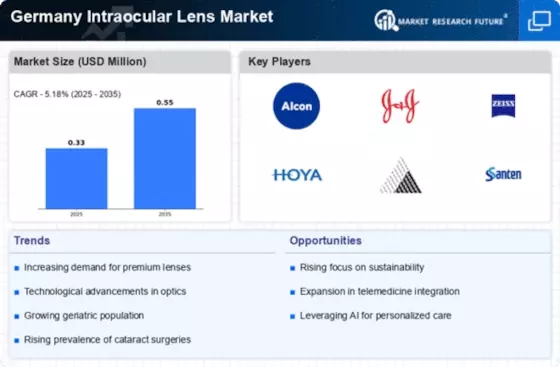
As per analysis, the Germany Intraocular Lens Market is projected to grow from USD 314 Million in 2024 to USD 548 Million by 2035, exhibiting a compound annual growth rate (CAGR) of 5.18% during the forecast period (2025 - 2035).

Key Market Trends & Highlights

The Germany Intraocular Lens Market is poised for growth driven by technological advancements and increasing patient-centric solutions.

  • Technological advancements in lens design are enhancing the performance and safety of intraocular lenses.
  • The cataract surgery segment remains the largest, while the refractive surgery segment is experiencing the fastest growth.
  • Acrylic lenses dominate the market, yet silicone lenses are rapidly gaining traction due to their flexibility and comfort.
  • Rising prevalence of eye disorders and government initiatives supporting innovative products are key drivers of market expansion.

Market Size & Forecast

2024 Market Size 0.314 (USD Million)
2035 Market Size 0.548 (USD Million)
CAGR (2025 - 2035) 5.18%

Major Players

Alcon (CH), Johnson & Johnson (US), Bausch + Lomb (US), Carl Zeiss (DE), Hoya Corporation (JP), Rayner (GB), Santen Pharmaceutical (JP), Abbott Laboratories (US), Medennium (US)

Our Impact
Enabled $4.3B Revenue Impact for Fortune 500 and Leading Multinationals
Partnering with 2000+ Global Organizations Each Year
30K+ Citations by Top-Tier Firms in the Industry

Germany Intraocular Lens Market Trends

The Germany Intraocular Lens Market is currently experiencing a notable evolution, driven by advancements in technology and an increasing prevalence of cataract surgeries. The demand for intraocular lenses is on the rise, as more individuals seek effective solutions for vision correction. This trend is further supported by the aging population in Germany, which is likely to contribute to a higher incidence of age-related eye conditions. Additionally, the healthcare system in Germany is well-equipped to support innovative surgical procedures, enhancing the accessibility of intraocular lens implantation for patients. As a result, the market appears poised for growth, with various stakeholders, including manufacturers and healthcare providers, actively engaging in the development of new products and techniques. Moreover, the regulatory environment in Germany is conducive to the introduction of advanced intraocular lens technologies. The emphasis on patient safety and product efficacy is paramount, leading to rigorous testing and approval processes. This focus on quality assurance may foster consumer confidence in the products available in the market. Furthermore, collaborations between research institutions and industry players could potentially accelerate the development of next-generation intraocular lenses, addressing specific patient needs and preferences. Overall, the Germany Intraocular Lens Market seems to be on a promising trajectory, with opportunities for innovation and growth in the coming years.

Technological Advancements in Lens Design

The Germany Intraocular Lens Market is witnessing a surge in innovative lens designs, which aim to enhance visual outcomes for patients. These advancements include the development of multifocal and accommodating lenses that provide improved vision at various distances. Such innovations are likely to cater to the diverse needs of patients, particularly the aging population, who may require more versatile solutions for their vision correction.

Increased Focus on Patient-Centric Solutions

There is a growing emphasis on patient-centric approaches within the Germany Intraocular Lens Market. Healthcare providers are increasingly prioritizing personalized treatment plans that consider individual patient needs and preferences. This trend may lead to a more tailored selection of intraocular lenses, ensuring that patients receive the most suitable options for their specific conditions.

Regulatory Support for Innovative Products

The regulatory framework in Germany appears to be supportive of the introduction of innovative intraocular lens products. Stringent safety and efficacy standards are in place, which may encourage manufacturers to invest in research and development. This supportive environment could facilitate the launch of advanced lens technologies, ultimately benefiting patients and enhancing surgical outcomes.

Germany Intraocular Lens Market Drivers

Technological Innovations in IOLs

Technological advancements in intraocular lens design and materials are transforming the Germany Intraocular Lens Market. Innovations such as multifocal and accommodating lenses are gaining traction, offering patients improved visual outcomes. The introduction of premium lenses, which provide enhanced vision at multiple distances, is particularly appealing to the aging population. Market data suggests that the share of premium lenses in the overall intraocular lens market is expected to grow, reflecting a shift towards higher-quality products. As manufacturers invest in research and development to create more effective and user-friendly lenses, the Germany Intraocular Lens Market is likely to experience robust growth driven by these technological innovations.

Rising Prevalence of Eye Disorders

The increasing prevalence of eye disorders, particularly cataracts, is a primary driver of the Germany Intraocular Lens Market. According to recent health statistics, approximately 6 million people in Germany are affected by cataracts, leading to a heightened demand for intraocular lenses. This trend is likely to continue as the population ages, with projections indicating that by 2030, the number of individuals over 65 will rise significantly. Consequently, healthcare providers are focusing on enhancing surgical outcomes, which further propels the demand for advanced intraocular lenses. The Germany Intraocular Lens Market is thus positioned to benefit from this demographic shift, as more patients seek surgical interventions to restore vision.

Aging Population and Lifestyle Changes

The aging population in Germany, coupled with lifestyle changes, is a significant driver of the Germany Intraocular Lens Market. As life expectancy increases, the number of elderly individuals requiring cataract surgery is also on the rise. Additionally, lifestyle factors such as increased screen time and exposure to UV light may contribute to the development of cataracts at an earlier age. Market analysis indicates that the demand for intraocular lenses is likely to grow in tandem with these demographic shifts. As healthcare providers adapt to the needs of an aging population, the Germany Intraocular Lens Market is poised for expansion, driven by the necessity for effective vision correction solutions.

Growing Awareness and Education on Eye Health

Increasing awareness and education regarding eye health are driving factors in the Germany Intraocular Lens Market. Public health campaigns and initiatives by organizations have significantly improved knowledge about cataracts and the benefits of surgical intervention. As more individuals become informed about the options available for vision correction, the demand for intraocular lenses is likely to rise. Market surveys indicate that patients are increasingly seeking consultations for cataract surgery, reflecting a proactive approach to eye health. This trend is expected to continue, as educational efforts emphasize the importance of early detection and treatment, thereby positively impacting the Germany Intraocular Lens Market.

Government Initiatives and Reimbursement Policies

Government initiatives and favorable reimbursement policies play a crucial role in shaping the Germany Intraocular Lens Market. The German healthcare system provides comprehensive coverage for cataract surgeries, including intraocular lens implantation, which encourages patients to seek treatment. Recent reforms aimed at improving access to eye care services have further bolstered the market. For instance, the introduction of new reimbursement codes for advanced lens types has incentivized ophthalmologists to adopt innovative solutions. This supportive regulatory environment not only enhances patient access to quality care but also stimulates market growth by encouraging the adoption of advanced intraocular lenses in surgical practices across Germany.


Market Segment Insights

By Application: Cataract Surgery (Largest) vs. Refractive Surgery (Fastest-Growing)

In the Germany Intraocular Lens Market, the application segment is primarily dominated by cataract surgery, which holds the largest share. This procedure accounts for a significant portion of the market due to the high prevalence of cataracts among the aging population. Refractive surgery, while smaller in share, is quickly gaining traction and is recognized as the fastest-growing segment due to advancements in technology and increasing patient awareness. The growth trend in the intraocular lens application segment is driven by several factors. The aging demographic in Germany has escalated the demand for cataract surgeries. Additionally, the rising popularity and acceptance of refractive surgeries, fueled by improved laser technology and better outcomes, are contributing to a dynamic market environment. As more patients seek correction for vision impairments, the market is expected to continue evolving.

Cataract Surgery (Dominant) vs. Refractive Surgery (Emerging)

Cataract surgery is the dominant application segment in the Germany Intraocular Lens Market. This procedure is characterized by its high efficiency and the ability to restore vision to individuals with cataracts, primarily affecting older adults. The extensive experience of surgeons and established protocols contribute to its widespread use. In contrast, refractive surgery is an emerging segment focusing on correcting vision imperfections such as myopia, hyperopia, and astigmatism. It utilizes advanced laser technologies and offers patients a quicker recovery time. This segment is gaining momentum due to the desire for reduced dependency on corrective lenses, appealing strongly to younger demographics.

By Material Type: Acrylic (Largest) vs. Silicone (Fastest-Growing)

In the Germany Intraocular Lens Market, the material type segment is primarily dominated by Acrylic lenses, which hold the largest share due to their lightweight properties and excellent optical quality. Silicone lenses, while not as widely adopted, are gaining traction as advancements in technology enhance their performance characteristics. PMMA and hydrophilic lenses constitute a smaller share of the market, as they are less favored compared to the advantages presented by Acrylic and Silicone options. Current trends indicate a steady increase in demand for Silicone lenses, driven by a growing preference for minimally invasive surgical techniques and the increased awareness of the benefits of various lens materials. The innovative designs and improved features of Silicone lenses are contributing to their status as the fastest-growing segment in this market, appealing particularly to younger patients seeking optimal vision solutions.

Acrylic (Dominant) vs. Silicone (Emerging)

Acrylic lenses are regarded as the dominant material in the Germany Intraocular Lens Market, primarily due to their superior optical quality, low risk of glare, and reduced likelihood of posterior capsule opacification. Their biocompatibility and durability further enhance their appeal among ophthalmic surgeons. In contrast, Silicone lenses are emerging as a viable alternative, especially with recent technological developments improving their flexibility and performance. Silicone lenses offer advantages such as excellent hydration levels and reduced susceptibility to scratches, making them particularly attractive for patients seeking comfort and improved visual outcomes. The competition between Acrylic and Silicone lenses is intensifying, with both material types continuously evolving to better meet the demands of the market.

By Design Type: Monofocal (Largest) vs. Multifocal (Fastest-Growing)

In the Germany intraocular lens market, monofocal lenses currently hold the largest market share due to their widespread acceptance and effectiveness in correcting distances. These lenses are preferred by a vast majority of cataract patients seeking clarity at a single focal point, making them the go-to choice for many surgeons. Conversely, multifocal lenses are witnessing rapid growth, as they cater to patients seeking the convenience of clear vision at multiple distances, matching the needs of the aging population.

Monofocal (Dominant) vs. Multifocal (Emerging)

Monofocal intraocular lenses remain dominant in the German market due to their reliability and simpler design, primarily designed to correct vision at a single distance. Their efficacy, combined with lower costs compared to other lens types, establishes a strong base of preference among both surgeons and patients. On the other hand, the emerging multifocal lenses, known for offering a wider range of vision and reducing dependence on glasses, are gaining traction rapidly. This growth is driven by an increase in patients willing to invest in premium lens options, coupled with advancements in lens technology that enhance their performance, making them a popular choice among patients seeking versatile visual solutions.

By End User: Hospitals (Largest) vs. Ambulatory Surgical Centers (Fastest-Growing)

In the Germany Intraocular Lens Market, the distribution of market share among end-users is significant. Hospitals hold a dominant position, being the primary setting for cataract surgeries and lens implantations. They are equipped with comprehensive medical facilities and specialized surgeons to handle complex cases. In contrast, Ambulatory Surgical Centers (ASCs) are emerging as a popular choice due to their efficiency and focus on outpatient procedures, catering to patients seeking faster recovery times. As the healthcare landscape continues to evolve, growth trends show that ASCs are rapidly gaining traction due to their cost-effectiveness and personalized care. The overarching demographic shifts, including an aging population and a rising prevalence of cataracts, will further bolster the demand for intraocular lenses across both segments, with significant yearly shifts expected in preference toward ASCs for outpatient surgeries.

Hospitals (Dominant) vs. Ophthalmology Clinics (Emerging)

Hospitals serve as the dominant End User in the Germany Intraocular Lens Market due to their extensive facilities and access to advanced technologies. They handle a large volume of inpatient surgeries, creating a consistent demand for intraocular lenses. In contrast, Ophthalmology Clinics are emerging as significant players, providing more specialized care for cataract patients. Equipped with state-of-the-art technology, these clinics focus on personalized treatment plans, thereby increasing patient satisfaction. As patients gain more awareness regarding lens options and the significance of specialized care, Ophthalmology Clinics are steadily establishing their position, particularly in urban areas where access to specialized services is paramount.

Get more detailed insights about Germany Intraocular Lens Market

Key Players and Competitive Insights

The Intraocular Lens Market in Germany exhibits a dynamic competitive landscape characterized by rapid innovation and strategic maneuvering among key players. Major companies such as Alcon (CH), Johnson & Johnson (US), and Carl Zeiss (DE) are at the forefront, each leveraging distinct strategies to enhance their market presence. Alcon (CH) focuses on advancing its product portfolio through cutting-edge technology, particularly in premium intraocular lenses, while Johnson & Johnson (US) emphasizes strategic partnerships to expand its reach in the ophthalmic sector. Carl Zeiss (DE), known for its precision optics, is investing heavily in research and development to introduce next-generation lens solutions, thereby shaping a competitive environment that prioritizes innovation and quality.

The market structure appears moderately fragmented, with several players vying for market share. Key business tactics include localizing manufacturing to reduce costs and optimize supply chains, which is particularly relevant in the context of rising operational expenses. The collective influence of these major players fosters a competitive atmosphere where differentiation is increasingly based on technological advancements rather than solely on pricing strategies.

In December 2025, Alcon (CH) announced the launch of its latest intraocular lens, which incorporates advanced digital technology to enhance patient outcomes. This strategic move not only reinforces Alcon's commitment to innovation but also positions the company to capture a larger share of the premium lens segment, which is witnessing growing demand among ophthalmic surgeons and patients alike. The introduction of such technologically advanced products is likely to set new benchmarks in the market.

In November 2025, Johnson & Johnson (US) entered into a collaboration with a leading digital health company to integrate AI-driven analytics into its intraocular lens offerings. This partnership aims to enhance surgical precision and patient monitoring, reflecting a broader trend towards digital transformation in the healthcare sector. By leveraging AI, Johnson & Johnson (US) is poised to improve patient outcomes and streamline surgical processes, thereby gaining a competitive edge.

In October 2025, Carl Zeiss (DE) unveiled a new manufacturing facility in Germany dedicated to the production of high-performance intraocular lenses. This investment underscores the company's strategy to localize production and enhance supply chain efficiency. By establishing a state-of-the-art facility, Carl Zeiss (DE) not only aims to meet the increasing demand for its products but also to ensure quality control and reduce lead times, which are critical in maintaining competitiveness in the market.

As of January 2026, the competitive trends in the Intraocular Lens Market are increasingly defined by digitalization, sustainability, and the integration of AI technologies. Strategic alliances are becoming more prevalent, as companies recognize the value of collaboration in driving innovation and expanding market reach. Looking ahead, competitive differentiation is likely to evolve, with a pronounced shift from price-based competition to a focus on technological innovation, product quality, and supply chain reliability. This transition suggests that companies that prioritize these aspects will be better positioned to thrive in an increasingly complex market.

Key Companies in the Germany Intraocular Lens Market include

Industry Developments

Recent developments in the Germany Intraocular Lens Market reflect notable advancements and strategic movements among key players. Alcon has launched innovative advancements in lens technology aimed at enhancing patient outcomes and vision quality, capitalizing on the growing demand for cataract surgery solutions.

In September 2023, Johnson and Johnson Vision announced significant investments in Research and Development to further their product portfolio in Germany, responding to increasing competition in the sector. The market is witnessing a measurable growth in valuation, driven by rising aging populations and heightened awareness of eye health.

During the past two to three years, companies like Bausch + Lomb and Hoya Corporation have intensified their presence in Germany, focusing on expanding distribution networks and marketing strategies. Notably, in July 2022, Abbott Laboratories announced the completion of its merger with a leading optical technology firm to enhance its intraocular lens offerings, marking a significant shift in market dynamics.

Similarly, Santen Pharmaceutical is working on partnerships to advance innovative IOL technologies in the German market. These collective movements underscore a vibrant and evolving landscape for intraocular lens manufacturers in Germany.

Future Outlook

Germany Intraocular Lens Market Future Outlook

The Germany Intraocular Lens Market is projected to grow at a 5.18% CAGR from 2025 to 2035, driven by technological advancements, increasing geriatric population, and rising awareness of eye health.

New opportunities lie in:

  • Development of premium multifocal lenses for enhanced patient satisfaction.
  • Expansion of telemedicine platforms for pre- and post-operative consultations.
  • Investment in AI-driven diagnostic tools for personalized lens selection.

By 2035, the market is expected to achieve robust growth, positioning itself as a leader in ophthalmic innovations.

Market Segmentation

Germany Intraocular Lens Market End User Outlook

  • Hospitals
  • Ambulatory Surgical Centers
  • Ophthalmology Clinics

Germany Intraocular Lens Market Application Outlook

  • Cataract Surgery
  • Refractive Surgery
  • Corneal Surgery
  • Retinal Surgery

Germany Intraocular Lens Market Design Type Outlook

  • Monofocal
  • Multifocal
  • Toric
  • Accommodative

Germany Intraocular Lens Market Material Type Outlook

  • Acrylic
  • Silicone
  • PMMA
  • Hydrophilic

Report Scope

MARKET SIZE 20240.314(USD Million)
MARKET SIZE 20250.333(USD Million)
MARKET SIZE 20350.548(USD Million)
COMPOUND ANNUAL GROWTH RATE (CAGR)5.18% (2024 - 2035)
REPORT COVERAGERevenue Forecast, Competitive Landscape, Growth Factors, and Trends
BASE YEAR2024
Market Forecast Period2025 - 2035
Historical Data2019 - 2024
Market Forecast UnitsUSD Million
Key Companies ProfiledAlcon (CH), Johnson & Johnson (US), Bausch + Lomb (US), Carl Zeiss (DE), Hoya Corporation (JP), Rayner (GB), Santen Pharmaceutical (JP), Abbott Laboratories (US), Medennium (US)
Segments CoveredApplication, Material Type, Design Type, End User
Key Market OpportunitiesGrowing demand for advanced intraocular lenses driven by aging population and technological innovations in Germany.
Key Market DynamicsTechnological advancements and regulatory changes drive growth in Germany's Intraocular Lens Market.
Countries CoveredGermany
Leave a Comment

FAQs

What is the current valuation of the Germany Intraocular Lens Market?

The market valuation was 0.314 USD Million in 2024.

What is the projected market valuation for the Germany Intraocular Lens Market in 2035?

The projected valuation for 2035 is 0.548 USD Million.

What is the expected CAGR for the Germany Intraocular Lens Market during the forecast period?

The expected CAGR for the market from 2025 to 2035 is 5.18%.

Which companies are the key players in the Germany Intraocular Lens Market?

Key players include Alcon, Johnson & Johnson, Bausch + Lomb, and Carl Zeiss.

What are the primary applications of intraocular lenses in Germany?

The primary applications include Cataract Surgery, Refractive Surgery, Corneal Surgery, and Retinal Surgery.

How does the market perform in terms of material types for intraocular lenses?

The market segments by material type include Acrylic, Silicone, PMMA, and Hydrophilic lenses.

What design types are available in the Germany Intraocular Lens Market?

Design types include Monofocal, Multifocal, Toric, and Accommodative lenses.

Which end users are significant in the Germany Intraocular Lens Market?

Significant end users include Hospitals, Ambulatory Surgical Centers, and Ophthalmology Clinics.

What was the market performance for Cataract Surgery in 2024?

Cataract Surgery generated a valuation of 0.157 USD Million in 2024.

What is the projected growth for the Refractive Surgery segment by 2035?

The Refractive Surgery segment is expected to grow from 0.079 USD Million in 2024 to 0.139 USD Million by 2035.

Download Free Sample

Kindly complete the form below to receive a free sample of this Report

Compare Licence

×
Features License Type
Single User Multiuser License Enterprise User
Price $4,950 $5,950 $7,250
Maximum User Access Limit 1 User Upto 10 Users Unrestricted Access Throughout the Organization
Free Customization
Direct Access to Analyst
Deliverable Format
Platform Access
Discount on Next Purchase 10% 15% 15%
Printable Versions