×
Request Free Sample ×

Kindly complete the form below to receive a free sample of this Report

* Please use a valid business email

Leading companies partner with us for data-driven Insights

clients tt-cursor
Hero Background

Germany Immunoassay Market

ID: MRFR/HC/48526-HCR
200 Pages
Garvit Vyas
February 2026

Germany Immunoassay Market Research Report By Type (Enzyme-Linked Immunosorbent Assay, Radioimmunoassay, Fluorescent Immunoassay, Chemiluminescent Immunoassay, Western Blot), By Technology (Automated Immunoassay, Point of Care Immunoassay, Lateral Flow Assay), By Application (Clinical Diagnostics, Drug Development, Environmental Testing, Food Safety Testing) andBy End Use (Hospitals, Diagnostic Laboratories, Pharmaceutical Companies, Academic Research Institutions) - Growth & Industry Forecast 2025 To 2035

Share:
Download PDF ×

We do not share your information with anyone. However, we may send you emails based on your report interest from time to time. You may contact us at any time to opt-out.

Germany Immunoassay Market Infographic
Purchase Options

Germany Immunoassay Market Summary

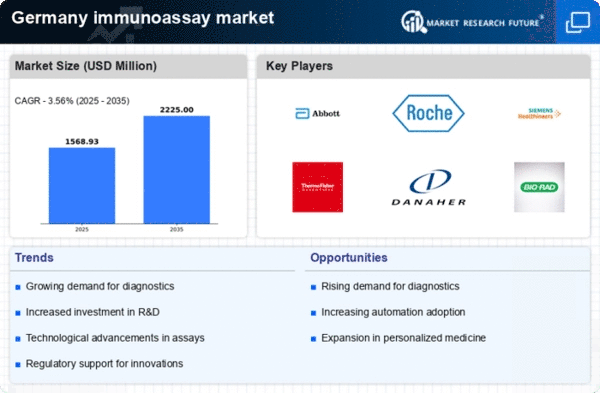
As per Market Research Future analysis, the Germany immunoassay market Size was estimated at 1515.0 USD Million in 2024. The Germany immunoassay market is projected to grow from 1568.93 USD Million in 2025 to 2225.0 USD Million by 2035, exhibiting a compound annual growth rate (CAGR) of 3.5% during the forecast period 2025 - 2035

Key Market Trends & Highlights

The Germany immunoassay market is poised for growth driven by technological advancements and rising demand for diagnostics.

  • Technological advancements are enhancing the accuracy and efficiency of immunoassays.
  • The largest segment in the market is the clinical diagnostics segment, while the fastest-growing segment is the research applications segment.
  • There is a notable focus on personalized medicine, which is shaping product development and market strategies.
  • Key market drivers include the increasing prevalence of chronic diseases and government initiatives and funding supporting healthcare advancements.

Market Size & Forecast

2024 Market Size 1515.0 (USD Million)
2035 Market Size 2225.0 (USD Million)
CAGR (2025 - 2035) 3.56%

Major Players

Abbott Laboratories (US), Roche Diagnostics (CH), Siemens Healthineers (DE), Thermo Fisher Scientific (US), Danaher Corporation (US), Bio-Rad Laboratories (US), Ortho Clinical Diagnostics (US), PerkinElmer (US)

Our Impact
Enabled $4.3B Revenue Impact for Fortune 500 and Leading Multinationals
Partnering with 2000+ Global Organizations Each Year
30K+ Citations by Top-Tier Firms in the Industry

Germany Immunoassay Market Trends

The immunoassay market in Germany is currently experiencing notable growth, driven by advancements in technology and increasing demand for diagnostic testing. The integration of automation and digital solutions into immunoassay systems appears to enhance efficiency and accuracy, which is crucial for laboratories and healthcare providers. Furthermore, the rising prevalence of chronic diseases necessitates more reliable and rapid diagnostic tools, thereby propelling the market forward. Regulatory support and funding for research and development initiatives also seem to play a pivotal role in fostering innovation within this sector. In addition, the trend towards personalized medicine is influencing the immunoassay market, as healthcare professionals seek tailored diagnostic solutions for individual patients. This shift is likely to encourage the development of novel assays that can provide specific insights into patient health. Moreover, collaborations between academic institutions and industry players may further stimulate advancements in immunoassay technologies, ensuring that Germany remains at the forefront of this evolving market. Overall, the landscape appears promising, with various factors converging to support sustained growth in the immunoassay market.

Technological Advancements

Recent innovations in immunoassay technologies are enhancing the sensitivity and specificity of diagnostic tests. Automation and integration of artificial intelligence are streamlining laboratory workflows, which may lead to faster turnaround times and improved accuracy in results.

Rising Demand for Diagnostics

The increasing prevalence of chronic diseases and the need for early detection are driving the demand for immunoassay tests. Healthcare providers are increasingly relying on these assays for routine screenings and monitoring, which could significantly impact market growth.

Focus on Personalized Medicine

The shift towards personalized medicine is influencing the development of immunoassays tailored to individual patient needs. This trend may lead to the creation of more specific and effective diagnostic tools, aligning with the broader healthcare movement towards customized treatment plans.

Germany Immunoassay Market Drivers

Government Initiatives and Funding

Government initiatives aimed at enhancing healthcare infrastructure in Germany significantly influence the immunoassay market. The German government has been investing heavily in healthcare research and development, with funding allocations reaching approximately €3 billion annually for medical innovations. These investments are directed towards improving diagnostic capabilities, including the development and implementation of advanced immunoassay technologies. Furthermore, public health campaigns promoting early disease detection and prevention are likely to increase the adoption of immunoassays in clinical laboratories. As a result, the immunoassay market is poised for growth, supported by favorable government policies and financial backing that encourage the integration of cutting-edge diagnostic solutions into routine healthcare practices.

Growing Focus on Preventive Healthcare

The increasing emphasis on preventive healthcare in Germany is a significant driver for the immunoassay market. As healthcare systems shift towards proactive management of health, the demand for diagnostic tools that facilitate early detection of diseases is surging. Immunoassays play a crucial role in preventive healthcare by enabling routine screenings and monitoring of biomarkers associated with various health conditions. This trend is reflected in the rising adoption of immunoassays in both clinical and home settings, as patients and healthcare providers prioritize early intervention strategies. Consequently, the immunoassay market is expected to experience robust growth, fueled by the growing awareness of the importance of preventive measures in maintaining health and well-being.

Rising Demand for Personalized Medicine

The shift towards personalized medicine in Germany is reshaping the immunoassay market. As healthcare becomes increasingly tailored to individual patient needs, the demand for diagnostic tools that can provide specific insights into a patient's health profile is growing. Immunoassays are particularly well-suited for this purpose, as they can measure specific biomarkers that inform treatment decisions. The market for personalized medicine is projected to expand significantly, with estimates suggesting a growth rate of over 10% annually. This trend is likely to drive innovation in immunoassay technologies, as manufacturers strive to develop assays that cater to the unique genetic and biochemical characteristics of patients. As a result, the immunoassay market is positioned to benefit from the rising demand for personalized healthcare solutions.

Increasing Prevalence of Chronic Diseases

The rising incidence of chronic diseases in Germany is a pivotal driver for the immunoassay market. Conditions such as diabetes, cardiovascular diseases, and autoimmune disorders necessitate regular monitoring and diagnostics. According to recent health statistics, chronic diseases account for approximately 70% of all deaths in Germany, underscoring the urgent need for effective diagnostic tools. Immunoassays, known for their sensitivity and specificity, are increasingly utilized in clinical settings to facilitate early detection and management of these conditions. This trend is likely to propel the demand for immunoassay products, as healthcare providers seek reliable solutions to improve patient outcomes. The immunoassay market is expected to witness substantial growth, driven by the need for innovative diagnostic solutions that cater to the growing patient population suffering from chronic ailments.

Technological Innovations in Assay Development

Technological advancements in assay development are transforming the landscape of the immunoassay market in Germany. Innovations such as microfluidics, lab-on-a-chip technologies, and automation are enhancing the efficiency and accuracy of immunoassays. These advancements allow for faster turnaround times and reduced sample volumes, making immunoassays more accessible in various clinical settings. The introduction of point-of-care testing devices is particularly noteworthy, as they enable rapid diagnostics outside traditional laboratory environments. As healthcare providers increasingly adopt these technologies, the immunoassay market is likely to expand, driven by the demand for more efficient and user-friendly diagnostic solutions that cater to the needs of both patients and healthcare professionals.


Market Segment Insights

By Type: Chemiluminescent Immunoassay (Largest) vs. Fluorescent Immunoassay (Fastest-Growing)

The Germany immunoassay market exhibits a diverse range of assay types, where the Chemiluminescent Immunoassay holds the largest share due to its high sensitivity and specificity. Following it, the Enzyme-Linked Immunosorbent Assay and Radioimmunoassay also play significant roles, although with comparatively smaller shares. Despite the established presence of these traditional methods, the market is witnessing a growing inclination towards Fluorescent Immunoassays, which are being recognized for their innovative approaches to diagnostics. In terms of growth trends, the demand for Fluorescent Immunoassays is surging as they provide rapid and accurate results with minimal sample volumes. This has been driven by advancements in technology and increased investment in research and development within the healthcare sector. As diagnostic needs evolve, the introduction of new products and improved methodologies are expected to further accelerate the growth of the Immunoassay market, particularly in innovative sectors like personalized medicine and preventive health.

Assay Type: Chemiluminescent (Dominant) vs. Fluorescent (Emerging)

Chemiluminescent Immunoassays are currently the dominant force in the Germany immunoassay market due to their impeccable ability to detect low concentrations of analytes with unparalleled precision. These assays utilize chemical reactions to produce light, enabling sensitive measurements that are crucial for diagnostics. Conversely, Fluorescent Immunoassays are emerging as a dynamic alternative, leveraging advances in fluorescence technologies. Their increased speed and efficiency, along with the capability of multiplexing, allow for comprehensive testing using smaller sample sizes. This versatility is driving their rapid adoption in clinical settings, making them increasingly popular among laboratories seeking to enhance diagnostic efficiencies and deliver better patient outcomes.

By Technology: Automated Immunoassay (Largest) vs. Point of Care Immunoassay (Fastest-Growing)

The technology segment of the Germany immunoassay market consists mainly of Automated Immunoassay, Point of Care Immunoassay, and Lateral Flow Assay. Automated Immunoassay holds the largest share due to its efficiency and capability to process high volumes of samples. On the other hand, Point of Care Immunoassay has been rapidly gaining traction, thanks to the increasing demand for quick and accurate test results in clinical settings. While Lateral Flow Assay continues to hold a steady market presence, it is the automated technologies that are currently leading market dynamics. Growth in this segment is primarily driven by technological advancements, the rising prevalence of various diseases, and an increased focus on preventive healthcare. The demand for rapid diagnostic tests, especially in point-of-care settings, has contributed significantly to the popularity of Point of Care Immunoassay. Furthermore, the ongoing integration of artificial intelligence and automation into immunoassays offers improved accuracy and efficiency, positioning Automated Immunoassay as a persistent leader in the market while also paving the way for innovative solutions in the future.

Technology: Automated Immunoassay (Dominant) vs. Point of Care Immunoassay (Emerging)

Automated Immunoassay is characterized by its ability to handle a significant volume of tests with high precision, making it essential in laboratory settings where workflow optimization is critical. This segment benefits from advanced robotics and software that streamline operations and reduce human error. On the other hand, Point of Care Immunoassay is rapidly emerging as a crucial player in the market, addressing the need for rapid diagnostics at the site of care. This technology facilitates timely treatment decisions, thus enhancing patient outcomes. By providing immediate results, Point of Care Immunoassays are becoming increasingly popular in various healthcare settings, ensuring that they maintain a strong growth trajectory in the market.

By Application: Clinical Diagnostics (Largest) vs. Drug Development (Fastest-Growing)

In the Germany immunoassay market, the application segments are diversified, with Clinical Diagnostics holding the largest share due to its critical role in disease detection and management. This segment's established infrastructure coupled with high demand for reliable testing methods ensures its predominance. Drug Development follows closely, increasingly gaining traction in the market as pharmaceutical companies emphasize the need for efficient and rapid testing solutions. Growth trends in this market are significantly driven by advancements in technology and increasing demand for rapid diagnostic solutions. The emerging Drug Development segment is witnessing acceleration in investment and research, primarily due to the recent focus on personalized medicine and biologics. Furthermore, there is a rising emphasis on environmental and food safety testing, which, while currently smaller, is anticipated to expand in response to regulatory pressures and public health concerns.

Clinical Diagnostics (Dominant) vs. Drug Development (Emerging)

Clinical Diagnostics is the dominant segment in the Germany immunoassay market, characterized by a robust framework for laboratory procedures and a high demand for accuracy in results. It encompasses a wide range of tests critical for diagnosing various medical conditions, thereby securing its leading position. On the other hand, Drug Development is emerging swiftly, thanks to innovations in immunoassay technologies that facilitate more efficient drug testing and development processes. This segment is particularly appealing to biotech firms and research institutions focused on novel therapeutic approaches, indicating a shift towards more integrated and rapid development cycles in the pharmaceutical landscape.

By End Use: Hospitals (Largest) vs. Diagnostic Laboratories (Fastest-Growing)

In the Germany immunoassay market, Hospitals constitute the largest segment, commanding a significant share as they implement a wide array of immunoassays for diagnostic and therapeutic purposes. Diagnostic Laboratories, while smaller, are rapidly gaining market traction due to their pivotal role in delivering precise and timely test results that influence patient management. Their increasing adoption of advanced immunoassay technologies showcases their importance in the healthcare ecosystem. Growth trends in the Germany immunoassay market are primarily driven by the rising prevalence of chronic diseases and an aging population, prompting hospitals to expand their testing capabilities. Furthermore, technological advancements in immunoassay methods are enabling diagnostic laboratories to enhance their testing efficiency and accuracy. This is leading to an accelerated adoption of immunoassay solutions, especially in specialized diagnostic settings, establishing them as an essential component in modern healthcare practices.

Hospitals: Dominant vs. Diagnostic Laboratories: Emerging

Hospitals hold a dominant position in the Germany immunoassay market as they integrate various immunoassay applications into patient care workflows, facilitating early disease detection and tailored treatment options. Their vast infrastructure and access to patient populations allow for high-volume testing, further solidifying their market influence. Conversely, Diagnostic Laboratories are emerging, characterized by their agile operations and focus on specialized testing. They are increasingly adopting automation and advanced immunoassay technologies, enhancing their capabilities. With a robust emphasis on personalized medicine and rapid testing, these laboratories are well-positioned to meet the growing demand for intricate diagnostic solutions, thus attracting more healthcare partnerships and investment.

Get more detailed insights about Germany Immunoassay Market

Key Players and Competitive Insights

The immunoassay market in Germany is characterized by a competitive landscape that is both dynamic and multifaceted. Key growth drivers include the increasing prevalence of chronic diseases, advancements in diagnostic technologies, and a growing emphasis on personalized medicine. Major players such as Abbott Laboratories (US), Roche Diagnostics (CH), and Siemens Healthineers (DE) are strategically positioned to leverage these trends. Abbott Laboratories (US) focuses on innovation and product development, particularly in point-of-care testing, while Roche Diagnostics (CH) emphasizes its strong R&D capabilities to enhance its diagnostic portfolio. Siemens Healthineers (DE) is actively pursuing digital transformation initiatives, integrating AI and data analytics into its offerings, which collectively shapes a competitive environment that is increasingly reliant on technological advancements and strategic partnerships.In terms of business tactics, companies are localizing manufacturing and optimizing supply chains to enhance operational efficiency and responsiveness to market demands. The market structure appears moderately fragmented, with a mix of established players and emerging companies. The collective influence of these key players fosters a competitive atmosphere where innovation and strategic collaborations are paramount.

In October Roche Diagnostics (CH) announced the launch of a new immunoassay platform designed to streamline laboratory workflows and improve diagnostic accuracy. This strategic move is significant as it not only reinforces Roche's commitment to innovation but also positions the company to capture a larger market share by addressing the growing demand for efficient diagnostic solutions.

In September Siemens Healthineers (DE) expanded its partnership with a leading healthcare provider to enhance the integration of AI in immunoassay testing. This collaboration is likely to enhance Siemens' competitive edge by improving diagnostic precision and operational efficiency, thereby responding to the increasing demand for advanced healthcare solutions.

In August Abbott Laboratories (US) acquired a small biotech firm specializing in novel biomarker discovery. This acquisition is indicative of Abbott's strategy to bolster its product pipeline and enhance its capabilities in personalized medicine, which is becoming increasingly relevant in the immunoassay market.

As of November current competitive trends are heavily influenced by digitalization, sustainability, and the integration of AI technologies. Strategic alliances are shaping the landscape, enabling companies to pool resources and expertise to drive innovation. Looking ahead, competitive differentiation is expected to evolve, with a notable shift from price-based competition towards a focus on technological innovation, reliability in supply chains, and the development of advanced diagnostic solutions.

Key Companies in the Germany Immunoassay Market include

Industry Developments

The Germany Immunoassay Market is experiencing notable growth driven by advancements in technology and increasing demand for rapid diagnostic testing. Recent developments include significant investments by companies such as Beckman Coulter and Roche in enhancing their Research and Development capabilities, improving assay efficiency, and expanding product portfolios. In July 2023, F. Hoffmann-La Roche announced the launch of a novel immunoassay for kidney disease diagnosis, reflecting the market’s shift toward specialized tests. Additionally, in August 2023, Merck Group formed a strategic collaboration with Qiagen to develop integrated workflows for biomarker discovery, enhancing the immunoassay landscape.

There have been mergers, such as Danaher Corporation's acquisition of GE Biosciences in June 2022, which has fueled growth in bioprocessing within immunoassays. Companies like Siemens Healthineers and Thermo Fisher Scientific are also expanding their product offerings, focusing on automation and connectivity in diagnostics. The market is poised for further expansion due to rising healthcare spending in Germany, which is pushing for advanced diagnostic solutions. Over the last two years, increased focus on personalized medicine and point-of-care testing has been a critical development, driving demand for immunoassays across clinical and research settings.

Future Outlook

Germany Immunoassay Market Future Outlook

The Immunoassay Market in Germany is projected to grow at a 3.56% CAGR from 2025 to 2035, driven by technological advancements and increasing demand for rapid diagnostics.

New opportunities lie in:

  • Development of point-of-care testing devices for remote diagnostics.
  • Expansion of automated immunoassay systems in clinical laboratories.
  • Introduction of novel biomarkers for disease detection and monitoring.

By 2035, the immunoassay market is expected to achieve robust growth, reflecting evolving healthcare needs.

Market Segmentation

Germany Immunoassay Market Type Outlook

  • Enzyme-Linked Immunosorbent Assay
  • Radioimmunoassay
  • Fluorescent Immunoassay
  • Chemiluminescent Immunoassay
  • Western Blot

Germany Immunoassay Market End Use Outlook

  • Hospitals
  • Diagnostic Laboratories
  • Pharmaceutical Companies
  • Academic Research Institutions

Germany Immunoassay Market Technology Outlook

  • Automated Immunoassay
  • Point of Care Immunoassay
  • Lateral Flow Assay

Germany Immunoassay Market Application Outlook

  • Clinical Diagnostics
  • Drug Development
  • Environmental Testing
  • Food Safety Testing

Report Scope

MARKET SIZE 2024 1515.0(USD Million)
MARKET SIZE 2025 1568.93(USD Million)
MARKET SIZE 2035 2225.0(USD Million)
COMPOUND ANNUAL GROWTH RATE (CAGR) 3.56% (2025 - 2035)
REPORT COVERAGE Revenue Forecast, Competitive Landscape, Growth Factors, and Trends
BASE YEAR 2024
Market Forecast Period 2025 - 2035
Historical Data 2019 - 2024
Market Forecast Units USD Million
Key Companies Profiled Abbott Laboratories (US), Roche Diagnostics (CH), Siemens Healthineers (DE), Thermo Fisher Scientific (US), Danaher Corporation (US), Bio-Rad Laboratories (US), Ortho Clinical Diagnostics (US), PerkinElmer (US)
Segments Covered Type, Technology, Application, End Use
Key Market Opportunities Advancements in point-of-care testing technologies enhance accessibility in the immunoassay market.
Key Market Dynamics Technological advancements and regulatory changes drive growth in the immunoassay market, enhancing diagnostic capabilities.
Countries Covered Germany
Leave a Comment

FAQs

What is the expected market size of the Germany Immunoassay Market in 2024?

The Germany Immunoassay Market is expected to be valued at 1.58 billion USD in 2024.

What will the market size of the Germany Immunoassay Market reach by 2035?

By 2035, the Germany Immunoassay Market is projected to reach a valuation of 2.5 billion USD.

What is the expected CAGR for the Germany Immunoassay Market from 2025 to 2035?

The expected CAGR for the Germany Immunoassay Market from 2025 to 2035 is 4.252 percent.

Which type of immunoassay has the highest market value in 2024?

In 2024, the Enzyme-Linked Immunosorbent Assay is valued at 0.58 billion USD, making it the highest in market value.

What is the market value of the Radioimmunoassay segment in 2035?

The Radioimmunoassay segment is expected to reach a market value of 0.45 billion USD by 2035.

Who are the major players in the Germany Immunoassay Market?

Key players include Beckman Coulter, Merck Group, F. HoffmannLa Roche, Qiagen, and Sysmex Corporation among others.

What market value is projected for the Fluorescent Immunoassay segment in 2035?

The Fluorescent Immunoassay segment is anticipated to reach a market value of 0.4 billion USD by 2035.

What is the expected market size for Chemiluminescent Immunoassay in 2024?

In 2024, the Chemiluminescent Immunoassay segment is expected to be valued at 0.3 billion USD.

What is the expected value of the Western Blot segment in the market by 2035?

The Western Blot segment is expected to reach a market value of 0.25 billion USD by 2035.

How are global trends affecting the Germany Immunoassay Market?

Current global trends are driving innovation and investments in the Germany Immunoassay Market, affecting growth positively.

Download Free Sample

Kindly complete the form below to receive a free sample of this Report

Compare Licence

×
Features License Type
Single User Multiuser License Enterprise User
Price $4,950 $5,950 $7,250
Maximum User Access Limit 1 User Upto 10 Users Unrestricted Access Throughout the Organization
Free Customization
Direct Access to Analyst
Deliverable Format
Platform Access
Discount on Next Purchase 10% 15% 15%
Printable Versions