×
Request Free Sample ×

Kindly complete the form below to receive a free sample of this Report

* Please use a valid business email

Leading companies partner with us for data-driven Insights

clients tt-cursor
Hero Background

Germany Frozen Meat Market

ID: MRFR/FnB/46925-HCR
128 Pages
Varsha More
February 2026

Germany Frozen Meat Market Size, Share, Industry Trend & Analysis Research Report By Product Type (Frozen Processed Meat, Frozen Whole Cut), By End User (Food Service, Retail Customers) and By Distribution Channel (Store Based, Non-Store Based) - Forecast to 2035

Share:
Download PDF ×

We do not share your information with anyone. However, we may send you emails based on your report interest from time to time. You may contact us at any time to opt-out.

Germany Frozen Meat Market Infographic
Purchase Options

Germany Frozen Meat Market Summary

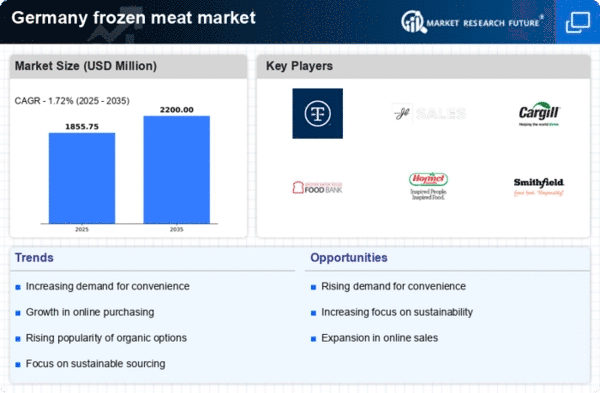
As per Market Research Future analysis, the Germany frozen meat market size was estimated at 1824.38 USD Million in 2024. The Germany frozen meat market is projected to grow from 1855.75 USD Million in 2025 to 2200.0 USD Million by 2035, exhibiting a compound annual growth rate (CAGR) of 1.7% during the forecast period 2025 - 2035

Key Market Trends & Highlights

The Germany frozen meat market is experiencing a shift towards premium products and sustainability, driven by evolving consumer preferences.

  • The market is witnessing a rising demand for premium frozen meat products, reflecting changing consumer tastes.
  • Sustainability initiatives are becoming increasingly important, influencing production and packaging practices.
  • Technological advancements in preservation methods are enhancing product quality and shelf life.
  • Key market drivers include increasing consumer preference for convenience foods and health consciousness among buyers.

Market Size & Forecast

2024 Market Size 1824.38 (USD Million)
2035 Market Size 2200.0 (USD Million)
CAGR (2025 - 2035) 1.72%

Major Players

Tyson Foods (US), JBS (BR), Cargill (US), BRF (BR), Hormel Foods (US), Smithfield Foods (US), Marfrig (BR), Pinnacle Foods (US), Danish Crown (DK)

Our Impact
Enabled $4.3B Revenue Impact for Fortune 500 and Leading Multinationals
Partnering with 2000+ Global Organizations Each Year
30K+ Citations by Top-Tier Firms in the Industry

Germany Frozen Meat Market Trends

The frozen meat market in Germany is currently experiencing notable shifts driven by evolving consumer preferences and technological advancements. As individuals increasingly prioritize convenience and quality, the demand for frozen meat products appears to be on the rise. This trend is further supported by a growing awareness of food safety and preservation methods, which enhances the appeal of frozen options. Additionally, the market is witnessing a surge in innovative packaging solutions that extend shelf life and maintain product integrity, thereby attracting health-conscious consumers. Moreover, the influence of e-commerce cannot be overlooked, as online platforms facilitate easier access to a variety of frozen meat products. This shift towards digital shopping is reshaping traditional purchasing behaviors, allowing consumers to explore diverse offerings from the comfort of their homes. As a result, the frozen meat market is likely to continue evolving, adapting to the changing landscape of consumer habits and technological progress. The interplay between convenience, quality, and accessibility is expected to define the future trajectory of this sector.

Rising Demand for Premium Products

There is an increasing inclination among consumers towards high-quality frozen meat options. This trend suggests that individuals are willing to invest more in premium products that promise superior taste and nutritional value. As a result, manufacturers are focusing on sourcing high-quality ingredients and implementing stringent quality control measures to meet this demand.

Sustainability Initiatives

Sustainability is becoming a crucial factor in the frozen meat market. Companies are exploring eco-friendly practices, such as sustainable sourcing and environmentally friendly packaging. This shift indicates a growing consumer preference for products that align with their values regarding environmental responsibility.

Technological Advancements in Preservation

Innovations in freezing and preservation technologies are transforming the frozen meat market. Enhanced methods are being developed to maintain flavor and texture while extending shelf life. This evolution suggests that consumers can expect improved product quality and safety, further driving market growth.

Germany Frozen Meat Market Drivers

Rising Import and Export Opportunities

Germany's strategic position within Europe presents significant opportunities for the frozen meat market, particularly in terms of import and export activities. The country is one of the largest exporters of frozen meat in Europe, with exports valued at approximately €3 billion annually. This robust export market is driven by high demand from neighboring countries, which rely on German products for their quality and safety standards. Additionally, the increasing import of specialty frozen meats from other regions is likely to diversify the offerings available in the market. As the frozen meat market capitalizes on these opportunities, it may witness growth fueled by both domestic consumption and international trade.

Health Consciousness and Nutritional Awareness

In recent years, there has been a marked increase in health consciousness among German consumers, which is influencing their purchasing habits in the frozen meat market. Many consumers are now more aware of the nutritional content of their food, leading to a preference for leaner cuts and organic options. Data indicates that around 45% of consumers actively seek out healthier frozen meat alternatives, such as those with reduced fat content or free from additives. This shift towards health-oriented choices is likely to drive innovation within the frozen meat market, as manufacturers respond by offering products that align with these preferences. Consequently, the market may witness a rise in demand for frozen meats that are not only convenient but also cater to the health-conscious consumer.

Evolving Retail Landscape and Distribution Channels

The retail landscape in Germany is evolving, significantly impacting the frozen meat market. The rise of discount retailers and online platforms has transformed how consumers access frozen meat products. Recent statistics reveal that online grocery sales have surged by 30% in the past year, indicating a shift in shopping habits. This evolution in distribution channels is likely to enhance the visibility and availability of frozen meat products, making them more accessible to a broader audience. As retailers adapt to these changes, the frozen meat market may experience increased competition, prompting innovation and diversification in product offerings. This dynamic environment could lead to a more robust market, catering to diverse consumer needs.

Increasing Consumer Preference for Convenience Foods

The frozen meat market in Germany is experiencing a notable shift as consumers increasingly favor convenience foods. This trend is driven by busy lifestyles, where ready-to-cook and easy-to-prepare meals are becoming essential. According to recent data, approximately 60% of German households prioritize convenience when selecting food products. This consumer behavior is likely to bolster the frozen meat market, as frozen options provide a longer shelf life and require minimal preparation. Additionally, the rise of online grocery shopping has made it easier for consumers to access frozen meat products, further enhancing their appeal. As a result, the frozen meat market is expected to see sustained growth, with convenience being a key driver in shaping purchasing decisions.

Technological Innovations in Processing and Packaging

Technological advancements in processing and packaging are playing a crucial role in shaping the frozen meat market in Germany. Innovations such as vacuum sealing and modified atmosphere packaging are enhancing the preservation of meat products, extending shelf life while maintaining quality. These technologies not only improve food safety but also reduce waste, which is increasingly important to environmentally conscious consumers. The frozen meat market is likely to benefit from these advancements, as they enable manufacturers to offer fresher products with longer storage capabilities. As a result, the market may see a rise in consumer trust and preference for frozen meat options that leverage these cutting-edge technologies.


Market Segment Insights

By Type: Beef (Largest) vs. Poultry (Fastest-Growing)

In the Germany frozen meat market, beef holds the largest market share among various types of frozen meat. This dominance can be attributed to traditional consumer preferences and the rich flavor profile that beef offers, making it a staple protein source for many households. Following beef, pork and poultry also occupy significant portions of the market, though they do not match the volume and popularity of beef in consumer choices. Lamb and seafood are comparatively smaller segments, catering to niche markets and specific consumer tastes. Growth trends in the Germany frozen meat market show a pronounced rise in the demand for poultry, which is recognized as the fastest-growing segment. Health consciousness among consumers, along with a shift towards white meat consumption, is driving this trend. Furthermore, innovative processing and preservation techniques have improved product quality and shelf life, enhancing the appeal of frozen poultry. In contrast, while beef remains dominant, it faces challenges from emerging health trends that favor leaner meats.

Beef: Dominant vs. Poultry: Emerging

Beef, as the dominant type in the Germany frozen meat market, is characterized by its rich flavor, versatility in preparation, and cultural significance in traditional dishes. Consumer loyalty and preferences largely influence its sustained market presence, making it a preferred choice for various meal occasions. On the other hand, poultry, classified as the emerging type, is gaining traction due to its perceived health benefits and leaner profile. Its growing popularity is supported by innovative marketing strategies and increasing awareness of the advantages of consuming poultry over red meat. The shift in consumption patterns among health-conscious consumers positions poultry as a critical player in market dynamics, challenging the traditional dominance of beef.

By End Use: Household (Largest) vs. Food Service (Fastest-Growing)

In the Germany frozen meat market, the market share distribution among various end use segments shows that the Household segment holds the largest share, driven by the increasing consumption of frozen meat products in homes. This segment benefits from convenience, longer shelf life, and versatility, making it a preferred choice for many consumers. On the other hand, the Food Service segment, although smaller in comparison, is rapidly expanding, fueled by the growth of the restaurant and catering industries, which seek to offer frozen meat options for efficiency and cost-effectiveness. Growth trends in the Germany frozen meat market indicate a strong preference for convenience foods within households, which continues to bolster the Household segment. Additionally, changing consumer preferences towards ready-to-cook meals and the increasing number of food establishments drive demand in the Food Service segment. With a significant rise in online food ordering and delivery through restaurants, these trends emphasize the necessity for quality frozen meat products that cater to evolving consumer needs.

Household (Dominant) vs. Food Service (Emerging)

The Household segment is characterized by its substantial demand for convenience foods, where frozen meat is favored for its long shelf life and easy preparation. Consumers in this segment prioritize products that save time while maintaining quality, thereby driving innovation and variety in frozen meat offerings. In contrast, the Food Service segment represents an emerging opportunity within the Germany frozen meat market. This segment is increasingly appealing to restaurants and caterers seeking efficient inventory management, cost savings, and consistent quality in their meat offerings. As dining preferences shift towards diverse cuisine choices, the Food Service segment is adapting quickly to meet such demands, making it a crucial area for growth.

By Sales Channel: Online (Largest) vs. Hypermarkets (Fastest-Growing)

In the Germany frozen meat market, the sales channel dynamics reveal that online channels hold a significant share, becoming the largest segment in recent years. In contrast, hypermarkets are gaining momentum due to their increasing popularity among consumers, offering convenience and a wide variety of products. Offline channels, including traditional grocery stores and supermarkets, play a substantial role but have seen slower growth compared to online and hypermarket channels. The growth trends in the Germany frozen meat market highlight a shift towards online shopping, driven by changing consumer behaviors and increased digital penetration. Hypermarkets are also emerging as a fast-growing segment, capitalizing on consumer preferences for one-stop shopping experiences. Factors such as urbanization, busy lifestyles, and the demand for frozen convenience foods are propelling growth in these channels, catering to the evolving needs of consumers.

Online (Dominant) vs. Hypermarkets (Emerging)

Online sales channels have established themselves as dominant players in the frozen meat sector, leveraging e-commerce platforms to enhance accessibility and convenience for consumers. These channels appeal to tech-savvy customers seeking quick purchases and home delivery options. In contrast, hypermarkets are positioned as an emerging force, providing customers with a diverse selection of frozen meat products under one roof. The expansive physical presence and promotional activities of hypermarkets attract a broad customer base, while their growth is fueled by changing shopping habits and the desire for greater variety and value. As competition intensifies, both segments are expected to innovate and adapt to consumer preferences, solidifying their roles in the market.

By Packaging Type: Bulk Packaging (Largest) vs. Vacuum Packaging (Fastest-Growing)

In the Germany frozen meat market, Bulk Packaging commands a significant share of the overall packaging choices, appealing primarily to industrial customers and large-scale distributors. This segment's strength lies in its cost-effectiveness and efficiency for bulk purchases, leading to its dominance in the market share distribution. Conversely, Vacuum Packaging has been gaining traction, particularly among retailers looking to extend shelf life while ensuring product quality, positioning it as a robust competitor. The growth trends for packaging types in this market are driven by changing consumer preferences and technological advancements. Despite its current status, Bulk Packaging faces challenges as consumers increasingly prefer convenience, which Vacuum Packaging provides. Technological innovations in vacuum sealing and sustainability initiatives further bolster Vacuum Packaging's growth, making it the fastest-growing segment amid a shift toward more consumer-friendly packaging options.

Bulk Packaging (Dominant) vs. Vacuum Packaging (Emerging)

Bulk Packaging is characterized by its capacity to store large quantities of frozen meat, making it an ideal choice for B2B sales and processing industries. This packaging type often employs simple, cost-effective materials that prioritize functionality over aesthetics, appealing to buyers focused on price stability. On the other hand, Vacuum Packaging is becoming increasingly popular for its ability to prevent freezer burn and extend shelf-life while maintaining meat quality. This emerging segment attracts health and quality-conscious consumers, as it often incorporates innovative features, including tamper-proof seals and visual appeal, appealing to both retailers and end consumers who seek convenience along with quality.

Get more detailed insights about Germany Frozen Meat Market

Key Players and Competitive Insights

The frozen meat market in Germany exhibits a dynamic competitive landscape characterized by a blend of established players and emerging trends. Key growth drivers include increasing consumer demand for convenience foods, a rising focus on protein-rich diets, and the expansion of e-commerce platforms. Major companies such as Tyson Foods (US), JBS (BR), and Cargill (US) are strategically positioned to leverage these trends. Tyson Foods (US) emphasizes innovation in product offerings, particularly in plant-based alternatives, while JBS (BR) focuses on sustainability initiatives to enhance its market appeal. Cargill (US) is actively pursuing digital transformation to optimize its supply chain, thereby enhancing operational efficiency. Collectively, these strategies shape a competitive environment that is increasingly focused on sustainability and technological advancement.Key business tactics within the market include localizing manufacturing to reduce transportation costs and enhance freshness, as well as optimizing supply chains to improve responsiveness to consumer demands. The competitive structure appears moderately fragmented, with several key players holding substantial market shares. This fragmentation allows for a diverse range of products and price points, catering to various consumer preferences while also fostering innovation among competitors.

In October Tyson Foods (US) announced a partnership with a leading technology firm to develop AI-driven solutions for supply chain management. This strategic move is likely to enhance operational efficiency and reduce waste, aligning with the growing consumer demand for sustainable practices. By integrating advanced technologies, Tyson Foods (US) positions itself as a forward-thinking leader in the market, potentially setting new standards for operational excellence.

In September JBS (BR) launched a new line of organic frozen meat products aimed at health-conscious consumers. This initiative reflects a strategic pivot towards meeting the increasing demand for organic and sustainably sourced food options. By diversifying its product portfolio, JBS (BR) not only enhances its competitive edge but also aligns with broader consumer trends favoring health and sustainability.

In August Cargill (US) expanded its distribution network in Germany by acquiring a local logistics company. This acquisition is expected to streamline operations and improve delivery times, thereby enhancing customer satisfaction. Such strategic expansions indicate Cargill's commitment to strengthening its market presence and responding effectively to the evolving needs of consumers.

As of November current competitive trends in the frozen meat market are heavily influenced by digitalization, sustainability, and the integration of AI technologies. Strategic alliances among key players are shaping the landscape, fostering innovation and collaboration. The shift from price-based competition to a focus on technological advancements and supply chain reliability is evident. Moving forward, competitive differentiation will likely hinge on the ability to innovate and adapt to changing consumer preferences, with an emphasis on sustainability and quality.

Key Companies in the Germany Frozen Meat Market include

Industry Developments

The Germany Frozen Meat Market has experienced significant developments in recent months. The demand for frozen meat products has surged, driven by changing consumer preferences towards convenience and longer shelf life. Nestle has been focusing on expanding its frozen food portfolio, while JBS continues to innovate in meat processing techniques to enhance product quality. In recent merger and acquisition news, Vion Food Group announced its acquisition of a smaller player in the German market in October 2023, aimed at strengthening its market position and expanding its distribution network.

Additionally, Cargill has invested heavily in sustainability initiatives to align with consumer demand for environmentally friendly products. The Germany Frozen Meat Market witnessed a growth rate of approximately 5% in market valuation over the past two years, attributed to rising health consciousness and the increased popularity of protein-rich diets. Companies like Beyond Meat are also carving out their space in the market by offering plant-based frozen meat alternatives, appealing to the growing vegan demographic. Overall, the market is evolving rapidly, fueled by innovation, strategic acquisitions, and changing consumer preferences.

Future Outlook

Germany Frozen Meat Market Future Outlook

The Frozen Meat Market in Germany is projected to grow at 1.72% CAGR from 2025 to 2035, driven by increasing consumer demand and convenience trends.

New opportunities lie in:

  • Expansion of e-commerce platforms for frozen meat sales.
  • Development of premium, organic frozen meat product lines.
  • Implementation of advanced cold chain logistics solutions.

By 2035, the market is expected to achieve robust growth, reflecting evolving consumer preferences.

Market Segmentation

Germany Frozen Meat Market Type Outlook

  • Beef
  • Pork
  • Poultry
  • Lamb
  • Seafood

Germany Frozen Meat Market End Use Outlook

  • Household
  • Food Service
  • Retail

Germany Frozen Meat Market Sales Channel Outlook

  • Online
  • Offline
  • Hypermarkets
  • Supermarkets

Germany Frozen Meat Market Packaging Type Outlook

  • Bulk Packaging
  • Retail Packaging
  • Vacuum Packaging

Report Scope

MARKET SIZE 2024 1824.38(USD Million)
MARKET SIZE 2025 1855.75(USD Million)
MARKET SIZE 2035 2200.0(USD Million)
COMPOUND ANNUAL GROWTH RATE (CAGR) 1.72% (2025 - 2035)
REPORT COVERAGE Revenue Forecast, Competitive Landscape, Growth Factors, and Trends
BASE YEAR 2024
Market Forecast Period 2025 - 2035
Historical Data 2019 - 2024
Market Forecast Units USD Million
Key Companies Profiled Tyson Foods (US), JBS (BR), Cargill (US), BRF (BR), Hormel Foods (US), Smithfield Foods (US), Marfrig (BR), Pinnacle Foods (US), Danish Crown (DK)
Segments Covered Type, End Use, Sales Channel, Packaging Type
Key Market Opportunities Growing demand for sustainable and ethically sourced products in the frozen meat market.
Key Market Dynamics Rising consumer demand for convenience drives innovation in frozen meat product offerings and packaging solutions.
Countries Covered Germany
Leave a Comment

FAQs

What was the market size of the Germany Frozen Meat Market in 2024?

The market size of the Germany Frozen Meat Market in 2024 was valued at 3.85 billion USD.

What will be the market size of the Germany Frozen Meat Market by 2035?

By 2035, the Germany Frozen Meat Market is projected to reach a value of 5.78 billion USD.

What is the expected CAGR for the Germany Frozen Meat Market from 2025 to 2035?

The expected CAGR for the Germany Frozen Meat Market from 2025 to 2035 is 3.763 percent.

Which product type dominates the Germany Frozen Meat Market?

Frozen Processed Meat is expected to dominate the Germany Frozen Meat Market, valued at 2.3 billion USD in 2024.

What is the projected market value for Frozen Whole Cut in 2035?

The projected market value for Frozen Whole Cut by 2035 is 2.36 billion USD.

Who are the key players in the Germany Frozen Meat Market?

Key players in the Germany Frozen Meat Market include Nestle, Vion Food Group, JBS, Cargill, and Beyond Meat.

What are the growth drivers for the Germany Frozen Meat Market?

Key growth drivers for the Germany Frozen Meat Market include increasing consumer demand for convenience and product variety.

What challenges does the Germany Frozen Meat Market currently face?

Challenges for the Germany Frozen Meat Market include fluctuations in meat prices and competition from plant-based alternatives.

How does the market growth differ between product segments?

Frozen Processed Meat is expected to experience significant growth compared to Frozen Whole Cut during the forecast period.

What impact does the current global scenario have on the Germany Frozen Meat Market?

The current global scenario may affect supply chain dynamics, potentially impacting the availability and pricing of frozen meat products.

Download Free Sample

Kindly complete the form below to receive a free sample of this Report

Compare Licence

×
Features License Type
Single User Multiuser License Enterprise User
Price $4,950 $5,950 $7,250
Maximum User Access Limit 1 User Upto 10 Users Unrestricted Access Throughout the Organization
Free Customization
Direct Access to Analyst
Deliverable Format
Platform Access
Discount on Next Purchase 10% 15% 15%
Printable Versions