×
Request Free Sample ×

Kindly complete the form below to receive a free sample of this Report

* Please use a valid business email

Leading companies partner with us for data-driven Insights

clients tt-cursor
Hero Background

Germany Digital Identity In Education Market

ID: MRFR/ICT/58298-HCR
200 Pages
Aarti Dhapte
February 2026

Germany Digital Identity in Education Market Size, Share and Trends Analysis Report By Offering (Solutions, Services), By Solution Type (Identity Verification, Authentication, Identity Lifecycle Management, Other Solution Types), By Identity Type (Biometric, Non-biometric) and By Organization Size (Large Organization, SMEs)-Forecast to 2035

Share:
Download PDF ×

We do not share your information with anyone. However, we may send you emails based on your report interest from time to time. You may contact us at any time to opt-out.

Germany Digital Identity In Education Market Infographic
Purchase Options

Germany Digital Identity In Education Market Summary

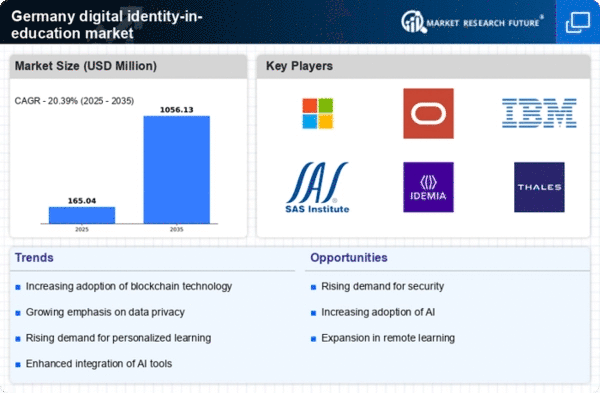
As per Market Research Future analysis, the Germany Digital Identity In Education Market size was estimated at 137.09 USD Million in 2024. The Digital Identity-in-education market is projected to grow from 165.04 USD Million in 2025 to 1056.13 USD Million by 2035, exhibiting a compound annual growth rate (CAGR) of 20.3% during the forecast period 2025 - 2035

Key Market Trends & Highlights

The Germany is undergoing a transformative shift towards enhanced security and technological integration.

  • The market is witnessing an increased focus on data privacy, driven by growing concerns over personal information security.
  • Adoption of blockchain technology is becoming prevalent, particularly in the largest segment of online learning platforms.
  • Integration of AI in identity verification is emerging as a key trend, especially in the fastest-growing segment of vocational training.
  • Rising demand for secure access and government initiatives are major drivers propelling market growth.

Market Size & Forecast

2024 Market Size 137.09 (USD Million)
2035 Market Size 1056.13 (USD Million)
CAGR (2025 - 2035) 20.39%

Major Players

Microsoft (US), Oracle (US), IBM (US), SAS Institute (US), IDEMIA (FR), Gemalto (NL), Verifiable Credentials (US), Civitas Learning (US), Instructure (US)

Our Impact
Enabled $4.3B Revenue Impact for Fortune 500 and Leading Multinationals
Partnering with 2000+ Global Organizations Each Year
30K+ Citations by Top-Tier Firms in the Industry

Germany Digital Identity In Education Market Trends

The Germany Digital Identity In Education Market is undergoing a transformative phase, driven by the increasing need for secure and efficient identity verification systems. In Germany, educational institutions are increasingly adopting digital solutions to streamline administrative processes and enhance student experiences. This shift is largely influenced by the growing emphasis on data protection and privacy regulations, which necessitate robust identity management systems. As a result, educational entities are investing in technologies that not only ensure compliance but also foster trust among students and parents. Furthermore, the integration of digital identity solutions is seen as a means to facilitate remote learning and access to educational resources, thereby broadening opportunities for learners across various demographics. In addition, the rise of digital credentials is reshaping how qualifications are recognized and verified. Institutions are exploring blockchain technology and other innovative methods to issue and manage digital certificates, which could potentially reduce fraud and enhance the credibility of educational achievements. This trend aligns with the broader movement towards lifelong learning, where individuals seek to continuously update their skills and qualifications. As the digital identity-in-education market evolves, it appears poised to play a crucial role in shaping the future of education in Germany, ensuring that identity verification processes are not only efficient but also secure and user-friendly.

Increased Focus on Data Privacy

The emphasis on data privacy is becoming more pronounced within the digital identity-in-education market. Educational institutions are prioritizing compliance with stringent data protection regulations, which influences their choice of identity management solutions. This trend indicates a shift towards systems that not only secure personal information but also enhance user trust.

Adoption of Blockchain Technology

Blockchain technology is gaining traction as a viable solution for managing digital credentials. Educational institutions are exploring its potential to issue tamper-proof certificates, thereby reducing instances of fraud. This trend suggests a move towards more transparent and reliable verification processes in the digital identity-in-education market.

Integration of AI in Identity Verification

The integration of artificial intelligence in identity verification processes is emerging as a key trend. AI technologies are being utilized to enhance the accuracy and efficiency of identity checks, which could streamline administrative tasks for educational institutions. This development indicates a growing reliance on advanced technologies to improve user experiences.

Germany Digital Identity In Education Market Drivers

Rising Demand for Secure Access

The digital identity-in-education market is experiencing a notable increase in demand for secure access solutions. Educational institutions in Germany are prioritizing the protection of sensitive student data, which has led to a surge in the implementation of robust identity verification systems. According to recent statistics, approximately 70% of educational organizations are investing in advanced security measures to safeguard personal information. This trend is driven by the need to comply with stringent data protection regulations, such as the General Data Protection Regulation (GDPR). As a result, The digital identity-in-education market is expected to expand as institutions seek reliable solutions that ensure secure access to educational resources.

Government Initiatives and Funding

Government initiatives play a crucial role in shaping the digital identity-in-education market. In Germany, various funding programs are being introduced to support the development and implementation of digital identity solutions in educational settings. For instance, the Federal Ministry of Education and Research has allocated €100 million to enhance digital infrastructure in schools, which includes identity management systems. This financial backing encourages educational institutions to adopt innovative technologies that streamline identity verification processes. Consequently, the digital identity-in-education market is poised for growth as government support fosters an environment conducive to technological advancement.

Increased Online Learning Platforms

The proliferation of online learning platforms is significantly influencing the digital identity-in-education market. With the rise of e-learning, educational institutions in Germany are increasingly adopting digital identity solutions to manage user access and ensure the integrity of online assessments. Reports indicate that the online education sector is projected to grow by 15% annually, necessitating effective identity management systems. This growth creates a demand for secure and efficient identity verification processes, thereby driving the digital identity-in-education market forward. Institutions are likely to invest in technologies that facilitate seamless access to online resources while maintaining stringent security protocols.

Growing Awareness of Cybersecurity Threats

As cybersecurity threats become more prevalent, awareness among educational institutions in Germany is rising. The digital identity-in-education market is responding to this heightened concern by offering solutions that address potential vulnerabilities. Recent surveys indicate that over 60% of educational leaders recognize the importance of implementing comprehensive identity management systems to mitigate risks associated with data breaches. This awareness is likely to propel investments in advanced identity verification technologies, as institutions seek to protect their digital assets and maintain the trust of students and parents. The digital identity-in-education market is thus expected to benefit from this growing emphasis on cybersecurity.

Technological Advancements in Identity Solutions

Technological advancements are reshaping the landscape of the digital identity-in-education market. Innovations such as biometric authentication and multi-factor authentication are gaining traction among educational institutions in Germany. These technologies enhance the security and efficiency of identity verification processes, making them increasingly attractive to schools and universities. Data suggests that the adoption of biometric solutions could increase by 25% in the next few years, driven by the need for more secure access methods. As educational institutions embrace these advancements, the digital identity-in-education market is likely to witness substantial growth, reflecting the ongoing evolution of identity management technologies.


Market Segment Insights

By Offering: Solutions (Largest) vs. Services (Fastest-Growing)

In the Germany digital identity-in-education market, Solutions dominate the offering segment with a significant market share, reflecting the preference for comprehensive tools that address identity management needs. As educational institutions seek to enhance security and streamline administrative processes, Solutions have become essential, paving the way for more innovative digital identity applications. Conversely, Services are emerging as the fastest-growing segment in response to the increasing demand for personalized support and training. The rapid digitalization of education has highlighted the need for professional services that can assist with the implementation and optimization of digital identity solutions, driving significant growth and investment in this area.

Solutions (Dominant) vs. Services (Emerging)

Solutions in the Germany digital identity-in-education market are characterized by their robust capabilities in managing digital identities across various educational platforms. These solutions offer features such as secure access, data protection, and integration with existing systems, making them essential for educational institutions. On the other hand, Services are rapidly gaining traction as organizations recognize the importance of tailored support, consulting, and training to maximize the effectiveness of digital identity solutions. This trend indicates a shift towards more client-focused offerings, with a growing need for services that not only implement solutions but also continuously enhance user experience and system efficiency.

By Solution Type: Identity Verification (Largest) vs. Authentication (Fastest-Growing)

In the Germany digital identity-in-education market, the segment values showcase varied market share distributions, with Identity Verification emerging as the largest player. This segment captures the majority of the market due to its fundamental role in ensuring secure access to educational platforms. Authentication, while smaller, is rapidly gaining traction as it adapts to evolving security needs. Growth trends indicate a robust expansion in the Authentication sector, driven by increasing digitalization in education and a heightened focus on securing digital identities. Factors such as regulatory compliance, the rise of online learning platforms, and user awareness regarding data security are propelling the growth of this segment, allowing it to emerge as the fastest-growing solution type.

Identity Verification: Dominant vs. Authentication: Emerging

The Identity Verification segment is characterized by its foundational role in safeguarding access to educational resources, making it a dominant force in the market. It focuses on verifying the identities of users to prevent fraud and unauthorized access, thus instilling trust in digital education systems. Conversely, the Authentication segment is emerging as a crucial solution type, offering advanced methods to confirm user identity during digital interactions. With solutions like biometric authentication and multi-factor authentication gaining popularity, this segment responds to increasing security demands, positioning itself for significant growth as educational institutions seek to enhance their digital security frameworks.

By Identity Type: Biometric (Largest) vs. Non-biometric (Fastest-Growing)

The Germany digital identity-in-education market exhibits a competitive landscape characterized by the dominance of biometric solutions. Biometric identity verification, encompassing fingerprints and facial recognition technologies, captures a significant share, appealing to educational institutions seeking enhanced security and accessibility. In contrast, non-biometric solutions, while currently holding a smaller market share, are rapidly gaining traction as they offer flexibility and ease of integration into existing educational frameworks. Growth trends in this segment are influenced by the increasing emphasis on secure digital identity verification as institutions prioritize protecting students' data. The rise in remote learning environments and online assessments has propelled the adoption of both biometric and non-biometric methods. Furthermore, regulatory compliance and the need for streamlined processes are driving innovations within the non-biometric segment, positioning it as a promising avenue for growth in the coming years.

Biometric (Dominant) vs. Non-biometric (Emerging)

In the Germany digital identity-in-education market, biometric solutions are regarded as the dominant force due to their robust security features and user-friendly biometric authentication methods. These solutions, including fingerprint and facial recognition, align well with the demands for accuracy and reliability in identity verification. On the other hand, non-biometric solutions are emerging as an appealing alternative, offering functionalities that cater to diverse educational needs. These may encompass PINs, passwords, and security questions, fostering flexibility and simplicity in user engagement. As educational institutions navigate towards more inclusive and adaptable identity management systems, the non-biometric segment is expected to expand significantly, appealing to entities that prioritize cost-effectiveness while maintaining essential security measures.

By Organization Size: Large Organization (Largest) vs. SMEs (Fastest-Growing)

In the Germany digital identity-in-education market, the distribution of market share reflects a significant divide between large organizations and SMEs. Large organizations hold a predominant share, benefiting from established infrastructures and resources, allowing them to implement comprehensive digital identity solutions. In contrast, SMEs are gaining ground rapidly, leveraging agility and innovative approaches to meet their digital needs effectively. The growth trends in this segment indicate a rising demand for digital identity solutions among SMEs, driven by the increasing need for secure access to educational resources and management tools. As technology evolves, SMEs are expected to adopt more flexible and robust identities, positioning them as a notable segment in the overall market landscape. The support from government initiatives aimed at fostering digital transformation in education further propels SMEs toward growth.

Large Organizations (Dominant) vs. SMEs (Emerging)

Large organizations in the Germany digital identity-in-education market are characterized by their substantial resources and established systems, enabling them to implement intricate digital identity frameworks efficiently. These organizations often have dedicated teams to manage their digital identity solutions, ensuring compliance and security. In contrast, SMEs are emerging as a vital segment due to their adaptability and focus on niche innovations. They tend to adopt cloud-based solutions that offer scalability without significant initial investments. This adaptability not only caters to their specific needs but also aligns with the broader trends of digitalization in education, allowing SMEs to compete dynamically with larger players.

Get more detailed insights about Germany Digital Identity In Education Market

Key Players and Competitive Insights

The digital identity-in-education market in Germany is characterized by a dynamic competitive landscape, driven by the increasing demand for secure and efficient identity management solutions. Key players are actively engaging in strategic initiatives to enhance their market positioning. For instance, Microsoft (US) has been focusing on innovation through its Azure Active Directory, which integrates advanced security features tailored for educational institutions. Similarly, Oracle (US) emphasizes partnerships with local educational authorities to expand its reach and adapt its offerings to meet regional needs. These strategies collectively contribute to a competitive environment that is increasingly centered around technological advancement and localized solutions.In terms of business tactics, companies are adopting various approaches to optimize their operations. Localizing manufacturing and enhancing supply chain efficiency are prevalent strategies among key players. The market structure appears moderately fragmented, with several companies vying for dominance. However, the influence of major players like IBM (US) and SAS Institute (US) is notable, as they leverage their extensive resources and technological expertise to shape market trends and consumer preferences.

In October IBM (US) announced a partnership with a consortium of German universities to develop a blockchain-based identity verification system. This initiative aims to streamline the enrollment process and enhance data security for students. The strategic importance of this move lies in IBM's commitment to leveraging cutting-edge technology to address the unique challenges faced by educational institutions, thereby reinforcing its position as a leader in the digital identity space.

In September SAS Institute (US) launched a new analytics platform designed specifically for educational institutions, focusing on data-driven decision-making in identity management. This platform integrates AI capabilities to provide insights into student behavior and identity verification processes. The introduction of this platform signifies SAS's strategic pivot towards harnessing data analytics to improve operational efficiency and enhance user experience in the education sector.

In November IDEMIA (FR) expanded its operations in Germany by acquiring a local identity verification startup. This acquisition is expected to bolster IDEMIA's capabilities in providing secure digital identity solutions tailored for educational environments. The strategic significance of this acquisition lies in IDEMIA's intent to enhance its service offerings and strengthen its foothold in the German market, which is increasingly prioritizing secure identity solutions.

As of November current trends in the digital identity-in-education market are heavily influenced by digitalization, sustainability, and the integration of AI technologies. Strategic alliances among key players are shaping the competitive landscape, fostering innovation and collaboration. Looking ahead, it appears that competitive differentiation will increasingly hinge on technological innovation and supply chain reliability, rather than solely on price. This shift suggests a potential evolution in how companies position themselves, emphasizing the importance of advanced solutions and strategic partnerships in navigating the complexities of the market.

Key Companies in the Germany Digital Identity In Education Market include

Industry Developments

In recent months, the Germany Digital Identity in Education Market has seen significant developments, particularly with major players such as SAP, Deutsche Telekom, and Microsoft taking leading roles in enhancing digital identity solutions. The market has been impacted by Germany's increased emphasis on data privacy and security following the implementation of the General Data Protection Regulation (GDPR) in 2018. This has accelerated the adoption of digital identity solutions within educational institutions.

In June 2023, SAP announced a collaboration with educational authorities to streamline identity verification processes for students, enhancing data security. Furthermore, in August 2023, Deutsche Telekom launched a new digital identity verification platform aimed at educational users to improve access to e-learning resources securely.

In terms of mergers and acquisitions, there have been no notable transactions recently involving key players like Unisys, IBM, and Oracle within this sector. However, growth in market valuation is apparent as investments in digital identity technologies continue to rise, reflecting a strong emphasis on secure educational frameworks. The landscape continues to evolve, driven by government initiatives and technological advancements aimed at increasing efficiencies in educational settings in Germany.

Future Outlook

Germany Digital Identity In Education Market Future Outlook

The Digital Identity in Education market is projected to grow at a 20.39% CAGR from 2025 to 2035, driven by technological advancements and increasing demand for secure identity solutions.

New opportunities lie in:

  • Development of AI-driven identity verification tools for educational institutions.
  • Integration of blockchain technology for secure student records management.
  • Creation of personalized digital identity platforms for enhanced student engagement.

By 2035, the market is expected to achieve substantial growth, driven by innovation and increasing adoption.

Market Segmentation

Germany Digital Identity In Education Market Offering Outlook

  • Solutions
  • Services

Germany Digital Identity In Education Market Identity Type Outlook

  • Biometric
  • Non-biometric

Germany Digital Identity In Education Market Solution Type Outlook

  • Identity Verification
  • Authentication
  • Identity Lifecycle Management
  • Other Solution Types

Germany Digital Identity In Education Market Organization Size Outlook

  • Large Organization
  • SMEs

Report Scope

MARKET SIZE 2024 137.09(USD Million)
MARKET SIZE 2025 165.04(USD Million)
MARKET SIZE 2035 1056.13(USD Million)
COMPOUND ANNUAL GROWTH RATE (CAGR) 20.39% (2025 - 2035)
REPORT COVERAGE Revenue Forecast, Competitive Landscape, Growth Factors, and Trends
BASE YEAR 2024
Market Forecast Period 2025 - 2035
Historical Data 2019 - 2024
Market Forecast Units USD Million
Key Companies Profiled Microsoft (US), Oracle (US), IBM (US), SAS Institute (US), IDEMIA (FR), Gemalto (NL), Verifiable Credentials (US), Civitas Learning (US), Instructure (US)
Segments Covered Offering, Solution Type, Identity Type, Organization Size
Key Market Opportunities Integration of blockchain technology enhances security and trust in the digital identity-in-education market.
Key Market Dynamics Growing emphasis on secure digital identities in education drives innovation and regulatory compliance in Germany's educational institutions.
Countries Covered Germany
Leave a Comment

FAQs

What is the expected market size of the Germany Digital Identity in Education Market for the year 2024?

The expected market size for the Germany Digital Identity in Education Market in 2024 is valued at 122.0 million USD.

What will be the market size of the Germany Digital Identity in Education Market by the year 2035?

By 2035, the Germany Digital Identity in Education Market is expected to be valued at 731.0 million USD.

What is the projected CAGR for the Germany Digital Identity in Education Market from 2025 to 2035?

The projected CAGR for the Germany Digital Identity in Education Market from 2025 to 2035 is 17.676%.

What major segments contribute to the Germany Digital Identity in Education Market offerings?

The market offerings are divided into two major segments: Solutions and Services.

What is the market value for Solutions in the Germany Digital Identity in Education Market in 2024?

The market value for Solutions in the Germany Digital Identity in Education Market in 2024 is estimated at 80.0 million USD.

How much is the Services segment of the Germany Digital Identity in Education Market projected to be worth in 2035?

The Services segment of the market is projected to be worth 251.0 million USD by 2035.

Who are the key players in the Germany Digital Identity in Education Market?

Key players in the market include SAP, Secunet, Unisys, Fujitsu, Atos, Verisign, and Deutsche Telekom among others.

What opportunities are driving growth in the Germany Digital Identity in Education Market?

Growth opportunities are being driven by increasing demand for secure digital solutions and technology integration in education.

Are there any specific challenges facing the Germany Digital Identity in Education Market?

Challenges include ensuring cybersecurity and addressing privacy concerns associated with digital identity management.

What is the expected market growth rate for Solutions from 2025 to 2035 in the Germany Digital Identity in Education Market?

The Solutions segment is expected to experience significant growth, increasing from 80.0 million USD in 2024 to 480.0 million USD by 2035.

Download Free Sample

Kindly complete the form below to receive a free sample of this Report

Compare Licence

×
Features License Type
Single User Multiuser License Enterprise User
Price $4,950 $5,950 $7,250
Maximum User Access Limit 1 User Upto 10 Users Unrestricted Access Throughout the Organization
Free Customization
Direct Access to Analyst
Deliverable Format
Platform Access
Discount on Next Purchase 10% 15% 15%
Printable Versions