×
Request Free Sample ×

Kindly complete the form below to receive a free sample of this Report

* Please use a valid business email

Leading companies partner with us for data-driven Insights

clients tt-cursor
Hero Background

Germany Cluster Computing Market

ID: MRFR/ICT/63027-HCR
200 Pages
Aarti Dhapte
February 2026

Germany Cluster Computing Market Research Report By Application (Data Processing, High-Performance Computing, Data Storage, Simulation and Modeling), By Deployment Model (On-Premises, Cloud-Based, Hybrid), By Cluster Type (Load-Balancing Cluster, High-Availability Cluster, High-Performance Cluster) and By End Use (Information Technology, Education, Healthcare, Manufacturing, Telecommunications)- Forecast to 2035

Share:
Download PDF ×

We do not share your information with anyone. However, we may send you emails based on your report interest from time to time. You may contact us at any time to opt-out.

Germany Cluster Computing Market Infographic
Purchase Options

Germany Cluster Computing Market Summary

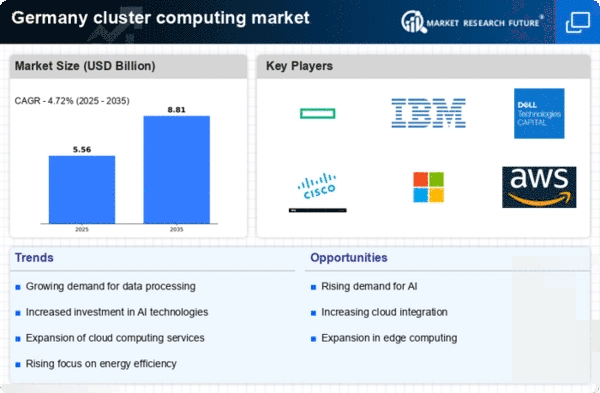
As per Market Research Future analysis, the Germany cluster computing market was estimated at 5.31 USD Billion in 2024. The Germany cluster computing market is projected to grow from 5.56 USD Billion in 2025 to 8.81 USD Billion by 2035, exhibiting a compound annual growth rate (CAGR) of 4.7% during the forecast period 2025 - 2035

Key Market Trends & Highlights

The Germany cluster computing market is experiencing robust growth driven by technological advancements and increasing demand for high-performance solutions.

  • The largest segment in the Germany cluster computing market is cloud-based solutions, reflecting a trend towards increased adoption of these technologies.
  • Energy efficiency remains a critical focus, as organizations seek to optimize their computing resources and reduce operational costs.
  • The fastest-growing segment is the integration of AI and machine learning, which enhances data processing capabilities and operational efficiency.
  • Rising demand for high-performance computing and government initiatives are key drivers propelling market expansion.

Market Size & Forecast

2024 Market Size 5.31 (USD Billion)
2035 Market Size 8.81 (USD Billion)
CAGR (2025 - 2035) 4.72%

Major Players

Hewlett Packard Enterprise (US), IBM (US), Dell Technologies (US), Cisco Systems (US), Microsoft (US), Amazon Web Services (US), NVIDIA (US), Lenovo (CN), Cray Inc. (US)

Our Impact
Enabled $4.3B Revenue Impact for Fortune 500 and Leading Multinationals
Partnering with 2000+ Global Organizations Each Year
30K+ Citations by Top-Tier Firms in the Industry

Germany Cluster Computing Market Trends

The cluster computing market in Germany is currently experiencing a notable evolution, driven by advancements in technology and increasing demand for efficient data processing solutions. Organizations across various sectors are recognizing the advantages of utilizing cluster computing systems to enhance performance, scalability, and reliability. This trend is particularly evident in industries such as finance, healthcare, and manufacturing, where large volumes of data require rapid analysis and processing. As a result, investments in high-performance computing infrastructure are on the rise, reflecting a shift towards more sophisticated computing environments. Moreover, the growing emphasis on artificial intelligence and machine learning applications is further propelling the cluster computing market. Companies are increasingly leveraging these technologies to gain insights from vast datasets, thereby improving decision-making processes. The integration of cloud computing with cluster systems is also becoming more prevalent, allowing for greater flexibility and resource optimization. This convergence of technologies suggests a promising future for the cluster computing market, as organizations seek to remain competitive in an ever-evolving digital landscape.

Increased Adoption of Cloud-Based Solutions

There is a rising trend towards the adoption of cloud-based cluster computing solutions. Organizations are increasingly migrating their workloads to the cloud, which offers scalability and cost-effectiveness. This shift allows businesses to access powerful computing resources without the need for extensive on-premises infrastructure.

Focus on Energy Efficiency

Energy efficiency is becoming a critical consideration in the cluster computing market. Companies are actively seeking solutions that minimize energy consumption while maximizing performance. This focus not only reduces operational costs but also aligns with sustainability goals.

Integration of AI and Machine Learning

The integration of artificial intelligence and machine learning into cluster computing systems is gaining traction. This trend enables organizations to process and analyze large datasets more effectively, leading to improved insights and enhanced operational efficiency.

Germany Cluster Computing Market Drivers

Government Initiatives and Funding

The German government is actively promoting the advancement of digital technologies, including cluster computing, through various initiatives and funding programs. These efforts aim to bolster the country's position as a leader in technology and innovation. For instance, the Federal Ministry of Education and Research has allocated substantial funds to support research projects that utilize cluster computing for scientific advancements. This financial backing not only encourages the development of new technologies but also stimulates collaboration between academia and industry. As a result, the cluster computing market is likely to benefit from increased investment and innovation, fostering a conducive environment for growth and expansion.

Advancements in Networking Technologies

Recent advancements in networking technologies are playing a pivotal role in shaping the cluster computing market in Germany. Innovations such as high-speed interconnects and low-latency networking solutions are enhancing the performance and efficiency of cluster computing systems. These developments enable organizations to achieve faster data transfer rates and improved communication between nodes, which is essential for optimizing computational tasks. As businesses increasingly adopt these advanced networking solutions, the cluster computing market is likely to witness a corresponding increase in demand. The integration of cutting-edge networking technologies is expected to enhance the overall capabilities of cluster computing systems, making them more attractive to potential users.

Growing Data Volumes and Analytics Needs

The exponential growth of data generated across industries in Germany is significantly impacting the cluster computing market. Organizations are increasingly recognizing the necessity of advanced analytics to derive actionable insights from vast datasets. This trend is particularly evident in sectors such as retail, telecommunications, and manufacturing, where data-driven decision-making is becoming paramount. As a consequence, the demand for cluster computing solutions that can efficiently process and analyze large volumes of data is on the rise. It is estimated that the data analytics market in Germany will reach €5 billion by 2025, further underscoring the critical role of cluster computing in enabling organizations to harness the power of their data.

Increased Focus on Research and Development

The cluster computing market in Germany is benefiting from a heightened focus on research and development (R&D) across various sectors. Organizations are investing in R&D to explore innovative applications of cluster computing, particularly in fields such as artificial intelligence, machine learning, and big data analytics. This emphasis on R&D is fostering a culture of innovation, leading to the development of new algorithms and methodologies that leverage the power of cluster computing. As a result, the market is likely to see an influx of novel solutions and applications, further driving growth. The commitment to R&D in Germany is expected to solidify the country's position as a hub for technological advancement in the cluster computing market.

Rising Demand for High-Performance Computing

The cluster computing market in Germany is experiencing a notable surge in demand for high-performance computing (HPC) solutions. This trend is driven by the increasing need for complex data analysis and simulations across various sectors, including finance, healthcare, and scientific research. As organizations seek to enhance their computational capabilities, investments in cluster computing infrastructure are projected to grow. According to recent data, the HPC market in Germany is expected to reach approximately €1.5 billion by 2026, reflecting a compound annual growth rate (CAGR) of around 8%. This growth indicates a robust interest in leveraging cluster computing technologies to address computational challenges, thereby propelling the overall cluster computing market forward.

Market Segment Insights

By Application: Data Processing (Largest) vs. High-Performance Computing (Fastest-Growing)

In the Germany cluster computing market, the application segment showcases a competitive landscape among different segment values. Data Processing holds the largest share, significantly impacting the market dynamics while serving various sectors. High-Performance Computing, on the other hand, is rapidly accelerating, catering to the increasing demand for complex computations in fields like scientific research and analytics. Growth trends in this segment reveal a shift towards more data-intensive applications, propelling the demand for High-Performance Computing solutions. The integration of advanced technologies, such as AI and machine learning, is further driving innovation within the segment. The rising focus on simulation and modeling applications also indicates a growing interest in creating virtual environments for testing and development purposes.

Data Processing: Dominant vs. Simulation and Modeling: Emerging

Data Processing stands as the dominant player in the Germany cluster computing market, primarily due to its foundational role in managing and analyzing vast datasets across industries. This segment ensures efficient data handling, critical for businesses aiming to leverage data for decision-making. Conversely, Simulation and Modeling is emerging as a vital area, driven by the need to simulate real-world processes and test scenarios without real-life implications. This segment attracts attention from sectors like automotive and healthcare, where performance optimization and predictive analysis is essential. As technology advances, both segments will continue to evolve, meeting the growing complexities of industry requirements.

By Deployment Model: Cloud-Based (Largest) vs. Hybrid (Fastest-Growing)

The Germany cluster computing market exhibits a distinct distribution of market share among its deployment model segments. Currently, Cloud-Based solutions hold the largest share, supported by businesses prioritizing scalability and flexibility. In contrast, On-Premises solutions, while still relevant for organizations with strict compliance needs, have seen a decline in growth, indicating a shift in preference towards more adaptable solutions. Meanwhile, Hybrid has emerged as a competitive contender, appealing to companies seeking to balance traditional infrastructure with the advantages of cloud capabilities. Growth trends in the deployment model segment are driven by the increasing demand for remote access and the scalability of services. Hybrid solutions are recognized as the fastest-growing segment, catering to the need for seamless integration of on-premises and cloud infrastructures. The rising adoption of digital transformation strategies has accelerated this trend, as businesses seek to harness the benefits of both environments to improve agility, reduce costs, and enhance operational efficiencies.

On-Premises (Dominant) vs. Cloud-Based (Emerging)

The On-Premises deployment model remains a dominant choice for many organizations in the Germany cluster computing market, primarily due to security concerns and legacy system dependencies. Businesses valuing control over their data often prefer this model, as it allows for tailored configurations and adherence to strict regulatory compliance. However, the emerging trend of Cloud-Based deployments is gaining traction, driven by the increasing need for flexibility and remote accessibility. These organizations benefit from reduced operational costs and enhanced scalability, making Cloud-Based infrastructures an attractive option. As companies continue to navigate the complexities of their IT environments, the hybrid approach is likely to become integral, integrating the strengths of both On-Premises and Cloud-Based solutions.

By Cluster Type: High-Performance Cluster (Largest) vs. High-Availability Cluster (Fastest-Growing)

The Germany cluster computing market exhibits a varied market share distribution among its segment values. High-Performance Clusters dominate this landscape, capturing a significant portion of the market due to their ability to handle complex computations and data-intensive applications. Conversely, High-Availability Clusters are gaining traction as businesses increasingly demand uninterrupted service and minimal downtime, contributing to their growing market presence. In terms of growth trends, the High-Performance Cluster segment remains robust, driven by advancements in processing technologies and the rising need for high-speed computational capabilities across industries. Meanwhile, the High-Availability Cluster segment is set to witness rapid growth as organizations prioritize operational resilience and disaster recovery solutions in their IT strategies, making it an emerging favorite in the cluster computing landscape.

High-Performance Cluster (Dominant) vs. High-Availability Cluster (Emerging)

High-Performance Clusters are characterized by their exceptional processing capabilities, making them ideal for scientific simulations, financial modeling, and large data analytics. They typically utilize a combination of high-speed networks and powerful processors to achieve high throughput and efficiency. As a result, these clusters are extensively used in sectors such as research, finance, and analytics where performance is paramount. On the other hand, High-Availability Clusters focus on providing reliable and continuous operation, emphasizing redundancy and fault tolerance. They cater primarily to enterprises that require constant access to their applications, thus reducing maintenance costs and ensuring service continuity. This segment is particularly appealing to businesses that cannot afford downtime, making it a crucial part of their IT infrastructure strategy.

By End Use: Information Technology (Largest) vs. Healthcare (Fastest-Growing)

The distribution of market share among the various end-use segments in the Germany cluster computing market reveals a significant dominance of the Information Technology sector. This segment encompasses a wide range of applications from cloud computing to data analytics, making it the largest contributor to market revenues. Following closely, the Education and Telecommunications sectors also play vital roles, although they capture a smaller share, reflecting the diverse use cases of cluster computing technologies across different fields. On the growth front, the Healthcare sector is emerging as the fastest-growing end-use segment in the Germany cluster computing market. The increasing need for advanced data processing capabilities in healthcare settings, driven by the demand for electronic health records and telemedicine, is propelling this sector forward. Additionally, the manufacturing sector is witnessing steady growth due to the integration of IoT and automation in production processes, further enhancing the role of cluster computing in optimizing operations and resource management.

Information Technology: Dominant vs. Healthcare: Emerging

The Information Technology segment stands as the dominant player in the Germany cluster computing market, characterized by its robust infrastructure and extensive service offerings. It includes a wide array of applications such as big data analytics, cloud computing, and enterprise resource planning, benefiting significantly from the digital transformation initiatives across industries. Meanwhile, the Healthcare sector is emerging swiftly, fueled by innovations in telehealth and electronic medical records, which require reliable and efficient computing power. This segment's focus on patient-centered solutions and digital advancements showcases its potential for substantial market growth. As organizations continue to harness data for improved patient outcomes, the demand for cluster computing in healthcare will likely surge, establishing it as a critical area of investment.

Get more detailed insights about Germany Cluster Computing Market

Key Players and Competitive Insights

The cluster computing market in Germany exhibits a dynamic competitive landscape, characterized by rapid technological advancements and a growing demand for high-performance computing solutions. Key players such as Hewlett Packard Enterprise (US), IBM (US), and NVIDIA (US) are at the forefront, leveraging their extensive expertise in innovation and digital transformation. These companies are strategically positioned to capitalize on the increasing need for data processing capabilities across various sectors, including finance, healthcare, and research. Their operational focus on enhancing computational efficiency and scalability is shaping the competitive environment, fostering a climate of continuous improvement and adaptation.In terms of business tactics, companies are increasingly localizing manufacturing and optimizing supply chains to enhance responsiveness to market demands. The competitive structure of the market appears moderately fragmented, with several players vying for market share. However, the collective influence of major companies like Dell Technologies (US) and Amazon Web Services (US) is significant, as they drive trends in cloud computing and integrated solutions, thereby influencing the overall market dynamics.

In October IBM (US) announced a strategic partnership with a leading German university to develop advanced AI-driven cluster computing solutions. This collaboration aims to enhance research capabilities in machine learning and data analytics, indicating IBM's commitment to fostering innovation through academic partnerships. Such initiatives not only bolster IBM's market position but also contribute to the broader ecosystem of technological advancement in Germany.

In September NVIDIA (US) unveiled its latest GPU architecture designed specifically for cluster computing applications, emphasizing energy efficiency and performance. This launch is pivotal as it aligns with the growing emphasis on sustainability within the tech industry. By prioritizing energy-efficient solutions, NVIDIA positions itself as a leader in addressing environmental concerns while meeting the demands of high-performance computing.

In August Hewlett Packard Enterprise (US) expanded its presence in Germany by establishing a new research and development center focused on edge computing technologies. This move reflects HPE's strategy to enhance its capabilities in delivering localized solutions that cater to the unique needs of German enterprises. The establishment of this center is likely to strengthen HPE's competitive edge by fostering innovation and collaboration with local businesses.

As of November current competitive trends in the cluster computing market are heavily influenced by digitalization, sustainability, and the integration of AI technologies. Strategic alliances among key players are shaping the landscape, facilitating knowledge sharing and resource optimization. Looking ahead, competitive differentiation is expected to evolve, with a pronounced shift from price-based competition to a focus on innovation, technological advancements, and supply chain reliability. This transition underscores the importance of agility and responsiveness in meeting the ever-changing demands of the market.

Key Companies in the Germany Cluster Computing Market include

Industry Developments

Oracle announced in July 2025 that it would invest $2 billion over a five-year period to enhance its AI and cloud infrastructure in the Frankfurt region of Germany. The objective of the initiative is to improve the capacity of Oracle Cloud Infrastructure (OCI), provide sovereign AI and multicloud capabilities, and assist public and private sector organizations in the adoption of AI and cloud.Nvidia and Hewlett Packard Enterprise (HPE) disclosed their intentions to construct a new supercomputer, "Blue Lion," at the Leibniz Supercomputing Centre in Germany in June 2025. 

The system is expected to support advanced scientific computation by early 2027, utilizing Nvidia's next-generation "Vera Rubin" processors.The "Jupiter" supercomputer, an exascale system from EuroHPC, was operationalized at Forschungszentrum Jülich in North Rhine-Westphalia in June 2025. Jupiter is now the most energy-efficient and quickest supercomputer in Europe, offering 793.4 petaFLOPS and featuring NVIDIA GH200 Grace Hopper superchips.

Future Outlook

Germany Cluster Computing Market Future Outlook

The Cluster Computing Market is projected to grow at a 4.72% CAGR from 2025 to 2035, driven by advancements in AI, big data analytics, and cloud computing.

New opportunities lie in:

  • Development of energy-efficient cluster systems for data centers.
  • Integration of AI-driven resource management tools.
  • Expansion of hybrid cloud solutions for enhanced scalability.

By 2035, the cluster computing market is expected to achieve robust growth and innovation.

Market Segmentation

Germany Cluster Computing Market End Use Outlook

  • Information Technology
  • Education
  • Healthcare
  • Manufacturing
  • Telecommunications

Germany Cluster Computing Market Application Outlook

  • Data Processing
  • High-Performance Computing
  • Data Storage
  • Simulation and Modeling

Germany Cluster Computing Market Cluster Type Outlook

  • Load-Balancing Cluster
  • High-Availability Cluster
  • High-Performance Cluster

Germany Cluster Computing Market Deployment Model Outlook

  • On-Premises
  • Cloud-Based
  • Hybrid

Report Scope

MARKET SIZE 2024 5.31(USD Billion)
MARKET SIZE 2025 5.56(USD Billion)
MARKET SIZE 2035 8.81(USD Billion)
COMPOUND ANNUAL GROWTH RATE (CAGR) 4.72% (2025 - 2035)
REPORT COVERAGE Revenue Forecast, Competitive Landscape, Growth Factors, and Trends
BASE YEAR 2024
Market Forecast Period 2025 - 2035
Historical Data 2019 - 2024
Market Forecast Units USD Billion
Key Companies Profiled Hewlett Packard Enterprise (US), IBM (US), Dell Technologies (US), Cisco Systems (US), Microsoft (US), Amazon Web Services (US), NVIDIA (US), Lenovo (CN), Cray Inc. (US)
Segments Covered Application, Deployment Model, Cluster Type, End Use
Key Market Opportunities Growing demand for high-performance computing solutions in various industries drives cluster computing market expansion.
Key Market Dynamics Rising demand for high-performance computing drives innovation and competition in the cluster computing market.
Countries Covered Germany
Leave a Comment

FAQs

What is the expected market size of the Germany Cluster Computing Market in 2024?

The Germany Cluster Computing Market is expected to be valued at 5.5 USD Billion in 2024.

What will be the market size of the Germany Cluster Computing Market by 2035?

By 2035, the Germany Cluster Computing Market is projected to reach 9.0 USD Billion.

What is the expected CAGR for the Germany Cluster Computing Market from 2025 to 2035?

The market is anticipated to grow at a CAGR of 4.579 percent during the period from 2025 to 2035.

What are the key applications of the Germany Cluster Computing Market?

The key applications include Data Processing, High-Performance Computing, Data Storage, and Simulation and Modeling.

How much is the Data Processing segment valued at in 2024?

The Data Processing segment of the Germany Cluster Computing Market is valued at 1.3 USD Billion in 2024.

What is the projected value of the High-Performance Computing segment in 2035?

The High-Performance Computing segment is projected to reach 2.3 USD Billion by 2035.

Which companies are considered major players in the Germany Cluster Computing Market?

Major players include Oracle, Dell Technologies, NVIDIA, Siemens, Univa, and several others.

What is the expected market valuation for the Data Storage application in 2035?

The Data Storage application is projected to be valued at 2.5 USD Billion in 2035.

What growth opportunities exist within the Germany Cluster Computing Market?

The market is witnessing growth opportunities due to the increasing demand for data processing and high-performance computing.

What will be the market value for the Simulation and Modeling application in 2024?

The Simulation and Modeling application is expected to be valued at 1.2 USD Billion in 2024.

Download Free Sample

Kindly complete the form below to receive a free sample of this Report

Compare Licence

×
Features License Type
Single User Multiuser License Enterprise User
Price $4,950 $5,950 $7,250
Maximum User Access Limit 1 User Upto 10 Users Unrestricted Access Throughout the Organization
Free Customization
Direct Access to Analyst
Deliverable Format
Platform Access
Discount on Next Purchase 10% 15% 15%
Printable Versions