×
Request Free Sample ×

Kindly complete the form below to receive a free sample of this Report

* Please use a valid business email

Leading companies partner with us for data-driven Insights

clients tt-cursor
Hero Background

Canada Cluster Computing Market

ID: MRFR/ICT/63030-HCR
200 Pages
Aarti Dhapte
February 2026

Canada Cluster Computing Market Research Report By Application (Data Processing, High-Performance Computing, Data Storage, Simulation and Modeling), By Deployment Model (On-Premises, Cloud-Based, Hybrid), By Cluster Type (Load-Balancing Cluster, High-Availability Cluster, High-Performance Cluster) and By End Use (Information Technology, Education, Healthcare, Manufacturing, Telecommunications)- Forecast to 2035

Share:
Download PDF ×

We do not share your information with anyone. However, we may send you emails based on your report interest from time to time. You may contact us at any time to opt-out.

Canada Cluster Computing Market Infographic
Purchase Options

Canada Cluster Computing Market Summary

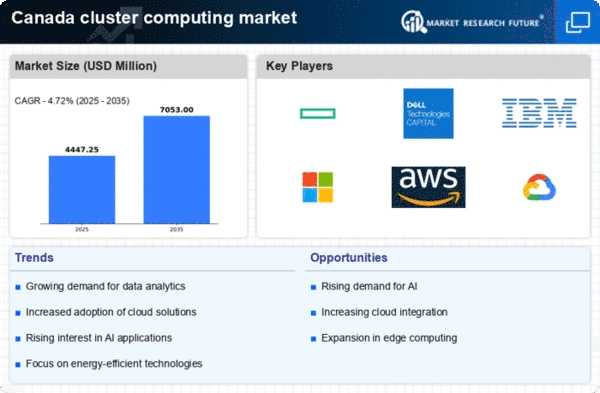
As per Market Research Future analysis, the Canada cluster computing market size was estimated at 4246.8 USD Million in 2024. The Canada cluster computing market is projected to grow from 4447.25 USD Million in 2025 to 7053.0 USD Million by 2035, exhibiting a compound annual growth rate (CAGR) of 4.7% during the forecast period 2025 - 2035

Key Market Trends & Highlights

The Canada cluster computing market is experiencing robust growth driven by technological advancements and increasing demand for efficient computing solutions.

  • The market is witnessing an increased adoption of cloud-based solutions, enhancing scalability and flexibility for businesses.
  • Energy efficiency has become a focal point, as organizations seek to reduce operational costs and environmental impact.
  • Integration of artificial intelligence is transforming cluster computing, enabling smarter data processing and analytics.
  • Key market drivers include the growing demand for high-performance computing and rising data generation needs, supported by government initiatives.

Market Size & Forecast

2024 Market Size 4246.8 (USD Million)
2035 Market Size 7053.0 (USD Million)
CAGR (2025 - 2035) 4.72%

Major Players

Hewlett Packard Enterprise (US), Dell Technologies (US), IBM (US), Microsoft (US), Amazon Web Services (US), Google Cloud (US), Lenovo (CN), Cray Inc. (US), Fujitsu (JP)

Our Impact
Enabled $4.3B Revenue Impact for Fortune 500 and Leading Multinationals
Partnering with 2000+ Global Organizations Each Year
30K+ Citations by Top-Tier Firms in the Industry

Canada Cluster Computing Market Trends

the cluster computing market is experiencing notable growth, driven by advancements in technology and increasing demand for high-performance computing solutions. Organizations across various sectors are recognizing the benefits of cluster computing, which allows for enhanced processing power and improved efficiency. This trend is particularly evident in industries such as healthcare, finance, and research, where large datasets require robust computational capabilities. As businesses seek to optimize their operations, the adoption of cluster computing systems is likely to rise, fostering innovation and competitiveness. In addition, the emphasis on data analytics and artificial intelligence is propelling the cluster computing market forward. Companies are increasingly investing in infrastructure that supports complex algorithms and large-scale data processing. This shift not only enhances decision-making processes but also enables organizations to derive valuable insights from their data. Furthermore, the growing trend of cloud computing is influencing the cluster computing landscape, as more enterprises explore hybrid solutions that combine on-premises and cloud resources. Overall, the cluster computing market is poised for continued expansion, reflecting the evolving technological landscape and the need for efficient computing solutions.

Increased Adoption of Cloud-Based Solutions

Organizations are increasingly turning to cloud-based cluster computing solutions to enhance flexibility and scalability. This trend allows businesses to access powerful computing resources without the need for significant upfront investments in hardware. As cloud technology matures, it is likely that more companies will leverage these solutions to meet their computational needs.

Focus on Energy Efficiency

There is a growing emphasis on energy efficiency within the cluster computing market. Companies are seeking to reduce operational costs and minimize their environmental impact by adopting energy-efficient technologies. This trend may lead to the development of more sustainable computing practices, aligning with broader environmental goals.

Integration of Artificial Intelligence

The integration of artificial intelligence into cluster computing systems is becoming increasingly prevalent. This trend suggests that organizations are looking to enhance their computational capabilities by utilizing AI algorithms for data processing and analysis. As AI technologies advance, their incorporation into cluster computing may drive further innovation and efficiency.

Canada Cluster Computing Market Drivers

Increased Focus on Cybersecurity

As the reliance on cluster computing solutions grows, so does the emphasis on cybersecurity within the market. Organizations in Canada are becoming increasingly aware of the potential vulnerabilities associated with distributed computing environments. Consequently, there is a heightened focus on implementing robust security measures to protect sensitive data and maintain system integrity. This trend is likely to drive investments in cybersecurity solutions tailored for cluster computing environments. The cluster computing market is expected to see a rise in demand for integrated security features, as businesses seek to mitigate risks and ensure compliance with regulatory standards. This focus on cybersecurity may shape the future landscape of the cluster computing market.

Government Initiatives and Funding

Government initiatives in Canada aimed at promoting technological innovation are playing a crucial role in the growth of the cluster computing market. Various funding programs and grants are available to support research and development in advanced computing technologies. For instance, the Canadian government has allocated substantial resources to enhance the country's digital infrastructure, which includes investments in cluster computing capabilities. This support not only fosters innovation but also encourages collaboration between academia and industry. As a result, the cluster computing market is likely to benefit from increased funding and resources, facilitating the development of cutting-edge solutions that meet the evolving needs of Canadian businesses.

Advancements in Networking Technologies

Advancements in networking technologies are significantly influencing the cluster computing market in Canada. The emergence of high-speed networking solutions, such as 5G and fiber-optic connections, is enabling faster data transfer and improved connectivity between cluster nodes. This enhanced networking capability allows organizations to leverage the full potential of cluster computing, resulting in better performance and efficiency. As businesses increasingly rely on distributed computing environments, the demand for robust networking solutions is expected to rise. This trend suggests that the cluster computing market will continue to evolve, driven by the need for seamless integration and communication among computing resources.

Rising Data Generation and Analytics Needs

The explosion of data generation across various sectors in Canada is significantly impacting the cluster computing market. With the advent of IoT devices, social media, and digital transactions, organizations are inundated with data that requires robust processing capabilities. The need for real-time analytics and data-driven decision-making is pushing companies to adopt cluster computing solutions. It is estimated that data generation in Canada will increase by over 30% annually, necessitating scalable computing resources. Consequently, businesses are turning to cluster computing to manage and analyze this data effectively, thereby driving growth in the market. This trend indicates a strong correlation between data proliferation and the demand for cluster computing technologies.

Growing Demand for High-Performance Computing

The cluster computing market in Canada is experiencing a notable surge in demand for high-performance computing (HPC) solutions. Industries such as finance, healthcare, and research are increasingly relying on HPC to process vast amounts of data efficiently. This trend is driven by the need for faster data analysis and improved computational capabilities. According to recent estimates, the HPC market in Canada is projected to grow at a CAGR of approximately 8% over the next five years. As organizations seek to enhance their operational efficiency, the adoption of cluster computing technologies becomes essential. This growing demand for HPC is likely to propel the cluster computing market forward, as businesses invest in advanced computing infrastructures to remain competitive.


Market Segment Insights

By Application: Data Processing (Largest) vs. High-Performance Computing (Fastest-Growing)

In the Canada cluster computing market, the application segment exhibits distinct market share distribution among key values, with Data Processing taking the lead due to its widespread adoption across various industries. High-Performance Computing closely follows, driven by increasing demands in scientific research and complex simulations. Data Storage and Simulation and Modeling also contribute significantly; however, their market presence is comparatively smaller as enterprises prioritize high-efficiency solutions. Growth trends indicate that High-Performance Computing is rapidly gaining traction, propelled by advancements in parallel processing and the need for faster data analysis. Data Processing remains crucial due to the growing volume of data generated daily, while Data Storage is evolving with cloud technologies. Simulation and Modeling have also seen upticks due to increased applications in sectors like finance and healthcare, showcasing an overall positive outlook for this segment.

Data Processing: Dominant vs. Simulation and Modeling: Emerging

Data Processing is characterized as a dominant value within the application segment, reflecting its essential role in managing and analyzing vast amounts of data across organizations. Its robust infrastructure supports various analytical processes, making it indispensable for decision-making and operational efficiency. Conversely, Simulation and Modeling is considered an emerging value, leveraging cutting-edge technologies to create virtual environments for analyzing complex scenarios. This segment is gaining momentum as industries adopt simulation for risk assessment and predictive analysis, supported by advancements in graphical processing units and software. Both segments showcase the dynamic nature of the application landscape, catering to distinct but equally vital organizational needs.

By Deployment Model: Cloud-Based (Largest) vs. Hybrid (Fastest-Growing)

In the Canada cluster computing market, the deployment model segment is primarily composed of three categories: On-Premises, Cloud-Based, and Hybrid solutions. Cloud-Based deployment dominates the market, capturing a significant share due to its scalability and cost-efficiency. On-Premises solutions follow, favored by enterprises needing control over their infrastructure, while Hybrid models are gaining traction as organizations seek flexible integration of both environments. The growth trends within this segment indicate a strong shift towards Cloud-Based solutions, driven by increased demand for remote accessibility and operational flexibility. Moreover, Hybrid models are emerging as the fastest-growing segment, appealing to businesses looking for a balance of control and scalability. The evolving technological landscape and the push for digital transformation are key drivers propelling this change.

Cloud-Based (Dominant) vs. Hybrid (Emerging)

Cloud-Based deployment stands out as the dominant solution in the Canada cluster computing market, primarily due to its adaptability and cost efficiency, making it particularly appealing for businesses looking to minimize overheads while maximizing performance. This model allows easy access to resources and scalability, which are essential for organizations aiming to stay competitive in a rapid technological landscape. Conversely, Hybrid deployment is characterized as the emerging choice for companies that desire the flexibility of both On-Premises and Cloud-Based solutions. This approach enables firms to strategically manage workloads, ensuring sensitive data remains on-site while leveraging Cloud benefits for less sensitive operations, thus facilitating a tailored infrastructure as business needs evolve.

By Cluster Type: High-Performance Cluster (Largest) vs. High-Availability Cluster (Fastest-Growing)

In the Canada cluster computing market, the Load-Balancing Cluster holds a substantial market share, primarily due to its capability to distribute workloads efficiently across multiple nodes. This ensures optimal resource use, leading to enhanced performance. Following closely is the High-Performance Cluster, which, while dominant in certain applications, faces intense competition from High-Availability Clusters that promise improved uptime and fault tolerance. The emergence of distributed computing solutions further diversifies the preferences within this segment. Growth trends indicate that the High-Availability Cluster is increasingly favored for mission-critical applications, leveraging its ability to minimize downtime substantially. With organizations prioritizing reliability and system resilience, the demand for High-Availability Clusters is on the rise, marking them as the fastest-growing segment. Meanwhile, the High-Performance Cluster, while still critical for data-intensive tasks, is witnessing gradual adjustments in investment as companies adopt more flexible computing strategies.

Load-Balancing Cluster (Dominant) vs. High-Availability Cluster (Emerging)

The Load-Balancing Cluster remains the dominant player in the Canada cluster computing market, characterized by its ability to manage traffic efficiently and optimize resource utilization across multiple servers. This cluster type excels in environments where scalability and performance are crucial, catering to industries that require consistent workload distribution. On the other hand, the High-Availability Cluster is emerging as a vital segment as organizations increasingly seek solutions that guarantee minimal service interruptions. This segment focuses on ensuring system resilience, supporting critical applications where uptime is non-negotiable. As businesses become more reliant on their digital infrastructure, the High-Availability Cluster is rapidly gaining traction, reflecting a significant shift toward prioritizing reliability and operational continuity.

By End Use: Information Technology (Largest) vs. Education (Fastest-Growing)

In the Canada cluster computing market, the Information Technology segment holds the largest share, reflecting its critical role in driving digital transformation across various sectors. Following closely, the Education segment is gaining momentum, leveraging technological advancements to enhance learning experiences, particularly through e-learning platforms and digital resources. As organizations pivot towards innovative solutions, the Education sector is witnessing rapid growth driven by increased investment in digital infrastructure and a shift towards remote and hybrid learning. The demand for computing resources in healthcare and telecommunications is also on the rise, but the pace of growth in Education showcases its future potential in shaping market dynamics and tapping into evolving consumer demands.

Information Technology: Dominant vs. Education: Emerging

The Information Technology segment stands as the dominant force in the Canada cluster computing market, characterized by widespread adoption of cloud services, data analytics, and cybersecurity solutions. This sector thrives on innovation, consistently integrating cutting-edge technologies to meet the challenges of modern business environments. In contrast, the Education segment, defined as emerging, is experiencing a transformative phase, fueled by the ongoing digitalization of educational systems. Institutions are increasingly adopting cloud computing and collaborative platforms to enhance educational access and delivery. As both segments continue to evolve, their interplay will significantly influence market trends and growth prospects in the coming years.

Get more detailed insights about Canada Cluster Computing Market

Key Players and Competitive Insights

The cluster computing market exhibits a dynamic competitive landscape, characterized by rapid technological advancements and a growing demand for high-performance computing solutions. Key players such as Hewlett Packard Enterprise (US), IBM (US), and Amazon Web Services (US) are at the forefront, each adopting distinct strategies to enhance their market positioning. Hewlett Packard Enterprise (US) focuses on innovation through its GreenLake platform, which emphasizes hybrid cloud solutions, while IBM (US) leverages its expertise in AI and quantum computing to differentiate its offerings. Amazon Web Services (US) continues to expand its cloud services, integrating advanced analytics and machine learning capabilities, thereby shaping a competitive environment that prioritizes technological prowess and customer-centric solutions.In terms of business tactics, companies are increasingly localizing manufacturing and optimizing supply chains to enhance operational efficiency. The market structure appears moderately fragmented, with a mix of established players and emerging startups. This fragmentation allows for diverse offerings, yet the collective influence of major companies like Dell Technologies (US) and Microsoft (US) remains substantial, as they drive innovation and set industry standards.

In October Dell Technologies (US) announced a strategic partnership with a leading Canadian university to develop next-generation computing solutions tailored for research applications. This collaboration is poised to enhance Dell's visibility in the academic sector while fostering innovation in cluster computing technologies. Such partnerships not only bolster Dell's market presence but also align with the growing trend of academia-industry collaboration in technology development.

In September IBM (US) unveiled its latest quantum computing system, designed to integrate seamlessly with existing cluster computing frameworks. This launch signifies IBM's commitment to advancing computational capabilities and positions the company as a leader in the integration of quantum technologies into mainstream computing. The strategic importance of this development lies in its potential to revolutionize data processing and analytics, thereby attracting a broader customer base.

In August Amazon Web Services (US) expanded its data center footprint in Canada, enhancing its capacity to deliver cloud-based cluster computing solutions. This expansion reflects AWS's strategy to meet the increasing demand for scalable computing resources and underscores its commitment to regional growth. By bolstering its infrastructure, AWS is likely to strengthen its competitive edge in the cloud services market.

As of November current trends in the cluster computing market are heavily influenced by digitalization, sustainability initiatives, and the integration of AI technologies. Strategic alliances are becoming increasingly vital, as companies seek to leverage complementary strengths to enhance their offerings. The competitive differentiation is expected to evolve, shifting from traditional price-based competition to a focus on innovation, technological advancements, and supply chain reliability. This transition suggests that companies that prioritize R&D and strategic partnerships will likely emerge as leaders in the evolving landscape.

Key Companies in the Canada Cluster Computing Market include

Industry Developments

IBM announced the establishment of a new Cloud Multizone Region (MZR) in Montreal in April 2024. This region has three availability zones. This expansion, which is expected to commence in the first half of 2025, is designed to provide services such as Power Virtual Server, VMware as a Service, SAP, and HPC-as-a-Service, all of which are powered by 100% renewable energy. It also enhances resilience, supports generative AI workloads, and ensures compliance with Canadian regulatory and data sovereignty requirements.The third-largest IBM software lab in Canada, the Technology Expert Labs in Markham, Ontario, was expanded in October 2024 to assist Canadian enterprises in the adoption of generative AI (e.g., watsonx), hybrid cloud solutions, automation, cybersecurity, and other technologies. 

This expansion aimed to address skill gaps and accelerate digital transformation.In December 2023, Amazon Web Services introduced its second Canadian cloud region, Canada West (Calgary), which comprises three availability zones. The purpose of this regional expansion is to provide developers, entrepreneurs, enterprises, government, and institutions in Western Canada with access to AWS technologies in the areas of analytics, security, machine learning, and AI.

Future Outlook

Canada Cluster Computing Market Future Outlook

The Cluster Computing Market in Canada is projected to grow at a 4.72% CAGR from 2025 to 2035, driven by advancements in data analytics, cloud computing, and AI integration.

New opportunities lie in:

  • Development of hybrid cloud solutions for enhanced scalability and flexibility.
  • Investment in energy-efficient computing technologies to reduce operational costs.
  • Creation of specialized training programs for workforce development in cluster computing.

By 2035, the cluster computing market is expected to achieve robust growth and innovation.

Market Segmentation

Canada Cluster Computing Market End Use Outlook

  • Information Technology
  • Education
  • Healthcare
  • Manufacturing
  • Telecommunications

Canada Cluster Computing Market Application Outlook

  • Data Processing
  • High-Performance Computing
  • Data Storage
  • Simulation and Modeling

Canada Cluster Computing Market Cluster Type Outlook

  • Load-Balancing Cluster
  • High-Availability Cluster
  • High-Performance Cluster

Canada Cluster Computing Market Deployment Model Outlook

  • On-Premises
  • Cloud-Based
  • Hybrid

Report Scope

MARKET SIZE 2024 4246.8(USD Million)
MARKET SIZE 2025 4447.25(USD Million)
MARKET SIZE 2035 7053.0(USD Million)
COMPOUND ANNUAL GROWTH RATE (CAGR) 4.72% (2025 - 2035)
REPORT COVERAGE Revenue Forecast, Competitive Landscape, Growth Factors, and Trends
BASE YEAR 2024
Market Forecast Period 2025 - 2035
Historical Data 2019 - 2024
Market Forecast Units USD Million
Key Companies Profiled Hewlett Packard Enterprise (US), Dell Technologies (US), IBM (US), Microsoft (US), Amazon Web Services (US), Google Cloud (US), Lenovo (CN), Cray Inc. (US), Fujitsu (JP)
Segments Covered Application, Deployment Model, Cluster Type, End Use
Key Market Opportunities Growing demand for scalable solutions in data-intensive applications drives cluster computing market expansion.
Key Market Dynamics Growing demand for high-performance computing drives innovation and competition in the cluster computing market.
Countries Covered Canada
Leave a Comment

FAQs

What is the expected market size of the Canada Cluster Computing Market in 2024?

The Canada Cluster Computing Market is expected to be valued at 4.5 USD Billion in 2024.

What market size is projected for the Canada Cluster Computing Market by 2035?

By 2035, the overall market is projected to reach a valuation of 8.5 USD Billion.

What is the expected compound annual growth rate (CAGR) of the Canada Cluster Computing Market from 2025 to 2035?

The market is anticipated to grow at a CAGR of 5.952% during the period from 2025 to 2035.

Which company has the largest market share in the Canada Cluster Computing Market?

Major players in the market include Oracle, Dell Technologies, and Amazon Web Services, contributing significantly to the market share.

What are the key applications driving growth in the Canada Cluster Computing Market?

Key applications include Data Processing, High-Performance Computing, Data Storage, and Simulation and Modeling.

How much is the Data Processing application projected to be valued in 2035?

The Data Processing application is projected to be valued at 2.8 USD Billion by 2035.

What is the projected market size for High-Performance Computing in 2024 and 2035?

High-Performance Computing is expected to be valued at 1.2 USD Billion in 2024 and 2.4 USD Billion in 2035.

What challenges does the Canada Cluster Computing Market face?

The market faces challenges such as rapid technological changes and the need for skilled workforce.

What is the projected market value for Data Storage in 2025 to 2035?

The Data Storage segment is expected to grow from 1.0 USD Billion in 2024 to 1.8 USD Billion by 2035.

What opportunities for growth exist within the Canada Cluster Computing Market?

Emerging trends in artificial intelligence and big data analytics present significant growth opportunities for the market.

Download Free Sample

Kindly complete the form below to receive a free sample of this Report

Compare Licence

×
Features License Type
Single User Multiuser License Enterprise User
Price $4,950 $5,950 $7,250
Maximum User Access Limit 1 User Upto 10 Users Unrestricted Access Throughout the Organization
Free Customization
Direct Access to Analyst
Deliverable Format
Platform Access
Discount on Next Purchase 10% 15% 15%
Printable Versions