×
Request Free Sample ×

Kindly complete the form below to receive a free sample of this Report

* Please use a valid business email

Leading companies partner with us for data-driven Insights

clients tt-cursor
Hero Background

Germany Chikungunya Vaccine Market

ID: MRFR/Pharma/51603-HCR
200 Pages
Rahul Gotadki
February 2026

Germany Chikungunya Vaccine Market Research Report: Size, Share, Trend Analysis By Product Technology (Live-Attenuated Virus Vaccines, Inactivated Viral Vaccine, Recombinant Viral Vaccines, Chimeric-Alphavirus Candidates, Others), By Age Group (Pediatric, Adult, Geriatric) and By Distribution Channel (Hospital Pharmacies, Retail Pharmacies, Others) - Growth Outlook & Industry Forecast 2025 To 2035

Share:
Download PDF ×

We do not share your information with anyone. However, we may send you emails based on your report interest from time to time. You may contact us at any time to opt-out.

Germany Chikungunya Vaccine Market Infographic
Purchase Options

Germany Chikungunya Vaccine Market Summary

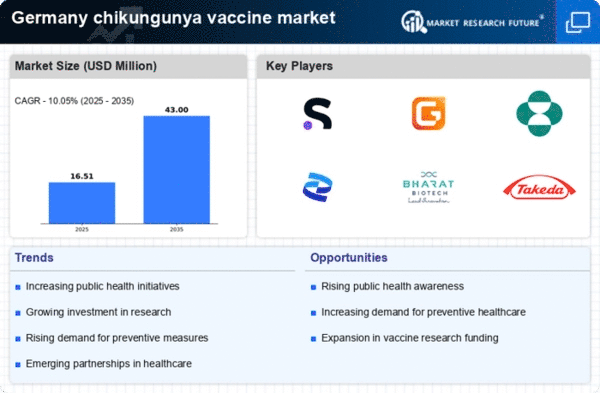
As per Market Research Future analysis, the Germany chikungunya vaccine market size was estimated at 15.0 USD Million in 2024. The Germany chikungunya vaccine market is projected to grow from 16.51 USD Million in 2025 to 43.0 USD Million by 2035, exhibiting a compound annual growth rate (CAGR) of 10.0% during the forecast period 2025 - 2035

Key Market Trends & Highlights

The Germany chikungunya vaccine market is poised for growth driven by increased research and public health initiatives.

  • The market is witnessing increased research and development efforts aimed at chikungunya vaccine innovation.
  • Regulatory support and streamlined approval processes are enhancing the market landscape for vaccine introduction.
  • Public awareness and education initiatives are crucial in driving demand for chikungunya vaccination.
  • Rising incidence of chikungunya cases and advancements in vaccine technology are key drivers propelling market growth.

Market Size & Forecast

2024 Market Size 15.0 (USD Million)
2035 Market Size 43.0 (USD Million)
CAGR (2025 - 2035) 10.05%

Major Players

Sanofi (FR), GSK (GB), Merck & Co (US), Pfizer (US), Bharat Biotech (IN), Takeda Pharmaceutical (JP), Novavax (US), Inovio Pharmaceuticals (US)

Our Impact
Enabled $4.3B Revenue Impact for Fortune 500 and Leading Multinationals
Partnering with 2000+ Global Organizations Each Year
30K+ Citations by Top-Tier Firms in the Industry

Germany Chikungunya Vaccine Market Trends

The chikungunya vaccine market is currently experiencing a notable evolution, driven by increasing awareness of the disease and its potential health impacts. In Germany, the incidence of chikungunya has prompted health authorities to prioritize vaccine development and distribution. This heightened focus is reflected in ongoing research initiatives and collaborations among pharmaceutical companies and governmental health organizations. The commitment to public health is evident, as stakeholders aim to mitigate the risks associated with chikungunya outbreaks. Furthermore, the regulatory environment appears to be supportive, facilitating the introduction of innovative vaccine solutions. In addition, the chikungunya vaccine market is likely to benefit from advancements in biotechnology and vaccine delivery systems. These innovations may enhance the efficacy and accessibility of vaccines, making them more appealing to the population. Public health campaigns are also expected to play a crucial role in educating citizens about the importance of vaccination. As awareness grows, the demand for effective chikungunya vaccines may increase, leading to a more robust market landscape. Overall, the future of the chikungunya vaccine market seems promising, with various factors converging to support its growth and development.

Increased Research and Development

There is a marked emphasis on research and development within the chikungunya vaccine market. This trend is characterized by collaborations between academic institutions and pharmaceutical companies, aiming to accelerate the creation of effective vaccines. The focus on innovative technologies may lead to breakthroughs that enhance vaccine efficacy and safety.

Regulatory Support and Approval Processes

The regulatory framework in Germany appears to be conducive to the chikungunya vaccine market. Authorities are streamlining approval processes for new vaccines, which may facilitate quicker access to immunization options. This supportive environment is likely to encourage investment in vaccine development.

Public Awareness and Education Initiatives

Public health campaigns are increasingly focusing on educating the population about chikungunya and the benefits of vaccination. These initiatives aim to raise awareness and promote vaccine uptake, potentially leading to higher immunization rates. As citizens become more informed, the demand for vaccines may rise.

Germany Chikungunya Vaccine Market Drivers

Growing Public Health Awareness

The chikungunya vaccine market is being positively impacted by growing public health awareness regarding vector-borne diseases. In Germany, educational campaigns aimed at informing the public about chikungunya and its potential health risks are gaining traction. Surveys indicate that approximately 60% of the population is now aware of chikungunya, compared to just 30% five years ago. This increased awareness is likely to translate into higher vaccination rates as individuals become more proactive about their health. Consequently, the chikungunya vaccine market may experience a boost as more people seek vaccination to protect themselves from the disease.

Advancements in Vaccine Technology

Technological advancements in vaccine development are significantly influencing the chikungunya vaccine market. Innovations such as mRNA technology and viral vector platforms are being explored to enhance vaccine efficacy and safety. These advancements may lead to the introduction of more effective vaccines, which could potentially capture a larger share of the market. In Germany, the research community is actively engaged in developing novel vaccine candidates, with several clinical trials underway. The successful development and approval of these vaccines could stimulate market growth, as healthcare providers and patients alike seek effective solutions to combat chikungunya.

Government Initiatives and Funding

Government initiatives aimed at controlling vector-borne diseases are playing a crucial role in shaping the chikungunya vaccine market. In Germany, public health agencies are increasingly allocating funds for research and development of vaccines. For instance, recent budget proposals indicate an increase of 15% in funding for infectious disease research, which includes chikungunya. This financial support is likely to accelerate vaccine development timelines and enhance collaboration between public and private sectors. As a result, the chikungunya vaccine market may witness a surge in new product launches and improved access to vaccines for the population.

Rising Incidence of Chikungunya Cases

The chikungunya vaccine market is experiencing growth due to the rising incidence of chikungunya cases in Germany. Recent data indicates that the number of reported cases has increased by approximately 30% over the past five years, raising public health concerns. This surge in cases has prompted health authorities to prioritize vaccination efforts, thereby driving demand for vaccines. The chikungunya vaccine market is likely to benefit from increased funding and resources allocated to combat the disease. Furthermore, the heightened awareness of vector-borne diseases among the population may lead to greater acceptance of vaccination, ultimately contributing to market expansion.

Increased Collaboration Among Stakeholders

Collaboration among various stakeholders, including government agencies, research institutions, and pharmaceutical companies, is fostering growth in the chikungunya vaccine market. In Germany, partnerships are being formed to share resources and expertise, which may lead to more efficient vaccine development processes. These collaborations can also facilitate knowledge transfer and innovation, ultimately benefiting the market. Additionally, joint efforts in public health campaigns may enhance community engagement and awareness regarding chikungunya vaccination, further driving demand. The synergy created through these partnerships is likely to strengthen the overall market landscape.


Market Segment Insights

By Product Technology: Live-Attenuated Virus Vaccines (Largest) vs. Recombinant Viral Vaccines (Fastest-Growing)

The market share distribution within the segment of product technology for chikungunya vaccines reveals that Live-Attenuated Virus Vaccines hold the largest portion, showcasing their longstanding establishment in immunization efforts. This traditional approach continues to provide substantial protection, leading to their dominance in the current landscape. Conversely, Recombinant Viral Vaccines are gaining traction, gradually capturing a significant share as innovation enhances their effectiveness and appeal. Growth trends in the Germany chikungunya vaccine market are mainly driven by advancements in vaccine technology and increasing awareness of disease prevention among the population. Emerging techniques, such as genetically-modified constructs utilized in recombinant vaccines, are attracting investment and interest, thus promoting rapid growth. Additionally, the rising incidence of chikungunya cases underscores which technologies will likely see the highest demand as public health initiatives adapt to combat the virus more effectively.

Live-Attenuated Virus Vaccines (Dominant) vs. Recombinant Viral Vaccines (Emerging)

Live-Attenuated Virus Vaccines are characterized by their ability to provoke robust immune responses, leading to long-lasting immunity and making them a time-tested choice for numerous vaccine programs. They dominate the market due to their proven efficacy and established track record. In contrast, Recombinant Viral Vaccines represent an emerging technology that utilizes recombinant DNA technology to create a safer and more effective vaccine option. The growing interest in these innovative products is fueled by their potential for rapid development and adaptability to evolving pathogens, making them a promising addition to the vaccine options available.

By Age Group: Adult (Largest) vs. Pediatric (Fastest-Growing)

In the Germany chikungunya vaccine market, the distribution among the age groups reveals that the adult segment holds the largest share, reflecting the higher vulnerability of this demographic to severe chikungunya infections. The pediatric segment, although smaller in proportion, is witnessing rapid growth as awareness increases about the importance of vaccinations for children. The geriatric segment, while significant, is not growing at the same pace as the other age groups due to varied vaccination coverage and different health priorities among older populations. Growth trends in the age group segmentation of the Germany chikungunya vaccine market indicate a steeper incline in demand for the pediatric and adult segments. The prioritization of immunization programs for kids, coupled with health initiatives aimed at educating parents, has led to the pediatric segment being recognized as the fastest-growing demographic. Simultaneously, the adult segment benefits from increasing infection awareness and preventive health measures, further solidifying its dominant position in the market.

Adult (Dominant) vs. Pediatric (Emerging)

The adult segment is characterized by its dominant position in the Germany chikungunya vaccine market, driven by a higher incidence of severe disease cases and proactive health campaigns emphasizing vaccination's importance for this group. Adults tend to have greater access to healthcare and are more likely to receive vaccinations as part of routine health care updates. On the other hand, the pediatric segment is emerging as a vital focus area due to heightened awareness among parents about protecting their children's health through vaccinations. This demographic is increasingly targeted through specialized awareness programs, indicating a shift towards prioritizing childhood vaccinations, and showcasing its potential for rapid market growth.

By Distribution Channel: Hospital Pharmacies (Largest) vs. Retail Pharmacies (Fastest-Growing)

In the Germany chikungunya vaccine market, the distribution of market share among different distribution channels reveals that Hospital Pharmacies hold the largest share of the market. Retail Pharmacies follow as significant players, contributing to the competitive landscape with their growing presence. Other distribution channels, while relevant, have a more niche impact compared to the two leading segments. The growth trends in the distribution channel segment showcase Retail Pharmacies as the fastest-growing segment due to increasing consumer reliance on convenience and accessibility. This is driven by the rising awareness of chikungunya and the need for prompt vaccination, as well as the expansion of Pharmacies in various urban and rural areas, enhancing their ability to meet consumer demand.

Hospital Pharmacies (Dominant) vs. Retail Pharmacies (Emerging)

Hospital Pharmacies play a dominant role in the Germany chikungunya vaccine market by providing a secure and systematic environment for vaccination, where healthcare professionals can ensure proper administration. These facilities are equipped with the necessary resources and staff to cater to patients, which enhances trust and reliability. On the other hand, Retail Pharmacies are emerging as a vital channel by offering convenience and accessibility for consumers seeking vaccinations. Their growth is propelled by increasing health awareness and the strategic placement of vaccination services within community settings, thereby attracting a wider demographic looking for immediate healthcare solutions.

Get more detailed insights about Germany Chikungunya Vaccine Market

Key Players and Competitive Insights

The chikungunya vaccine market is currently characterized by a dynamic competitive landscape, driven by increasing awareness of vector-borne diseases and the need for effective preventive measures. Key players such as Sanofi (FR), GSK (GB), and Merck & Co (US) are actively engaged in developing innovative vaccine solutions, with a focus on enhancing efficacy and safety profiles. These companies are strategically positioned to leverage their extensive research capabilities and established distribution networks, which collectively shape a competitive environment that is both collaborative and competitive, fostering innovation while addressing public health needs.In terms of business tactics, companies are increasingly localizing manufacturing to reduce costs and improve supply chain efficiency. The market appears moderately fragmented, with several players vying for market share, yet the influence of major companies remains substantial. This competitive structure allows for a diverse range of products and strategies, which can cater to varying regional demands and regulatory requirements.

In October GSK (GB) announced a partnership with a leading biotechnology firm to enhance its chikungunya vaccine development program. This collaboration aims to combine GSK's extensive vaccine expertise with innovative technologies from its partner, potentially accelerating the development timeline and improving the vaccine's effectiveness. Such strategic alliances are indicative of a broader trend towards collaboration in the industry, as companies seek to pool resources and knowledge to tackle complex health challenges.

In September Sanofi (FR) launched a new clinical trial for its chikungunya vaccine candidate, focusing on a novel adjuvant that may enhance immune response. This trial is significant as it reflects Sanofi's commitment to innovation and its proactive approach to addressing the evolving landscape of infectious diseases. The results of this trial could potentially position Sanofi as a leader in the market, should the vaccine demonstrate superior efficacy.

In August Merck & Co (US) expanded its manufacturing capabilities in Germany, aiming to increase production capacity for its chikungunya vaccine. This strategic move not only enhances supply chain reliability but also positions Merck to respond more effectively to market demands. The expansion underscores the importance of operational efficiency in maintaining a competitive edge in a rapidly evolving market.

As of November current trends in the chikungunya vaccine market are increasingly defined by digitalization, sustainability, and the integration of advanced technologies such as AI in research and development. Strategic alliances are shaping the landscape, enabling companies to innovate more rapidly and effectively. Looking ahead, competitive differentiation is likely to evolve from traditional price-based competition towards a focus on innovation, technological advancements, and supply chain reliability, as companies strive to meet the growing demand for effective vaccines.

Key Companies in the Germany Chikungunya Vaccine Market include

Industry Developments

Recent developments in the Germany Chikungunya Vaccine Market indicate a significant focus on research and development efforts to combat the virus, with multiple pharmaceutical companies actively engaged in creating effective vaccines. GlaxoSmithKline and Pfizer have been particularly prominent, intensifying their vaccine initiatives following increased awareness of Chikungunya cases across Europe. Valneva, in collaboration with AstraZeneca, has advanced its clinical trials, generating interest in its vaccine formulation. Notably, Bayer and Johnson and Johnson announced a partnership in July 2023 to explore innovative approaches in vector control, which could synergistically enhance vaccination efforts. 

In the realm of mergers and acquisitions, no recent deals have been publicly reported specific to Chikungunya vaccine development within Germany's market, focusing instead on strategic partnerships for R&D. The market valuation of companies in this sector has shown upward trends, influenced by government initiatives supporting vaccine research and public health readiness against arboviral diseases. Furthermore, the German government has allocated increased funding towards vaccine development efforts since the onset of COVID-19, resulting in an intensified focus on infectious diseases, including Chikungunya, thereby positively impacting the overall market landscape.

Future Outlook

Germany Chikungunya Vaccine Market Future Outlook

The Chikungunya Vaccine Market is projected to grow at a 10.05% CAGR from 2025 to 2035, driven by rising disease prevalence, increased public health initiatives, and technological advancements in vaccine development.

New opportunities lie in:

  • Development of mobile vaccination units for remote areas
  • Partnerships with local health authorities for community outreach
  • Investment in digital health platforms for vaccine tracking and education

By 2035, the chikungunya vaccine market is expected to achieve substantial growth and enhanced accessibility.

Market Segmentation

Germany Chikungunya Vaccine Market Age Group Outlook

  • Pediatric
  • Adult
  • Geriatric

Germany Chikungunya Vaccine Market Product Technology Outlook

  • Live-Attenuated Virus Vaccines
  • Inactivated Viral Vaccines
  • Recombinant Viral Vaccines
  • Chimeric-Alphavirus Candidates
  • Others

Germany Chikungunya Vaccine Market Distribution Channel Outlook

  • Hospital Pharmacies
  • Retail Pharmacies
  • Others

Report Scope

MARKET SIZE 2024 15.0(USD Million)
MARKET SIZE 2025 16.51(USD Million)
MARKET SIZE 2035 43.0(USD Million)
COMPOUND ANNUAL GROWTH RATE (CAGR) 10.05% (2025 - 2035)
REPORT COVERAGE Revenue Forecast, Competitive Landscape, Growth Factors, and Trends
BASE YEAR 2024
Market Forecast Period 2025 - 2035
Historical Data 2019 - 2024
Market Forecast Units USD Million
Key Companies Profiled Sanofi (FR), GSK (GB), Merck & Co (US), Pfizer (US), Bharat Biotech (IN), Takeda Pharmaceutical (JP), Novavax (US), Inovio Pharmaceuticals (US)
Segments Covered Product Technology, Age Group, Distribution Channel
Key Market Opportunities Emerging technologies in vaccine development enhance efficacy and accessibility in the chikungunya vaccine market.
Key Market Dynamics Rising demand for chikungunya vaccines driven by increased awareness and regulatory support for preventive healthcare initiatives.
Countries Covered Germany
Leave a Comment

FAQs

What is the expected market size of the Germany Chikungunya Vaccine Market in 2024?

The Germany Chikungunya Vaccine Market is expected to be valued at 15.0 million USD in 2024.

What will the market size be by 2035?

By 2035, the market size is projected to reach 50.0 million USD.

What is the expected CAGR for the market from 2025 to 2035?

The Germany Chikungunya Vaccine Market is expected to grow at a CAGR of 11.567% from 2025 to 2035.

Which product technology segment will have the highest value in 2035?

The Live-Attenuated Virus Vaccines segment is expected to hold the highest value at 15.0 million USD in 2035.

What is the market value of Inactivated Viral Vaccines in 2024?

Inactivated Viral Vaccines are valued at 3.0 million USD in 2024.

Who are the key players in the Germany Chikungunya Vaccine Market?

Major players include GlaxoSmithKline, Pfizer, Bayer, and Johnson & Johnson among others.

What are the anticipated values for Recombinant Viral Vaccines by 2035?

The Recombinant Viral Vaccines segment is anticipated to reach 12.0 million USD by 2035.

What market value is projected for Chimeric-Alphavirus Candidates in 2024?

Chimeric-Alphavirus Candidates are projected to be valued at 2.5 million USD in 2024.

What challenges are present in the Germany Chikungunya Vaccine Market?

Key challenges include the need for effective distribution and public awareness of vaccine benefits.

What trends are influencing growth in the Germany Chikungunya Vaccine Market?

Emerging trends include advancements in vaccine technology and increasing public health initiatives.

Download Free Sample

Kindly complete the form below to receive a free sample of this Report

Compare Licence

×
Features License Type
Single User Multiuser License Enterprise User
Price $4,950 $5,950 $7,250
Maximum User Access Limit 1 User Upto 10 Users Unrestricted Access Throughout the Organization
Free Customization
Direct Access to Analyst
Deliverable Format
Platform Access
Discount on Next Purchase 10% 15% 15%
Printable Versions