×
Request Free Sample ×

Kindly complete the form below to receive a free sample of this Report

* Please use a valid business email

Leading companies partner with us for data-driven Insights

clients tt-cursor
Hero Background

Germany Biodegradable Packaging Market

ID: MRFR/PCM/54135-HCR
111 Pages
Snehal Singh
February 2026

Germany Biodegradable Packaging Market Research Report By Material (Polylactic Acid, Starch-Based, Polyhydroxyalkanoates, Cellulose, Mushroom Packaging), By Packaging Type (Flexible Packaging, Rigid Packaging, Food Service Packaging, Containers, Bags), By End Use (Food and Beverages, Electronics, Personal Care, Textiles, Healthcare) and By Distribution Channel (Online Retail, Supermarkets, Convenience Stores, Specialty Stores, Wholesalers)- Forecast to 2035

Share:
Download PDF ×

We do not share your information with anyone. However, we may send you emails based on your report interest from time to time. You may contact us at any time to opt-out.

Germany Biodegradable Packaging Market Infographic
Purchase Options

Germany Biodegradable Packaging Market Summary

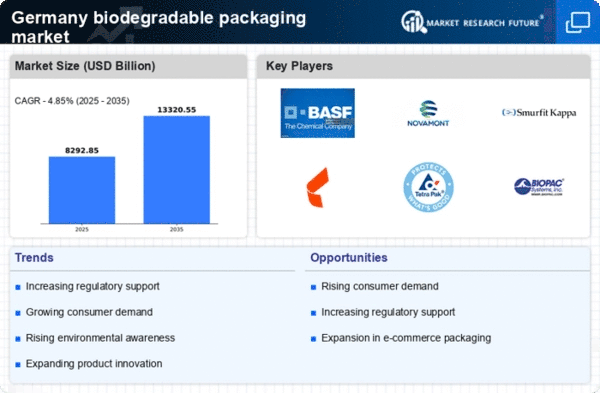
As per Market Research Future analysis, the Germany Biodegradable Packaging Market size was estimated at 7909.25 USD Billion in 2024. The Germany biodegradable packaging market is projected to grow from 8292.85 USD Billion in 2025 to 13320.55 USD Billion by 2035, exhibiting a compound annual growth rate (CAGR) of 4.8% during the forecast period 2025 - 2035

Key Market Trends & Highlights

The Germany biodegradable packaging market is experiencing robust growth driven by consumer preferences and regulatory support.

  • Rising consumer demand for sustainable packaging solutions is reshaping the market landscape.
  • The food and beverage segment remains the largest contributor to the biodegradable packaging market in Germany.
  • Innovation in materials is propelling the fastest-growing segment, which includes e-commerce packaging solutions.
  • Environmental awareness and government initiatives are key drivers fueling the expansion of biodegradable packaging in Germany.

Market Size & Forecast

2024 Market Size 7909.25 (USD Billion)
2035 Market Size 13320.55 (USD Billion)
CAGR (2025 - 2035) 4.85%

Major Players

BASF SE (DE), Novamont S.p.A. (IT), Smurfit Kappa Group (IE), Mondi Group (GB), Tetra Pak (SE), Biopac (GB), NatureWorks LLC (US), Sealed Air Corporation (US), Avery Dennison Corporation (US)

Our Impact
Enabled $4.3B Revenue Impact for Fortune 500 and Leading Multinationals
Partnering with 2000+ Global Organizations Each Year
30K+ Citations by Top-Tier Firms in the Industry

Germany Biodegradable Packaging Market Trends

The Germany Biodegradable Packaging Market is experiencing notable growth in Germany, driven by increasing environmental awareness. As sustainability becomes a priority, companies are actively seeking alternatives to traditional packaging materials that contribute to pollution and waste. This shift is reflected in the rising demand for biodegradable options, which are perceived as more eco-friendly and responsible. Furthermore, government regulations promoting sustainable practices are likely to bolster this trend, encouraging manufacturers to innovate and adopt biodegradable solutions. In addition, the market is characterized by a diverse range of products, including bags, containers, and films made from renewable resources. The emphasis on reducing carbon footprints and enhancing circular economy principles is influencing product development. As a result, various industries, such as food and beverage, cosmetics, and e-commerce, are increasingly integrating biodegradable packaging into their supply chains. This trend not only aligns with consumer preferences but also positions companies favorably in a competitive landscape where sustainability is becoming a key differentiator.

Rising Consumer Demand

There is a growing inclination among consumers in Germany towards sustainable products, including biodegradable packaging. This trend is driven by heightened awareness of environmental issues and a desire to reduce plastic waste. As consumers become more informed, they are likely to favor brands that prioritize eco-friendly packaging solutions.

Regulatory Support

Government initiatives aimed at reducing plastic usage are playing a crucial role in shaping the biodegradable packaging market. Policies promoting sustainable practices and incentivizing the use of biodegradable materials are encouraging manufacturers to transition away from conventional packaging options.

Innovation in Materials

The biodegradable packaging market is witnessing significant advancements in material technology. Research and development efforts are focused on creating new biodegradable materials that offer improved performance and functionality. This innovation is essential for meeting the diverse needs of various industries while ensuring environmental sustainability.

Germany Biodegradable Packaging Market Drivers

Government Initiatives

Government initiatives aimed at reducing plastic waste are significantly influencing the biodegradable packaging market in Germany. The German government has implemented various policies and regulations to promote sustainable packaging solutions, including incentives for companies that adopt biodegradable materials. For instance, the introduction of the Packaging Act mandates that businesses minimize packaging waste and encourages the use of biodegradable options. This regulatory framework is expected to drive the biodegradable packaging market, as companies strive to comply with these regulations. Market analysis indicates that the biodegradable packaging segment could witness a growth rate of around 15% annually, driven by these supportive government measures. Such initiatives not only foster innovation in packaging solutions but also align with Germany's broader environmental goals.

Environmental Awareness

The increasing environmental awareness among consumers in Germany is a pivotal driver for the biodegradable packaging market. As individuals become more conscious of their ecological footprint, they actively seek sustainable alternatives to traditional packaging. This shift in consumer behavior is reflected in market data, indicating that approximately 70% of German consumers prefer products with eco-friendly packaging. Consequently, businesses are compelled to adapt their packaging strategies to meet this demand, thereby propelling the growth of the biodegradable packaging market. Companies that prioritize sustainability not only enhance their brand image but also tap into a lucrative segment of environmentally conscious consumers. This trend suggests that the biodegradable packaging market will continue to expand as more consumers advocate for responsible consumption and waste reduction.

Technological Advancements

Technological advancements in material science are playing a crucial role in the evolution of the biodegradable packaging market in Germany. Innovations in bioplastics and other biodegradable materials are enhancing the performance and affordability of these packaging solutions. Research indicates that the development of new biodegradable polymers could reduce production costs by up to 30%, making them more accessible to manufacturers. This technological progress not only improves the functionality of biodegradable packaging but also addresses concerns regarding durability and shelf life. As a result, businesses are more inclined to invest in biodegradable options, thereby stimulating growth in the market. The ongoing research and development efforts suggest that the biodegradable packaging market will continue to benefit from these advancements, leading to a wider adoption across various industries.

Corporate Sustainability Goals

Many corporations in Germany are setting ambitious sustainability goals, which is a key driver for the biodegradable packaging market. As companies strive to reduce their carbon footprint and enhance their corporate social responsibility (CSR) profiles, they are increasingly turning to biodegradable packaging solutions. This trend is evident in various sectors, including food and beverage, where brands are committing to 100% recyclable or biodegradable packaging by 2025. Market data suggests that the demand for biodegradable packaging could rise by 20% in the next five years as more companies integrate sustainability into their core business strategies. This alignment of corporate objectives with environmental stewardship is likely to bolster the biodegradable packaging market, creating a competitive advantage for early adopters.

Consumer Preferences for Convenience

Consumer preferences for convenience are increasingly shaping the biodegradable packaging market in Germany. As lifestyles become busier, consumers are gravitating towards packaging solutions that offer ease of use while being environmentally friendly. This trend is particularly evident in the food delivery and takeaway sectors, where biodegradable packaging is gaining traction due to its convenience and sustainability. Industry expert's reveal that around 60% of consumers are willing to pay a premium for biodegradable packaging that enhances convenience. This willingness to invest in sustainable options indicates a strong potential for growth in the biodegradable packaging market. Companies that can effectively combine convenience with eco-friendliness are likely to capture a larger share of the market, reflecting the evolving preferences of German consumers.


Market Segment Insights

By Material: Polylactic Acid (Largest) vs. Starch-Based (Fastest-Growing)

In the Germany biodegradable packaging market, Polylactic Acid emerges as the largest segment, commanding considerable market share due to its versatility and favorable properties. Starch-Based packaging follows, gaining traction as manufacturers and consumers increasingly seek sustainable alternatives to traditional plastics. Other materials like Polyhydroxyalkanoates, Cellulose, and Mushroom Packaging are also significant, contributing to the overall growth and diversification of biodegradable options in this market. The growth trends indicate a robust upward trajectory for Starch-Based materials, driven by rising environmental awareness and government regulations favoring biodegradable solutions. The increasing demand from various industries, including food and beverage, is promoting innovation and adoption of materials like Polylactic Acid and Starch-Based. This growth is supported by advancements in technology and materials science, enabling higher performance and broader application of biodegradable packaging solutions.

Polylactic Acid (Dominant) vs. Starch-Based (Emerging)

Polylactic Acid (PLA) is the dominant force in the biodegradable packaging segment, known for its high clarity, rigidity, and ability to be molded into various forms. Its roots in renewable resources, such as corn starch, position it favorably within the sustainability movement, appealing to eco-conscious consumers and companies. Conversely, Starch-Based packaging is rapidly emerging, characterized by its cost-effectiveness and bio-based composition. It attracts attention due to its compostability and biodegradability, addressing industry demands for sustainable practices. The positioning of these materials reflects a competitive landscape where PLA leads in established applications while Starch-Based solutions are paving the way for innovative packaging possibilities, especially in disposable and single-use categories.

By Packaging Type: Flexible Packaging (Largest) vs. Rigid Packaging (Fastest-Growing)

In the Germany biodegradable packaging market, Flexible Packaging leads the segment with a significant share, driven by its versatility and increasing adoption across various industries. Rigid Packaging, while currently smaller, is rapidly gaining traction due to rising demand for sustainable solutions in retail and food sectors. Other notable segments include Food Service Packaging and Containers, each contributing to the diverse landscape of biodegradable options available to consumers. Growth trends in this market are fueled by heightened environmental awareness among consumers and stringent government regulations promoting sustainable practices. Flexible Packaging is diversifying with innovative materials that maintain functionality, while Rigid Packaging is witnessing a surge in designs that enhance recyclability. As the market evolves, both segments are poised for continued growth, reflecting the overall shift towards eco-friendly packaging solutions in Germany.

Flexible Packaging: Dominant vs. Rigid Packaging: Emerging

Flexible Packaging is the dominant player in the Germany biodegradable packaging market, recognized for its adaptability and efficiency in preserving product integrity. This segment often utilizes materials like bio-based plastics and compostable films, which appeal to environmentally aware consumers. Its widespread application across food and consumer goods sectors is a significant advantage. In contrast, Rigid Packaging is an emerging segment that is rapidly developing to meet the demand for sturdy and sustainable packaging solutions. Innovations in biodegradable materials are attracting attention, especially for items requiring longer shelf-life and stability. Although still growing, Rigid Packaging is expected to catch up, driven by innovations and the push for comprehensive sustainable practices in packaging.

By End Use: Food and Beverages (Largest) vs. Healthcare (Fastest-Growing)

In the Germany biodegradable packaging market, the Food and Beverages segment holds the largest share, driven by growing consumer demand for sustainable packaging solutions. It dominates the market as manufacturers prioritize biodegradable options to enhance their brand image and meet regulatory requirements. Other segments like Electronics, Personal Care, Textiles, and Healthcare follow but do not match the significant market share of Food and Beverages. The Healthcare segment is emerging as the fastest-growing area within the market, propelled by an increased focus on environmentally friendly packaging for medical supplies and products. A surge in green initiatives and tighter regulations has spurred healthcare companies to adopt biodegradable packaging solutions, aligning with broader sustainability goals and fostering market expansion in this domain.

Food and Beverages: Dominant vs. Healthcare: Emerging

The Food and Beverages segment is characterized by its robust market position, generating substantial demand for biodegradable materials that cater to food safety and eco-friendliness. Companies within this segment are innovating to create packaging that not only preserves food quality but also minimizes landfill waste. In contrast, the Healthcare segment is recognized as emerging due to its rapid adoption of biodegradable packaging, primarily for pharmaceuticals and medical devices. This shift is fueled by increasing awareness of environmental issues and compliance with health regulations, positioning healthcare firms to leverage sustainable packaging as a competitive advantage.

By Distribution Channel: Supermarkets (Largest) vs. Online Retail (Fastest-Growing)

In the Germany biodegradable packaging market, the distribution channels are diverse, with supermarkets commanding the largest share. This segment offers wide accessibility, making it easier for consumers to find biodegradable options. Convenience stores and specialty stores also play an important role, but their market shares are comparatively smaller. Wholesalers support these retail channels by ensuring a steady supply of biodegradable products, contributing to the overall market dynamics. Growth trends within the distribution channel segment are promising, particularly for online retail, which is identified as the fastest-growing channel. The surge in e-commerce driven by changing consumer behaviors and preferences for convenient shopping is significant. Moreover, the increased demand for sustainable packaging solutions in various sectors is fueling the growth of online platforms, allowing consumers access to a broader range of biodegradable options, fostering market expansion.

Supermarkets: Dominant vs. Online Retail: Emerging

Supermarkets are positioned as the dominant distribution channel in the Germany biodegradable packaging market due to their extensive reach and ability to provide consumers with a wide range of products. Their physical presence and ability to display biodegradable packaging visibly enhance consumer awareness and demand. On the other hand, online retail is emerging as a significant player, driven by the ongoing trend of digital shopping. The convenience of browsing and purchasing biodegradable products online appeals to environmentally conscious consumers, allowing for greater market participation. As these two channels evolve, the interplay between traditional retail and online platforms will shape the market landscape.

Get more detailed insights about Germany Biodegradable Packaging Market

Key Players and Competitive Insights

The biodegradable packaging market in Germany is characterized by a dynamic competitive landscape, driven by increasing consumer demand for sustainable solutions and regulatory pressures aimed at reducing plastic waste. Key players such as BASF SE (DE), Novamont S.p.A. (IT), and Smurfit Kappa Group (IE) are actively shaping the market through innovative product offerings and strategic partnerships. BASF SE (DE) focuses on developing advanced biopolymers, while Novamont S.p.A. (IT) emphasizes its commitment to circular economy principles. Smurfit Kappa Group (IE) leverages its extensive experience in sustainable packaging to enhance its product portfolio, thereby influencing the competitive environment significantly.The market structure appears moderately fragmented, with a mix of established players and emerging companies vying for market share. Key business tactics include localizing manufacturing to reduce carbon footprints and optimizing supply chains for efficiency. This collective approach not only enhances operational capabilities but also fosters a competitive atmosphere where innovation and sustainability are paramount.

In September BASF SE (DE) announced the launch of a new line of biodegradable films designed for food packaging applications. This strategic move is likely to strengthen its position in the market by addressing the growing demand for sustainable food packaging solutions. The introduction of these films aligns with global trends towards reducing plastic waste and could potentially enhance BASF's market share in the biodegradable segment.

In August Novamont S.p.A. (IT) entered into a partnership with a leading European retailer to supply biodegradable packaging for its private label products. This collaboration not only underscores Novamont's commitment to sustainability but also expands its market reach, allowing it to tap into the growing consumer base that prioritizes eco-friendly packaging. Such partnerships may serve as a model for future collaborations within the industry.

In October Smurfit Kappa Group (IE) unveiled a new initiative aimed at increasing the recyclability of its biodegradable packaging solutions. This initiative is indicative of the company's proactive approach to sustainability and reflects a broader industry trend towards enhancing the lifecycle of packaging materials. By focusing on recyclability, Smurfit Kappa is likely to appeal to environmentally conscious consumers and strengthen its competitive edge.

As of November the competitive trends in the biodegradable packaging market are increasingly defined by digitalization, sustainability, and the integration of advanced technologies such as AI. Strategic alliances are becoming more prevalent, enabling companies to leverage shared resources and expertise. The shift from price-based competition to a focus on innovation, technology, and supply chain reliability is evident, suggesting that future competitive differentiation will hinge on the ability to deliver sustainable and technologically advanced solutions.

Key Companies in the Germany Biodegradable Packaging Market include

Industry Developments

Recent developments in the Germany Biodegradable Packaging Market have included significant advancements in sustainability practices and product innovation among leading companies like BASF and Mondi. In August 2023, BASF announced a collaboration with TerraCycle to enhance the accessibility of their biodegradable packaging solutions and promote circular economy principles. Meanwhile, in July 2023, Amcor highlighted its commitment to sustainable packaging by launching a new line of biodegradable films designed for food packaging, aligning with Germany's growing regulations to reduce plastic waste.

Notably, Stora Enso and NatureWorks have been focusing on increasing their production capacities to meet the rising demand driven by consumer preferences for environmentally friendly packaging. Over the past few years, growth in the market valuation for biodegradable packaging in Germany has been substantial, supported by government initiatives aimed at reducing single-use plastics, which have seen a rise in stakeholder investments. Major happenings in this sector include Novamont's acquisition of a local firm in March 2022 to bolster its product offerings within the European market. Overall, Germany continues to lead by example in promoting biodegradable solutions to meet sustainability goals.

Future Outlook

Germany Biodegradable Packaging Market Future Outlook

The biodegradable packaging market is projected to grow at a 4.85% CAGR from 2025 to 2035, driven by increasing environmental regulations, consumer demand for sustainable products, and technological advancements.

New opportunities lie in:

  • Development of innovative compostable materials for food packaging
  • Expansion of e-commerce packaging solutions using biodegradable options
  • Partnerships with local governments for waste management initiatives

By 2035, the biodegradable packaging market is expected to achieve substantial growth and widespread adoption.

Market Segmentation

Germany Biodegradable Packaging Market End Use Outlook

  • Food and Beverages
  • Electronics
  • Personal Care
  • Textiles
  • Healthcare

Germany Biodegradable Packaging Market Material Outlook

  • Polylactic Acid
  • Starch-Based
  • Polyhydroxyalkanoates
  • Cellulose
  • Mushroom Packaging

Germany Biodegradable Packaging Market Packaging Type Outlook

  • Flexible Packaging
  • Rigid Packaging
  • Food Service Packaging
  • Containers
  • Bags

Germany Biodegradable Packaging Market Distribution Channel Outlook

  • Online Retail
  • Supermarkets
  • Convenience Stores
  • Specialty Stores
  • Wholesalers

Report Scope

MARKET SIZE 2024 7909.25(USD Billion)
MARKET SIZE 2025 8292.85(USD Billion)
MARKET SIZE 2035 13320.55(USD Billion)
COMPOUND ANNUAL GROWTH RATE (CAGR) 4.85% (2025 - 2035)
REPORT COVERAGE Revenue Forecast, Competitive Landscape, Growth Factors, and Trends
BASE YEAR 2024
Market Forecast Period 2025 - 2035
Historical Data 2019 - 2024
Market Forecast Units USD Billion
Key Companies Profiled BASF SE (DE), Novamont S.p.A. (IT), Smurfit Kappa Group (IE), Mondi Group (GB), Tetra Pak (SE), Biopac (GB), NatureWorks LLC (US), Sealed Air Corporation (US), Avery Dennison Corporation (US)
Segments Covered Material, Packaging Type, End Use, Distribution Channel
Key Market Opportunities Growing consumer demand for sustainable solutions drives innovation in the biodegradable packaging market.
Key Market Dynamics Rising consumer demand for sustainable solutions drives innovation in biodegradable packaging technologies and materials.
Countries Covered Germany
Leave a Comment

FAQs

What is the expected value of the Germany Biodegradable Packaging Market in 2024?

The Germany Biodegradable Packaging Market is expected to be valued at 1.6 billion USD in 2024.

What will the market size be for the Germany Biodegradable Packaging Market by 2035?

By 2035, the Germany Biodegradable Packaging Market is predicted to reach a valuation of 4.0 billion USD.

What is the expected compound annual growth rate (CAGR) for the Germany Biodegradable Packaging Market from 2025 to 2035?

The expected CAGR for the Germany Biodegradable Packaging Market from 2025 to 2035 is 8.687%.

Which biodegradable packaging material is expected to have the largest market share in 2024?

Polylactic Acid is anticipated to capture a significant market share, valued at 0.45 billion USD in 2024.

What will be the market size of Starch-Based biodegradable packaging by 2035?

The market size for Starch-Based biodegradable packaging is projected to reach 0.85 billion USD by 2035.

What are the key players operating in the Germany Biodegradable Packaging Market?

Major players include Biopak, Amcor, Cardia Bioplastics, Stora Enso, and Smurfit Kappa, among others.

How much is the market for Polyhydroxyalkanoates projected to grow by 2035?

The market for Polyhydroxyalkanoates is expected to grow to 0.6 billion USD by 2035.

What is the anticipated market value of Cellulose biodegradable packaging in 2024?

The Cellulose biodegradable packaging segment is anticipated to be valued at 0.3 billion USD in 2024.

What challenges could affect the growth of the Germany Biodegradable Packaging Market?

Challenges include competition from traditional packaging materials and varying regulations across regions.

What impact could global trends have on the Germany Biodegradable Packaging Market?

Increasing consumer demand for sustainable products and stricter environmental regulations are expected to drive market growth.

Download Free Sample

Kindly complete the form below to receive a free sample of this Report

Compare Licence

×
Features License Type
Single User Multiuser License Enterprise User
Price $4,950 $5,950 $7,250
Maximum User Access Limit 1 User Upto 10 Users Unrestricted Access Throughout the Organization
Free Customization
Direct Access to Analyst
Deliverable Format
Platform Access
Discount on Next Purchase 10% 15% 15%
Printable Versions