×
Request Free Sample ×

Kindly complete the form below to receive a free sample of this Report

* Please use a valid business email

Leading companies partner with us for data-driven Insights

clients tt-cursor
Hero Background

Germany AI Robots Market

ID: MRFR/ICT/57146-HCR
200 Pages
Aarti Dhapte
February 2026

Germany AI Robots Market Size, Share and Research Report: By Offering (hardware, software), By Type (service robots, industrial robots), By Technology (machine learning, context awareness, computer vision, natural language processing), and By Application (law enforcement, military and defense, public relations, personal assistance and care, education & entertainment robots, healthcare, research & space exploration, industrial, stock management, others)- Industry Forecast to 2035

Share:
Download PDF ×

We do not share your information with anyone. However, we may send you emails based on your report interest from time to time. You may contact us at any time to opt-out.

Germany AI Robots Market Infographic
Purchase Options

Germany AI Robots Market Summary

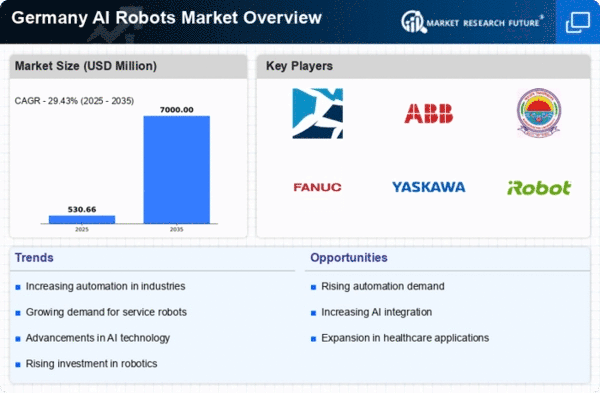
As per Market Research Future analysis, the Germany AI Robots Market size was estimated at 410.0 USD Million in 2024. The Ai Robots market is projected to grow from 530.66 USD Million in 2025 to 7000.0 USD Million by 2035, exhibiting a compound annual growth rate (CAGR) of 29.4% during the forecast period 2025 - 2035

Key Market Trends & Highlights

The Germany AI robots market is experiencing robust growth driven by technological advancements and increasing demand across various sectors.

  • The manufacturing segment remains the largest contributor to the Germany AI robots market, reflecting a trend towards automation and efficiency.
  • Healthcare applications are emerging as the fastest-growing segment, driven by the need for precision and improved patient care.
  • Research and development efforts are intensifying, indicating a strong focus on innovation within the AI robotics landscape.
  • Rising labor costs and government initiatives are key drivers propelling the adoption of AI robots across industries.

Market Size & Forecast

2024 Market Size 410.0 (USD Million)
2035 Market Size 7000.0 (USD Million)
CAGR (2025 - 2035) 29.43%

Major Players

Boston Dynamics (US), ABB (CH), KUKA (DE), Fanuc (JP), Yaskawa (JP), iRobot (US), Intuitive Surgical (US), NVIDIA (US), SoftBank Robotics (JP)

Our Impact
Enabled $4.3B Revenue Impact for Fortune 500 and Leading Multinationals
Partnering with 2000+ Global Organizations Each Year
30K+ Citations by Top-Tier Firms in the Industry

Germany AI Robots Market Trends

The Germany AI Robots Market in Germany is currently experiencing a notable transformation, driven by advancements in technology and increasing demand across various sectors. Industries such as manufacturing, healthcare, and logistics are integrating ai robots to enhance efficiency and productivity. This shift appears to be influenced by the need for automation to address labor shortages and improve operational capabilities. Furthermore, the German government is actively promoting research and development in robotics, which may contribute to the growth of this market. As companies adopt these technologies, they are likely to benefit from improved accuracy and reduced operational costs. In addition, the regulatory environment in Germany seems to be evolving to accommodate the integration of ai robots. This includes establishing standards for safety and ethical considerations, which could foster consumer trust and acceptance. The collaboration between academia and industry is also noteworthy, as it may lead to innovative solutions tailored to specific market needs. Overall, the ai robots market is poised for growth, with various factors indicating a positive trajectory in the coming years.

Increased Adoption in Manufacturing

The ai robots market is witnessing a surge in adoption within the manufacturing sector. Companies are increasingly utilizing these robots to streamline production processes, enhance precision, and reduce human error. This trend suggests a shift towards more automated and efficient manufacturing practices.

Expansion in Healthcare Applications

There is a growing trend of integrating ai robots into healthcare settings. These robots are being employed for tasks such as patient monitoring, surgical assistance, and rehabilitation. This expansion indicates a potential for improved patient outcomes and operational efficiency in medical facilities.

Focus on Research and Development

Investment in research and development within the ai robots market is on the rise. This focus aims to foster innovation and create advanced robotic solutions tailored to specific industry needs. Such initiatives may lead to breakthroughs that enhance the capabilities and applications of ai robots.

Germany AI Robots Market Drivers

Rising Labor Costs

The ai robots market in Germany is experiencing a notable surge due to rising labor costs. As companies face increasing wage demands, particularly in manufacturing and logistics, the adoption of ai robots appears to be a viable solution. These robots can perform repetitive tasks with high efficiency, potentially reducing the need for a large workforce. In 2025, labor costs in Germany are projected to rise by approximately 3.5%, prompting businesses to seek automation solutions. The ai robots market is thus likely to benefit from this trend, as organizations aim to maintain profitability while managing operational expenses.

Growing E-commerce Sector

The rapid growth of the e-commerce sector in Germany is significantly influencing the ai robots market. As online shopping continues to expand, logistics and warehousing operations are under pressure to enhance efficiency and speed. In 2025, the e-commerce market in Germany is projected to reach €100 billion, leading to increased investments in automation technologies. The ai robots market is poised to capitalize on this trend, as companies seek to implement robotic solutions for inventory management, order fulfillment, and delivery processes. This shift towards automation in e-commerce logistics is likely to drive substantial growth in the ai robots market.

Technological Advancements

Technological advancements play a crucial role in the growth of the ai robots market in Germany. Innovations in artificial intelligence, machine learning, and robotics are enabling the development of more sophisticated and capable robots. In 2025, the market is expected to witness a growth rate of around 15% annually, driven by these advancements. Companies are increasingly investing in research and development to enhance robot functionalities, making them more adaptable to various industries. This trend indicates a strong future for the ai robots market, as businesses leverage cutting-edge technology to improve efficiency and productivity.

Government Initiatives and Funding

Government initiatives and funding are significantly impacting the ai robots market in Germany. The German government has launched several programs aimed at promoting automation and digitalization across industries. In 2025, public funding for robotics and automation projects is expected to exceed €500 million, fostering innovation and encouraging companies to adopt ai robots. This support not only enhances the capabilities of the ai robots market but also positions Germany as a leader in robotics technology. The collaboration between public and private sectors is likely to accelerate the integration of ai robots into various applications.

Increased Demand for Precision and Quality

The demand for precision and quality in production processes is driving the ai robots market in Germany. Industries such as automotive and electronics are increasingly relying on robots to achieve higher standards of accuracy and consistency. In 2025, it is estimated that 60% of manufacturing companies will incorporate ai robots to enhance product quality. This trend suggests that the ai robots market is well-positioned to meet the evolving needs of manufacturers seeking to improve operational efficiency while maintaining high-quality outputs. The integration of ai robots is likely to become a standard practice in these sectors.


Market Segment Insights

By Vehicle Type: Vans (Largest) vs. Pickup (Fastest-Growing)

In the Germany ai robots market, Vans represent the largest segment, capturing a significant portion of overall market share. They are favored for their versatility and capacity, making them ideal for various applications, from logistics to urban transportation. On the other hand, Pickup vehicles are emerging rapidly, gaining traction especially among businesses seeking reliable and robust options for mobility, highlighting a dynamic shift in market preferences. The growth trends indicate a rising demand for efficient transportation solutions, with both Vans and Pickup vehicles benefitting from advancements in ai technologies. Key drivers include increased urbanization, the push for sustainable logistics, and the need for enhanced operational efficiencies. The expected uptick in commercial activities and e-commerce is also likely to bolster the market, making it a pivotal time for both segments.

Vans (Dominant) vs. Pickup (Emerging)

In the context of the Germany ai robots market, Vans stand out as the dominant vehicle type due to their established presence and broader applicability across sectors such as e-commerce and delivery services. They are equipped with advanced ai functionalities that streamline operations, ensuring efficient cargo management and real-time tracking. Conversely, Pickup vehicles, while currently in an emerging phase, are diversifying their appeal with unique capabilities suited for both personal and commercial use. Their flexibility, coupled with a growing demand for rugged, reliable transportation solutions, positions them advantageously in a market that increasingly values practicality alongside innovation.

By Type: Service Robots (Largest) vs. Industrial Robots (Fastest-Growing)

In the Germany ai robots market, Service Robots capture a significant share due to their diverse applications in sectors like healthcare and hospitality. These robots are increasingly adopted for tasks such as cleaning, delivery, and customer service, making them a substantial market segment. On the other hand, Industrial Robots, while growing rapidly, currently hold a smaller market share, driven by their deployment in manufacturing and logistics to enhance efficiency and productivity. The growth trajectory of Industrial Robots is particularly notable, as advancements in automation technology and the rise of Industry 4.0 create new opportunities. Factors such as a growing demand for automation, the need for precision in manufacturing, and the increasing adoption of AI technologies drive their expansion. The increasing focus on efficiency and cost reduction is expected to further propel the growth of these robots in the coming years.

Service Robots (Dominant) vs. Industrial Robots (Emerging)

Service Robots are recognized as the dominant force in the Germany ai robots market, often preferred for their versatility and ability to enhance customer experiences across various industries. They cater to both household and commercial needs, reducing labor costs and improving service delivery. Conversely, Industrial Robots are emerging strongly, fueled by innovations in automation and robotics technologies. They are primarily utilized in manufacturing processes, assembly lines, and logistics. As industries strive for higher efficiency and minimal downtime, Industrial Robots are being increasingly integrated into production workflows, positioning them as vital assets in the modern industrial landscape.

By Technology: Machine Learning (Largest) vs. Natural Language Processing (Fastest-Growing)

In the Germany ai robots market, Machine Learning stands out as the largest technology segment, accounting for a significant portion of the market share. This is due to its broad applications across various industries, driving efficiency and innovation in robot design and operations. Following closely, Natural Language Processing is gaining traction, reflecting a notable growth trajectory as more businesses seek to integrate advanced communication capabilities into their robotic systems. Factors contributing to the growth of these technologies include the increasing demand for autonomous devices in sectors such as manufacturing and healthcare. Machine Learning continues to evolve, optimizing performance and enhancing customizable solutions for users. In contrast, Natural Language Processing is witnessing rapid adoption as organizations recognize the value of enabling robots to understand and interact with human language more effectively, thus improving user engagement and operational efficiencies.

Technology: Machine Learning (Dominant) vs. Natural Language Processing (Emerging)

Machine Learning is the dominant technology in the Germany ai robots market, known for its ability to process vast amounts of data and improve operational efficiency through predictive analytics. It plays a crucial role in enabling robots to learn from their environments and make decisions autonomously. On the other hand, Natural Language Processing is an emerging technology that focuses on facilitating seamless communication between humans and robots. Its rapid growth is driven by advancements in artificial intelligence, allowing robots to understand, interpret, and generate human language. This technology is becoming essential for creating more intuitive and user-friendly robotic interfaces, thus enhancing overall user experiences and expanding market applications.

By Application: Healthcare (Largest) vs. Personal Assistance and Care (Fastest-Growing)

The Germany ai robots market demonstrates a diverse application landscape, with the Healthcare segment leading the pack in market share. This sector encompasses a variety of robotic technologies used in surgeries, rehabilitation, and elderly care, showcasing its essential role in enhancing patient outcomes. In contrast, segments such as Personal Assistance and Care are gaining traction, fueled by innovations in robotics that support daily living tasks, thus broadening their applicability and appeal. Growth trends indicate an accelerating demand for AI robots, particularly driven by an aging population that requires enhanced healthcare solutions and personal assistance. Furthermore, the advancements in AI technology and robotics are being leveraged to meet the increasing expectations for service and efficiency in various sectors. As businesses and healthcare facilities seek to optimize operations, application areas are rapidly expanding, providing a robust growth trajectory in the market.

Healthcare (Dominant) vs. Personal Assistance and Care (Emerging)

The Healthcare segment stands out in the Germany ai robots market for its extensive applications ranging from surgical robots to rehabilitation aids. This dominance stems from the significant investment in medical research and the integration of cutting-edge AI technologies that improve patient care. In contrast, the Personal Assistance and Care segment, though emerging, is rapidly gaining popularity. This is primarily due to the growing need for support solutions for the elderly and disabled, leveraging AI robots to aid in routine tasks and foster independent living. Both segments showcase the versatility and potential of AI integration in improving quality of life and operational efficiencies across various domains.

Get more detailed insights about Germany AI Robots Market

Key Players and Competitive Insights

The ai robots market in Germany is characterized by a dynamic competitive landscape, driven by rapid technological advancements and increasing demand across various sectors, including manufacturing, healthcare, and logistics. Key players such as KUKA (Germany), ABB (Switzerland), and Boston Dynamics (US) are at the forefront, each adopting distinct strategies to enhance their market positioning. KUKA (Germany) focuses on innovation in automation solutions, particularly in collaborative robots, while ABB (Switzerland) emphasizes digital transformation through its robotics and automation technologies. Boston Dynamics (US), known for its advanced robotics, is leveraging partnerships to expand its reach in industrial applications, thereby shaping a competitive environment that is increasingly reliant on technological prowess and strategic collaborations.In terms of business tactics, companies are localizing manufacturing to reduce costs and enhance supply chain efficiency. The market structure appears moderately fragmented, with several players vying for market share, yet the influence of major companies is substantial. This competitive structure fosters an environment where innovation and operational excellence are paramount, as firms strive to differentiate themselves in a crowded marketplace.

In October KUKA (Germany) announced a strategic partnership with a leading automotive manufacturer to develop next-generation robotic assembly lines. This collaboration is poised to enhance KUKA's capabilities in smart manufacturing, aligning with the industry's shift towards automation and efficiency. The strategic importance of this partnership lies in its potential to set new standards in production processes, thereby reinforcing KUKA's competitive edge.

In September ABB (Switzerland) unveiled a new AI-driven robotic system designed for precision tasks in the healthcare sector. This innovation not only showcases ABB's commitment to integrating AI into its product offerings but also addresses the growing demand for automation in healthcare. The introduction of this system is likely to enhance operational efficiency and patient outcomes, positioning ABB as a leader in this niche market.

In August Boston Dynamics (US) expanded its collaboration with logistics companies to implement its robotic solutions in warehouse automation. This move is significant as it reflects the increasing reliance on robotics to streamline supply chain operations. By enhancing its presence in the logistics sector, Boston Dynamics is likely to capitalize on the growing trend of automation in warehousing, further solidifying its market position.

As of November current trends in the ai robots market are heavily influenced by digitalization, sustainability, and the integration of AI technologies. Strategic alliances are becoming increasingly vital, as companies recognize the need to pool resources and expertise to remain competitive. Looking ahead, the competitive differentiation in this market is expected to evolve, with a pronounced shift from price-based competition to a focus on innovation, technological advancements, and supply chain reliability. This transition underscores the importance of agility and responsiveness in a rapidly changing market landscape.

Key Companies in the Germany AI Robots Market include

Industry Developments

Siemens introduced its new AI-driven inspection robots for automated industries in Bavaria in March 2024. These robots employ sophisticated computer vision to carry out quality control and predictive maintenance on production lines. This signifies a change towards industrial processes that are more independent and flexible.In order to promote mobility, social contact, and monitoring while maintaining data privacy, the Fraunhofer Institute and Bosch began a joint initiative in July 2024 to test domestic help robots in senior living facilities throughout Berlin.

In the Stuttgart R&D centre, Mercedes-Benz and the Karlsruhe Institute of Technology (KIT) collaborated to create AI-powered robotic arms for vehicle detailing and assembly in October 2024, which will provide improved accuracy and quicker cycle times.The German government awarded €25 million in January 2025 to support the country's "Robotics4Trust" initiative, which focusses on ethical AI and sophisticated trust models in robotic systems used in public areas and healthcare.

Lastly, in April 2025, KUKA unveiled their lightweight "LBR iQ" series, which is intended for flexible use in SMEs in the manufacturing and logistics industries and has on-device AI enabling real-time gesture and voice instructions. These advancements are part of a broader trend in Germany towards robotic solutions that are more intelligent, reliable, and end-user-capable.

Future Outlook

Germany AI Robots Market Future Outlook

The AI Robots Market in Germany is projected to grow at a remarkable 29.43% CAGR from 2025 to 2035, driven by advancements in AI technology, automation demand, and increased investment.

New opportunities lie in:

  • Development of AI-driven robotic process automation solutions for enterprises.
  • Integration of AI robots in healthcare for patient monitoring and assistance.
  • Expansion of AI robotics in logistics for automated warehousing and delivery systems.

By 2035, the ai robots market is expected to achieve substantial growth, positioning itself as a leader in technological innovation.

Market Segmentation

Germany AI Robots Market Type Outlook

  • Service Robots
  • Industrial Robots

Germany AI Robots Market Technology Outlook

  • Machine Learning
  • Context Awareness
  • Computer Vision
  • Natural Language Processing

Germany AI Robots Market Application Outlook

  • Law Enforcement
  • Military and Defense
  • Public Relations
  • Personal Assistance and Care
  • Education & Entertainment Robots
  • Healthcare
  • Research & Space Exploration
  • Industrial
  • Stock Management
  • Others

Germany AI Robots Market Vehicle Type Outlook

  • Vans
  • Pickup

Report Scope

MARKET SIZE 2024 410.0(USD Million)
MARKET SIZE 2025 530.66(USD Million)
MARKET SIZE 2035 7000.0(USD Million)
COMPOUND ANNUAL GROWTH RATE (CAGR) 29.43% (2025 - 2035)
REPORT COVERAGE Revenue Forecast, Competitive Landscape, Growth Factors, and Trends
BASE YEAR 2024
Market Forecast Period 2025 - 2035
Historical Data 2019 - 2024
Market Forecast Units USD Million
Key Companies Profiled Boston Dynamics (US), ABB (CH), KUKA (DE), Fanuc (JP), Yaskawa (JP), iRobot (US), Intuitive Surgical (US), NVIDIA (US), SoftBank Robotics (JP)
Segments Covered Vehicle Type, Type, Technology, Application
Key Market Opportunities Integration of advanced artificial intelligence in robotics enhances automation across various industries.
Key Market Dynamics Rising demand for automation drives innovation and competition in the ai robots market.
Countries Covered Germany
Leave a Comment

FAQs

What is the expected market size of the Germany AI Robots Market in 2024?

The Germany AI Robots Market is expected to be valued at approximately 498.96 million USD in 2024.

How much is the Germany AI Robots Market valued at by 2035?

By 2035, the market is projected to reach a valuation of around 2191.38 million USD.

What is the expected compound annual growth rate (CAGR) for the Germany AI Robots Market from 2025 to 2035?

The market is anticipated to grow at a CAGR of 14.399 percent from 2025 to 2035.

Which segments dominate the hardware and software offerings of the Germany AI Robots Market?

In 2024, hardware is valued at 199.59 million USD and software at 299.37 million USD.

What will be the projected value of hardware and software in the Germany AI Robots Market by 2035?

By 2035, hardware is expected to reach 887.27 million USD and software approximately 1304.11 million USD.

Who are the major players in the Germany AI Robots Market?

Key competitors in this market include Yaskawa, Omron, Intel, Fanuc, and Siemens among others.

What are the key growth drivers for the Germany AI Robots Market?

Factors such as advancements in AI technology and increasing automation across industries drive market growth.

What trends are currently emerging in the Germany AI Robots Market?

Emerging trends include the integration of AI in robotic systems and a focus on collaborative robots for manufacturing.

What are the predicted challenges faced by the Germany AI Robots Market?

Challenges include regulatory hurdles and the need for significant investment in research and development.

What impact does the current global scenario have on the Germany AI Robots Market?

The ongoing geopolitical situations may influence supply chains but the demand for automation remains strong.

Download Free Sample

Kindly complete the form below to receive a free sample of this Report

Compare Licence

×
Features License Type
Single User Multiuser License Enterprise User
Price $4,950 $5,950 $7,250
Maximum User Access Limit 1 User Upto 10 Users Unrestricted Access Throughout the Organization
Free Customization
Direct Access to Analyst
Deliverable Format
Platform Access
Discount on Next Purchase 10% 15% 15%
Printable Versions