×
Request Free Sample ×

Kindly complete the form below to receive a free sample of this Report

* Please use a valid business email

Leading companies partner with us for data-driven Insights

clients tt-cursor
Hero Background
English
Chinese
French
Japanese
Korean
German
Spanish

Geomarketing Market Trends

ID: MRFR/ICT/6601-HCR
200 Pages
Aarti Dhapte
February 2026

Geo Market Size, Share and Research Report: By Application (Urban Development, Environmental Monitoring, Disaster Management, Natural Resource Management), By Technology (Geospatial Analysis, Remote Sensing, GPS Technology, Geographic Information System), By End Use (Government, Commercial, Academic, Non-Profit Organizations), By Data Type (Vector Data, Raster Data, Point Cloud Data) and By Regional (North America, Europe, South America, Asia Pacific, Middle East and Africa) - Industry Forecast to 2035

Share:
Download PDF ×

We do not share your information with anyone. However, we may send you emails based on your report interest from time to time. You may contact us at any time to opt-out.

Geomarketing Market Infographic
Purchase Options

Market Trends

Key Emerging Trends in the Geomarketing Market

GeoMarket uses an integrated approach to ensure its competitive position without concentrating on any single area within its business operations. At its core is a detailed examination of customer requirements and changes in market conditions by identifying where it can break into new markets first, such as investing in product differentiation, which enables it to stand out among all other players within that industry. For this reason, GeoMarket not only attracts new clients but also builds loyalty among older clients by differentiating itself from competitors. It has been highlighted that pricing holds much influence in the purchasing decision behavior of consumers as far as GeoMarket's survival is concerned. The company adopts a pricing strategy that balances affordability against perceived value so that its goods always remain competitive, yet their quality does not suffer either way. Additionally, GeoMartket places considerable emphasis on efficient distribution channels apart from differentiation and pricing issues. Consequently, consumer choices are influenced by accessing facilities due to the location where they live. Further, technology adoption forms part of the firm's position for increasing market share. Similarly, adopting innovations helps it improve product quality at one end, while at another, it introduces modern features appealing to technologically minded buyers. This farsighted approach puts GeoMartket ahead of the competition, thereby attracting innovative customers.

Another part of GEOMarket's marketing strategy involves customer engagement (PARENTHESES). The company recognizes the importance of customer relationship management and thus invests in effective communication and customer service. GeoMarket makes use of social media, mechanisms for feedback from customers, and one-on-one interactions, mainly to ensure that consumers feel heard, valued, and appreciated. Additionally, GEOMarket prides itself on strategic alliances and partnerships (PARENTHESES) because these widen its coverage area and increase its potential clientele. Environmental concerns are now part of the company's marketing strategy when seeking market share. This speaks to increasing numbers of conscious consumer groups but also distinguishes GeoMartket as a responsible corporate citizen who positively contributes to the brand image and positioning in the market.

Author
Aarti Dhapte
AVP - Research

A consulting professional focused on helping businesses navigate complex markets through structured research and strategic insights. I partner with clients to solve high-impact business problems across market entry strategy, competitive intelligence, and opportunity assessment. Over the course of my experience, I have led and contributed to 100+ market research and consulting engagements, delivering insights across multiple industries and geographies, and supporting strategic decisions linked to $500M+ market opportunities. My core expertise lies in building robust market sizing, forecasting, and commercial models (top-down and bottom-up), alongside deep-dive competitive and industry analysis. I have played a key role in shaping go-to-market strategies, investment cases, and growth roadmaps, enabling clients to make confident, data-backed decisions in dynamic markets.

Leave a Comment

FAQs

What is the current valuation of the Geomarketing Market as of 2024?

<p>The Geomarketing Market was valued at 57.67 USD Billion in 2024.</p>

What is the projected market valuation for the Geomarketing Market in 2035?

<p>The projected valuation for the Geomarketing Market in 2035 is 85.19 USD Billion.</p>

What is the expected CAGR for the Geomarketing Market from 2025 to 2035?

<p>The expected CAGR for the Geomarketing Market during the forecast period 2025 - 2035 is 3.61%.</p>

Which companies are considered key players in the Geomarketing Market?

<p>Key players in the Geomarketing Market include Esri, IBM, Oracle, SAP, Google, Microsoft, HERE Technologies, Pitney Bowes, and Mapbox.</p>

How does the Geomarketing Market perform in the retail sector?

<p>In 2024, the retail sector contributed between 20.0 and 30.0 USD Billion to the Geomarketing Market.</p>

What is the valuation of the Geomarketing Market in the transportation sector?

<p>The transportation sector accounted for a valuation between 10.0 and 15.0 USD Billion in 2024.</p>

What are the projected values for the healthcare segment in the Geomarketing Market?

<p>The healthcare segment is projected to range from 10.67 to 15.19 USD Billion in 2024.</p>

What is the contribution of large enterprises to the Geomarketing Market?

<p>Large enterprises contributed between 20.0 and 30.0 USD Billion to the Geomarketing Market in 2024.</p>

How does the Geographic Information System segment perform in the Geomarketing Market?

<p>The Geographic Information System segment was valued between 15.0 and 22.0 USD Billion in 2024.</p>

What is the expected growth trend for location-based services in the Geomarketing Market?

<p>The location-based services segment is projected to grow between 12.0 and 18.0 USD Billion in 2024.</p>

Market Summary

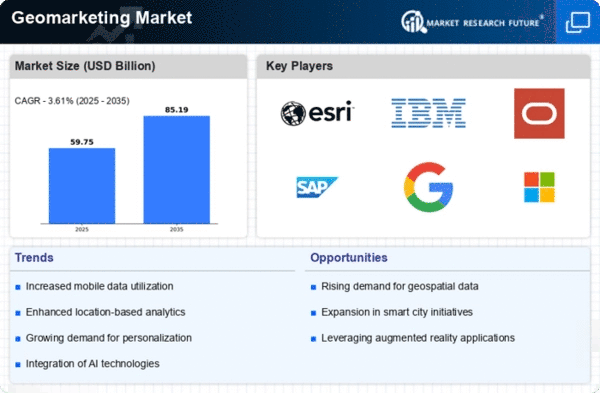
As per MRFR analysis, the Geomarketing Market Size was estimated at 57.67 USD Billion in 2024. The Geomarketing industry is projected to grow from 59.75 USD Billion in 2025 to 85.19 USD Billion by 2035, exhibiting a compound annual growth rate (CAGR) of 3.61% during the forecast period 2025 - 2035.

Key Market Trends & Highlights

The Geomarketing Market is experiencing robust growth driven by technological advancements and evolving consumer preferences.

  • The integration of AI and machine learning is transforming data analysis and customer targeting strategies in the geomarketing landscape. North America remains the largest market, while the Asia-Pacific region is emerging as the fastest-growing area for geomarketing solutions. Retail continues to dominate the market, whereas healthcare is rapidly gaining traction as a key segment for geomarketing applications. Advancements in technology and the growing demand for personalized marketing are significant drivers propelling the geomarketing market forward.

Market Size & Forecast

2024 Market Size 57.67 (USD Billion)
2035 Market Size 85.19 (USD Billion)
CAGR (2025 - 2035) 3.61%
Largest Regional Market Share in 2024 North America

Major Players

Esri (US), IBM (US), Oracle (US), SAP (DE), Google (US), Microsoft (US), HERE Technologies (NL), Pitney Bowes (US), Mapbox (US)

Market Trends

The Geomarketing Market is currently experiencing a transformative phase, driven by advancements in technology and the increasing importance of location-based data. Businesses are increasingly recognizing the value of integrating geographic information systems with marketing strategies to enhance customer engagement and optimize resource allocation. This integration allows for more precise targeting of audiences, enabling companies to tailor their offerings based on geographic and demographic insights. As a result, organizations are likely to invest more in geomarketing tools and platforms that facilitate data analysis and visualization, thereby improving decision-making processes. Moreover, the rise of mobile technology and the proliferation of smart devices have further fueled the growth of the Geomarketing Market. Consumers are now more connected than ever, and their behaviors can be tracked and analyzed in real-time. This shift presents opportunities for businesses to create personalized marketing campaigns that resonate with their target audiences. The emphasis on data privacy and ethical considerations is also becoming increasingly relevant, as companies navigate the complexities of utilizing consumer data responsibly. Overall, the Geomarketing Market appears poised for continued growth as organizations adapt to evolving consumer expectations and technological advancements.

Integration of AI and Machine Learning

The incorporation of artificial intelligence and machine learning into geomarketing strategies is becoming more prevalent. These technologies enable businesses to analyze vast amounts of location-based data, uncovering patterns and trends that inform marketing decisions. By leveraging predictive analytics, companies can anticipate consumer behavior and tailor their campaigns accordingly.

Emphasis on Data Privacy

As the Geomarketing Market expands, there is a growing focus on data privacy and ethical data usage. Consumers are increasingly aware of how their information is utilized, prompting businesses to adopt transparent practices. This trend may lead to the development of new regulations and standards that govern the collection and application of location data.

Rise of Location-Based Services

The demand for location-based services is on the rise, as consumers seek personalized experiences. Businesses are utilizing geomarketing to enhance customer interactions through targeted promotions and localized content. This trend suggests a shift towards more dynamic marketing strategies that respond to the immediate needs and preferences of consumers.

Geomarketing Market Market Drivers

Market Growth Projections

The Global Geo Market Industry is poised for substantial growth, with projections indicating a market size of 57.7 USD Billion in 2024 and an anticipated increase to 85.2 USD Billion by 2035. This growth trajectory reflects the increasing reliance on geo-spatial data across various sectors, including urban planning, environmental management, and disaster response. The industry is expected to experience a compound annual growth rate (CAGR) of 3.61% from 2025 to 2035, highlighting the ongoing demand for innovative geo-data solutions and technologies.

Technological Advancements

The Global Geo Market Industry is experiencing a surge in technological advancements that enhance data collection and analysis. Innovations such as satellite imagery, Geographic Information Systems (GIS), and remote sensing technologies are revolutionizing how geographical data is utilized. These technologies enable more accurate mapping and spatial analysis, which is crucial for urban planning, environmental monitoring, and disaster management. As a result, the industry is projected to reach 57.7 USD Billion in 2024, driven by the increasing demand for precise geographical information across various sectors.

Integration of Big Data and AI

The integration of big data analytics and artificial intelligence (AI) into the Global Geo Market Industry is transforming how geographical information is processed and utilized. These technologies enable the analysis of vast datasets, leading to more informed decision-making and predictive modeling. For instance, AI algorithms can identify patterns in geographical data that may not be apparent through traditional methods. This integration enhances the capabilities of geo-spatial applications in various sectors, including agriculture, transportation, and public health, thereby driving market growth and innovation.

Growing Demand for Urban Planning

Urbanization is a significant driver in the Global Geo Market Industry, as cities expand and require effective planning solutions. The need for sustainable urban development has led to an increased reliance on geographical data to inform infrastructure projects, transportation systems, and resource management. Governments and municipalities are investing in geo-spatial technologies to optimize land use and improve public services. This trend is expected to contribute to the industry's growth, with projections indicating a market size of 85.2 USD Billion by 2035, reflecting the critical role of geo-data in shaping urban environments.

Government Initiatives and Funding

Government initiatives and funding are crucial drivers of growth in the Global Geo Market Industry. Many governments are recognizing the importance of geo-spatial data for national security, infrastructure development, and environmental management. As a result, they are investing in geo-data projects and establishing policies that promote the use of geographical information systems. These initiatives not only enhance the capabilities of public services but also stimulate private sector involvement in geo-data solutions, contributing to the overall expansion of the market.

Environmental Monitoring and Management

The Global Geo Market Industry plays a vital role in environmental monitoring and management, particularly in the context of climate change and natural resource conservation. Geographic data is essential for tracking environmental changes, assessing biodiversity, and managing natural disasters. Organizations and governments utilize geo-spatial technologies to develop strategies for sustainable resource use and environmental protection. As awareness of environmental issues grows, the demand for geo-data solutions is likely to increase, supporting a compound annual growth rate (CAGR) of 3.61% from 2025 to 2035.

Market Segment Insights

By Application: Retail (Largest) vs. Healthcare (Fastest-Growing)

In the Geomarketing Market, the application segment showcases a diverse distribution of market share among various fields. Retail stands out as the largest segment, leveraging geomarketing strategies to enhance customer engagement and optimize inventory management. Telecommunications and real estate also hold significant portions, with advancements in location-based marketing. Healthcare, while smaller in share, is rapidly expanding as clinical applications and targeted marketing become more prevalent. Growth trends within the Geomarketing sector reveal that businesses increasingly recognize the value of location data for decision-making. Retail continues to innovate with personalized services, while the healthcare sector emerges, powered by telemedicine and patient-centric systems. The demand for nuanced Market Research Future drives these segments towards expansion, reflecting a broader acceptance of geomarketing methodologies.

Retail: Dominant vs. Healthcare: Emerging

The retail segment in the Geomarketing Market dominates due to its extensive application in enhancing customer targeting, optimizing supply chains, and driving sales through data-driven insights. Retailers utilize geomarketing tools to analyze shopping habits and preferences to tailor their offerings accordingly. In contrast, the healthcare segment is still emerging but showcases rapid development as organizations adopt geomarketing for patient engagement and operational efficiency. Healthcare providers leverage spatial data to improve service delivery and optimize resource allocation. The increasing integration of technology in patient interactions significantly contributes to the growth of this segment, positioning it as a vital player in the geomarketing landscape.

By Technology: Geographic Information System (Largest) vs. Location-Based Services (Fastest-Growing)

In the Geomarketing Market, the <a href="geographic%20information%20system%20-%20https://www.marketresearchfuture.com/reports/geographic-information-system-market-26690">Geographic Information System (GIS) </a>has established itself as the dominant technology, playing a crucial role in data visualization and analysis. Coupled with its extensive applications across various sectors, GIS holds the largest market share, significantly influencing strategic decision-making for businesses. Meanwhile, Location-Based Services (LBS) are gaining traction, leveraging advanced mobile technologies and GPS capabilities to provide real-time data and insights, thus marking their rapid growth in the market.

Technology: GIS (Dominant) vs. LBS (Emerging)

Geographic Information Systems (GIS) are the backbone of modern geomarketing strategies, offering comprehensive spatial analysis and rich visual data representations. As the leading technology, GIS enables companies to integrate, manage, and analyze geographic data efficiently, thus driving informed marketing decisions. In contrast, Location-Based Services (LBS) are emerging as the fastest-growing segment, harnessing mobile connectivity and GPS technology to provide pertinent location-specific information to users. The rapid adoption of smartphones and a growing emphasis on personalized marketing initiatives underscore LBS's potential for innovation and growth, making it a key player in the evolving geomarketing landscape.

By End Use: Large Enterprises (Largest) vs. Government Agencies (Fastest-Growing)

<p>The Geomarketing Market showcases a diverse distribution across its end-use segments, with Large Enterprises commanding a substantial share. These enterprises leverage geomarketing strategies to optimize their outreach and customer engagement, reflecting their significant budget allocations towards these initiatives. Meanwhile, Government Agencies, although currently smaller in share, represent the fastest-growing segment. Their increasing reliance on geospatial data for urban planning and public services is driving rapid growth within this sector. As innovation and technology evolve, the growth trends highlight the shift towards data-driven decision-making among all segments. Government Agencies are particularly adapting to digital transformation by embracing technologies that enhance their operational efficiencies and service delivery. In contrast, Large Enterprises are increasingly focusing on integrating advanced analytics to deepen customer insights and improve marketing effectiveness, ensuring their position as market leaders beyond traditional methods.</p>

<p>Large Enterprises: Dominant vs. Government Agencies: Emerging</p>

<p>Large Enterprises in the Geomarketing Market are characterized by substantial investments in advanced marketing technologies, allowing them to harness extensive data for targeted campaigns. These organizations typically feature sophisticated internal teams that utilize geomarketing for strategic planning, customer segmentation, and localized marketing efforts. On the other hand, Government Agencies, while emerging as a significant player, are increasingly adopting geomarketing tools to enhance public engagement and urban planning. They utilize geospatial insights for improved resource allocation and enhanced population services, marking a transition towards data-centric governance. As they grow, the collaboration between these agencies and technology providers is expected to yield innovative applications that further drive sector evolution.</p>

Get more detailed insights about Geomarketing Market Research Report - Global Forecast till 2035

Regional Insights

North America : Market Leader in Geomarketing

North America continues to lead the geomarketing market, holding a significant share of 30.0% as of December 2025. The region's growth is driven by advanced technological infrastructure, increasing demand for data-driven marketing strategies, and supportive regulatory frameworks. Companies are leveraging geographic data to enhance customer engagement and optimize marketing efforts, making it a fertile ground for innovation and investment. The competitive landscape is robust, with key players such as Esri, IBM, and Google dominating the market. The U.S. stands out as a leader, supported by a strong presence of tech giants and startups alike. This environment fosters collaboration and innovation, ensuring that North America remains at the forefront of geomarketing advancements. The region's focus on integrating AI and machine learning into geomarketing strategies further solidifies its position as a global leader.

Europe : Emerging Geomarketing Hub

Europe is witnessing a significant transformation in the geomarketing landscape, with a market share of 15.0% as of December 2025. The region's growth is fueled by increasing investments in digital marketing technologies and a rising emphasis on data privacy regulations. The General Data Protection Regulation (GDPR) has catalyzed the need for compliant geomarketing solutions, driving demand for innovative approaches that respect consumer privacy while delivering targeted marketing. Leading countries such as Germany, the UK, and France are at the forefront of this growth, with a competitive landscape featuring major players like SAP and HERE Technologies. The presence of these companies, along with a strong startup ecosystem, is fostering innovation in geomarketing solutions. As businesses increasingly adopt location-based strategies, Europe is poised to become a key player in The Geomarketing.

Asia-Pacific : Rapidly Growing Market Potential

The Asia-Pacific region is emerging as a significant player in the geomarketing market, with a market share of 10.0% as of December 2025. The growth is driven by rapid urbanization, increasing smartphone penetration, and a growing emphasis on data analytics in marketing strategies. Governments in the region are also promoting digital transformation initiatives, which are catalyzing the adoption of geomarketing solutions across various sectors. Countries like China, India, and Japan are leading the charge, with a competitive landscape that includes both established players and innovative startups. Companies such as Mapbox and Pitney Bowes are expanding their presence, catering to the unique needs of the region. As businesses increasingly recognize the value of location-based insights, the Asia-Pacific market is set for substantial growth in the coming years.

Middle East and Africa : Emerging Market Opportunities

The Middle East and Africa (MEA) region is gradually emerging in the geomarketing landscape, holding a market share of 2.67% as of December 2025. The growth is driven by increasing internet penetration, mobile device usage, and a growing awareness of data-driven marketing strategies. Governments are also investing in digital infrastructure, which is essential for the adoption of geomarketing solutions in various sectors, including retail and tourism. Countries like South Africa and the UAE are leading the way, with a competitive landscape that includes both local and international players. The presence of companies like Oracle and Microsoft is helping to drive innovation and adoption of geomarketing technologies. As businesses in the region recognize the potential of location-based marketing, the MEA market is poised for growth in the coming years.

Key Players and Competitive Insights

The Geomarketing Market is currently characterized by a dynamic competitive landscape, driven by technological advancements and the increasing demand for data-driven decision-making. Major players such as Esri (US), IBM (US), and Google (US) are at the forefront, leveraging their robust technological capabilities to enhance their service offerings. Esri (US) focuses on innovative GIS solutions, while IBM (US) emphasizes integrating AI with geomarketing analytics to provide actionable insights. Google (US) continues to expand its geospatial data services, enhancing its mapping capabilities to support businesses in optimizing their marketing strategies. Collectively, these strategies foster a competitive environment that prioritizes innovation and customer-centric solutions.In terms of business tactics, companies are increasingly localizing their services to cater to regional market needs, optimizing supply chains to enhance efficiency. The competitive structure of the Geomarketing Market appears moderately fragmented, with several key players exerting influence. This fragmentation allows for diverse offerings, yet the presence of dominant firms like SAP (DE) and Microsoft (US) suggests a trend towards consolidation, as these companies seek to expand their market share through strategic partnerships and acquisitions.
In November SAP (DE) announced a partnership with HERE Technologies (NL) to integrate advanced location intelligence into its cloud solutions. This collaboration aims to enhance SAP's analytics capabilities, allowing businesses to leverage geospatial data for improved operational efficiency. The strategic importance of this partnership lies in its potential to provide clients with comprehensive insights, thereby driving better decision-making processes.
In October IBM (US) launched a new suite of geomarketing tools that utilize AI to analyze consumer behavior patterns. This initiative is particularly significant as it positions IBM as a leader in the integration of AI within geomarketing, enabling businesses to tailor their marketing strategies based on predictive analytics. The move reflects a broader trend towards data-driven marketing solutions, which are increasingly vital in a competitive landscape.
In September Google (US) expanded its geospatial data offerings by acquiring a startup specializing in augmented reality (AR) mapping technologies. This acquisition is likely to enhance Google’s capabilities in providing immersive marketing experiences, which could redefine customer engagement strategies. The integration of AR into geomarketing is indicative of a shift towards more interactive and engaging consumer experiences, aligning with current market demands.
As of December the Geomarketing Market is witnessing trends such as digitalization, sustainability, and the integration of AI technologies. Strategic alliances are increasingly shaping the competitive landscape, as companies recognize the value of collaboration in enhancing their service offerings. Looking ahead, competitive differentiation is expected to evolve, with a notable shift from price-based competition to a focus on innovation, technology, and supply chain reliability. This transition underscores the importance of adaptability and forward-thinking strategies in maintaining a competitive edge.

Key Companies in the Geomarketing Market include

Industry Developments

Geo Market dynamics are witnessing significant movements, with companies like Facebook, Microsoft, and Oracle leading the charge in innovation and market strategy. Qualcomm showcased on-device AI applications on Snapdragon-powered Windows 11 devices at Microsoft Build 2023. This partnership, which was also demonstrated at Computex, emphasizes a partnership to introduce 5G and periphery AI to PCs through the Snapdragon X platform, rather than a standalone August 2023 telecom partnership.

IBM has intensified its partnership with SAP in the development of hybrid-cloud and generative AI solutions. In mid-2024, they implemented RISE with SAP on IBM Power Virtual Server, which provides enterprise clients with efficient SAP cloud migrations that include embedded AI services.

Intel's market capitalization was approximately US$147.9 billion as of September 29, 2023, with a share price of approximately $34.97.


Future Outlook

Geomarketing Market Future Outlook

The Geomarketing Market is projected to grow at a 3.61% CAGR from 2025 to 2035, driven by advancements in <a href="data%20analytics%20-%20https://www.marketresearchfuture.com/reports/data-analytics-market-1689">data analytics</a>, increased mobile usage, and enhanced location-based services.

New opportunities lie in:

  • <p>Integration of AI-driven analytics for personalized marketing strategies. Development of location-based <a href="mobile%20application%20-%20https://www.marketresearchfuture.com/reports/mobile-application-market-4497">mobile applications </a>for real-time consumer engagement. Expansion of geomarketing services into emerging markets with high mobile penetration.</p>

By 2035, the Geomarketing Market is expected to be robust, driven by innovative technologies and strategic expansions.

Market Segmentation

Geomarketing Market End Use Outlook

  • Small Enterprises
  • Large Enterprises
  • Government Agencies
  • Non-Profit Organizations
  • Educational Institutions

Geomarketing Market Technology Outlook

  • Geographic Information System
  • Global Positioning System
  • Remote Sensing
  • Location-Based Services
  • Spatial Data Analysis

Geomarketing Market Application Outlook

  • Retail
  • Transportation
  • Real Estate
  • Telecommunications
  • Healthcare

Report Scope

MARKET SIZE 2024 57.67(USD Billion)
MARKET SIZE 2025 59.75(USD Billion)
MARKET SIZE 2035 85.19(USD Billion)
COMPOUND ANNUAL GROWTH RATE (CAGR) 3.61% (2025 - 2035)
REPORT COVERAGE Revenue Forecast, Competitive Landscape, Growth Factors, and Trends
BASE YEAR 2024
Market Forecast Period 2025 - 2035
Historical Data 2019 - 2024
Market Forecast Units USD Billion
Key Companies Profiled Esri (US), IBM (US), Oracle (US), SAP (DE), Google (US), Microsoft (US), HERE Technologies (NL), Pitney Bowes (US), Mapbox (US)
Segments Covered Application, Technology, End Use
Key Market Opportunities Integration of artificial intelligence in Geomarketing enhances targeted consumer engagement and location-based strategies.
Key Market Dynamics Rising demand for location-based services drives innovation and competition in the Geomarketing Market.
Countries Covered North America, Europe, APAC, South America, MEA

FAQs

What is the current valuation of the Geomarketing Market as of 2024?

<p>The Geomarketing Market was valued at 57.67 USD Billion in 2024.</p>

What is the projected market valuation for the Geomarketing Market in 2035?

<p>The projected valuation for the Geomarketing Market in 2035 is 85.19 USD Billion.</p>

What is the expected CAGR for the Geomarketing Market from 2025 to 2035?

<p>The expected CAGR for the Geomarketing Market during the forecast period 2025 - 2035 is 3.61%.</p>

Which companies are considered key players in the Geomarketing Market?

<p>Key players in the Geomarketing Market include Esri, IBM, Oracle, SAP, Google, Microsoft, HERE Technologies, Pitney Bowes, and Mapbox.</p>

How does the Geomarketing Market perform in the retail sector?

<p>In 2024, the retail sector contributed between 20.0 and 30.0 USD Billion to the Geomarketing Market.</p>

What is the valuation of the Geomarketing Market in the transportation sector?

<p>The transportation sector accounted for a valuation between 10.0 and 15.0 USD Billion in 2024.</p>

What are the projected values for the healthcare segment in the Geomarketing Market?

<p>The healthcare segment is projected to range from 10.67 to 15.19 USD Billion in 2024.</p>

What is the contribution of large enterprises to the Geomarketing Market?

<p>Large enterprises contributed between 20.0 and 30.0 USD Billion to the Geomarketing Market in 2024.</p>

How does the Geographic Information System segment perform in the Geomarketing Market?

<p>The Geographic Information System segment was valued between 15.0 and 22.0 USD Billion in 2024.</p>

What is the expected growth trend for location-based services in the Geomarketing Market?

<p>The location-based services segment is projected to grow between 12.0 and 18.0 USD Billion in 2024.</p>

  1. SECTION I: EXECUTIVE SUMMARY AND KEY HIGHLIGHTS
    1. | 1.1 EXECUTIVE SUMMARY
    2. | | 1.1.1 Market Overview
    3. | | 1.1.2 Key Findings
    4. | | 1.1.3 Market Segmentation
    5. | | 1.1.4 Competitive Landscape
    6. | | 1.1.5 Challenges and Opportunities
    7. | | 1.1.6 Future Outlook
  2. SECTION II: SCOPING, METHODOLOGY AND MARKET STRUCTURE
    1. | 2.1 MARKET INTRODUCTION
    2. | | 2.1.1 Definition
    3. | | 2.1.2 Scope of the study
    4. | | | 2.1.2.1 Research Objective
    5. | | | 2.1.2.2 Assumption
    6. | | | 2.1.2.3 Limitations
    7. | 2.2 RESEARCH METHODOLOGY
    8. | | 2.2.1 Overview
    9. | | 2.2.2 Data Mining
    10. | | 2.2.3 Secondary Research
    11. | | 2.2.4 Primary Research
    12. | | | 2.2.4.1 Primary Interviews and Information Gathering Process
    13. | | | 2.2.4.2 Breakdown of Primary Respondents
    14. | | 2.2.5 Forecasting Model
    15. | | 2.2.6 Market Size Estimation
    16. | | | 2.2.6.1 Bottom-Up Approach
    17. | | | 2.2.6.2 Top-Down Approach
    18. | | 2.2.7 Data Triangulation
    19. | | 2.2.8 Validation
  3. SECTION III: QUALITATIVE ANALYSIS
    1. | 3.1 MARKET DYNAMICS
    2. | | 3.1.1 Overview
    3. | | 3.1.2 Drivers
    4. | | 3.1.3 Restraints
    5. | | 3.1.4 Opportunities
    6. | 3.2 MARKET FACTOR ANALYSIS
    7. | | 3.2.1 Value chain Analysis
    8. | | 3.2.2 Porter's Five Forces Analysis
    9. | | | 3.2.2.1 Bargaining Power of Suppliers
    10. | | | 3.2.2.2 Bargaining Power of Buyers
    11. | | | 3.2.2.3 Threat of New Entrants
    12. | | | 3.2.2.4 Threat of Substitutes
    13. | | | 3.2.2.5 Intensity of Rivalry
    14. | | 3.2.3 COVID-19 Impact Analysis
    15. | | | 3.2.3.1 Market Impact Analysis
    16. | | | 3.2.3.2 Regional Impact
    17. | | | 3.2.3.3 Opportunity and Threat Analysis
  4. SECTION IV: QUANTITATIVE ANALYSIS
    1. | 4.1 Information and Communications Technology, BY Application (USD Billion)
    2. | | 4.1.1 Retail
    3. | | 4.1.2 Transportation
    4. | | 4.1.3 Real Estate
    5. | | 4.1.4 Telecommunications
    6. | | 4.1.5 Healthcare
    7. | 4.2 Information and Communications Technology, BY Technology (USD Billion)
    8. | | 4.2.1 Geographic Information System
    9. | | 4.2.2 Global Positioning System
    10. | | 4.2.3 Remote Sensing
    11. | | 4.2.4 Location-Based Services
    12. | | 4.2.5 Spatial Data Analysis
    13. | 4.3 Information and Communications Technology, BY End Use (USD Billion)
    14. | | 4.3.1 Small Enterprises
    15. | | 4.3.2 Large Enterprises
    16. | | 4.3.3 Government Agencies
    17. | | 4.3.4 Non-Profit Organizations
    18. | | 4.3.5 Educational Institutions
    19. | 4.4 Information and Communications Technology, BY Region (USD Billion)
    20. | | 4.4.1 North America
    21. | | | 4.4.1.1 US
    22. | | | 4.4.1.2 Canada
    23. | | 4.4.2 Europe
    24. | | | 4.4.2.1 Germany
    25. | | | 4.4.2.2 UK
    26. | | | 4.4.2.3 France
    27. | | | 4.4.2.4 Russia
    28. | | | 4.4.2.5 Italy
    29. | | | 4.4.2.6 Spain
    30. | | | 4.4.2.7 Rest of Europe
    31. | | 4.4.3 APAC
    32. | | | 4.4.3.1 China
    33. | | | 4.4.3.2 India
    34. | | | 4.4.3.3 Japan
    35. | | | 4.4.3.4 South Korea
    36. | | | 4.4.3.5 Malaysia
    37. | | | 4.4.3.6 Thailand
    38. | | | 4.4.3.7 Indonesia
    39. | | | 4.4.3.8 Rest of APAC
    40. | | 4.4.4 South America
    41. | | | 4.4.4.1 Brazil
    42. | | | 4.4.4.2 Mexico
    43. | | | 4.4.4.3 Argentina
    44. | | | 4.4.4.4 Rest of South America
    45. | | 4.4.5 MEA
    46. | | | 4.4.5.1 GCC Countries
    47. | | | 4.4.5.2 South Africa
    48. | | | 4.4.5.3 Rest of MEA
  5. SECTION V: COMPETITIVE ANALYSIS
    1. | 5.1 Competitive Landscape
    2. | | 5.1.1 Overview
    3. | | 5.1.2 Competitive Analysis
    4. | | 5.1.3 Market share Analysis
    5. | | 5.1.4 Major Growth Strategy in the Information and Communications Technology
    6. | | 5.1.5 Competitive Benchmarking
    7. | | 5.1.6 Leading Players in Terms of Number of Developments in the Information and Communications Technology
    8. | | 5.1.7 Key developments and growth strategies
    9. | | | 5.1.7.1 New Product Launch/Service Deployment
    10. | | | 5.1.7.2 Merger & Acquisitions
    11. | | | 5.1.7.3 Joint Ventures
    12. | | 5.1.8 Major Players Financial Matrix
    13. | | | 5.1.8.1 Sales and Operating Income
    14. | | | 5.1.8.2 Major Players R&D Expenditure. 2023
    15. | 5.2 Company Profiles
    16. | | 5.2.1 Esri (US)
    17. | | | 5.2.1.1 Financial Overview
    18. | | | 5.2.1.2 Products Offered
    19. | | | 5.2.1.3 Key Developments
    20. | | | 5.2.1.4 SWOT Analysis
    21. | | | 5.2.1.5 Key Strategies
    22. | | 5.2.2 IBM (US)
    23. | | | 5.2.2.1 Financial Overview
    24. | | | 5.2.2.2 Products Offered
    25. | | | 5.2.2.3 Key Developments
    26. | | | 5.2.2.4 SWOT Analysis
    27. | | | 5.2.2.5 Key Strategies
    28. | | 5.2.3 Oracle (US)
    29. | | | 5.2.3.1 Financial Overview
    30. | | | 5.2.3.2 Products Offered
    31. | | | 5.2.3.3 Key Developments
    32. | | | 5.2.3.4 SWOT Analysis
    33. | | | 5.2.3.5 Key Strategies
    34. | | 5.2.4 SAP (DE)
    35. | | | 5.2.4.1 Financial Overview
    36. | | | 5.2.4.2 Products Offered
    37. | | | 5.2.4.3 Key Developments
    38. | | | 5.2.4.4 SWOT Analysis
    39. | | | 5.2.4.5 Key Strategies
    40. | | 5.2.5 Google (US)
    41. | | | 5.2.5.1 Financial Overview
    42. | | | 5.2.5.2 Products Offered
    43. | | | 5.2.5.3 Key Developments
    44. | | | 5.2.5.4 SWOT Analysis
    45. | | | 5.2.5.5 Key Strategies
    46. | | 5.2.6 Microsoft (US)
    47. | | | 5.2.6.1 Financial Overview
    48. | | | 5.2.6.2 Products Offered
    49. | | | 5.2.6.3 Key Developments
    50. | | | 5.2.6.4 SWOT Analysis
    51. | | | 5.2.6.5 Key Strategies
    52. | | 5.2.7 HERE Technologies (NL)
    53. | | | 5.2.7.1 Financial Overview
    54. | | | 5.2.7.2 Products Offered
    55. | | | 5.2.7.3 Key Developments
    56. | | | 5.2.7.4 SWOT Analysis
    57. | | | 5.2.7.5 Key Strategies
    58. | | 5.2.8 Pitney Bowes (US)
    59. | | | 5.2.8.1 Financial Overview
    60. | | | 5.2.8.2 Products Offered
    61. | | | 5.2.8.3 Key Developments
    62. | | | 5.2.8.4 SWOT Analysis
    63. | | | 5.2.8.5 Key Strategies
    64. | | 5.2.9 Mapbox (US)
    65. | | | 5.2.9.1 Financial Overview
    66. | | | 5.2.9.2 Products Offered
    67. | | | 5.2.9.3 Key Developments
    68. | | | 5.2.9.4 SWOT Analysis
    69. | | | 5.2.9.5 Key Strategies
    70. | 5.3 Appendix
    71. | | 5.3.1 References
    72. | | 5.3.2 Related Reports
  6. LIST OF FIGURES
    1. | 6.1 MARKET SYNOPSIS
    2. | 6.2 NORTH AMERICA MARKET ANALYSIS
    3. | 6.3 US MARKET ANALYSIS BY APPLICATION
    4. | 6.4 US MARKET ANALYSIS BY TECHNOLOGY
    5. | 6.5 US MARKET ANALYSIS BY END USE
    6. | 6.6 CANADA MARKET ANALYSIS BY APPLICATION
    7. | 6.7 CANADA MARKET ANALYSIS BY TECHNOLOGY
    8. | 6.8 CANADA MARKET ANALYSIS BY END USE
    9. | 6.9 EUROPE MARKET ANALYSIS
    10. | 6.10 GERMANY MARKET ANALYSIS BY APPLICATION
    11. | 6.11 GERMANY MARKET ANALYSIS BY TECHNOLOGY
    12. | 6.12 GERMANY MARKET ANALYSIS BY END USE
    13. | 6.13 UK MARKET ANALYSIS BY APPLICATION
    14. | 6.14 UK MARKET ANALYSIS BY TECHNOLOGY
    15. | 6.15 UK MARKET ANALYSIS BY END USE
    16. | 6.16 FRANCE MARKET ANALYSIS BY APPLICATION
    17. | 6.17 FRANCE MARKET ANALYSIS BY TECHNOLOGY
    18. | 6.18 FRANCE MARKET ANALYSIS BY END USE
    19. | 6.19 RUSSIA MARKET ANALYSIS BY APPLICATION
    20. | 6.20 RUSSIA MARKET ANALYSIS BY TECHNOLOGY
    21. | 6.21 RUSSIA MARKET ANALYSIS BY END USE
    22. | 6.22 ITALY MARKET ANALYSIS BY APPLICATION
    23. | 6.23 ITALY MARKET ANALYSIS BY TECHNOLOGY
    24. | 6.24 ITALY MARKET ANALYSIS BY END USE
    25. | 6.25 SPAIN MARKET ANALYSIS BY APPLICATION
    26. | 6.26 SPAIN MARKET ANALYSIS BY TECHNOLOGY
    27. | 6.27 SPAIN MARKET ANALYSIS BY END USE
    28. | 6.28 REST OF EUROPE MARKET ANALYSIS BY APPLICATION
    29. | 6.29 REST OF EUROPE MARKET ANALYSIS BY TECHNOLOGY
    30. | 6.30 REST OF EUROPE MARKET ANALYSIS BY END USE
    31. | 6.31 APAC MARKET ANALYSIS
    32. | 6.32 CHINA MARKET ANALYSIS BY APPLICATION
    33. | 6.33 CHINA MARKET ANALYSIS BY TECHNOLOGY
    34. | 6.34 CHINA MARKET ANALYSIS BY END USE
    35. | 6.35 INDIA MARKET ANALYSIS BY APPLICATION
    36. | 6.36 INDIA MARKET ANALYSIS BY TECHNOLOGY
    37. | 6.37 INDIA MARKET ANALYSIS BY END USE
    38. | 6.38 JAPAN MARKET ANALYSIS BY APPLICATION
    39. | 6.39 JAPAN MARKET ANALYSIS BY TECHNOLOGY
    40. | 6.40 JAPAN MARKET ANALYSIS BY END USE
    41. | 6.41 SOUTH KOREA MARKET ANALYSIS BY APPLICATION
    42. | 6.42 SOUTH KOREA MARKET ANALYSIS BY TECHNOLOGY
    43. | 6.43 SOUTH KOREA MARKET ANALYSIS BY END USE
    44. | 6.44 MALAYSIA MARKET ANALYSIS BY APPLICATION
    45. | 6.45 MALAYSIA MARKET ANALYSIS BY TECHNOLOGY
    46. | 6.46 MALAYSIA MARKET ANALYSIS BY END USE
    47. | 6.47 THAILAND MARKET ANALYSIS BY APPLICATION
    48. | 6.48 THAILAND MARKET ANALYSIS BY TECHNOLOGY
    49. | 6.49 THAILAND MARKET ANALYSIS BY END USE
    50. | 6.50 INDONESIA MARKET ANALYSIS BY APPLICATION
    51. | 6.51 INDONESIA MARKET ANALYSIS BY TECHNOLOGY
    52. | 6.52 INDONESIA MARKET ANALYSIS BY END USE
    53. | 6.53 REST OF APAC MARKET ANALYSIS BY APPLICATION
    54. | 6.54 REST OF APAC MARKET ANALYSIS BY TECHNOLOGY
    55. | 6.55 REST OF APAC MARKET ANALYSIS BY END USE
    56. | 6.56 SOUTH AMERICA MARKET ANALYSIS
    57. | 6.57 BRAZIL MARKET ANALYSIS BY APPLICATION
    58. | 6.58 BRAZIL MARKET ANALYSIS BY TECHNOLOGY
    59. | 6.59 BRAZIL MARKET ANALYSIS BY END USE
    60. | 6.60 MEXICO MARKET ANALYSIS BY APPLICATION
    61. | 6.61 MEXICO MARKET ANALYSIS BY TECHNOLOGY
    62. | 6.62 MEXICO MARKET ANALYSIS BY END USE
    63. | 6.63 ARGENTINA MARKET ANALYSIS BY APPLICATION
    64. | 6.64 ARGENTINA MARKET ANALYSIS BY TECHNOLOGY
    65. | 6.65 ARGENTINA MARKET ANALYSIS BY END USE
    66. | 6.66 REST OF SOUTH AMERICA MARKET ANALYSIS BY APPLICATION
    67. | 6.67 REST OF SOUTH AMERICA MARKET ANALYSIS BY TECHNOLOGY
    68. | 6.68 REST OF SOUTH AMERICA MARKET ANALYSIS BY END USE
    69. | 6.69 MEA MARKET ANALYSIS
    70. | 6.70 GCC COUNTRIES MARKET ANALYSIS BY APPLICATION
    71. | 6.71 GCC COUNTRIES MARKET ANALYSIS BY TECHNOLOGY
    72. | 6.72 GCC COUNTRIES MARKET ANALYSIS BY END USE
    73. | 6.73 SOUTH AFRICA MARKET ANALYSIS BY APPLICATION
    74. | 6.74 SOUTH AFRICA MARKET ANALYSIS BY TECHNOLOGY
    75. | 6.75 SOUTH AFRICA MARKET ANALYSIS BY END USE
    76. | 6.76 REST OF MEA MARKET ANALYSIS BY APPLICATION
    77. | 6.77 REST OF MEA MARKET ANALYSIS BY TECHNOLOGY
    78. | 6.78 REST OF MEA MARKET ANALYSIS BY END USE
    79. | 6.79 KEY BUYING CRITERIA OF INFORMATION AND COMMUNICATIONS TECHNOLOGY
    80. | 6.80 RESEARCH PROCESS OF MRFR
    81. | 6.81 DRO ANALYSIS OF INFORMATION AND COMMUNICATIONS TECHNOLOGY
    82. | 6.82 DRIVERS IMPACT ANALYSIS: INFORMATION AND COMMUNICATIONS TECHNOLOGY
    83. | 6.83 RESTRAINTS IMPACT ANALYSIS: INFORMATION AND COMMUNICATIONS TECHNOLOGY
    84. | 6.84 SUPPLY / VALUE CHAIN: INFORMATION AND COMMUNICATIONS TECHNOLOGY
    85. | 6.85 INFORMATION AND COMMUNICATIONS TECHNOLOGY, BY APPLICATION, 2024 (% SHARE)
    86. | 6.86 INFORMATION AND COMMUNICATIONS TECHNOLOGY, BY APPLICATION, 2024 TO 2035 (USD Billion)
    87. | 6.87 INFORMATION AND COMMUNICATIONS TECHNOLOGY, BY TECHNOLOGY, 2024 (% SHARE)
    88. | 6.88 INFORMATION AND COMMUNICATIONS TECHNOLOGY, BY TECHNOLOGY, 2024 TO 2035 (USD Billion)
    89. | 6.89 INFORMATION AND COMMUNICATIONS TECHNOLOGY, BY END USE, 2024 (% SHARE)
    90. | 6.90 INFORMATION AND COMMUNICATIONS TECHNOLOGY, BY END USE, 2024 TO 2035 (USD Billion)
    91. | 6.91 BENCHMARKING OF MAJOR COMPETITORS
  7. LIST OF TABLES
    1. | 7.1 LIST OF ASSUMPTIONS
    2. | | 7.1.1
    3. | 7.2 North America MARKET SIZE ESTIMATES; FORECAST
    4. | | 7.2.1 BY APPLICATION, 2025-2035 (USD Billion)
    5. | | 7.2.2 BY TECHNOLOGY, 2025-2035 (USD Billion)
    6. | | 7.2.3 BY END USE, 2025-2035 (USD Billion)
    7. | 7.3 US MARKET SIZE ESTIMATES; FORECAST
    8. | | 7.3.1 BY APPLICATION, 2025-2035 (USD Billion)
    9. | | 7.3.2 BY TECHNOLOGY, 2025-2035 (USD Billion)
    10. | | 7.3.3 BY END USE, 2025-2035 (USD Billion)
    11. | 7.4 Canada MARKET SIZE ESTIMATES; FORECAST
    12. | | 7.4.1 BY APPLICATION, 2025-2035 (USD Billion)
    13. | | 7.4.2 BY TECHNOLOGY, 2025-2035 (USD Billion)
    14. | | 7.4.3 BY END USE, 2025-2035 (USD Billion)
    15. | 7.5 Europe MARKET SIZE ESTIMATES; FORECAST
    16. | | 7.5.1 BY APPLICATION, 2025-2035 (USD Billion)
    17. | | 7.5.2 BY TECHNOLOGY, 2025-2035 (USD Billion)
    18. | | 7.5.3 BY END USE, 2025-2035 (USD Billion)
    19. | 7.6 Germany MARKET SIZE ESTIMATES; FORECAST
    20. | | 7.6.1 BY APPLICATION, 2025-2035 (USD Billion)
    21. | | 7.6.2 BY TECHNOLOGY, 2025-2035 (USD Billion)
    22. | | 7.6.3 BY END USE, 2025-2035 (USD Billion)
    23. | 7.7 UK MARKET SIZE ESTIMATES; FORECAST
    24. | | 7.7.1 BY APPLICATION, 2025-2035 (USD Billion)
    25. | | 7.7.2 BY TECHNOLOGY, 2025-2035 (USD Billion)
    26. | | 7.7.3 BY END USE, 2025-2035 (USD Billion)
    27. | 7.8 France MARKET SIZE ESTIMATES; FORECAST
    28. | | 7.8.1 BY APPLICATION, 2025-2035 (USD Billion)
    29. | | 7.8.2 BY TECHNOLOGY, 2025-2035 (USD Billion)
    30. | | 7.8.3 BY END USE, 2025-2035 (USD Billion)
    31. | 7.9 Russia MARKET SIZE ESTIMATES; FORECAST
    32. | | 7.9.1 BY APPLICATION, 2025-2035 (USD Billion)
    33. | | 7.9.2 BY TECHNOLOGY, 2025-2035 (USD Billion)
    34. | | 7.9.3 BY END USE, 2025-2035 (USD Billion)
    35. | 7.10 Italy MARKET SIZE ESTIMATES; FORECAST
    36. | | 7.10.1 BY APPLICATION, 2025-2035 (USD Billion)
    37. | | 7.10.2 BY TECHNOLOGY, 2025-2035 (USD Billion)
    38. | | 7.10.3 BY END USE, 2025-2035 (USD Billion)
    39. | 7.11 Spain MARKET SIZE ESTIMATES; FORECAST
    40. | | 7.11.1 BY APPLICATION, 2025-2035 (USD Billion)
    41. | | 7.11.2 BY TECHNOLOGY, 2025-2035 (USD Billion)
    42. | | 7.11.3 BY END USE, 2025-2035 (USD Billion)
    43. | 7.12 Rest of Europe MARKET SIZE ESTIMATES; FORECAST
    44. | | 7.12.1 BY APPLICATION, 2025-2035 (USD Billion)
    45. | | 7.12.2 BY TECHNOLOGY, 2025-2035 (USD Billion)
    46. | | 7.12.3 BY END USE, 2025-2035 (USD Billion)
    47. | 7.13 APAC MARKET SIZE ESTIMATES; FORECAST
    48. | | 7.13.1 BY APPLICATION, 2025-2035 (USD Billion)
    49. | | 7.13.2 BY TECHNOLOGY, 2025-2035 (USD Billion)
    50. | | 7.13.3 BY END USE, 2025-2035 (USD Billion)
    51. | 7.14 China MARKET SIZE ESTIMATES; FORECAST
    52. | | 7.14.1 BY APPLICATION, 2025-2035 (USD Billion)
    53. | | 7.14.2 BY TECHNOLOGY, 2025-2035 (USD Billion)
    54. | | 7.14.3 BY END USE, 2025-2035 (USD Billion)
    55. | 7.15 India MARKET SIZE ESTIMATES; FORECAST
    56. | | 7.15.1 BY APPLICATION, 2025-2035 (USD Billion)
    57. | | 7.15.2 BY TECHNOLOGY, 2025-2035 (USD Billion)
    58. | | 7.15.3 BY END USE, 2025-2035 (USD Billion)
    59. | 7.16 Japan MARKET SIZE ESTIMATES; FORECAST
    60. | | 7.16.1 BY APPLICATION, 2025-2035 (USD Billion)
    61. | | 7.16.2 BY TECHNOLOGY, 2025-2035 (USD Billion)
    62. | | 7.16.3 BY END USE, 2025-2035 (USD Billion)
    63. | 7.17 South Korea MARKET SIZE ESTIMATES; FORECAST
    64. | | 7.17.1 BY APPLICATION, 2025-2035 (USD Billion)
    65. | | 7.17.2 BY TECHNOLOGY, 2025-2035 (USD Billion)
    66. | | 7.17.3 BY END USE, 2025-2035 (USD Billion)
    67. | 7.18 Malaysia MARKET SIZE ESTIMATES; FORECAST
    68. | | 7.18.1 BY APPLICATION, 2025-2035 (USD Billion)
    69. | | 7.18.2 BY TECHNOLOGY, 2025-2035 (USD Billion)
    70. | | 7.18.3 BY END USE, 2025-2035 (USD Billion)
    71. | 7.19 Thailand MARKET SIZE ESTIMATES; FORECAST
    72. | | 7.19.1 BY APPLICATION, 2025-2035 (USD Billion)
    73. | | 7.19.2 BY TECHNOLOGY, 2025-2035 (USD Billion)
    74. | | 7.19.3 BY END USE, 2025-2035 (USD Billion)
    75. | 7.20 Indonesia MARKET SIZE ESTIMATES; FORECAST
    76. | | 7.20.1 BY APPLICATION, 2025-2035 (USD Billion)
    77. | | 7.20.2 BY TECHNOLOGY, 2025-2035 (USD Billion)
    78. | | 7.20.3 BY END USE, 2025-2035 (USD Billion)
    79. | 7.21 Rest of APAC MARKET SIZE ESTIMATES; FORECAST
    80. | | 7.21.1 BY APPLICATION, 2025-2035 (USD Billion)
    81. | | 7.21.2 BY TECHNOLOGY, 2025-2035 (USD Billion)
    82. | | 7.21.3 BY END USE, 2025-2035 (USD Billion)
    83. | 7.22 South America MARKET SIZE ESTIMATES; FORECAST
    84. | | 7.22.1 BY APPLICATION, 2025-2035 (USD Billion)
    85. | | 7.22.2 BY TECHNOLOGY, 2025-2035 (USD Billion)
    86. | | 7.22.3 BY END USE, 2025-2035 (USD Billion)
    87. | 7.23 Brazil MARKET SIZE ESTIMATES; FORECAST
    88. | | 7.23.1 BY APPLICATION, 2025-2035 (USD Billion)
    89. | | 7.23.2 BY TECHNOLOGY, 2025-2035 (USD Billion)
    90. | | 7.23.3 BY END USE, 2025-2035 (USD Billion)
    91. | 7.24 Mexico MARKET SIZE ESTIMATES; FORECAST
    92. | | 7.24.1 BY APPLICATION, 2025-2035 (USD Billion)
    93. | | 7.24.2 BY TECHNOLOGY, 2025-2035 (USD Billion)
    94. | | 7.24.3 BY END USE, 2025-2035 (USD Billion)
    95. | 7.25 Argentina MARKET SIZE ESTIMATES; FORECAST
    96. | | 7.25.1 BY APPLICATION, 2025-2035 (USD Billion)
    97. | | 7.25.2 BY TECHNOLOGY, 2025-2035 (USD Billion)
    98. | | 7.25.3 BY END USE, 2025-2035 (USD Billion)
    99. | 7.26 Rest of South America MARKET SIZE ESTIMATES; FORECAST
    100. | | 7.26.1 BY APPLICATION, 2025-2035 (USD Billion)
    101. | | 7.26.2 BY TECHNOLOGY, 2025-2035 (USD Billion)
    102. | | 7.26.3 BY END USE, 2025-2035 (USD Billion)
    103. | 7.27 MEA MARKET SIZE ESTIMATES; FORECAST
    104. | | 7.27.1 BY APPLICATION, 2025-2035 (USD Billion)
    105. | | 7.27.2 BY TECHNOLOGY, 2025-2035 (USD Billion)
    106. | | 7.27.3 BY END USE, 2025-2035 (USD Billion)
    107. | 7.28 GCC Countries MARKET SIZE ESTIMATES; FORECAST
    108. | | 7.28.1 BY APPLICATION, 2025-2035 (USD Billion)
    109. | | 7.28.2 BY TECHNOLOGY, 2025-2035 (USD Billion)
    110. | | 7.28.3 BY END USE, 2025-2035 (USD Billion)
    111. | 7.29 South Africa MARKET SIZE ESTIMATES; FORECAST
    112. | | 7.29.1 BY APPLICATION, 2025-2035 (USD Billion)
    113. | | 7.29.2 BY TECHNOLOGY, 2025-2035 (USD Billion)
    114. | | 7.29.3 BY END USE, 2025-2035 (USD Billion)
    115. | 7.30 Rest of MEA MARKET SIZE ESTIMATES; FORECAST
    116. | | 7.30.1 BY APPLICATION, 2025-2035 (USD Billion)
    117. | | 7.30.2 BY TECHNOLOGY, 2025-2035 (USD Billion)
    118. | | 7.30.3 BY END USE, 2025-2035 (USD Billion)
    119. | 7.31 PRODUCT LAUNCH/PRODUCT DEVELOPMENT/APPROVAL
    120. | | 7.31.1
    121. | 7.32 ACQUISITION/PARTNERSHIP
    122. | | 7.32.1

Information and Communications Technology Market Segmentation

Information and Communications Technology By Application (USD Billion, 2025-2035)

  • Retail
  • Transportation
  • Real Estate
  • Telecommunications
  • Healthcare

Information and Communications Technology By Technology (USD Billion, 2025-2035)

  • Geographic Information System
  • Global Positioning System
  • Remote Sensing
  • Location-Based Services
  • Spatial Data Analysis

Information and Communications Technology By End Use (USD Billion, 2025-2035)

  • Small Enterprises
  • Large Enterprises
  • Government Agencies
  • Non-Profit Organizations
  • Educational Institutions
Infographic

Free Sample Request

Kindly complete the form below to receive a free sample of this Report

Get Free Sample

Customer Strories

Compare Licence

×
Features License Type
Single User Multiuser License Enterprise User
Price $4,950 $5,950 $7,250
Maximum User Access Limit 1 User Upto 10 Users Unrestricted Access Throughout the Organization
Free Customization
Direct Access to Analyst
Deliverable Format
Platform Access
Discount on Next Purchase 10% 15% 15%
Printable Versions