Technological Innovations in Capacitor Design
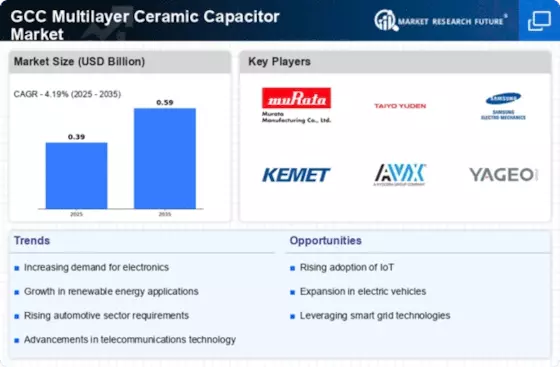
The GCC Multilayer Ceramic Capacitor Market is witnessing advancements in capacitor design and technology, which are driving market growth. Innovations such as improved dielectric materials and manufacturing techniques are enhancing the performance and reliability of multilayer ceramic capacitors. These advancements allow for higher capacitance values in smaller packages, catering to the needs of modern electronic applications. The GCC region is home to several research and development initiatives focused on electronics, which are likely to yield new technologies that can be integrated into capacitor manufacturing. As these innovations emerge, they may create new opportunities for market players and contribute to the overall expansion of the GCC Multilayer Ceramic Capacitor Market.
Expansion of Telecommunications Infrastructure
The GCC Multilayer Ceramic Capacitor Market is poised for growth due to the ongoing expansion of telecommunications infrastructure. With the rollout of 5G networks, there is an increasing need for high-performance capacitors that can support advanced communication technologies. Countries like Saudi Arabia and Qatar are investing significantly in enhancing their telecommunications capabilities, which is expected to boost the demand for multilayer ceramic capacitors. According to recent data, the telecommunications sector in the GCC is projected to grow at a CAGR of over 5% through 2026, indicating a favorable environment for capacitor manufacturers. This expansion not only enhances connectivity but also drives innovation in capacitor design and application.
Rising Demand for Miniaturization in Electronics
The GCC Multilayer Ceramic Capacitor Market is significantly influenced by the rising demand for miniaturization in electronic devices. As consumer electronics become increasingly compact, the need for smaller, high-capacity capacitors is paramount. Multilayer ceramic capacitors are favored for their small size and high capacitance, making them ideal for use in smartphones, tablets, and wearables. The GCC region, with its growing electronics manufacturing sector, is likely to see a surge in demand for these components. Market data indicates that the consumer electronics segment in the GCC is expected to grow at a CAGR of approximately 6% over the next few years, further propelling the need for advanced multilayer ceramic capacitors.
Increasing Adoption of Renewable Energy Solutions
The GCC Multilayer Ceramic Capacitor Market is experiencing a notable surge due to the increasing adoption of renewable energy solutions across the region. Governments in GCC countries are investing heavily in solar and wind energy projects, which require efficient energy storage systems. Multilayer ceramic capacitors are integral to these systems, providing stability and reliability. For instance, the UAE's commitment to generating 50% of its energy from clean sources by 2050 is likely to drive demand for capacitors that can withstand high voltages and temperatures. This trend suggests a robust growth trajectory for the GCC Multilayer Ceramic Capacitor Market, as manufacturers align their production capabilities to meet the specific needs of renewable energy applications.
Government Initiatives Supporting Electronics Manufacturing
The GCC Multilayer Ceramic Capacitor Market benefits from various government initiatives aimed at bolstering the electronics manufacturing sector. Countries like Saudi Arabia and the UAE are implementing policies to encourage local production and reduce dependency on imports. These initiatives include financial incentives, tax breaks, and infrastructure development, which create a conducive environment for capacitor manufacturers. For example, the Saudi Vision 2030 plan emphasizes the importance of localizing manufacturing capabilities, which is likely to enhance the growth of the multilayer ceramic capacitor market. As local production increases, it may lead to reduced costs and improved supply chain efficiencies, further stimulating market growth.