×
Hero Background
English
Chinese
French
Japanese
Korean
German
Spanish

Gas Concentration Sensor Market Trends

ID: MRFR/SEM/11045-HCR
128 Pages
Aarti Dhapte
October 2025

Gas Concentration Sensor Market Research Report Information By Product (Oxygen (O2)/Lambda Sensors, Carbon Dioxide (CO2) Sensors, Carbon Monoxide (CO) Sensors, Nitrogen Oxide (NOx) Sensors, Methyl Mercaptan Sensor, and Others), By Type (Wireless, and Wired), By Technology (Electrochemical, Semiconductor, Solid State/MOS, Photo-ionization Detector (PID), Catalytic, Infrared (IR), and Others), By End-use (Building Automation & Domestic Appliances, Petrochemical, Automotive, Agriculture, and Others), And Region– Industry Forecast 2034

Share:
Download PDF ×

We do not share your information with anyone. However, we may send you emails based on your report interest from time to time. You may contact us at any time to opt-out.

Gas Concentration Sensor Market Infographic
Purchase Options

Market Trends

Key Emerging Trends in the Gas Concentration Sensor Market

Notable trends driving the Gas Concentration Sensor market are industries’ focus on environmental monitoring, compliance with regulatory standards, and workplace safety locking mechanism. Applications of gas concentration sensors that are significant in detecting and correlating the amount of gases present are evolving rapidly according to end-use besides leading factors. One of the major changing features that are seen in this Gas Concentration Sensor market is increased demand for multi-gas sensing type. Beside the threats of air quality and safety in workplace, it is crucial to have flex sensors detecting not only familiar pollutants but also those emerging contaminants. The sensing of gas concentration is increasingly focusing on the detection of gases other than this, VOCs, greenhouse gases as well as industrial pollutants and various techniques to monitor such variety in covered with respect to fully devised technique. At the market, there is also a movement in that aspect toward miniaturization and integration of gas sensors to multiple devices and systems. The use of gas concentration sensors has given rise to including them in wearable devices, smartphones as well as environmental monitoring systems during the era of IoT and other smart technologies. This trend enables real-time data gathering and analyzing before acts of potential gases related hazards, which makes it possible to answer faster while environmental problems management become more efficient. Technological changes are the factors leading to Gas Concentration Sensor market growths; sensors technology is changing because of solid state sensor and laser-based sensor. As solid-state sensors respond to changes more quickly and requirements for durability and robustness increase, they offer a much higher level of improvements in terms of structural reliability compared with fiber-optic ones. Compared to these, laser-based sensors allow the best gas detection accuracy and precision. These technological enhancements form part of the general dependability and performance of portable gas concentration sensors that find their use in various applications. In commercial and residential buildings, there is the increasing in indoor air quality concerns and this is encouraging people to use gas concentration sensors. In today’s world, more and more are spending hours inside while at home or work; monitoring indoor air quality for pollutants and gases is a necessary step towards maintaining the appropriate well-being setting. By this stage, it would aid the implementation of gas concentrations sensors which have air quality indicators to human beings and building managers, send them real-time reads that they need and can take preventive measures if there is need. Think how important environmental sustainability is becoming for the Gas Concentration Sensor market. Manufacturers are encouraging nearly non-destructive testing and green sensors and components, which means less disruption to the environment when developed and used by their products. These range from energy-free technologies to the use of environment-friendly materials. Economic entities and end-users are going to focus on sustainable technologies as we see new trends in the market for environment friendly gas concentration sensors.


Author
Aarti Dhapte
Team Lead - Research

She holds an experience of about 6+ years in Market Research and Business Consulting, working under the spectrum of Information Communication Technology, Telecommunications and Semiconductor domains. Aarti conceptualizes and implements a scalable business strategy and provides strategic leadership to the clients. Her expertise lies in market estimation, competitive intelligence, pipeline analysis, customer assessment, etc.

Leave a Comment

FAQs

How big is the market for Gas Concentration Sensors?

In 2024, A valuation of USD 722.78 Million was put on the market for gas concentration sensors.

How fast is the market for gas concentration sensors growing?

During the forecast period, 2025 to 2035, It is expected that the global market would grow at a CAGR of 11.30%.

Which region accounted for the greatest proportion of the market for Gas Concentration Sensors?

North America maintained the biggest market share globally.

Who are the leading companies in the market for gas concentration sensors?

ABB Ltd., AlphaSense Inc., City Technology Ltd., Dynament, Figaro Engineering Inc., Membrapor, Nemoto & Co. Ltd., and Robert Bosch LLC are the major competitors in the market.

Which product dominated the market for Gas Concentration Sensors?

In 2022, the market was dominated by Carbon Dioxide (CO2) Sensors.

Which type dominated the market for Gas Concentration Sensors?

Which type dominated the market for Gas Concentration Sensors?

Market Summary

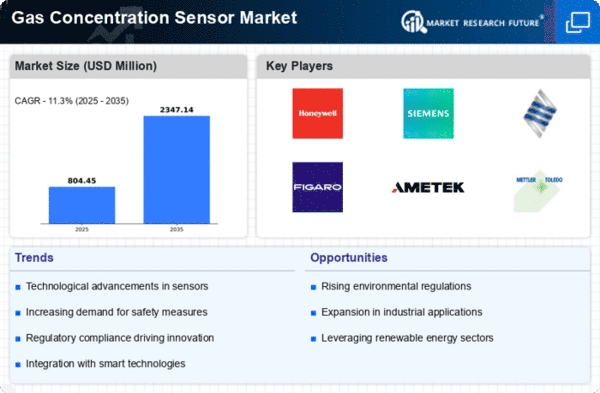
As per MRFR analysis, the Gas Concentration Sensor Market Size was estimated at 722.78 USD Million in 2024. The Gas Concentration Sensor industry is projected to grow from 804.47 in 2025 to 2347.14 by 2035, exhibiting a compound annual growth rate (CAGR) of 11.3 during the forecast period 2025 - 2035.

Key Market Trends & Highlights

The Gas Concentration Sensor Market is poised for substantial growth driven by technological advancements and increasing regulatory compliance.

  • Technological advancements are enhancing the accuracy and efficiency of gas concentration sensors across various applications.
  • North America remains the largest market, while Asia-Pacific is emerging as the fastest-growing region for gas concentration sensors.

  • The industrial segment dominates the market, whereas the environmental monitoring segment is experiencing rapid growth due to heightened awareness of air quality.
  • Key market drivers include rising environmental concerns and increasing industrial applications, particularly in the oil and gas and pharmaceuticals sectors.

Market Size & Forecast

2024 Market Size 722.78 (USD Million)
2035 Market Size 2347.14 (USD Million)
CAGR (2025 - 2035) 11.3%
Largest Regional Market Share in 2024 North America

Major Players

<p>Honeywell (US), Siemens (DE), Emerson (US), Figaro Engineering (JP), Ametek (US), Mettler Toledo (CH), Teledyne Technologies (US), Sensirion (CH), MSA Safety (US)</p>

Market Trends

The Gas Concentration Sensor Market is currently experiencing a notable evolution, driven by advancements in technology and increasing awareness regarding environmental safety. The demand for precise gas detection solutions is rising across various sectors, including industrial, automotive, and healthcare. This trend is largely influenced by regulatory frameworks that emphasize the need for monitoring air quality and ensuring compliance with safety standards. As industries strive to enhance operational efficiency and minimize risks, the integration of sophisticated gas concentration sensors becomes paramount. Furthermore, the growing emphasis on smart technologies and the Internet of Things (IoT) is likely to propel the market forward, as these innovations facilitate real-time monitoring and data analysis. In addition to technological advancements, the Gas Concentration Sensor Market is also shaped by shifting consumer preferences and heightened environmental consciousness. Organizations are increasingly investing in sustainable practices, which necessitates the implementation of reliable gas detection systems. This shift is further supported by government initiatives aimed at reducing emissions and promoting cleaner air. As a result, manufacturers are focusing on developing sensors that are not only efficient but also environmentally friendly. The interplay of these factors suggests a dynamic landscape for the Gas Concentration Sensor Market, with opportunities for growth and innovation in the coming years.

Technological Advancements

The Gas Concentration Sensor Market is witnessing rapid technological advancements, particularly in sensor design and functionality. Innovations such as miniaturization and enhanced sensitivity are enabling the development of more efficient and accurate detection devices. These advancements are likely to improve the performance of sensors in various applications, from industrial safety to environmental monitoring.

Regulatory Compliance

Increasing regulatory requirements regarding air quality and safety standards are significantly influencing the Gas Concentration Sensor Market. Governments worldwide are implementing stricter guidelines to ensure the monitoring of hazardous gases, which is driving demand for reliable detection solutions. This trend suggests that compliance will remain a key driver for market growth.

Sustainability Focus

The growing emphasis on sustainability and environmental protection is shaping the Gas Concentration Sensor Market. Organizations are increasingly adopting eco-friendly practices, which necessitate the use of advanced gas detection systems. This focus on sustainability is likely to encourage manufacturers to innovate and develop sensors that align with environmental goals.

Gas Concentration Sensor Market Market Drivers

Growth in Industrial Applications

The Global Gas Concentration Sensor Market Industry is witnessing substantial growth due to the expanding industrial applications of gas sensors. Industries such as chemical manufacturing, food processing, and pharmaceuticals are increasingly adopting gas concentration sensors to monitor and control processes. For example, in the chemical sector, sensors are utilized to detect hazardous gases during production, ensuring safety and compliance with industry standards. This trend is indicative of a broader shift towards automation and process optimization, which is likely to drive market growth. As industries continue to prioritize efficiency and safety, the demand for gas concentration sensors is expected to rise significantly.

Increasing Environmental Regulations

The Global Gas Concentration Sensor Market Industry is experiencing growth due to stringent environmental regulations aimed at reducing air pollution. Governments worldwide are implementing laws that require continuous monitoring of gas emissions from industrial sources. For instance, the European Union's Industrial Emissions Directive mandates that companies utilize advanced monitoring technologies, including gas concentration sensors, to ensure compliance. This regulatory push is likely to drive the demand for gas sensors, as industries seek to avoid penalties and improve their environmental footprint. As a result, the market is projected to reach 722.8 USD Billion in 2024, reflecting the increasing emphasis on environmental sustainability.

Rising Demand for Safety and Security

The Global Gas Concentration Sensor Market Industry is significantly influenced by the rising demand for safety and security in various sectors. Industries such as oil and gas, manufacturing, and mining require reliable gas detection systems to prevent hazardous situations. For instance, the implementation of gas sensors in confined spaces has become critical in ensuring worker safety and compliance with occupational health standards. The increasing awareness of workplace safety is likely to propel the market forward, as organizations invest in advanced gas monitoring solutions. This trend is expected to contribute to the market's growth, with projections indicating a value of 2347.1 USD Billion by 2035.

Technological Advancements in Sensor Technology

The Global Gas Concentration Sensor Market Industry benefits from rapid technological advancements in sensor technology. Innovations such as miniaturization, enhanced sensitivity, and integration with IoT devices are transforming how gas concentration sensors operate. For example, the development of MEMS (Micro-Electro-Mechanical Systems) sensors has led to more compact and efficient devices that can provide real-time data. These advancements not only improve the accuracy of gas detection but also expand the application range across various sectors, including healthcare and automotive. Consequently, the market is anticipated to grow at a CAGR of 11.3% from 2025 to 2035, driven by these technological improvements.

Market Segment Insights

By Application: Industrial (Largest) vs. Environmental Monitoring (Fastest-Growing)

<p>The Gas Concentration Sensor Market is segmented into various applications, including Industrial, Environmental Monitoring, Automotive, Healthcare, and Aerospace. Among these, the Industrial sector holds the largest market share, driven by the widespread use of gas sensors in manufacturing processes and safety protocols. Environmental Monitoring, while smaller in comparison, is rapidly gaining traction due to increasing regulatory requirements and public awareness regarding air quality and pollution control.</p>

<p>Environmental Monitoring: Dominant vs. Automotive: Emerging</p>

<p>Environmental Monitoring is presently viewed as a dominant application within the Gas Concentration Sensor Market. This sector benefits from escalating regulatory pressures for sustainable practices and accurate assessment of air quality, thus propelling demand for advanced gas sensors. Meanwhile, the Automotive sector is emerging, propelled by trends towards enhanced vehicle safety and efficiency mandates. Innovations like real-time monitoring systems in vehicles are anticipated to drive growth, but its current market share remains behind. The adaptation of gas sensors into these applications is crucial for meeting both industrial safety standards and consumer expectations.</p>

By End Use: Oil and Gas (Largest) vs. Pharmaceuticals (Fastest-Growing)

<p>In the Gas Concentration Sensor Market, the manufacturing sector holds a significant share, but oil and gas emerge as the largest segment due to the extensive use of sensors in monitoring gas emissions and ensuring safety in production processes. Following oil and gas, mining and food and beverage sectors also command a considerable portion of the market. Pharmaceutical applications, while smaller currently, are gaining traction, thanks to the stringent regulations around air quality monitoring in production environments. Growth trends within this segment are propelled primarily by increasing safety regulations and the rise in demand for real-time data on gas emissions. The oil and gas industry continues to lead due to ongoing investments in technology and infrastructure. Conversely, the pharmaceutical sector is characterized by rapid innovation, focusing on precision and reliability, thus driving faster adoption of gas concentration sensors in production while addressing compliance needs effectively.</p>

<p>Oil and Gas (Dominant) vs. Pharmaceuticals (Emerging)</p>

<p>The oil and gas sector maintains a dominant position in the Gas Concentration Sensor Market due to its critical operational requirements for monitoring hazardous gases. Sensors are integral for ensuring safety, efficiency, and compliance in extraction, processing, and distribution activities. Innovations in sensor technology, such as improved accuracy and wireless capabilities, further enhance their usage in this sector. Meanwhile, the pharmaceutical sector, while emerging, is rapidly becoming a key player as it emphasizes stringent monitoring of air quality during production processes. The unique requirements for sensitive environments, combined with regulatory compliance, push pharmaceutical companies towards advanced sensor solutions. This dual focus on safety and accuracy creates a promising landscape for growth in this emerging segment.</p>

By Technology: Electrochemical (Largest) vs. Infrared (Fastest-Growing)

<p>The Gas Concentration Sensor Market is segmented by technology, which includes Electrochemical, Infrared, Semiconductor, Photoionization, and Catalytic sensors. Among these, the Electrochemical segment holds the largest market share due to its wide-ranging applications in various industries, including automotive and environmental monitoring. This reliability and cost-effectiveness reinforce its popularity among users, leading to substantial sales and market presence compared to other types. On the other hand, Infrared sensors are recognized as the fastest-growing segment of the market. Their increasing adoption is fueled by technological advancements that enhance their accuracy and responsiveness. Moreover, rising environmental concerns and stricter regulations are propelling demand for non-dispersive infrared (NDIR) sensors in applications related to gas detection and monitoring, marking a significant upward trend in this segment's growth trajectory.</p>

<p>Technology: Electrochemical (Dominant) vs. Infrared (Emerging)</p>

<p>The Electrochemical sensor technology stands out as the dominant force in the Gas Concentration Sensor Market due to its effectiveness in detecting various gases at relatively low concentrations. It operates efficiently in a variety of conditions and provides reliable readings, making it indispensable in industries such as pharmaceuticals and environmental safety. Conversely, the Infrared sensor technology is emerging as a strong contender, especially with its ability to provide high sensitivity and selectivity in gas detection without the need for consumable components. This not only makes them cost-effective in the long run but also environmentally friendly, driving their adoption across diverse sectors, including automotive and HVAC systems. As regulations tighten regarding emissions, the trend towards infrared sensors is likely to intensify, positioning them as a key player in this market.</p>

By Sensor Type: Fixed (Largest) vs. Portable (Fastest-Growing)

<p>In the Gas Concentration Sensor Market, the segmentation by sensor type reveals that Fixed sensors dominate the market share, catering to industries requiring continuous monitoring. Fixed sensors provide safety and regulatory compliance and are heavily favored in industrial applications, hospitals, and chemical plants due to their reliability. In contrast, Portable gas sensors, while smaller in market share, are witnessing rapid growth as safety protocols tighten and field applications increase, especially in first responder and environmental monitoring sectors.</p>

<p>Gas Sensors: Fixed (Dominant) vs. Portable (Emerging)</p>

<p>Fixed gas concentration sensors are essential for permanent installations aimed at constant monitoring. They offer high accuracy and robust construction suitable for harsh environments. Typically used in industrial settings, their reliability precedes the market, cementing their position as the dominant choice for continuous gas analysis. Conversely, Portable gas sensors are emerging as a vital technology, particularly for on-site assessments during emergencies or in outdoor conditions. Their flexibility, ease of use, and increasing demand for real-time data make them appealing for sectors like safety inspections and environmental assessments. With innovations focusing on battery life and multi-gas capabilities, their adoption rate is climbing steadily.</p>

By Detection Method: Non-Dispersive Infrared (Largest) vs. Electrochemical (Fastest-Growing)

<p>The Gas Concentration Sensor Market exhibits a diverse distribution among its detection methods, with Non-Dispersive Infrared (NDIR) sensors leading the market due to their accuracy and reliability in measuring gas concentrations. Electrochemical sensors, while currently holding a smaller market share, are experiencing rapid growth owing to their use in portable applications and specific gas detection. Together, these methods reflect the evolving preferences in gas detection technologies, influenced by application demands and regulatory standards.</p>

<p>Technology: Non-Dispersive Infrared (Dominant) vs. Electrochemical (Emerging)</p>

<p>Non-Dispersive Infrared (NDIR) sensors dominate the gas concentration detection market, leveraging infrared light absorption characteristics of gases to provide high-precision measurements. Their established technology is favored in various industries, particularly in environmental monitoring and industrial safety. In contrast, Electrochemical sensors are emerging as a key player, particularly in portable and compact applications. They provide quick response times for specific gas detections at lower costs, making them ideal for personal safety and automotive applications. As industries move towards cleaner technologies and better safety protocols, the versatility of Electrochemical sensors positions them for significant growth.</p>

Get more detailed insights about Gas Concentration Sensor Market Research Report—Global Forecast till 2035

Regional Insights

North America : Market Leader in Innovation

North America is poised to maintain its leadership in the gas concentration sensor market, holding a significant share of 360.0 million in 2025. The region's growth is driven by stringent regulatory frameworks aimed at enhancing safety standards across industries, particularly in manufacturing and energy sectors. Increasing investments in smart technologies and automation further fuel demand, as companies seek to improve operational efficiency and safety measures. The United States stands out as the primary market, with key players like Honeywell, Emerson, and Teledyne Technologies leading the charge. The competitive landscape is characterized by continuous innovation and strategic partnerships, enabling companies to develop advanced sensor technologies. The presence of established firms and a robust supply chain infrastructure positions North America as a critical hub for gas concentration sensor advancements.

Europe : Emerging Regulatory Frameworks

Europe's gas concentration sensor market is projected to reach 220.0 million by 2025, driven by increasing regulatory requirements aimed at ensuring environmental safety and public health. The European Union's stringent directives on emissions and workplace safety are significant catalysts for market growth. Additionally, the rising demand for smart sensors in industrial applications is enhancing the adoption of advanced gas detection technologies across various sectors. Germany and the UK are leading the market, with companies like Siemens and Mettler Toledo playing pivotal roles. The competitive landscape is marked by innovation and collaboration among key players, focusing on developing sensors that meet evolving regulatory standards. The presence of a well-established manufacturing base and research institutions further supports the region's growth trajectory.

Asia-Pacific : Rapid Industrialization and Growth

The Asia-Pacific region is witnessing rapid growth in the gas concentration sensor market, projected to reach 130.0 million by 2025. This growth is primarily driven by rapid industrialization, urbanization, and increasing environmental concerns. Countries like China and India are investing heavily in infrastructure and industrial projects, leading to a surge in demand for gas sensors to monitor air quality and ensure compliance with safety regulations. China is the dominant player in this market, with significant contributions from local manufacturers and international companies like Figaro Engineering. The competitive landscape is evolving, with a focus on innovation and cost-effective solutions. As regulatory frameworks become more stringent, the demand for advanced gas concentration sensors is expected to rise, positioning the Asia-Pacific region as a key player in the global market.

Middle East and Africa : Emerging Market Opportunities

The Middle East and Africa (MEA) gas concentration sensor market is relatively nascent, with a projected size of 12.78 million by 2025. However, the region is experiencing growth driven by increasing industrial activities and a rising focus on safety and environmental compliance. Governments are implementing regulations to monitor air quality and ensure workplace safety, which is catalyzing the demand for gas sensors across various sectors, including oil and gas, mining, and manufacturing. Countries like South Africa and the UAE are leading the market, with a growing presence of international players. The competitive landscape is characterized by partnerships and collaborations aimed at enhancing technological capabilities. As the region continues to develop its industrial base, the demand for gas concentration sensors is expected to rise significantly, presenting opportunities for growth.

Key Players and Competitive Insights

The Gas Concentration Sensor Market is currently characterized by a dynamic competitive landscape, driven by increasing demand for environmental monitoring and safety applications across various industries. Key players such as Honeywell (US), Siemens (DE), and Emerson (US) are strategically positioned to leverage their technological expertise and extensive product portfolios. Honeywell (US) focuses on innovation and digital transformation, enhancing its sensor capabilities through advanced analytics and IoT integration. Siemens (DE) emphasizes regional expansion and partnerships, particularly in Europe and Asia, to strengthen its market presence. Emerson (US) adopts a strategy centered on mergers and acquisitions, aiming to consolidate its position in the market by acquiring niche players with specialized technologies. Collectively, these strategies contribute to a competitive environment that is increasingly focused on technological advancement and customer-centric solutions.

In terms of business tactics, companies are localizing manufacturing and optimizing supply chains to enhance operational efficiency and reduce costs. The market structure appears moderately fragmented, with several key players exerting significant influence while also allowing for the presence of smaller, specialized firms. This fragmentation fosters innovation, as companies strive to differentiate their offerings in a competitive landscape.

In November 2025, Honeywell (US) announced the launch of a new line of gas concentration sensors designed for industrial applications, which utilize AI algorithms to improve accuracy and response times. This strategic move is likely to enhance Honeywell's competitive edge by addressing the growing need for precise monitoring solutions in hazardous environments. The integration of AI not only positions Honeywell as a leader in technological innovation but also aligns with the broader industry trend towards smart sensor technologies.

In October 2025, Siemens (DE) entered into a strategic partnership with a leading environmental monitoring firm to develop advanced gas detection systems. This collaboration is expected to enhance Siemens' product offerings and expand its reach in the environmental sector. By leveraging the expertise of its partner, Siemens aims to accelerate the development of next-generation sensors that meet stringent regulatory requirements, thereby reinforcing its commitment to sustainability and safety.

In September 2025, Emerson (US) completed the acquisition of a specialized sensor manufacturer, which is anticipated to bolster its capabilities in gas concentration measurement. This acquisition not only expands Emerson's product portfolio but also enhances its technological capabilities, allowing for the integration of advanced features into its existing sensor solutions. Such strategic actions reflect Emerson's focus on consolidating its market position and driving innovation through targeted investments.

As of December 2025, the competitive trends in the Gas Concentration Sensor Market are increasingly defined by digitalization, sustainability, and AI integration. Strategic alliances are playing a crucial role in shaping the landscape, enabling companies to pool resources and expertise to develop cutting-edge solutions. Looking ahead, competitive differentiation is likely to evolve from traditional price-based competition towards a focus on innovation, technology, and supply chain reliability. Companies that can effectively harness these trends will be well-positioned to thrive in an ever-evolving market.

Key Companies in the Gas Concentration Sensor Market market include

Industry Developments

October 2019: FLIR introduced the FLIR One Pro LT, a smart phone camera attachment, to broaden the use of thermal imaging technology.

April 2022: The MEMBRAPOR ETO/CA-10 sensor is designed for precise ethylene oxide (ETO) detection with greatly reduced cross-sensitivity to carbon monoxide (CO). With the use of this invention, specific ETO measurements can now be performed in areas where very low CO concentrations, such as those affected by traffic, may exist. Ethylene oxide plays a significant role as a sterilizing agent in many applications, hence accurate monitoring is required.

February 2021: ABB and Amazon Web Services (AWS) have established a collaborative partnership to develop an online platform for managing EV fleets. This platform would make it possible for companies to operate their electric car fleets more sustainably and cheaply.

Future Outlook

Gas Concentration Sensor Market Future Outlook

<p>The Gas Concentration Sensor Market is projected to grow at 11.3% CAGR from 2024 to 2035, driven by increasing industrial automation, stringent environmental regulations, and advancements in sensor technology.</p>

New opportunities lie in:

  • <p>Development of smart gas monitoring systems for industrial applications.</p>
  • <p>Expansion into emerging markets with tailored sensor solutions.</p>
  • <p>Integration of IoT capabilities for real-time data analytics and monitoring.</p>

<p>By 2035, the market is expected to achieve substantial growth, driven by innovation and demand for advanced sensing technologies.</p>

Market Segmentation

Gas Concentration Sensor Market End Use Outlook

  • Manufacturing
  • Oil and Gas
  • Mining
  • Food and Beverage
  • Pharmaceutical

Gas Concentration Sensor Market Technology Outlook

  • Electrochemical
  • Infrared
  • Semiconductor
  • Photoionization
  • Catalytic

Gas Concentration Sensor Market Application Outlook

  • Industrial
  • Environmental Monitoring
  • Automotive
  • Healthcare
  • Aerospace

Gas Concentration Sensor Market Sensor Type Outlook

  • Portable
  • Fixed
  • Multi-Gas
  • Single-Gas
  • Wireless

Gas Concentration Sensor Market Detection Method Outlook

  • Non-Dispersive Infrared
  • Electrochemical
  • Metal Oxide Semiconductor
  • Photoionization
  • Catalytic Combustion

Report Scope

MARKET SIZE 2024722.78(USD Million)
MARKET SIZE 2025804.47(USD Million)
MARKET SIZE 20352347.14(USD Million)
COMPOUND ANNUAL GROWTH RATE (CAGR)11.3% (2024 - 2035)
REPORT COVERAGERevenue Forecast, Competitive Landscape, Growth Factors, and Trends
BASE YEAR2024
Market Forecast Period2025 - 2035
Historical Data2019 - 2024
Market Forecast UnitsUSD Million
Key Companies ProfiledHoneywell (US), Siemens (DE), Emerson (US), Figaro Engineering (JP), Ametek (US), Mettler Toledo (CH), Teledyne Technologies (US), Sensirion (CH), MSA Safety (US)
Segments CoveredApplication, End Use, Technology, Sensor Type, Detection Method
Key Market OpportunitiesIntegration of advanced analytics in Gas Concentration Sensor Market enhances real-time monitoring capabilities.
Key Market DynamicsRising demand for air quality monitoring drives innovation and competition in the gas concentration sensor market.
Countries CoveredNorth America, Europe, APAC, South America, MEA

FAQs

How big is the market for Gas Concentration Sensors?

In 2024, A valuation of USD 722.78 Million was put on the market for gas concentration sensors.

How fast is the market for gas concentration sensors growing?

During the forecast period, 2025 to 2035, It is expected that the global market would grow at a CAGR of 11.30%.

Which region accounted for the greatest proportion of the market for Gas Concentration Sensors?

North America maintained the biggest market share globally.

Who are the leading companies in the market for gas concentration sensors?

ABB Ltd., AlphaSense Inc., City Technology Ltd., Dynament, Figaro Engineering Inc., Membrapor, Nemoto &amp; Co. Ltd., and Robert Bosch LLC are the major competitors in the market.

Which product dominated the market for Gas Concentration Sensors?

In 2022, the market was dominated by Carbon Dioxide (CO2) Sensors.

Which type dominated the market for Gas Concentration Sensors?

Which type dominated the market for Gas Concentration Sensors?

  1. EXECUTIVE SUMMARY
  2. MARKET INTRODUCTION
    1. Definition
    2. Scope of the Study
      1. Research Objective
      2. Limitations
    3. Assumptions
  3. RESEARCH METHODOLOGY
    1. Overview
    2. Data Mining
    3. Secondary Research
    4. Primary Research
      1. Breakdown of Primary
    5. Primary Interviews and Information Gathering Process
    6. Respondents
    7. Forecasting Model
    8. Market Size Estimation
      1. Top-Down Approach
    9. Bottom-Up Approach
    10. Data Triangulation
    11. Validation
  4. MARKET DYNAMICS
    1. Overview
    2. Drivers
    3. Restraints
    4. Opportunities
  5. MARKET FACTOR ANALYSIS
    1. Value Chain Analysis
    2. Porter’s Five Forces Analysis
      1. Bargaining
      2. Bargaining Power of Buyers
      3. Threat of
      4. Threat of Substitutes
      5. Intensity of Rivalry
    3. Power of Suppliers
    4. New Entrants
    5. COVID-19 Impact Analysis
      1. Market Impact Analysis
      2. Regional
      3. Opportunity and Threat Analysis
    6. Impact
  6. GLOBAL GAS CONCENTRATION
  7. SENSOR MARKET,BY PRODUCT
    1. Overview
    2. Oxygen (O2)/Lambda Sensors
    3. Carbon Dioxide (CO2) Sensors
    4. Carbon Monoxide (CO) Sensors
    5. Nitrogen Oxide (NOx) Sensors
    6. Methyl Mercaptan Sensor
    7. Others
    8. (Hydrogen, Ammonia, Hydrogen Sulfide)
  8. GLOBAL GAS CONCENTRATION SENSOR MARKET,BY
    1. TYPE
    2. Overview
    3. Wireless
    4. Wired
  9. GLOBAL GAS CONCENTRATION
  10. SENSOR MARKET,BY TECHNOLOGY
    1. Overview
    2. Electrochemical
    3. Semiconductor
    4. Solid State/MOS
    5. Photo-ionization Detector (PID)
    6. Catalytic
    7. Infrared (IR)
    8. Others
  11. GLOBAL GAS CONCENTRATION
  12. SENSOR MARKET, BY END-USE
    1. Overview
    2. Medical
    3. Building
    4. Automation & Domestic Appliances
    5. Environmental
    6. Petrochemical
    7. Automotive
    8. Industrial
    9. Agriculture
    10. Others
  13. GLOBAL GAS CONCENTRATION SENSOR MARKET, BY REGION
    1. Overview
      1. US
      2. Canada
    2. North America
    3. Europe
      1. France
      2. UK
      3. Italy
      4. Spain
      5. Rest of Europe
    4. Germany
    5. Asia-Pacific
      1. China
      2. Japan
      3. South Korea
      4. Australia
    6. India
    7. Rest of Asia-Pacific
    8. Rest of the World
      1. Middle East
      2. Latin America
    9. Africa
  14. COMPETITIVE LANDSCAPE
    1. Overview
    2. Competitive Analysis
    3. Market Share Analysis
    4. Major Growth
    5. Strategy in the Global Gas Concentration Sensor Market,
    6. Competitive Benchmarking
    7. Leading Players in Terms of Number of Developments in the Global Gas Concentration
    8. Sensor Market,
    9. Key developments and Growth Strategies
      1. New
      2. Merger &Acquisitions
    10. ProductLaunch/Service Deployment
    11. Joint Ventures
    12. Major Players Financial Matrix
      1. Sales &
      2. Major Players R&D Expenditure.2025
    13. Operating Income,2025
    14. COMPANY PROFILES
    15. ABB Ltd.;
      1. Company Overview
      2. Products Offered
      3. Key Developments
      4. SWOT Analysis
      5. Key Strategies
    16. Financial Overview
    17. AlphaSense Inc.;
      1. Company Overview
      2. Financial Overview
      3. Products
      4. Key Developments
      5. SWOT Analysis
      6. Key
    18. Offered
    19. Strategies
    20. City Technology Ltd.,
      1. Company Overview
      2. Products Offered
      3. Key Developments
      4. SWOT Analysis
      5. Key Strategies
    21. Financial Overview
    22. Dynament;
      1. Financial Overview
      2. Products Offered
      3. Key Developments
      4. SWOT Analysis
      5. Key Strategies
    23. Company Overview
    24. Figaro Engineering Inc.;
      1. Company Overview
      2. Financial
      3. Products Offered
      4. Key Developments
      5. Key Strategies
    25. Overview
    26. SWOT Analysis
    27. Membrapor;
      1. Company
      2. Financial Overview
      3. Products Offered
      4. SWOT Analysis
      5. Key Strategies
      6. Company Overview
      7. Financial Overview
      8. Products Offered
      9. Key Developments
      10. SWOT Analysis
      11. Key Strategies
    28. Overview
    29. Key Developments
    30. Nemoto & Co. Ltd.;.
    31. Robert Bosch LLC;.
      1. Company Overview
      2. Financial Overview
      3. Products Offered
      4. Key Developments
      5. SWOT Analysis
      6. Key Strategies
    32. Siemens;.
      1. Financial Overview
      2. Products Offered
      3. Key Developments
      4. SWOT Analysis
      5. Key Strategies
    33. Company Overview
    34. GfG Gas Detection UK Ltd.;
      1. Company Overview
      2. Products Offered
      3. Key Developments
      4. SWOT Analysis
      5. Key Strategies
    35. Financial Overview
    36. FLIR Systems,
      1. Company Overview
      2. Financial Overview
      3. Key Developments
      4. SWOT Analysis
    37. Inc..
    38. Products Offered
    39. Key Strategies
  15. APPENDIX
  16. APPENDIX
    1. References
    2. Related Reports
  17. LIST OF TABLES
  18. GLOBAL GAS
    1. CONCENTRATION SENSOR MARKET, SYNOPSIS, 2018-2034
  19. GLOBAL GAS CONCENTRATION
    1. SENSOR MARKET, ESTIMATES &FORECAST, 2025-2034 (USD BILLION)
  20. GLOBAL
  21. GAS CONCENTRATION SENSOR MARKET,BY PRODUCT, 2025-2034 (USD BILLION)
    1. TABLE 4
  22. GLOBAL GAS CONCENTRATION SENSOR MARKET,BY TYPE, 2025-2034 (USD BILLION)
    1. TABLE
  23. GLOBAL GAS CONCENTRATION SENSOR MARKET,BY TECHNOLOGY, 2025-2034 (USD BILLION)
  24. GLOBAL GAS CONCENTRATION SENSOR MARKET, BYEND-USE, 2025-2034 (USD BILLION)
  25. NORTH AMERICA: GAS CONCENTRATION SENSOR MARKET,BY PRODUCT, 2025-2034 (USD
    1. BILLION)
  26. NORTH AMERICA: GAS CONCENTRATION SENSOR MARKET,BY TYPE, 2025-2034
    1. (USD BILLION)
  27. NORTH AMERICA: GAS CONCENTRATION SENSOR MARKET,BY TECHNOLOGY,
  28. NORTH AMERICA: GAS CONCENTRATION SENSOR MARKET,BY
    1. END-USE,2025-2034 (USD BILLION)
  29. US: GAS CONCENTRATION SENSOR MARKET,BY
    1. PRODUCT, 2025-2034 (USD BILLION)
  30. US: GAS CONCENTRATION SENSOR MARKET,BY
    1. TYPE, 2025-2034 (USD BILLION)
  31. US: GAS CONCENTRATION SENSOR MARKET,BY
    1. TECHNOLOGY, 2025-2034 (USD BILLION)
  32. US: GAS CONCENTRATION SENSOR MARKET,BY
    1. END-USE,2025-2034 (USD BILLION)
  33. CANADA: GAS CONCENTRATION SENSOR MARKET,BY
    1. PRODUCT, 2025-2034 (USD BILLION)
  34. CANADA: GAS CONCENTRATION SENSOR
  35. MARKET,BY TYPE, 2025-2034 (USD BILLION)
  36. CANADA: GAS CONCENTRATION
  37. SENSOR MARKET,BY TECHNOLOGY, 2025-2034 (USD BILLION)
  38. CANADA: GAS CONCENTRATION
  39. SENSOR MARKET,BY END-USE,2025-2034 (USD BILLION)
  40. EUROPE: GAS CONCENTRATION
  41. SENSOR MARKET,BY PRODUCT, 2025-2034 (USD BILLION)
  42. EUROPE: GAS CONCENTRATION
  43. SENSOR MARKET, BY TYPE, 2025-2034 (USD BILLION)
  44. EUROPE: GAS CONCENTRATION
  45. SENSOR MARKET, BY TECHNOLOGY, 2025-2034 (USD BILLION)
  46. EUROPE: GAS CONCENTRATION
  47. SENSOR MARKET,BY END-USE,2025-2034 (USD BILLION)
  48. GERMANY: GAS CONCENTRATION
  49. SENSOR MARKET,BY PRODUCT,2025-2034 (USD BILLION)
  50. GERMANY: GAS CONCENTRATION
  51. SENSOR MARKET, BY TYPE, 2025-2034 (USD BILLION)
  52. GERMANY: GAS CONCENTRATION
  53. SENSOR MARKET, BY TECHNOLOGY, 2025-2034 (USD BILLION)
  54. GERMANY: GAS
  55. CONCENTRATION SENSOR MARKET,BY END-USE,2025-2034 (USD BILLION)
  56. FRANCE:
  57. GAS CONCENTRATION SENSOR MARKET,BY PRODUCT, 2025-2034 (USD BILLION)
    1. TABLE 10
  58. FRANCE: GAS CONCENTRATION SENSOR MARKET, BY TYPE, 2025-2034 (USD BILLION)
    1. TABLE
  59. FRANCE: GAS CONCENTRATION SENSOR MARKET, BY TECHNOLOGY, 2025-2034 (USD BILLION)
  60. FRANCE: GAS CONCENTRATION SENSOR MARKET,BY END-USE,2025-2034 (USD BILLION)
  61. ITALY: GAS CONCENTRATION SENSOR MARKET,BY PRODUCT, 2025-2034 (USD BILLION)
  62. ITALY: GAS CONCENTRATION SENSOR MARKET, BY TYPE, 2025-2034 (USD BILLION)
  63. ITALY: GAS CONCENTRATION SENSOR MARKET, BY TECHNOLOGY, 2025-2034 (USD
    1. BILLION)
  64. ITALY: GAS CONCENTRATION SENSOR MARKET,BY END-USE,2025-2034
    1. (USD BILLION)
  65. SPAIN: GAS CONCENTRATION SENSOR MARKET,BY PRODUCT, 2025-2034
    1. (USD BILLION)
  66. SPAIN: GAS CONCENTRATION SENSOR MARKET, BY TYPE, 2025-2034
    1. (USD BILLION)
  67. SPAIN: GAS CONCENTRATION SENSOR MARKET, BY TECHNOLOGY,
  68. SPAIN: GAS CONCENTRATION SENSOR MARKET,BY
    1. END-USE,2025-2034 (USD BILLION)
  69. UK: GAS CONCENTRATION SENSOR MARKET,BY
    1. PRODUCT, 2025-2034 (USD BILLION)
  70. UK: GAS CONCENTRATION SENSOR MARKET,
    1. BY TYPE, 2025-2034 (USD BILLION)
  71. UK: GAS CONCENTRATION SENSOR MARKET,
    1. BY TECHNOLOGY, 2025-2034 (USD BILLION)
  72. UK: GAS CONCENTRATION SENSOR
  73. MARKET,BY END-USE, 2025-2034 (USD BILLION)
  74. REST OF EUROPE: GAS CONCENTRATION
  75. SENSOR MARKET,BY PRODUCT, 2025-2034 (USD BILLION)
  76. REST OF EUROPE:
  77. GAS CONCENTRATION SENSOR MARKET, BY TYPE, 2025-2034 (USD BILLION)
    1. TABLE 27
  78. REST OF EUROPE: GAS CONCENTRATION SENSOR MARKET, BY TECHNOLOGY, 2025-2034 (USD BILLION)
  79. REST OF EUROPE: GAS CONCENTRATION SENSOR MARKET,BY END-USE,2025-2034
    1. (USD BILLION)
  80. ASIA-PACIFIC: GAS CONCENTRATION SENSOR MARKET,BY PRODUCT,
  81. ASIA-PACIFIC: GAS CONCENTRATION SENSOR MARKET,
    1. BY TYPE, 2025-2034 (USD BILLION)
  82. ASIA-PACIFIC: GAS CONCENTRATION SENSOR
  83. MARKET, BY TECHNOLOGY, 2025-2034 (USD BILLION)
  84. ASIA-PACIFIC: GAS CONCENTRATION
  85. SENSOR MARKET,BY END-USE,2025-2034 (USD BILLION)
  86. JAPAN: GAS CONCENTRATION
  87. SENSOR MARKET,BY PRODUCT, 2025-2034 (USD BILLION)
  88. JAPAN: GAS CONCENTRATION
  89. SENSOR MARKET, BY TYPE, 2025-2034 (USD BILLION)
  90. JAPAN: GAS CONCENTRATION
  91. SENSOR MARKET, BY TECHNOLOGY, 2025-2034 (USD BILLION)
  92. JAPAN: GAS CONCENTRATION
  93. SENSOR MARKET,BY END-USE,2025-2034 (USD BILLION)
  94. CHINA: GAS CONCENTRATION
  95. SENSOR MARKET,BY PRODUCT, 2025-2034 (USD BILLION)
  96. CHINA: GAS CONCENTRATION
  97. SENSOR MARKET, BY TYPE, 2025-2034 (USD BILLION)
  98. CHINA: GAS CONCENTRATION
  99. SENSOR MARKET, BY TECHNOLOGY, 2025-2034 (USD BILLION)
  100. CHINA: GAS CONCENTRATION
  101. SENSOR MARKET,BY END-USE,2025-2034 (USD BILLION)
  102. INDIA: GAS CONCENTRATION
  103. SENSOR MARKET,BY PRODUCT, 2025-2034 (USD BILLION)
  104. INDIA: GAS CONCENTRATION
  105. SENSOR MARKET, BY TYPE, 2025-2034 (USD BILLION)
  106. INDIA: GAS CONCENTRATION
  107. SENSOR MARKET, BY TECHNOLOGY, 2025-2034 (USD BILLION)
  108. INDIA: GAS CONCENTRATION
  109. SENSOR MARKET,BY END-USE,2025-2034 (USD BILLION)
  110. AUSTRALIA: GAS CONCENTRATION
  111. SENSOR MARKET,BY PRODUCT, 2025-2034 (USD BILLION)
  112. AUSTRALIA: GAS CONCENTRATION
  113. SENSOR MARKET, BY TYPE, 2025-2034 (USD BILLION)
  114. AUSTRALIA: GAS CONCENTRATION
  115. SENSOR MARKET, BY TECHNOLOGY, 2025-2034 (USD BILLION)
  116. AUSTRALIA: GAS
  117. CONCENTRATION SENSOR MARKET,BY END-USE,2025-2034 (USD BILLION)
  118. SOUTH
  119. KOREA: GAS CONCENTRATION SENSOR MARKET,BY PRODUCT, 2025-2034 (USD BILLION)
    1. TABLE
  120. SOUTH KOREA: GAS CONCENTRATION SENSOR MARKET, BY TYPE, 2025-2034 (USD BILLION)
  121. SOUTH KOREA: GAS CONCENTRATION SENSOR MARKET, BY TECHNOLOGY, 2025-2034
    1. (USD BILLION)
  122. SOUTH KOREA: GAS CONCENTRATION SENSOR MARKET,BY END-USE,2025-2034
    1. (USD BILLION)
  123. REST OF ASIA-PACIFIC: GAS CONCENTRATION SENSOR MARKET,BY
    1. PRODUCT, 2025-2034 (USD BILLION)
  124. REST OF ASIA-PACIFIC: GAS CONCENTRATION
  125. SENSOR MARKET, BY TYPE, 2025-2034 (USD BILLION)
  126. REST OF ASIA-PACIFIC:
  127. GAS CONCENTRATION SENSOR MARKET, BY TECHNOLOGY, 2025-2034 (USD BILLION)
    1. TABLE
  128. REST OF ASIA-PACIFIC: GAS CONCENTRATION SENSOR MARKET,BY END-USE,2025-2034 (USD
    1. BILLION)
  129. REST OF THE WORLD: GAS CONCENTRATION SENSOR MARKET,BY PRODUCT,
  130. REST OF THE WORLD: GAS CONCENTRATION SENSOR
  131. MARKET, BY TYPE, 2025-2034 (USD BILLION)
  132. REST OF THE WORLD: GAS CONCENTRATION
  133. SENSOR MARKET, BY TECHNOLOGY, 2025-2034 (USD BILLION)
  134. REST OF THE
  135. WORLD: GAS CONCENTRATION SENSOR MARKET,BY END-USE,2025-2034 (USD BILLION)
    1. TABLE
  136. MIDDLE EAST: GAS CONCENTRATION SENSOR MARKET,BY PRODUCT, 2025-2034 (USD BILLION)
  137. MIDDLE EAST: GAS CONCENTRATION SENSOR MARKET, BY TYPE, 2025-2034 (USD
    1. BILLION)
  138. MIDDLE EAST: GAS CONCENTRATION SENSOR MARKET, BY TECHNOLOGY,
  139. MIDDLE EAST: GAS CONCENTRATION SENSOR MARKET,BY
    1. END-USE,2025-2034 (USD BILLION)
  140. AFRICA: GAS CONCENTRATION SENSOR MARKET,BY
    1. PRODUCT, 2025-2034 (USD BILLION)
  141. AFRICA: GAS CONCENTRATION SENSOR
  142. MARKET, BY TYPE, 2025-2034 (USD BILLION)
  143. AFRICA: GAS CONCENTRATION
  144. SENSOR MARKET, BY TECHNOLOGY, 2025-2034 (USD BILLION)
  145. AFRICA: GAS
  146. CONCENTRATION SENSOR MARKET,BY END-USE,2025-2034 (USD BILLION)
  147. LATIN
  148. AMERICA: GAS CONCENTRATION SENSOR MARKET,BY PRODUCT, 2025-2034 (USD BILLION)
  149. LATIN AMERICA: GAS CONCENTRATION SENSOR MARKET, BY TYPE, 2025-2034 (USD
    1. BILLION)
  150. LATIN AMERICA: GAS CONCENTRATION SENSOR MARKET, BY TECHNOLOGY,
  151. LATIN AMERICA: GAS CONCENTRATION SENSOR MARKET,BY
    1. END-USE, 2025-2034 (USD BILLION)
  152. LIST OF FIGURES
  153. RESEARCH PROCESS
  154. MARKET STRUCTURE FOR THE GLOBAL GAS CONCENTRATION SENSOR MARKET
    1. FIGURE
  155. MARKET DYNAMICS FOR THE GLOBAL GAS CONCENTRATION SENSOR MARKET
  156. GLOBAL
  157. GAS CONCENTRATION SENSOR MARKET, SHARE (%), BY PRODUCT, 2025
  158. GLOBAL
  159. GAS CONCENTRATION SENSOR MARKET, SHARE (%), BY TYPE, 2025
  160. GLOBAL GAS
  161. CONCENTRATION SENSOR MARKET, SHARE (%), BY TECHNOLOGY, 2025
  162. GLOBAL
  163. GAS CONCENTRATION SENSOR MARKET, SHARE (%), BY END-USE,2025
  164. GLOBAL
  165. GAS CONCENTRATION SENSOR MARKET, SHARE (%), BY REGION, 2025
  166. NORTH
  167. AMERICA: GAS CONCENTRATION SENSOR MARKET, SHARE (%), BY REGION, 2025
    1. FIGURE
  168. EUROPE: GAS CONCENTRATION SENSOR MARKET, SHARE (%), BY REGION, 2025
    1. FIGURE
  169. ASIA-PACIFIC: GAS CONCENTRATION SENSOR MARKET, SHARE (%), BY REGION, 2025
  170. REST OF THE WORLD: GAS CONCENTRATION SENSOR MARKET, SHARE (%), BY REGION,
  171. GLOBAL GAS CONCENTRATION SENSOR MARKET: COMPANY SHARE ANALYSIS,
  172. ABB LTD.;: FINANCIAL OVERVIEW SNAPSHOT
  173. ABB
    1. LTD.;: SWOT ANALYSIS
  174. ALPHASENSE INC.;:FINANCIAL OVERVIEW SNAPSHOT
  175. ALPHASENSE INC.;:SWOT ANALYSIS
  176. CITY TECHNOLOGY LTD.,:FINANCIAL
    1. OVERVIEW SNAPSHOT
  177. CITY TECHNOLOGY LTD.,:SWOT ANALYSIS
    1. FIGURE
  178. DYNAMENT;: FINANCIAL OVERVIEW SNAPSHOT
  179. DYNAMENT;:SWOT ANALYSIS
  180. FIGARO ENGINEERING INC.; FINANCIAL OVERVIEW SNAPSHOT
    1. FIGURE 23
    2. FIGARO ENGINEERING INC.; SWOT ANALYSIS
  181. MEMBRAPOR.:FINANCIAL OVERVIEW
    1. SNAPSHOT
  182. MEMBRAPOR.:SWOT ANALYSIS
  183. NEMOTO & CO.
    1. LTD.: FINANCIAL OVERVIEW SNAPSHOT
  184. NEMOTO & CO. LTD.: SWOT ANALYSIS
  185. ROBERT BOSCH LLC.: FINANCIAL OVERVIEW SNAPSHOT
  186. ROBERT
    1. BOSCH LLC.: SWOT ANALYSIS
  187. SIEMENS;: FINANCIAL OVERVIEW SNAPSHOT
  188. SIEMENS;: SWOT ANALYSIS
  189. GFG GAS DETECTION UK LTD.;.:FINANCIAL
    1. OVERVIEW SNAPSHOT
  190. GFG GAS DETECTION UK LTD.;.:SWOT ANALYSIS
    1. FIGURE
  191. FLIR SYSTEMS, INC.: FINANCIAL OVERVIEW SNAPSHOT
  192. FLIR SYSTEMS,
    1. INC.: SWOT ANALYSIS

Gas Concentration Sensor Market Segmentation

Market Segmentation Overview

  • Detailed segmentation data will be available in the full report
  • Comprehensive analysis by multiple parameters
  • Regional and country-level breakdowns
  • Market size forecasts by segment
Infographic

Free Sample Request

Kindly complete the form below to receive a free sample of this Report

Get Free Sample

Customer Strories

Compare Licence

×
Features License Type
Single User Multiuser License Enterprise User
Price $4,950 $5,950 $7,250
Maximum User Access Limit 1 User Upto 10 Users Unrestricted Access Throughout the Organization
Free Customization
Direct Access to Analyst
Deliverable Format
Platform Access
Discount on Next Purchase 10% 15% 15%
Printable Versions