Request Free Sample ×

Kindly complete the form below to receive a free sample of this Report

* Please use a valid business email

Leading companies partner with us for data-driven Insights

clients tt-cursor
Hero Background
English
Chinese
French
Japanese
Korean
German
Spanish

Frozen Yogurt Market Share

ID: MRFR/FnB/2020-HCR
128 Pages
Tejas Chaudhary
December 2024

Frozen Yogurt Market Size, Share, Industry Trend & Analysis Research Report By Flavor (Fruit, Chocolate, Vanilla, Mixed, Others), By Formulation (Low-Fat, Non-Fat, Regular, Sugar-Free, Organic), By Distribution Channel (Supermarkets, Online Retail, Convenience Stores, Specialty Stores, Food Service), By End Use (Household, Food Service, Institutional) and By Regional (North America, Europe, South America, Asia Pacific, Middle East and Africa)- Forecast to 2035

Share:
Download PDF ×

We do not share your information with anyone. However, we may send you emails based on your report interest from time to time. You may contact us at any time to opt-out.

Frozen Yogurt Market Infographic
Purchase Options

Market Share

Frozen Yogurt Market Share Analysis

In the dynamic and competitive landscape of the Frozen Yogurt Market, businesses employ various market share positioning strategies to differentiate themselves and gain a strong market presence. One prevalent strategy is flavor innovation, where frozen yogurt shops constantly introduce new and unique flavors to cater to changing consumer preferences. By offering a diverse range of flavors, companies can attract a broader customer base and encourage repeat visits. This strategy also taps into the trend of experiential dining, providing customers with the excitement of trying novel and seasonal frozen yogurt options.

Moreover, customization plays a key role in the market share positioning strategies of frozen yogurt businesses. Allowing customers to create their own customized frozen yogurt bowls with a variety of toppings, sauces, and mix-ins enhances the overall customer experience. The ability to personalize their treat according to taste preferences fosters customer engagement and loyalty. This strategy not only sets brands apart from competitors but also aligns with the demand for unique and interactive food experiences.

Strategic partnerships and collaborations are also leveraged to enhance market share in the Frozen Yogurt Market. Partnering with popular brands, local businesses, or events can increase visibility and attract a larger customer base. For example, collaborations with confectionery brands for co-branded flavors or tie-ups with fitness studios for healthy toppings can create synergies that appeal to specific consumer segments. These partnerships contribute to brand recognition and customer acquisition.

In addition to flavor and customization, health and wellness positioning is a crucial strategy in the Frozen Yogurt Market. Brands that emphasize the health benefits of frozen yogurt, such as being a source of probiotics or offering low-fat and low-sugar options, appeal to health-conscious consumers. This strategy aligns with the growing trend of mindful eating and attracts customers seeking healthier dessert alternatives. Clear communication about nutritional information and the use of quality ingredients further strengthen the health positioning of frozen yogurt brands.

Franchise and expansion strategies are instrumental in gaining market share in the Frozen Yogurt Market. Companies that successfully establish franchise networks can rapidly expand their footprint, reaching new markets and demographics. Franchising offers a scalable model for growth, allowing businesses to leverage the entrepreneurial efforts of franchisees while maintaining brand consistency. Expanding into high-traffic locations, shopping centers, or strategic urban areas also contributes to market share growth by increasing accessibility to a wider customer base.

Pricing strategies play a role in market share positioning, especially in a market characterized by price-sensitive consumers. Some frozen yogurt businesses adopt a cost leadership strategy, offering affordable pricing to attract a larger customer base. This approach often involves promotions, discounts, or loyalty programs to encourage repeat business. On the other hand, premium pricing strategies may be employed by brands focusing on premium ingredients, unique flavors, or a higher-end customer experience.

Digital marketing and social media engagement are vital components of market share positioning in the Frozen Yogurt Market. Establishing a strong online presence, showcasing visually appealing content on social media platforms, and leveraging digital marketing campaigns can significantly impact brand visibility and customer engagement. Customer reviews, user-generated content, and online promotions contribute to building a positive brand image and attracting a larger audience.


Author
Author Profile
Tejas Chaudhary
Research Analyst Level II

I have a degree in Engineering (Civil), with masters in Business Administration (Marketing). With more than 4 years of experience in market research and consulting, I am involved in end-to-end process of market research, proposals, project kickoffs and delivery. I have research knowledge and expertise in consumer goods/packaging domain. Also I have worked for various other domains like construction & equipment. Effectively managed and delivered more than 60 report studies for regional as well as global clientele.

Leave a Comment

FAQs

What is the current valuation of the Frozen Yogurt Market in 2024?

<p>The Frozen Yogurt Market was valued at 3.54 USD Billion in 2024.</p>

What is the projected market size for the Frozen Yogurt Market by 2035?

<p>The market is projected to reach 5.496 USD Billion by 2035.</p>

What is the expected CAGR for the Frozen Yogurt Market during the forecast period 2025 - 2035?

<p>The expected CAGR for the Frozen Yogurt Market during 2025 - 2035 is 4.08%.</p>

Which distribution channel is anticipated to generate the highest revenue in the Frozen Yogurt Market?

<p>Supermarkets are expected to generate the highest revenue, with a valuation projected between 1.5 and 2.3 USD Billion.</p>

How do the different flavors of frozen yogurt compare in terms of market valuation?

<p>In 2024, Vanilla led the flavor segment with a valuation of 0.9 to 1.4 USD Billion, followed by Fruit at 0.85 to 1.25 USD Billion.</p>

What are the key players in the Frozen Yogurt Market?

<p>Key players include Yasso, Tasti D-Lite, Pinkberry, Menchie's, Red Mango, Froyo World, Sweet Frog, Yogurtland, and Berrypop.</p>

What is the market valuation for organic frozen yogurt in 2024?

<p>The market valuation for organic frozen yogurt ranged from 0.54 to 0.84 USD Billion in 2024.</p>

Which end-use segment is projected to have the highest growth in the Frozen Yogurt Market?

<p>The household end-use segment is projected to grow significantly, with a valuation expected between 1.77 and 2.66 USD Billion.</p>

What is the market outlook for online retail in the Frozen Yogurt Market?

<p>Online retail is anticipated to grow, with a projected valuation between 0.5 and 1.0 USD Billion.</p>

How does the performance of low-fat frozen yogurt compare to regular frozen yogurt?

<p>In 2024, regular frozen yogurt had a valuation of 1.5 to 2.25 USD Billion, while low-fat frozen yogurt was valued between 0.5 and 0.75 USD Billion.</p>

Market Summary

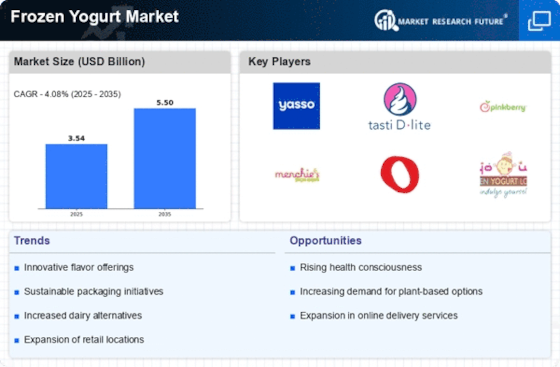
As per Market Research Future analysis, the Frozen Yogurt Market Size was estimated at 3.54 USD Billion in 2024. The Frozen Yogurt industry is projected to grow from 3.684 USD Billion in 2025 to 5.496 USD Billion by 2035, exhibiting a compound annual growth rate (CAGR) of 4.08% during the forecast period 2025 - 2035, supported by evolving frozen yogurt market trends and consumer behavior.

Key Market Trends & Highlights

The Frozen Yogurt Market is experiencing a dynamic shift towards health-conscious and diverse offerings.

  • North America remains the largest market for frozen yogurt, driven by a growing preference for healthier dessert options. The Asia-Pacific region is emerging as the fastest-growing market, fueled by increasing urbanization and changing consumer preferences. Fruit-flavored frozen yogurt continues to dominate the market, while chocolate-flavored options are witnessing rapid growth. Health-conscious choices and diverse flavor profiles are key drivers propelling the market forward.

Market Size & Forecast

2024 Market Size 3.54 (USD Billion)
2035 Market Size 5.496 (USD Billion)
CAGR (2025 - 2035) 4.08%
Largest Regional Market Share in 2024 North America

Major Players

<p>Yasso (US), Tasti D-Lite (US), Pinkberry (US), Menchie's (US), Red Mango (US), Froyo World (US), Sweet Frog (US), Yogurtland (US), Berrypop (US)</p>

Market Trends

The Frozen Yogurt Market is currently experiencing a dynamic evolution, characterized by shifting consumer preferences and an increasing inclination towards healthier dessert options, reinforcing key frozen yogurt market trends. This market appears to be influenced by a growing awareness of health and wellness, prompting consumers to seek alternatives that offer lower fat content and probiotic benefits. As a result, frozen yogurt is often perceived as a more nutritious choice compared to traditional ice cream, which may contribute to its rising popularity. Additionally, the market seems to be benefiting from innovative flavor combinations, experiential retail formats such as frozen yogurt market street concepts and destination-based consumption points including frozen yogurt pike place market, which enhance consumer engagement and visibility. Moreover, the Frozen Yogurt Market is likely to witness a surge in demand for plant-based and dairy-free options, expanding the target market for frozen yogurt across varied consumer segments. These developments strengthen overall frozen yogurt market analysis outcomes. This shift may cater to a diverse range of dietary preferences, including veganism and lactose intolerance. Furthermore, the expansion of frozen yogurt shops and kiosks in urban areas indicates a strategic move to capture the attention of on-the-go consumers. As the market continues to adapt to these evolving trends, it may present opportunities for new entrants and established brands alike to innovate and differentiate their offerings.

Health-Conscious Choices

The Frozen Yogurt Market is increasingly shaped by consumers' desire for healthier dessert alternatives, influencing frozen yogurt market demographics and purchasing decisions. This trend suggests a preference for products that are lower in calories and fat, while also offering probiotic benefits. As health awareness rises, frozen yogurt is often viewed as a more nutritious option compared to traditional ice cream.

Diverse Flavor Profiles

Innovation in flavor offerings is a notable trend within the Frozen Yogurt Market, supporting creative frozen yogurt marketing ideas used by brands to attract adventurous consumers. Brands are experimenting with unique and exotic flavors, appealing to adventurous consumers. This variety not only enhances the consumer experience but also encourages repeat visits to frozen yogurt establishments.

Plant-Based Options

This trend indicates a growing market segment that caters to vegan and lactose-intolera This trend indicates a growing market segment that caters to vegan and lactose-intolerant consumers, allowing brands to expand their reach and appeal to a wider audience.

Frozen Yogurt Market Market Drivers

Plant-Based Options

The emergence of plant-based options is reshaping the Frozen Yogurt Market. With the rise of veganism and lactose intolerance awareness, consumers are increasingly seeking dairy-free alternatives. Frozen yogurt brands that offer plant-based varieties, such as coconut or almond milk-based options, are experiencing a surge in popularity. Market analysis reveals that the demand for plant-based frozen desserts has grown significantly, indicating a shift in consumer preferences. This trend suggests that the Frozen Yogurt Market must adapt to meet the needs of a diverse consumer base, potentially leading to increased innovation and product development.

Seasonal Promotions

Seasonal promotions serve as a vital driver for the Frozen Yogurt Market. Retailers often capitalize on holidays and seasonal events to boost sales through limited-time offers and themed flavors. For instance, summer months typically see a spike in frozen yogurt consumption, prompting businesses to introduce refreshing flavors and promotional deals. Market data shows that establishments that effectively leverage seasonal marketing strategies tend to experience higher foot traffic and sales. This indicates that the Frozen Yogurt Market can benefit from strategic promotional campaigns that align with consumer behavior throughout the year.

Diverse Flavor Profiles

The Frozen Yogurt Market benefits from the growing demand for diverse flavor profiles. Consumers are increasingly seeking unique and innovative flavors that cater to their adventurous palates. This trend is evident in the rise of artisanal frozen yogurt shops that offer a wide array of flavors, from classic vanilla to exotic combinations like lavender honey. Market data indicates that establishments providing a variety of flavors tend to attract a broader customer base, enhancing their competitive edge. As the Frozen Yogurt Market continues to evolve, the emphasis on flavor diversity is likely to play a crucial role in attracting and retaining customers.

Health-Conscious Choices

The increasing consumer inclination towards health-conscious choices is a pivotal driver for the Frozen Yogurt Market. As individuals become more aware of the nutritional content of their food, they are gravitating towards options that offer lower calories and fat content. Frozen yogurt, often perceived as a healthier alternative to traditional ice cream, aligns well with this trend. According to recent data, the demand for low-calorie desserts has surged, with the frozen yogurt segment witnessing a notable increase in sales. This shift in consumer behavior suggests that the Frozen Yogurt Market is likely to expand as more people seek guilt-free indulgence without compromising on taste.

Health Benefits Awareness

The growing awareness of health benefits associated with frozen yogurt is a significant driver for the Frozen Yogurt Market. Consumers are increasingly informed about the probiotic content and potential digestive benefits of frozen yogurt, which can enhance gut health. This awareness is leading to a rise in demand for products that highlight these health benefits. Market Research Future indicates that brands emphasizing the nutritional advantages of their frozen yogurt offerings are likely to attract health-conscious consumers. As this trend continues, the Frozen Yogurt Market may see an increase in product lines that focus on health benefits, further driving market growth.

Market Segment Insights

By Flavor: Fruit (Largest) vs. Chocolate (Fastest-Growing)

<p>Fruit flavors dominate this sector, securing a substantial portion of the market share due to their refreshing taste and perceived health benefits. Fruit flavors dominate this sector, securing a substantial portion of the market share due to their refreshing taste and perceived health benefits. <a href="https://www.marketresearchfuture.com/reports/chocolate-market-10947" target="_blank" rel="noopener">chocolate</a> flavors follow, capturing a significant share as a favorite indulgence, while Vanilla maintains a steady presence. Mixed and Other flavors are also contributing segments, catering to a niche audience that seeks variety and unique taste experiences that complement traditional offerings.</p>

<p>Fruit (Dominant) vs. <a href="https://www.marketresearchfuture.com/reports/chocolate-market-10947" target="_blank" rel="noopener">chocolate</a> (Emerging)</p>

<p>Fruit flavors dominate the Frozen Yogurt Market, while chocolate flavors are gaining popularity among younger audiences, supported by targeted frozen yogurt marketing campaigns These flavors often incorporate real fruit pieces or purees, enhancing the product's attractiveness. On the other hand, Chocolate flavors are emerging rapidly, gaining popularity for their rich, decadent appeal among younger demographics. With the rise of artisanal brands, innovative variations such as dark chocolate and chocolate with added health benefits are becoming more prevalent, driving growth and widening appeal in this segment.</p>

By Formulation: Low-Fat (Largest) vs. Non-Fat (Fastest-Growing)

<p>The formulation segment continues to evolve based on consumer preferences, playing a key role in shaping the frozen yogurt market size globally. Among these, Low-Fat formulations dominate the market, capturing a significant share, primarily driven by growing consumer preferences for healthier dessert options. Following closely, Non-Fat frozen yogurt is gaining traction as more consumers seek indulgent yet guilt-free treats, appealing to those watching their caloric intake. Growth trends within the formulation segment highlight a rise in demand for healthier and innovative frozen yogurt options. The increasing focus on fitness and nutrition, coupled with the rising number of health-conscious consumers, has prompted manufacturers to enhance their product lines. Additionally, sugar-free and organic variations are emerging as key trends, reflecting consumer demand for more natural and reduced-calorie options. As these preferences evolve, the market is expected to adapt quickly, benefiting the formulation segment significantly.</p>

<p>Low-Fat (Dominant) vs. Non-Fat (Emerging)</p>

<p>The Low-Fat frozen yogurt segment is currently the dominant player within the formulation category, appealing to health-conscious consumers looking for indulgent yet lighter dessert alternatives. This formulation maintains a rich flavor profile while offering reduced fat content, making it a preferred choice for many. On the other hand, the Non-Fat segment is emerging swiftly, capturing the attention of consumers who desire a completely guilt-free experience. Non-Fat options provide a similar taste profile as traditional formulations but without any fat content, positioning them as an attractive alternative for those seeking weight management solutions. This dynamic interplay between Low-Fat and Non-Fat formulations reflects a broader trend in consumer behavior towards healthier lifestyle choices in the Frozen Yogurt Market.</p>

By Distribution Channel: Supermarkets (Largest) vs. Online Retail (Fastest-Growing)

<p>In the Frozen Yogurt Market, the distribution channels play a crucial role in reaching consumers. Supermarkets remain dominant, while online retail supports modern frozen yogurt marketing plan executions focused on convenience and personalization. Online retail is emerging, attracting a growing customer base by providing convenience and a wider selection of frozen yogurt flavors and brands. Other channels, such as convenience stores, specialty stores, and food service, contribute significantly but do not match the extensive networks of supermarkets and the rapid rise of online platforms. The growth trends indicate a notable shift towards online retail, which is becoming the fastest-growing channel as consumers increasingly prefer the convenience of shopping online. Factors driving this trend include technological advancements, increased internet penetration, and changing consumer preferences towards home delivery services. Supermarkets continue to thrive due to their established presence, but the online sector is gaining traction at an unprecedented pace, shaping the future dynamics of the frozen yogurt market.</p>

<p>Supermarkets (Dominant) vs. Online Retail (Emerging)</p>

<p>Supermarkets hold a dominant position in the Frozen Yogurt Market, leveraging their broad product range and strategic locations to appeal to a wide audience. They are seen as the go-to destination for frozen treats, benefiting from consumer habits that favor in-store shopping for instant gratification and variety. On the other hand, online retail represents an emerging segment, catering to tech-savvy customers who prioritize convenience and the ability to shop from home. This channel offers personalized shopping experiences, subscription options, and home delivery services, enabling it to cater effectively to the demands of a modern consumer. While supermarkets remain a cornerstone of sales, online retail's rise denotes a significant shift in consumer buying behavior.</p>

By End Use: Household (Largest) vs. Food Service (Fastest-Growing)

<p>The household segment leads demand, while food service adoption reflects evolving frozen yogurt market demographics and lifestyle shifts The food service segment is following closely, experiencing substantial growth as establishments introduce frozen yogurt options to attract a health-oriented customer base. The institutional segment, while smaller, contributes to market dynamics through demand from educational and healthcare facilities offering healthier dessert alternatives.</p>

<p>Household (Dominant) vs. Food Service (Emerging)</p>

<p>The household segment is characterized by its dominance in the Frozen Yogurt Market, appealing to health-conscious consumers looking for quick and nutritious dessert solutions. Its popularity is fueled by the trend of home consumption and convenience offerings, allowing families to easily include frozen yogurt in their diets. Conversely, the food service segment is emerging rapidly, as restaurants and cafes expand their menus to include frozen yogurt, catering to customers seeking healthier dessert options. This segment benefits from growing trends toward customization and artisan products, positioning it as an exciting frontier within the market.</p>

Get more detailed insights about Frozen Yogurt Market Research Report - Forecast till 2035

Regional Insights

The Frozen Yogurt Market revenue is projected to grow significantly over the coming years, with North America dominating the market. Europe and APAC continue to gain momentum, strengthening the global frozen yogurt market footprint.  The Frozen Yogurt Market revenue is projected to grow significantly over the coming years, with North America dominating the market, valued at 1.17 USD Billion in 2024 and expected to reach 1.613 USD Billion by 2035. This represents a substantial share, highlighting the region's robust consumer base and preference for frozen yogurt as a healthier dessert option.

Europe followed closely, with a market value of 0.936 USD Billion in 2024, anticipated to grow to 1.32 USD Billion by 2035, driven by rising health consciousness and innovative flavors.The Asia-Pacific (APAC) region is also gaining traction, valued at 0.546 USD Billion in 2024, with growth expected to 0.807 USD Billion by 2035, thanks to increasing lifestyle changes and demand for low-fat alternatives. 

South America was the least dominant market, valued at 0.312 USD Billion in 2024 but projected to rise to 0.44 USD Billion by 2035, indicating the potential for growth as consumer preferences shift. Middle East and Africa (MEA) presented a significant opportunity as well, with growth from 0.577 USD Billion in 2024 to 1.32 USD Billion in 2035, driven by younger demographics and expanding urban populations.The diversity in these regions, coupled with changing consumer habits and preferences, contributes to varied growth rates within the Frozen Yogurt Market segmentation.Urban retail exposure, experiential outlets, and promotional visibility—such as menchie's frozen yogurt heb spring market photos—enhance brand engagement and regional penetration.

Key Players and Competitive Insights

The Frozen Yogurt Market continues to evolve as companies focus on differentiation, consumer engagement, and brand positioning. Strategic branding decisions are influenced by frozen yogurt marketing strategy, digital visibility, and experiential retail presence. Understanding according to marketers what happens when a frozen yogurt brand aligns product innovation with lifestyle branding has become critical for competitive success.  This dynamic market is characterized by a variety of products, flavors, and toppings, catering to diverse consumer tastes and dietary requirements. The competitive landscape is marked by the presence of numerous players, ranging from established brands to innovative startups. These companies are continuously seeking to differentiate themselves through product innovation, marketing strategies, and expansions into new geographical regions. As the market matures, businesses are focusing on building strong brand identities and developing customer loyalty while responding to ongoing trends such as plant-based diets and clean labels. Coconut Grove has positioned itself as a strong contender in the Frozen Yogurt Market, capitalizing on the growing demand for healthier dessert alternatives. The company's strength lies in its unique offerings of coconut-based frozen yogurt products, which not only appeal to dairy-free consumers but also cater to those seeking lower-calorie options.This specialization allows Coconut Grove to attract a niche audience, enhancing its market presence through targeted marketing strategies and collaborations with health-conscious retailers. The brand's commitment to quality and flavor innovation sets it apart, allowing it to maintain a loyal customer base while expanding its reach into new markets. By focusing on the health benefits of coconut, such as its natural sweetness and nutritional value, Coconut Grove continues to strengthen its competitive position in the dynamic frozen yogurt landscape. Froyo World has established itself as a notable player in the Frozen Yogurt Market with a diverse range of products and services designed to meet varying consumer demands. The company offers a wide selection of frozen yogurt flavors and toppings that cater to different taste preferences and dietary needs, including sugar-free and vegan options.This versatility has contributed to Froyo World's significant market presence across various regions, enabling it to tap into both traditional frozen yogurt consumers and those seeking healthier alternatives. Additionally, Froyo World has engaged in strategic mergers and acquisitions to bolster its operational capabilities and market reach. By integrating cutting-edge technology and enhancing customer experiences through innovative store designs and promotional campaigns, Froyo World continues to solidify its position in the competitive frozen yogurt space while capturing the interests of global consumers seeking indulgent yet healthier dessert options.

Key Companies in the Frozen Yogurt Market include

Industry Developments

Recent developments reflect growing investments in branding, retail expansion, and innovation, aligning with insights from frozen yogurt market research and evolving consumer behavior. For instance, in April 2023, Yogurtland announced a strategic partnership with a new supplier to enhance its product line, which is expected to increase market reach. Similarly, in June 2023, Sweet Frog expanded its footprint by acquiring several franchises, reflecting the growing consumer demand in the sector. The health-conscious trend is driving brands like Yasso and Red Mango to innovate their offerings, leading to increased market valuation and enhanced competition. 

Major players like TCBY and Menchie's are also adapting by introducing new flavors and healthier options. Over the past two to three years, the market has seen a rise in valuation due to increased consumer preference for healthier snack options, with February 2022 marking a notable increase in online sales attributed to changing buying behaviors during the pandemic. 

Additionally, increased investments in Research and Development are shaping product differentiation strategies, allowing companies such as Pinkberry and Froyo World to cater to diverse consumer palates globally while ensuring sustainable practices. This evolution within the Frozen Yogurt Market underscores the critical shifts in consumer trends and company strategies.

Future Outlook

Frozen Yogurt Market Future Outlook

<p>The Frozen Yogurt Market is projected to grow at a 4.08% CAGR from 2025 to 2035, driven by health trends, product innovation, and expanding distribution channels highlighted in frozen yogurt market analysis.</p>

New opportunities lie in:

  • <p>Development of plant-based frozen yogurt lines Implementation of mobile ordering and delivery systems Expansion into emerging markets with localized flavors</p>

<p>By 2035, the Frozen Yogurt Market is expected to achieve robust growth and diversification across the global frozen yogurt market.</p>

Market Segmentation

Frozen Yogurt Market Flavor Outlook

  • Fruit
  • Chocolate
  • Vanilla
  • Mixed
  • Others

Frozen Yogurt Market End Use Outlook

  • Household
  • Food Service
  • Institutional

Frozen Yogurt Market Formulation Outlook

  • Low-Fat
  • Non-Fat
  • Regular
  • Sugar-Free
  • Organic

Frozen Yogurt Market Distribution Channel Outlook

  • Supermarkets
  • Online Retail
  • Convenience Stores
  • Specialty Stores
  • Food Service

Report Scope

MARKET SIZE 2024 3.54(USD Billion)
MARKET SIZE 2025 3.684(USD Billion)
MARKET SIZE 2035 5.496(USD Billion)
COMPOUND ANNUAL GROWTH RATE (CAGR) 4.08% (2025 - 2035)
REPORT COVERAGE Revenue Forecast, Competitive Landscape, Growth Factors, and Trends
BASE YEAR 2024
Market Forecast Period 2025 - 2035
Historical Data 2019 - 2024
Market Forecast Units USD Billion
Key Companies Profiled Yasso (US), Tasti D-Lite (US), Pinkberry (US), Menchie's (US), Red Mango (US), Froyo World (US), Sweet Frog (US), Yogurtland (US), Berrypop (US)
Segments Covered Flavor, Formulation, Distribution Channel, End Use, Regional
Key Market Opportunities Growing consumer demand for healthier dessert alternatives drives innovation in the Frozen Yogurt Market.
Key Market Dynamics Rising consumer preference for healthier dessert options drives innovation and competition in the frozen yogurt market.
Countries Covered North America, Europe, APAC, South America, MEA

FAQs

What is the current valuation of the Frozen Yogurt Market in 2024?

<p>The Frozen Yogurt Market was valued at 3.54 USD Billion in 2024.</p>

What is the projected market size for the Frozen Yogurt Market by 2035?

<p>The market is projected to reach 5.496 USD Billion by 2035.</p>

What is the expected CAGR for the Frozen Yogurt Market during the forecast period 2025 - 2035?

<p>The expected CAGR for the Frozen Yogurt Market during 2025 - 2035 is 4.08%.</p>

Which distribution channel is anticipated to generate the highest revenue in the Frozen Yogurt Market?

<p>Supermarkets are expected to generate the highest revenue, with a valuation projected between 1.5 and 2.3 USD Billion.</p>

How do the different flavors of frozen yogurt compare in terms of market valuation?

<p>In 2024, Vanilla led the flavor segment with a valuation of 0.9 to 1.4 USD Billion, followed by Fruit at 0.85 to 1.25 USD Billion.</p>

What are the key players in the Frozen Yogurt Market?

<p>Key players include Yasso, Tasti D-Lite, Pinkberry, Menchie's, Red Mango, Froyo World, Sweet Frog, Yogurtland, and Berrypop.</p>

What is the market valuation for organic frozen yogurt in 2024?

<p>The market valuation for organic frozen yogurt ranged from 0.54 to 0.84 USD Billion in 2024.</p>

Which end-use segment is projected to have the highest growth in the Frozen Yogurt Market?

<p>The household end-use segment is projected to grow significantly, with a valuation expected between 1.77 and 2.66 USD Billion.</p>

What is the market outlook for online retail in the Frozen Yogurt Market?

<p>Online retail is anticipated to grow, with a projected valuation between 0.5 and 1.0 USD Billion.</p>

How does the performance of low-fat frozen yogurt compare to regular frozen yogurt?

<p>In 2024, regular frozen yogurt had a valuation of 1.5 to 2.25 USD Billion, while low-fat frozen yogurt was valued between 0.5 and 0.75 USD Billion.</p>

  1. SECTION I: EXECUTIVE SUMMARY AND KEY HIGHLIGHTS
    1. | 1.1 EXECUTIVE SUMMARY
    2. | | 1.1.1 Market Overview
    3. | | 1.1.2 Key Findings
    4. | | 1.1.3 Market Segmentation
    5. | | 1.1.4 Competitive Landscape
    6. | | 1.1.5 Challenges and Opportunities
    7. | | 1.1.6 Future Outlook
  2. SECTION II: SCOPING, METHODOLOGY AND MARKET STRUCTURE
    1. | 2.1 MARKET INTRODUCTION
    2. | | 2.1.1 Definition
    3. | | 2.1.2 Scope of the study
    4. | | | 2.1.2.1 Research Objective
    5. | | | 2.1.2.2 Assumption
    6. | | | 2.1.2.3 Limitations
    7. | 2.2 RESEARCH METHODOLOGY
    8. | | 2.2.1 Overview
    9. | | 2.2.2 Data Mining
    10. | | 2.2.3 Secondary Research
    11. | | 2.2.4 Primary Research
    12. | | | 2.2.4.1 Primary Interviews and Information Gathering Process
    13. | | | 2.2.4.2 Breakdown of Primary Respondents
    14. | | 2.2.5 Forecasting Model
    15. | | 2.2.6 Market Size Estimation
    16. | | | 2.2.6.1 Bottom-Up Approach
    17. | | | 2.2.6.2 Top-Down Approach
    18. | | 2.2.7 Data Triangulation
    19. | | 2.2.8 Validation
  3. SECTION III: QUALITATIVE ANALYSIS
    1. | 3.1 MARKET DYNAMICS
    2. | | 3.1.1 Overview
    3. | | 3.1.2 Drivers
    4. | | 3.1.3 Restraints
    5. | | 3.1.4 Opportunities
    6. | 3.2 MARKET FACTOR ANALYSIS
    7. | | 3.2.1 Value chain Analysis
    8. | | 3.2.2 Porter's Five Forces Analysis
    9. | | | 3.2.2.1 Bargaining Power of Suppliers
    10. | | | 3.2.2.2 Bargaining Power of Buyers
    11. | | | 3.2.2.3 Threat of New Entrants
    12. | | | 3.2.2.4 Threat of Substitutes
    13. | | | 3.2.2.5 Intensity of Rivalry
    14. | | 3.2.3 COVID-19 Impact Analysis
    15. | | | 3.2.3.1 Market Impact Analysis
    16. | | | 3.2.3.2 Regional Impact
    17. | | | 3.2.3.3 Opportunity and Threat Analysis
  4. SECTION IV: QUANTITATIVE ANALYSIS
    1. | 4.1 Food, Beverages & Nutrition, BY Flavor (USD Billion)
    2. | | 4.1.1 Fruit
    3. | | 4.1.2 Chocolate
    4. | | 4.1.3 Vanilla
    5. | | 4.1.4 Mixed
    6. | | 4.1.5 Others
    7. | 4.2 Food, Beverages & Nutrition, BY Formulation (USD Billion)
    8. | | 4.2.1 Low-Fat
    9. | | 4.2.2 Non-Fat
    10. | | 4.2.3 Regular
    11. | | 4.2.4 Sugar-Free
    12. | | 4.2.5 Organic
    13. | 4.3 Food, Beverages & Nutrition, BY Distribution Channel (USD Billion)
    14. | | 4.3.1 Supermarkets
    15. | | 4.3.2 Online Retail
    16. | | 4.3.3 Convenience Stores
    17. | | 4.3.4 Specialty Stores
    18. | | 4.3.5 Food Service
    19. | 4.4 Food, Beverages & Nutrition, BY End Use (USD Billion)
    20. | | 4.4.1 Household
    21. | | 4.4.2 Food Service
    22. | | 4.4.3 Institutional
    23. | 4.5 Food, Beverages & Nutrition, BY Region (USD Billion)
    24. | | 4.5.1 North America
    25. | | | 4.5.1.1 US
    26. | | | 4.5.1.2 Canada
    27. | | 4.5.2 Europe
    28. | | | 4.5.2.1 Germany
    29. | | | 4.5.2.2 UK
    30. | | | 4.5.2.3 France
    31. | | | 4.5.2.4 Russia
    32. | | | 4.5.2.5 Italy
    33. | | | 4.5.2.6 Spain
    34. | | | 4.5.2.7 Rest of Europe
    35. | | 4.5.3 APAC
    36. | | | 4.5.3.1 China
    37. | | | 4.5.3.2 India
    38. | | | 4.5.3.3 Japan
    39. | | | 4.5.3.4 South Korea
    40. | | | 4.5.3.5 Malaysia
    41. | | | 4.5.3.6 Thailand
    42. | | | 4.5.3.7 Indonesia
    43. | | | 4.5.3.8 Rest of APAC
    44. | | 4.5.4 South America
    45. | | | 4.5.4.1 Brazil
    46. | | | 4.5.4.2 Mexico
    47. | | | 4.5.4.3 Argentina
    48. | | | 4.5.4.4 Rest of South America
    49. | | 4.5.5 MEA
    50. | | | 4.5.5.1 GCC Countries
    51. | | | 4.5.5.2 South Africa
    52. | | | 4.5.5.3 Rest of MEA
  5. SECTION V: COMPETITIVE ANALYSIS
    1. | 5.1 Competitive Landscape
    2. | | 5.1.1 Overview
    3. | | 5.1.2 Competitive Analysis
    4. | | 5.1.3 Market share Analysis
    5. | | 5.1.4 Major Growth Strategy in the Food, Beverages & Nutrition
    6. | | 5.1.5 Competitive Benchmarking
    7. | | 5.1.6 Leading Players in Terms of Number of Developments in the Food, Beverages & Nutrition
    8. | | 5.1.7 Key developments and growth strategies
    9. | | | 5.1.7.1 New Product Launch/Service Deployment
    10. | | | 5.1.7.2 Merger & Acquisitions
    11. | | | 5.1.7.3 Joint Ventures
    12. | | 5.1.8 Major Players Financial Matrix
    13. | | | 5.1.8.1 Sales and Operating Income
    14. | | | 5.1.8.2 Major Players R&D Expenditure. 2023
    15. | 5.2 Company Profiles
    16. | | 5.2.1 Yasso (US)
    17. | | | 5.2.1.1 Financial Overview
    18. | | | 5.2.1.2 Products Offered
    19. | | | 5.2.1.3 Key Developments
    20. | | | 5.2.1.4 SWOT Analysis
    21. | | | 5.2.1.5 Key Strategies
    22. | | 5.2.2 Tasti D-Lite (US)
    23. | | | 5.2.2.1 Financial Overview
    24. | | | 5.2.2.2 Products Offered
    25. | | | 5.2.2.3 Key Developments
    26. | | | 5.2.2.4 SWOT Analysis
    27. | | | 5.2.2.5 Key Strategies
    28. | | 5.2.3 Pinkberry (US)
    29. | | | 5.2.3.1 Financial Overview
    30. | | | 5.2.3.2 Products Offered
    31. | | | 5.2.3.3 Key Developments
    32. | | | 5.2.3.4 SWOT Analysis
    33. | | | 5.2.3.5 Key Strategies
    34. | | 5.2.4 Menchie's (US)
    35. | | | 5.2.4.1 Financial Overview
    36. | | | 5.2.4.2 Products Offered
    37. | | | 5.2.4.3 Key Developments
    38. | | | 5.2.4.4 SWOT Analysis
    39. | | | 5.2.4.5 Key Strategies
    40. | | 5.2.5 Red Mango (US)
    41. | | | 5.2.5.1 Financial Overview
    42. | | | 5.2.5.2 Products Offered
    43. | | | 5.2.5.3 Key Developments
    44. | | | 5.2.5.4 SWOT Analysis
    45. | | | 5.2.5.5 Key Strategies
    46. | | 5.2.6 Froyo World (US)
    47. | | | 5.2.6.1 Financial Overview
    48. | | | 5.2.6.2 Products Offered
    49. | | | 5.2.6.3 Key Developments
    50. | | | 5.2.6.4 SWOT Analysis
    51. | | | 5.2.6.5 Key Strategies
    52. | | 5.2.7 Sweet Frog (US)
    53. | | | 5.2.7.1 Financial Overview
    54. | | | 5.2.7.2 Products Offered
    55. | | | 5.2.7.3 Key Developments
    56. | | | 5.2.7.4 SWOT Analysis
    57. | | | 5.2.7.5 Key Strategies
    58. | | 5.2.8 Yogurtland (US)
    59. | | | 5.2.8.1 Financial Overview
    60. | | | 5.2.8.2 Products Offered
    61. | | | 5.2.8.3 Key Developments
    62. | | | 5.2.8.4 SWOT Analysis
    63. | | | 5.2.8.5 Key Strategies
    64. | | 5.2.9 Berrypop (US)
    65. | | | 5.2.9.1 Financial Overview
    66. | | | 5.2.9.2 Products Offered
    67. | | | 5.2.9.3 Key Developments
    68. | | | 5.2.9.4 SWOT Analysis
    69. | | | 5.2.9.5 Key Strategies
    70. | 5.3 Appendix
    71. | | 5.3.1 References
    72. | | 5.3.2 Related Reports
  6. LIST OF FIGURES
    1. | 6.1 MARKET SYNOPSIS
    2. | 6.2 NORTH AMERICA MARKET ANALYSIS
    3. | 6.3 US MARKET ANALYSIS BY FLAVOR
    4. | 6.4 US MARKET ANALYSIS BY FORMULATION
    5. | 6.5 US MARKET ANALYSIS BY DISTRIBUTION CHANNEL
    6. | 6.6 US MARKET ANALYSIS BY END USE
    7. | 6.7 CANADA MARKET ANALYSIS BY FLAVOR
    8. | 6.8 CANADA MARKET ANALYSIS BY FORMULATION
    9. | 6.9 CANADA MARKET ANALYSIS BY DISTRIBUTION CHANNEL
    10. | 6.10 CANADA MARKET ANALYSIS BY END USE
    11. | 6.11 EUROPE MARKET ANALYSIS
    12. | 6.12 GERMANY MARKET ANALYSIS BY FLAVOR
    13. | 6.13 GERMANY MARKET ANALYSIS BY FORMULATION
    14. | 6.14 GERMANY MARKET ANALYSIS BY DISTRIBUTION CHANNEL
    15. | 6.15 GERMANY MARKET ANALYSIS BY END USE
    16. | 6.16 UK MARKET ANALYSIS BY FLAVOR
    17. | 6.17 UK MARKET ANALYSIS BY FORMULATION
    18. | 6.18 UK MARKET ANALYSIS BY DISTRIBUTION CHANNEL
    19. | 6.19 UK MARKET ANALYSIS BY END USE
    20. | 6.20 FRANCE MARKET ANALYSIS BY FLAVOR
    21. | 6.21 FRANCE MARKET ANALYSIS BY FORMULATION
    22. | 6.22 FRANCE MARKET ANALYSIS BY DISTRIBUTION CHANNEL
    23. | 6.23 FRANCE MARKET ANALYSIS BY END USE
    24. | 6.24 RUSSIA MARKET ANALYSIS BY FLAVOR
    25. | 6.25 RUSSIA MARKET ANALYSIS BY FORMULATION
    26. | 6.26 RUSSIA MARKET ANALYSIS BY DISTRIBUTION CHANNEL
    27. | 6.27 RUSSIA MARKET ANALYSIS BY END USE
    28. | 6.28 ITALY MARKET ANALYSIS BY FLAVOR
    29. | 6.29 ITALY MARKET ANALYSIS BY FORMULATION
    30. | 6.30 ITALY MARKET ANALYSIS BY DISTRIBUTION CHANNEL
    31. | 6.31 ITALY MARKET ANALYSIS BY END USE
    32. | 6.32 SPAIN MARKET ANALYSIS BY FLAVOR
    33. | 6.33 SPAIN MARKET ANALYSIS BY FORMULATION
    34. | 6.34 SPAIN MARKET ANALYSIS BY DISTRIBUTION CHANNEL
    35. | 6.35 SPAIN MARKET ANALYSIS BY END USE
    36. | 6.36 REST OF EUROPE MARKET ANALYSIS BY FLAVOR
    37. | 6.37 REST OF EUROPE MARKET ANALYSIS BY FORMULATION
    38. | 6.38 REST OF EUROPE MARKET ANALYSIS BY DISTRIBUTION CHANNEL
    39. | 6.39 REST OF EUROPE MARKET ANALYSIS BY END USE
    40. | 6.40 APAC MARKET ANALYSIS
    41. | 6.41 CHINA MARKET ANALYSIS BY FLAVOR
    42. | 6.42 CHINA MARKET ANALYSIS BY FORMULATION
    43. | 6.43 CHINA MARKET ANALYSIS BY DISTRIBUTION CHANNEL
    44. | 6.44 CHINA MARKET ANALYSIS BY END USE
    45. | 6.45 INDIA MARKET ANALYSIS BY FLAVOR
    46. | 6.46 INDIA MARKET ANALYSIS BY FORMULATION
    47. | 6.47 INDIA MARKET ANALYSIS BY DISTRIBUTION CHANNEL
    48. | 6.48 INDIA MARKET ANALYSIS BY END USE
    49. | 6.49 JAPAN MARKET ANALYSIS BY FLAVOR
    50. | 6.50 JAPAN MARKET ANALYSIS BY FORMULATION
    51. | 6.51 JAPAN MARKET ANALYSIS BY DISTRIBUTION CHANNEL
    52. | 6.52 JAPAN MARKET ANALYSIS BY END USE
    53. | 6.53 SOUTH KOREA MARKET ANALYSIS BY FLAVOR
    54. | 6.54 SOUTH KOREA MARKET ANALYSIS BY FORMULATION
    55. | 6.55 SOUTH KOREA MARKET ANALYSIS BY DISTRIBUTION CHANNEL
    56. | 6.56 SOUTH KOREA MARKET ANALYSIS BY END USE
    57. | 6.57 MALAYSIA MARKET ANALYSIS BY FLAVOR
    58. | 6.58 MALAYSIA MARKET ANALYSIS BY FORMULATION
    59. | 6.59 MALAYSIA MARKET ANALYSIS BY DISTRIBUTION CHANNEL
    60. | 6.60 MALAYSIA MARKET ANALYSIS BY END USE
    61. | 6.61 THAILAND MARKET ANALYSIS BY FLAVOR
    62. | 6.62 THAILAND MARKET ANALYSIS BY FORMULATION
    63. | 6.63 THAILAND MARKET ANALYSIS BY DISTRIBUTION CHANNEL
    64. | 6.64 THAILAND MARKET ANALYSIS BY END USE
    65. | 6.65 INDONESIA MARKET ANALYSIS BY FLAVOR
    66. | 6.66 INDONESIA MARKET ANALYSIS BY FORMULATION
    67. | 6.67 INDONESIA MARKET ANALYSIS BY DISTRIBUTION CHANNEL
    68. | 6.68 INDONESIA MARKET ANALYSIS BY END USE
    69. | 6.69 REST OF APAC MARKET ANALYSIS BY FLAVOR
    70. | 6.70 REST OF APAC MARKET ANALYSIS BY FORMULATION
    71. | 6.71 REST OF APAC MARKET ANALYSIS BY DISTRIBUTION CHANNEL
    72. | 6.72 REST OF APAC MARKET ANALYSIS BY END USE
    73. | 6.73 SOUTH AMERICA MARKET ANALYSIS
    74. | 6.74 BRAZIL MARKET ANALYSIS BY FLAVOR
    75. | 6.75 BRAZIL MARKET ANALYSIS BY FORMULATION
    76. | 6.76 BRAZIL MARKET ANALYSIS BY DISTRIBUTION CHANNEL
    77. | 6.77 BRAZIL MARKET ANALYSIS BY END USE
    78. | 6.78 MEXICO MARKET ANALYSIS BY FLAVOR
    79. | 6.79 MEXICO MARKET ANALYSIS BY FORMULATION
    80. | 6.80 MEXICO MARKET ANALYSIS BY DISTRIBUTION CHANNEL
    81. | 6.81 MEXICO MARKET ANALYSIS BY END USE
    82. | 6.82 ARGENTINA MARKET ANALYSIS BY FLAVOR
    83. | 6.83 ARGENTINA MARKET ANALYSIS BY FORMULATION
    84. | 6.84 ARGENTINA MARKET ANALYSIS BY DISTRIBUTION CHANNEL
    85. | 6.85 ARGENTINA MARKET ANALYSIS BY END USE
    86. | 6.86 REST OF SOUTH AMERICA MARKET ANALYSIS BY FLAVOR
    87. | 6.87 REST OF SOUTH AMERICA MARKET ANALYSIS BY FORMULATION
    88. | 6.88 REST OF SOUTH AMERICA MARKET ANALYSIS BY DISTRIBUTION CHANNEL
    89. | 6.89 REST OF SOUTH AMERICA MARKET ANALYSIS BY END USE
    90. | 6.90 MEA MARKET ANALYSIS
    91. | 6.91 GCC COUNTRIES MARKET ANALYSIS BY FLAVOR
    92. | 6.92 GCC COUNTRIES MARKET ANALYSIS BY FORMULATION
    93. | 6.93 GCC COUNTRIES MARKET ANALYSIS BY DISTRIBUTION CHANNEL
    94. | 6.94 GCC COUNTRIES MARKET ANALYSIS BY END USE
    95. | 6.95 SOUTH AFRICA MARKET ANALYSIS BY FLAVOR
    96. | 6.96 SOUTH AFRICA MARKET ANALYSIS BY FORMULATION
    97. | 6.97 SOUTH AFRICA MARKET ANALYSIS BY DISTRIBUTION CHANNEL
    98. | 6.98 SOUTH AFRICA MARKET ANALYSIS BY END USE
    99. | 6.99 REST OF MEA MARKET ANALYSIS BY FLAVOR
    100. | 6.100 REST OF MEA MARKET ANALYSIS BY FORMULATION
    101. | 6.101 REST OF MEA MARKET ANALYSIS BY DISTRIBUTION CHANNEL
    102. | 6.102 REST OF MEA MARKET ANALYSIS BY END USE
    103. | 6.103 KEY BUYING CRITERIA OF FOOD, BEVERAGES & NUTRITION
    104. | 6.104 RESEARCH PROCESS OF MRFR
    105. | 6.105 DRO ANALYSIS OF FOOD, BEVERAGES & NUTRITION
    106. | 6.106 DRIVERS IMPACT ANALYSIS: FOOD, BEVERAGES & NUTRITION
    107. | 6.107 RESTRAINTS IMPACT ANALYSIS: FOOD, BEVERAGES & NUTRITION
    108. | 6.108 SUPPLY / VALUE CHAIN: FOOD, BEVERAGES & NUTRITION
    109. | 6.109 FOOD, BEVERAGES & NUTRITION, BY FLAVOR, 2024 (% SHARE)
    110. | 6.110 FOOD, BEVERAGES & NUTRITION, BY FLAVOR, 2024 TO 2035 (USD Billion)
    111. | 6.111 FOOD, BEVERAGES & NUTRITION, BY FORMULATION, 2024 (% SHARE)
    112. | 6.112 FOOD, BEVERAGES & NUTRITION, BY FORMULATION, 2024 TO 2035 (USD Billion)
    113. | 6.113 FOOD, BEVERAGES & NUTRITION, BY DISTRIBUTION CHANNEL, 2024 (% SHARE)
    114. | 6.114 FOOD, BEVERAGES & NUTRITION, BY DISTRIBUTION CHANNEL, 2024 TO 2035 (USD Billion)
    115. | 6.115 FOOD, BEVERAGES & NUTRITION, BY END USE, 2024 (% SHARE)
    116. | 6.116 FOOD, BEVERAGES & NUTRITION, BY END USE, 2024 TO 2035 (USD Billion)
    117. | 6.117 BENCHMARKING OF MAJOR COMPETITORS
  7. LIST OF TABLES
    1. | 7.1 LIST OF ASSUMPTIONS
    2. | | 7.1.1
    3. | 7.2 North America MARKET SIZE ESTIMATES; FORECAST
    4. | | 7.2.1 BY FLAVOR, 2025-2035 (USD Billion)
    5. | | 7.2.2 BY FORMULATION, 2025-2035 (USD Billion)
    6. | | 7.2.3 BY DISTRIBUTION CHANNEL, 2025-2035 (USD Billion)
    7. | | 7.2.4 BY END USE, 2025-2035 (USD Billion)
    8. | 7.3 US MARKET SIZE ESTIMATES; FORECAST
    9. | | 7.3.1 BY FLAVOR, 2025-2035 (USD Billion)
    10. | | 7.3.2 BY FORMULATION, 2025-2035 (USD Billion)
    11. | | 7.3.3 BY DISTRIBUTION CHANNEL, 2025-2035 (USD Billion)
    12. | | 7.3.4 BY END USE, 2025-2035 (USD Billion)
    13. | 7.4 Canada MARKET SIZE ESTIMATES; FORECAST
    14. | | 7.4.1 BY FLAVOR, 2025-2035 (USD Billion)
    15. | | 7.4.2 BY FORMULATION, 2025-2035 (USD Billion)
    16. | | 7.4.3 BY DISTRIBUTION CHANNEL, 2025-2035 (USD Billion)
    17. | | 7.4.4 BY END USE, 2025-2035 (USD Billion)
    18. | 7.5 Europe MARKET SIZE ESTIMATES; FORECAST
    19. | | 7.5.1 BY FLAVOR, 2025-2035 (USD Billion)
    20. | | 7.5.2 BY FORMULATION, 2025-2035 (USD Billion)
    21. | | 7.5.3 BY DISTRIBUTION CHANNEL, 2025-2035 (USD Billion)
    22. | | 7.5.4 BY END USE, 2025-2035 (USD Billion)
    23. | 7.6 Germany MARKET SIZE ESTIMATES; FORECAST
    24. | | 7.6.1 BY FLAVOR, 2025-2035 (USD Billion)
    25. | | 7.6.2 BY FORMULATION, 2025-2035 (USD Billion)
    26. | | 7.6.3 BY DISTRIBUTION CHANNEL, 2025-2035 (USD Billion)
    27. | | 7.6.4 BY END USE, 2025-2035 (USD Billion)
    28. | 7.7 UK MARKET SIZE ESTIMATES; FORECAST
    29. | | 7.7.1 BY FLAVOR, 2025-2035 (USD Billion)
    30. | | 7.7.2 BY FORMULATION, 2025-2035 (USD Billion)
    31. | | 7.7.3 BY DISTRIBUTION CHANNEL, 2025-2035 (USD Billion)
    32. | | 7.7.4 BY END USE, 2025-2035 (USD Billion)
    33. | 7.8 France MARKET SIZE ESTIMATES; FORECAST
    34. | | 7.8.1 BY FLAVOR, 2025-2035 (USD Billion)
    35. | | 7.8.2 BY FORMULATION, 2025-2035 (USD Billion)
    36. | | 7.8.3 BY DISTRIBUTION CHANNEL, 2025-2035 (USD Billion)
    37. | | 7.8.4 BY END USE, 2025-2035 (USD Billion)
    38. | 7.9 Russia MARKET SIZE ESTIMATES; FORECAST
    39. | | 7.9.1 BY FLAVOR, 2025-2035 (USD Billion)
    40. | | 7.9.2 BY FORMULATION, 2025-2035 (USD Billion)
    41. | | 7.9.3 BY DISTRIBUTION CHANNEL, 2025-2035 (USD Billion)
    42. | | 7.9.4 BY END USE, 2025-2035 (USD Billion)
    43. | 7.10 Italy MARKET SIZE ESTIMATES; FORECAST
    44. | | 7.10.1 BY FLAVOR, 2025-2035 (USD Billion)
    45. | | 7.10.2 BY FORMULATION, 2025-2035 (USD Billion)
    46. | | 7.10.3 BY DISTRIBUTION CHANNEL, 2025-2035 (USD Billion)
    47. | | 7.10.4 BY END USE, 2025-2035 (USD Billion)
    48. | 7.11 Spain MARKET SIZE ESTIMATES; FORECAST
    49. | | 7.11.1 BY FLAVOR, 2025-2035 (USD Billion)
    50. | | 7.11.2 BY FORMULATION, 2025-2035 (USD Billion)
    51. | | 7.11.3 BY DISTRIBUTION CHANNEL, 2025-2035 (USD Billion)
    52. | | 7.11.4 BY END USE, 2025-2035 (USD Billion)
    53. | 7.12 Rest of Europe MARKET SIZE ESTIMATES; FORECAST
    54. | | 7.12.1 BY FLAVOR, 2025-2035 (USD Billion)
    55. | | 7.12.2 BY FORMULATION, 2025-2035 (USD Billion)
    56. | | 7.12.3 BY DISTRIBUTION CHANNEL, 2025-2035 (USD Billion)
    57. | | 7.12.4 BY END USE, 2025-2035 (USD Billion)
    58. | 7.13 APAC MARKET SIZE ESTIMATES; FORECAST
    59. | | 7.13.1 BY FLAVOR, 2025-2035 (USD Billion)
    60. | | 7.13.2 BY FORMULATION, 2025-2035 (USD Billion)
    61. | | 7.13.3 BY DISTRIBUTION CHANNEL, 2025-2035 (USD Billion)
    62. | | 7.13.4 BY END USE, 2025-2035 (USD Billion)
    63. | 7.14 China MARKET SIZE ESTIMATES; FORECAST
    64. | | 7.14.1 BY FLAVOR, 2025-2035 (USD Billion)
    65. | | 7.14.2 BY FORMULATION, 2025-2035 (USD Billion)
    66. | | 7.14.3 BY DISTRIBUTION CHANNEL, 2025-2035 (USD Billion)
    67. | | 7.14.4 BY END USE, 2025-2035 (USD Billion)
    68. | 7.15 India MARKET SIZE ESTIMATES; FORECAST
    69. | | 7.15.1 BY FLAVOR, 2025-2035 (USD Billion)
    70. | | 7.15.2 BY FORMULATION, 2025-2035 (USD Billion)
    71. | | 7.15.3 BY DISTRIBUTION CHANNEL, 2025-2035 (USD Billion)
    72. | | 7.15.4 BY END USE, 2025-2035 (USD Billion)
    73. | 7.16 Japan MARKET SIZE ESTIMATES; FORECAST
    74. | | 7.16.1 BY FLAVOR, 2025-2035 (USD Billion)
    75. | | 7.16.2 BY FORMULATION, 2025-2035 (USD Billion)
    76. | | 7.16.3 BY DISTRIBUTION CHANNEL, 2025-2035 (USD Billion)
    77. | | 7.16.4 BY END USE, 2025-2035 (USD Billion)
    78. | 7.17 South Korea MARKET SIZE ESTIMATES; FORECAST
    79. | | 7.17.1 BY FLAVOR, 2025-2035 (USD Billion)
    80. | | 7.17.2 BY FORMULATION, 2025-2035 (USD Billion)
    81. | | 7.17.3 BY DISTRIBUTION CHANNEL, 2025-2035 (USD Billion)
    82. | | 7.17.4 BY END USE, 2025-2035 (USD Billion)
    83. | 7.18 Malaysia MARKET SIZE ESTIMATES; FORECAST
    84. | | 7.18.1 BY FLAVOR, 2025-2035 (USD Billion)
    85. | | 7.18.2 BY FORMULATION, 2025-2035 (USD Billion)
    86. | | 7.18.3 BY DISTRIBUTION CHANNEL, 2025-2035 (USD Billion)
    87. | | 7.18.4 BY END USE, 2025-2035 (USD Billion)
    88. | 7.19 Thailand MARKET SIZE ESTIMATES; FORECAST
    89. | | 7.19.1 BY FLAVOR, 2025-2035 (USD Billion)
    90. | | 7.19.2 BY FORMULATION, 2025-2035 (USD Billion)
    91. | | 7.19.3 BY DISTRIBUTION CHANNEL, 2025-2035 (USD Billion)
    92. | | 7.19.4 BY END USE, 2025-2035 (USD Billion)
    93. | 7.20 Indonesia MARKET SIZE ESTIMATES; FORECAST
    94. | | 7.20.1 BY FLAVOR, 2025-2035 (USD Billion)
    95. | | 7.20.2 BY FORMULATION, 2025-2035 (USD Billion)
    96. | | 7.20.3 BY DISTRIBUTION CHANNEL, 2025-2035 (USD Billion)
    97. | | 7.20.4 BY END USE, 2025-2035 (USD Billion)
    98. | 7.21 Rest of APAC MARKET SIZE ESTIMATES; FORECAST
    99. | | 7.21.1 BY FLAVOR, 2025-2035 (USD Billion)
    100. | | 7.21.2 BY FORMULATION, 2025-2035 (USD Billion)
    101. | | 7.21.3 BY DISTRIBUTION CHANNEL, 2025-2035 (USD Billion)
    102. | | 7.21.4 BY END USE, 2025-2035 (USD Billion)
    103. | 7.22 South America MARKET SIZE ESTIMATES; FORECAST
    104. | | 7.22.1 BY FLAVOR, 2025-2035 (USD Billion)
    105. | | 7.22.2 BY FORMULATION, 2025-2035 (USD Billion)
    106. | | 7.22.3 BY DISTRIBUTION CHANNEL, 2025-2035 (USD Billion)
    107. | | 7.22.4 BY END USE, 2025-2035 (USD Billion)
    108. | 7.23 Brazil MARKET SIZE ESTIMATES; FORECAST
    109. | | 7.23.1 BY FLAVOR, 2025-2035 (USD Billion)
    110. | | 7.23.2 BY FORMULATION, 2025-2035 (USD Billion)
    111. | | 7.23.3 BY DISTRIBUTION CHANNEL, 2025-2035 (USD Billion)
    112. | | 7.23.4 BY END USE, 2025-2035 (USD Billion)
    113. | 7.24 Mexico MARKET SIZE ESTIMATES; FORECAST
    114. | | 7.24.1 BY FLAVOR, 2025-2035 (USD Billion)
    115. | | 7.24.2 BY FORMULATION, 2025-2035 (USD Billion)
    116. | | 7.24.3 BY DISTRIBUTION CHANNEL, 2025-2035 (USD Billion)
    117. | | 7.24.4 BY END USE, 2025-2035 (USD Billion)
    118. | 7.25 Argentina MARKET SIZE ESTIMATES; FORECAST
    119. | | 7.25.1 BY FLAVOR, 2025-2035 (USD Billion)
    120. | | 7.25.2 BY FORMULATION, 2025-2035 (USD Billion)
    121. | | 7.25.3 BY DISTRIBUTION CHANNEL, 2025-2035 (USD Billion)
    122. | | 7.25.4 BY END USE, 2025-2035 (USD Billion)
    123. | 7.26 Rest of South America MARKET SIZE ESTIMATES; FORECAST
    124. | | 7.26.1 BY FLAVOR, 2025-2035 (USD Billion)
    125. | | 7.26.2 BY FORMULATION, 2025-2035 (USD Billion)
    126. | | 7.26.3 BY DISTRIBUTION CHANNEL, 2025-2035 (USD Billion)
    127. | | 7.26.4 BY END USE, 2025-2035 (USD Billion)
    128. | 7.27 MEA MARKET SIZE ESTIMATES; FORECAST
    129. | | 7.27.1 BY FLAVOR, 2025-2035 (USD Billion)
    130. | | 7.27.2 BY FORMULATION, 2025-2035 (USD Billion)
    131. | | 7.27.3 BY DISTRIBUTION CHANNEL, 2025-2035 (USD Billion)
    132. | | 7.27.4 BY END USE, 2025-2035 (USD Billion)
    133. | 7.28 GCC Countries MARKET SIZE ESTIMATES; FORECAST
    134. | | 7.28.1 BY FLAVOR, 2025-2035 (USD Billion)
    135. | | 7.28.2 BY FORMULATION, 2025-2035 (USD Billion)
    136. | | 7.28.3 BY DISTRIBUTION CHANNEL, 2025-2035 (USD Billion)
    137. | | 7.28.4 BY END USE, 2025-2035 (USD Billion)
    138. | 7.29 South Africa MARKET SIZE ESTIMATES; FORECAST
    139. | | 7.29.1 BY FLAVOR, 2025-2035 (USD Billion)
    140. | | 7.29.2 BY FORMULATION, 2025-2035 (USD Billion)
    141. | | 7.29.3 BY DISTRIBUTION CHANNEL, 2025-2035 (USD Billion)
    142. | | 7.29.4 BY END USE, 2025-2035 (USD Billion)
    143. | 7.30 Rest of MEA MARKET SIZE ESTIMATES; FORECAST
    144. | | 7.30.1 BY FLAVOR, 2025-2035 (USD Billion)
    145. | | 7.30.2 BY FORMULATION, 2025-2035 (USD Billion)
    146. | | 7.30.3 BY DISTRIBUTION CHANNEL, 2025-2035 (USD Billion)
    147. | | 7.30.4 BY END USE, 2025-2035 (USD Billion)
    148. | 7.31 PRODUCT LAUNCH/PRODUCT DEVELOPMENT/APPROVAL
    149. | | 7.31.1
    150. | 7.32 ACQUISITION/PARTNERSHIP
    151. | | 7.32.1

Food, Beverages & Nutrition Market Segmentation

Food, Beverages & Nutrition By Flavor (USD Billion, 2025-2035)

  • Fruit
  • Chocolate
  • Vanilla
  • Mixed
  • Others

Food, Beverages & Nutrition By Formulation (USD Billion, 2025-2035)

  • Low-Fat
  • Non-Fat
  • Regular
  • Sugar-Free
  • Organic

Food, Beverages & Nutrition By Distribution Channel (USD Billion, 2025-2035)

  • Supermarkets
  • Online Retail
  • Convenience Stores
  • Specialty Stores
  • Food Service

Food, Beverages & Nutrition By End Use (USD Billion, 2025-2035)

  • Household
  • Food Service
  • Institutional
Infographic

Free Sample Request

Kindly complete the form below to receive a free sample of this Report

Get Free Sample

Customer Strories

Compare Licence

×
Features License Type
Single User Multiuser License Enterprise User
Price $4,950 $5,950 $7,250
Maximum User Access Limit 1 User Upto 10 Users Unrestricted Access Throughout the Organization
Free Customization
Direct Access to Analyst
Deliverable Format
Platform Access
Discount on Next Purchase 10% 15% 15%
Printable Versions