×
Request Free Sample ×

Kindly complete the form below to receive a free sample of this Report

* Please use a valid business email

Leading companies partner with us for data-driven Insights

clients tt-cursor
Hero Background

France Smart Watch Market

ID: MRFR/SEM/45188-HCR
200 Pages
Garvit Vyas
February 2026

France Smart-Watch Market Size, Share and Research Report By Gender (Men, Women, Unisex), By Display (Analogue, Digital, Analogue-Digital), By Display Type (LCD, LED, AMOLED, OLED), By Operating System (iOS, Android, Tizen, FreeRTOS, Others) and By Application (Personal Assistance, Wellness, Healthcare, Sports, Others) - Industry Forecast Till 2035

Share:
Download PDF ×

We do not share your information with anyone. However, we may send you emails based on your report interest from time to time. You may contact us at any time to opt-out.

France Smart Watch Market Infographic
Purchase Options

France Smart Watch Market Summary

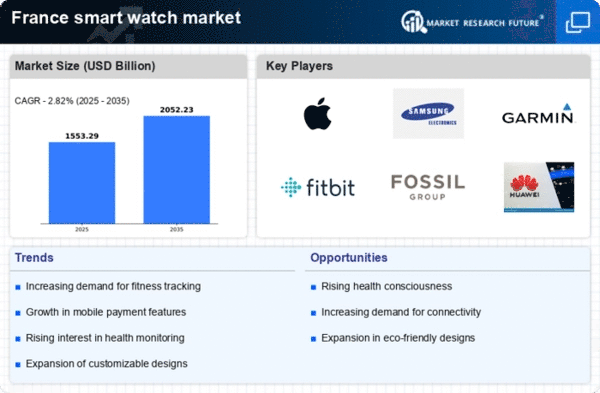
As per Market Research Future analysis, the France smart watch market Size was estimated at 1510.69 USD Billion in 2024. The France smart watch market industry is projected to grow from 1553.29 USD Billion in 2025 to 2052.23 USD Billion by 2035, exhibiting a compound annual growth rate (CAGR) of 2.8% during the forecast period 2025 - 2035

Key Market Trends & Highlights

The France smart watch market is experiencing robust growth driven by health awareness and technological innovation.

  • Health and fitness tracking remains a dominant trend, appealing to the largest segment of health-conscious consumers.
  • Stylish and customizable designs are increasingly sought after, particularly among younger demographics, making this the fastest-growing segment.
  • Enhanced interoperability with other devices is becoming a key feature, reflecting the growing demand for connectivity.
  • Rising health consciousness and technological advancements are major drivers propelling the market forward.

Market Size & Forecast

2024 Market Size 1510.69 (USD Billion)
2035 Market Size 2052.23 (USD Billion)
CAGR (2025 - 2035) 2.82%

Major Players

Apple Inc (US), Samsung Electronics (KR), Garmin Ltd (US), Fitbit LLC (US), Fossil Group Inc (US), Huawei Technologies Co Ltd (CN), Xiaomi Corporation (CN), Suunto Oy (FI)

Our Impact
Enabled $4.3B Revenue Impact for Fortune 500 and Leading Multinationals
Partnering with 2000+ Global Organizations Each Year
30K+ Citations by Top-Tier Firms in the Industry

France Smart Watch Market Trends

The smart watch market is currently experiencing a dynamic evolution, characterized by a growing consumer interest in health and fitness tracking features. This trend appears to be driven by an increasing awareness of personal health management, with many individuals seeking devices that can monitor vital signs, track physical activity, and provide insights into overall well-being. Additionally, the integration of advanced technologies, such as artificial intelligence and machine learning, seems to enhance the functionality of these devices, making them more appealing to a tech-savvy audience. As a result, manufacturers are likely to focus on developing innovative features that cater to the specific needs of users, thereby fostering a competitive landscape. Moreover, the demand for stylish and customizable designs is becoming more pronounced within the smart watch market. Consumers appear to favor devices that not only serve practical purposes but also reflect their personal style. This shift indicates a potential opportunity for brands to collaborate with fashion designers or influencers to create unique offerings. Furthermore, the increasing compatibility of smart watches with various operating systems and smartphones suggests a trend towards greater interoperability, which may further drive adoption rates. Overall, the smart watch market is poised for continued growth, driven by technological advancements and evolving consumer preferences.

Health and Fitness Tracking

There is a notable emphasis on health and fitness tracking features within the smart watch market. Consumers are increasingly seeking devices that can monitor heart rate, track workouts, and provide health insights, reflecting a broader trend towards personal health management.

Stylish and Customizable Designs

The demand for stylish and customizable designs is rising, as consumers desire devices that align with their personal aesthetics. This trend suggests potential collaborations between brands and fashion designers to create unique smart watch offerings.

Enhanced Interoperability

The growing compatibility of smart watches with various operating systems and smartphones indicates a trend towards enhanced interoperability. This development may facilitate greater adoption rates, as users seek seamless integration with their existing technology.

France Smart Watch Market Drivers

Technological Advancements

Technological innovations are significantly influencing the smart watch market in France. The integration of advanced sensors, improved battery life, and enhanced connectivity features are making smart watches more appealing to consumers. For instance, the introduction of features such as ECG monitoring and blood oxygen level tracking has expanded the functionality of these devices. Market data suggests that the adoption of such technologies has contributed to a growth rate of around 15% in the smart watch market industry over the past year. This trend indicates that as technology continues to evolve, the smart watch market will likely see increased competition and product differentiation.

Rising Health Consciousness

The increasing awareness of health and wellness among consumers in France appears to be a primary driver for the smart watch market. As individuals become more health-conscious, they seek devices that can monitor their fitness levels, heart rate, and other vital statistics. This trend is reflected in the market data, which indicates that the demand for health-related features in smart watches has surged, with approximately 60% of consumers prioritizing health tracking capabilities. The smart watch market industry is thus experiencing a shift towards devices that offer comprehensive health monitoring, which may lead to further innovations in this sector.

Growing Demand for Connectivity

The increasing reliance on connected devices is driving the smart watch market in France. Consumers are looking for smart watches that seamlessly integrate with their smartphones and other smart home devices. This demand for connectivity is reflected in the market, where approximately 70% of smart watch users report using their devices for notifications and app interactions. The smart watch market industry is thus adapting to this trend by enhancing interoperability features, which may lead to a more cohesive ecosystem of connected devices. This shift could potentially attract a broader audience, further expanding the market.

Increased Focus on Sustainability

Sustainability is becoming a significant consideration for consumers in the smart watch market. As environmental awareness grows, many consumers are seeking products that are eco-friendly and ethically produced. This shift is prompting manufacturers to explore sustainable materials and production methods. Market data shows that approximately 30% of consumers are willing to pay a premium for smart watches that are marketed as sustainable. The smart watch market industry is thus likely to see a rise in eco-conscious products, which may not only appeal to environmentally aware consumers but also enhance brand loyalty.

Fashion and Personalization Trends

The smart watch market in France is also being influenced by fashion trends and the desire for personalization. Consumers are increasingly viewing smart watches as fashion accessories, leading manufacturers to offer a variety of styles, colors, and customizable options. Market data indicates that around 40% of consumers consider design and aesthetics as crucial factors when purchasing a smart watch. This trend suggests that the smart watch market industry must focus on creating visually appealing products that cater to individual tastes, which may enhance consumer engagement and drive sales.


Market Segment Insights

By Gender: Men (Largest) vs. Women (Fastest-Growing)

In the France smart watch market, the distribution of market share among gender segments is notably diverse. Men constitute the largest portion, driven by their keen interest in technology and fitness functionalities. Women, while currently holding a smaller share, are gaining traction due to rising health awareness and the increasing demand for aesthetic designs that cater to their preferences. The growth trends within this segment are influenced by various factors, including changing lifestyle habits and evolving fashion trends. Women are emerging as the fastest-growing demographic, with brands focusing on creating inclusive designs that blend functionality with style. The increasing penetration of smart technology in daily life is also propelling interest among both genders, further enhancing market dynamics.

Men: Dominant vs. Women: Emerging

The men segment within the France smart watch market is characterized by a strong preference for feature-rich devices that enhance fitness tracking and connectivity. This demographic is attracted to robust designs and advanced technological capabilities, which are perceived as essential for an active lifestyle. Conversely, the women segment, although in an emerging phase, is rapidly evolving with brands developing smart watches that emphasize elegance and versatility, catering to both professional and lifestyle needs. Marketers are focused on incorporating features such as health monitoring and customizable designs, which resonate well with women's preferences. This competitive landscape is prompting innovation as both segments vie for market share, highlighting a shift towards more tailored offerings.

By Display: Digital (Largest) vs. Analogue-Digital (Fastest-Growing)

In the France smart watch market, the display segment showcases a significant preference for digital displays, capturing the largest share among consumers. Digital designs are favored for their versatility and functionality, appealing to tech-savvy users. Meanwhile, analogue watches, though with a relatively smaller market share, continue to maintain a loyal customer base that appreciates traditional aesthetics. This dynamic creates an interesting yet competitive environment within the display segment. The growth trends indicate that analogue-digital displays are emerging as the fastest-growing category, driven by consumers seeking a blend of classic and modern functionalities. Features such as fitness tracking, notifications, and personal customization are contributing to the increasing popularity. As technology progresses, the segment anticipates further innovation and an expanding user base as more individuals look for smart watches that combine style with smart capabilities.

Analogue (Dominant) vs. Digital (Emerging)

Digital displays are the dominant force in the display segment due to their user-friendly interfaces and multifaceted functionalities. The ease of access to notifications and fitness data showcases their practicality for users engaged in active lifestyles. Conversely, analogue watches are holding substantial market interest for their timeless and classic appeal. They attract a demographic that values elegance and simplicity alongside tech integration. With both styles catering to diverse consumer preferences, the dynamic ensures a robust competition, placing digital as the rapid frontrunner while analogue watches continue to resonate deeply with traditionalists who seek a stylish yet functional accessory.

By Display Type: AMOLED (Largest) vs. LCD (Fastest-Growing)

In the France smart watch market, AMOLED display technology commands a significant share, characterized by its superior color vibrancy and contrast. This dominance in market share is attributed to increasing consumer preferences for high-definition visual experiences, with many choosing smart watches equipped with AMOLED displays for their sleek aesthetics and functionality. Conversely, the LCD segment is experiencing rapid growth, driven by lower manufacturing costs and widespread adoption of budget-friendly models in the market. Growth trends in the display type sector indicate that while AMOLED remains the preferred choice among premium models, LCD is emerging as the go-to option for value-seeking consumers. Technological advancements and improved product offerings are fueling this expansion, with manufacturers focusing on enhancing display resolution and battery efficiency. As functionality becomes a key driver, both segments are expected to see continued investment in innovation, allowing them to cater to diverse consumer needs.

AMOLED (Dominant) vs. LCD (Emerging)

AMOLED technology stands out in the France smart watch market for its vibrant colors and deeper blacks, making it a preferred choice for high-end smart watches. Its ability to display rich visuals and consume less power when showcasing darker content enhances its overall appeal. Meanwhile, LCD serves as an emerging player, particularly among cost-effective smart watches. It offers reliable performance and is relatively cheaper to produce, thus attracting a broader audience. The competition between these two technologies is intensifying, as manufacturers aim to balance performance with affordability, leading to innovative offerings that may increasingly blur the lines between premium and budget segments.

By Operating System: iOS (Largest) vs. Android (Fastest-Growing)

In the France smart watch market, the segment values are displaying a diverse distribution of market share. iOS currently holds the largest portion, attributed to its integration with Apple devices, appealing to a loyal customer base. Android, while trailing in total share, is gaining traction rapidly, driven by various manufacturers expanding their ecosystem and offering more features, catering to broader consumer preferences. As growth trends evolve, Android is notably recognized as the fastest-growing segment, benefiting from increasing adoption among budget-conscious consumers and the enhancement of functionalities in smart watches. Meanwhile, iOS continues to solidify its presence through innovation and strong user engagement. Emerging technologies, fitness tracking capabilities, and personalized experiences are major drivers for growth across these operating systems.

iOS (Dominant) vs. Android (Emerging)

iOS, the dominant operating system in the France smart watch market, is primarily found on Apple’s smart watches, appealing to tech-savvy consumers who value seamless connectivity with their Apple devices. Its rich ecosystem allows for an intuitive user experience, supported by regular updates and a plethora of available applications. This dominance is fueled by brand loyalty and the perception of premium quality. In contrast, Android represents the emerging force in this segment, as it encompasses a variety of brands and devices, making smart watches more accessible to the mass market. With a focus on versatile designs and price points, Android devices have experienced a surge in popularity, driven by features that emphasize health tracking and smart technology integration.

By Application: Personal Assistance (Largest) vs. Wellness (Fastest-Growing)

In the France smart watch market, the application segment is predominantly driven by Personal Assistance, accounting for a significant share of the overall market. This segment is favored for its robust features such as notifications, calendar integration, and virtual assistants, appealing to tech-savvy consumers who prioritize connectivity and convenience. Furthermore, the Wellness category is climbing rapidly, reflecting the increasing consumer focus on health and fitness, indicating a competitive market landscape. As lifestyles evolve, the demand for smart watches incorporating Wellness applications is surging, making it the fastest-growing segment in the market. Factors such as rising awareness of health monitoring, the proliferation of fitness programs, and technology adoption among health-conscious consumers are key drivers of this growth. The ability of smart watches to track fitness metrics, sleep patterns, and stress levels positions Wellness as a compelling option for new buyers, aligning perfectly with modern health trends.

Personal Assistance (Dominant) vs. Wellness (Emerging)

The Personal Assistance segment stands out as the dominant application in the market, providing an array of features that enhance user connectivity and daily productivity. Its wide acceptance is driven by functionalities like call handling, messaging alerts, and integration with smart home devices, making it indispensable for busy individuals. On the other hand, the Wellness segment is emerging rapidly, capturing the interest of those inclined towards personal health management. It includes functionalities like heart rate monitoring, fitness tracking, and sleep analysis, appealing to a growing demographic that prioritizes health and fitness. This segment is characterized by innovation, with continuous advancements enhancing user experience and engagement, positioning it as a formidable contender in the competitive landscape.

Get more detailed insights about France Smart Watch Market

Key Players and Competitive Insights

The smart watch market in France exhibits a dynamic competitive landscape characterized by rapid technological advancements and evolving consumer preferences. Key players such as Apple Inc (US), Samsung Electronics (KR), and Garmin Ltd (US) are at the forefront, each adopting distinct strategies to enhance their market presence. Apple Inc (US) continues to leverage its ecosystem, integrating health and fitness features into its devices, thereby appealing to health-conscious consumers. Samsung Electronics (KR) focuses on diversifying its product range, offering models that cater to various price segments, which allows it to capture a broader audience. Garmin Ltd (US), known for its specialized fitness tracking capabilities, emphasizes innovation in outdoor and sports functionalities, positioning itself as a leader in niche markets.
The business tactics employed by these companies reflect a concerted effort to optimize supply chains and localize manufacturing. The market structure appears moderately fragmented, with several players vying for market share, yet dominated by a few key brands that significantly influence consumer choices. This competitive environment fosters innovation, as companies strive to differentiate their offerings through advanced features and superior user experiences.
In October 2025, Apple Inc (US) announced the launch of its latest smart watch model, which includes advanced health monitoring features such as blood glucose tracking. This strategic move not only reinforces Apple's commitment to health technology but also positions it to capture a growing segment of health-conscious consumers. The integration of such features is likely to enhance user engagement and loyalty, further solidifying Apple's market leadership.
In September 2025, Samsung Electronics (KR) unveiled a partnership with a leading fitness app developer to enhance its smart watch's fitness tracking capabilities. This collaboration aims to provide users with personalized fitness plans and real-time coaching, which could significantly improve user satisfaction and retention. By aligning its product offerings with popular fitness trends, Samsung appears to be strategically positioning itself to attract a younger demographic increasingly focused on health and wellness.
In August 2025, Garmin Ltd (US) expanded its product line by introducing a new series of smart watches specifically designed for outdoor enthusiasts. This launch is indicative of Garmin's strategy to cater to niche markets, emphasizing durability and specialized features such as GPS navigation and weather tracking. Such targeted offerings may enhance Garmin's competitive edge in the outdoor segment, appealing to consumers who prioritize functionality in extreme conditions.
As of November 2025, the competitive trends in the smart watch market are increasingly defined by digitalization, sustainability, and the integration of artificial intelligence (AI). Strategic alliances among companies are shaping the landscape, enabling them to pool resources and expertise to innovate more effectively. The shift from price-based competition to a focus on technological advancement and supply chain reliability is evident, suggesting that future differentiation will hinge on the ability to deliver unique, high-quality products that resonate with consumer values.

Key Companies in the France Smart Watch Market include

Industry Developments

The France Smart-Watch Market has seen significant developments recently, with consumer demand shifting towards wearables that offer health tracking and connectivity features. Companies such as Apple and Garmin are actively expanding their product lines to include advanced health monitoring capabilities, while Huawei is focusing on aesthetic designs to attract younger customers. In September 2023, Garmin announced a partnership in France with a fitness organization, enhancing its presence in the health and fitness segment. Notably, Withings has reported a growth of over 20% in sales year-over-year, driven by their innovative health-focused smartwatches.

Additionally, major brands like Fitbit and Amazfit are increasing their efforts on the sustainability front, appealing to environmentally conscious consumers. In terms of mergers and acquisitions, Fossil Group recently acquired the smartwatch technology from a smaller firm in France, aiming to enhance their product offerings in the local market as of October 2023. The French government is advocating for increased investment in technology and innovation, which aligns well with the dynamic growth in the smart-wearables sector. Companies continue to invest in Research and Development, further solidifying their positions in this competitive landscape.

Future Outlook

France Smart Watch Market Future Outlook

The smart watch market in France is projected to grow at a 2.82% CAGR from 2025 to 2035, driven by technological advancements, health monitoring features, and increasing consumer demand.

New opportunities lie in:

  • Develop subscription-based health monitoring services for users.
  • Expand partnerships with fitness brands for integrated solutions.
  • Invest in AI-driven personalization features to enhance user experience.

By 2035, the smart watch market is expected to achieve robust growth and increased consumer adoption.

Market Segmentation

France Smart Watch Market Gender Outlook

  • Men
  • Women
  • Unisex

France Smart Watch Market Display Outlook

  • Analogue
  • Digital
  • Analogue-Digital

France Smart Watch Market Application Outlook

  • Personal Assistance
  • Wellness
  • Healthcare
  • Sports
  • Others

France Smart Watch Market Display Type Outlook

  • LCD
  • LED
  • AMOLED
  • OLED

France Smart Watch Market Operating System Outlook

  • iOS
  • Android
  • Tizen
  • FreeRTOS
  • Others

Report Scope

MARKET SIZE 2024 1510.69(USD Billion)
MARKET SIZE 2025 1553.29(USD Billion)
MARKET SIZE 2035 2052.23(USD Billion)
COMPOUND ANNUAL GROWTH RATE (CAGR) 2.82% (2025 - 2035)
REPORT COVERAGE Revenue Forecast, Competitive Landscape, Growth Factors, and Trends
BASE YEAR 2024
Market Forecast Period 2025 - 2035
Historical Data 2019 - 2024
Market Forecast Units USD Billion
Key Companies Profiled Apple Inc (US), Samsung Electronics (KR), Garmin Ltd (US), Fitbit LLC (US), Fossil Group Inc (US), Huawei Technologies Co Ltd (CN), Xiaomi Corporation (CN), Suunto Oy (FI)
Segments Covered Gender, Display, Display Type, Operating System, Application
Key Market Opportunities Integration of health monitoring features aligns with rising consumer demand for wellness-focused smart watch solutions.
Key Market Dynamics Rising consumer demand for health monitoring features drives innovation in the smart watch market.
Countries Covered France
Leave a Comment

FAQs

What is the expected market size of the France Smart-Watch Market in 2024?

The France Smart-Watch Market is expected to be valued at 1.37 billion USD in 2024.

What is the projected market size for the France Smart-Watch Market by 2035?

By 2035, the France Smart-Watch Market is projected to reach a value of 3.18 billion USD.

What is the expected compound annual growth rate (CAGR) for the France Smart-Watch Market from 2025 to 2035?

The expected CAGR for the France Smart-Watch Market from 2025 to 2035 is 7.944%.

Which gender segment holds the highest market value in the France Smart-Watch Market for 2024?

The Men segment holds the highest market value at 0.55 billion USD in 2024.

What is the anticipated market value for women's smart-watches in France by 2035?

The anticipated market value for women's smart-watches in France by 2035 is 1.07 billion USD.

Who are the major players in the France Smart-Watch Market?

Major players in the France Smart-Watch Market include Garmin, Withings, Apple, Fossil Group, and Huawei.

What market size is expected for the unisex smart-watches segment in France by 2035?

The unisex smart-watches segment is expected to be valued at 0.85 billion USD in 2035.

What growth opportunities can be identified for the France Smart-Watch Market?

Growth opportunities include increasing health awareness and demand for advanced fitness-tracking features.

What challenges are currently affecting the France Smart-Watch Market?

Current challenges include market saturation and intense competition among key players.

What impact do emerging trends have on the France Smart-Watch Market?

Emerging trends focus on integration with health technology and personalized user experiences, driving market growth.

Download Free Sample

Kindly complete the form below to receive a free sample of this Report

Compare Licence

×
Features License Type
Single User Multiuser License Enterprise User
Price $4,950 $5,950 $7,250
Maximum User Access Limit 1 User Upto 10 Users Unrestricted Access Throughout the Organization
Free Customization
Direct Access to Analyst
Deliverable Format
Platform Access
Discount on Next Purchase 10% 15% 15%
Printable Versions