×
Request Free Sample ×

Kindly complete the form below to receive a free sample of this Report

* Please use a valid business email

Leading companies partner with us for data-driven Insights

clients tt-cursor
Hero Background

UK Smart Watch Market

ID: MRFR/SEM/45184-HCR
200 Pages
Garvit Vyas
February 2026

UK Smart Watch Market Size, Share and Research Report By Gender (Men, Women, Unisex), By Display (Analogue, Digital, Analogue-Digital), By Display Type (LCD, LED, AMOLED, OLED), By Operating System (iOS, Android, Tizen, FreeRTOS, Others) and By Application (Personal Assistance, Wellness, Healthcare, Sports, Others) - Industry Forecast Till 2035

Share:
Download PDF ×

We do not share your information with anyone. However, we may send you emails based on your report interest from time to time. You may contact us at any time to opt-out.

UK Smart Watch Market Infographic
Purchase Options

UK Smart Watch Market Summary

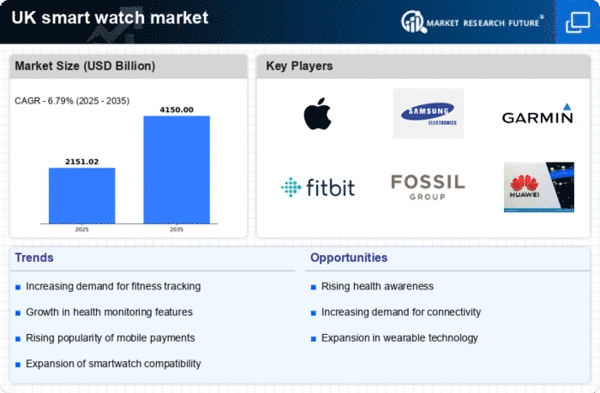
As per Market Research Future analysis, the UK smart watch market Size was estimated at 2014.25 USD Billion in 2024. The UK smart watch market industry is projected to grow from 2151.02 USD Billion in 2025 to 4150.0 USD Billion by 2035, exhibiting a compound annual growth rate (CAGR) of 6.7% during the forecast period 2025 - 2035

Key Market Trends & Highlights

The UK smart watch market is experiencing robust growth driven by health awareness and technological advancements.

  • Health and fitness tracking remains a dominant trend, appealing to consumers seeking to monitor their well-being.
  • Integration with smart home devices is increasingly popular, enhancing user convenience and connectivity.
  • Customization and personalization options are gaining traction, allowing consumers to tailor their devices to individual preferences.
  • Technological advancements in wearable devices and rising health awareness among consumers are key drivers propelling market growth.

Market Size & Forecast

2024 Market Size 2014.25 (USD Billion)
2035 Market Size 4150.0 (USD Billion)
CAGR (2025 - 2035) 6.79%

Major Players

Apple Inc (US), Samsung Electronics (KR), Garmin Ltd (US), Fitbit LLC (US), Fossil Group Inc (US), Huawei Technologies Co Ltd (CN), Xiaomi Corporation (CN), Suunto Oy (FI), Withings SA (FR)

Our Impact
Enabled $4.3B Revenue Impact for Fortune 500 and Leading Multinationals
Partnering with 2000+ Global Organizations Each Year
30K+ Citations by Top-Tier Firms in the Industry

UK Smart Watch Market Trends

The smart watch market is currently experiencing a dynamic evolution, driven by advancements in technology and changing consumer preferences. As individuals increasingly seek devices that offer convenience and connectivity, smart watches have emerged as essential accessories. The integration of health monitoring features, such as heart rate tracking and sleep analysis, has further enhanced their appeal. This trend aligns with a growing awareness of personal health and wellness, prompting consumers to invest in devices that support their fitness goals. Additionally, the rise of mobile payments and notifications has made smart watches more functional, allowing users to stay connected without needing to reach for their smartphones. Moreover, the competitive landscape of the smart watch market is intensifying, with various brands striving to differentiate their offerings. Companies are focusing on design, battery life, and compatibility with other devices to attract a broader audience. The increasing availability of customizable options, such as interchangeable bands and watch faces, caters to individual tastes and preferences. As technology continues to advance, the smart watch market is poised for further growth, with innovations likely to enhance user experience and functionality. Overall, the current trajectory suggests a robust future for smart watches, as they become integral to daily life for many consumers.

Health and Fitness Tracking

The emphasis on health and fitness tracking features is a prominent trend within the smart watch market. Consumers are increasingly drawn to devices that offer comprehensive health monitoring capabilities, such as heart rate, activity levels, and sleep quality. This focus on wellness aligns with a broader societal shift towards healthier lifestyles, making smart watches valuable tools for personal health management.

Integration with Smart Home Devices

Another notable trend is the integration of smart watches with smart home devices. As the Internet of Things (IoT) continues to expand, consumers are seeking seamless connectivity between their wearables and home automation systems. This trend enhances the functionality of smart watches, allowing users to control various aspects of their home environment directly from their wrists.

Customization and Personalization

Customization options are becoming increasingly important in the smart watch market. Consumers desire devices that reflect their personal style and preferences. Manufacturers are responding by offering a range of customizable features, including interchangeable bands, watch faces, and app selections, enabling users to tailor their smart watches to suit their individual tastes.

UK Smart Watch Market Drivers

Rising Health Awareness Among Consumers

There is a notable increase in health awareness among consumers in the UK, which is significantly impacting the smart watch market. As individuals become more conscious of their health and fitness, the demand for devices that can monitor vital signs and track physical activity is on the rise. Reports suggest that around 60% of UK consumers are now using wearable technology to assist in their health management. This trend is likely to continue, as smart watches offer features such as heart rate monitoring, sleep tracking, and fitness coaching. Consequently, the smart watch market is positioned to benefit from this heightened focus on personal health and wellness.

Technological Advancements in Wearable Devices

The smart watch market is experiencing rapid technological advancements, which are driving consumer interest and adoption. Innovations such as improved battery life, enhanced sensors, and advanced health monitoring features are becoming increasingly prevalent. For instance, the integration of ECG and blood oxygen monitoring capabilities has attracted health-conscious consumers. In the UK, the market for smart watches is projected to grow at a CAGR of approximately 15% from 2025 to 2030, indicating a robust demand for these advanced features. As manufacturers continue to innovate, the smart watch market is likely to see an influx of new models equipped with cutting-edge technology, further stimulating growth.

Expansion of E-commerce and Online Retail Channels

The expansion of e-commerce and online retail channels is significantly influencing the smart watch market. With the rise of online shopping, consumers in the UK are increasingly purchasing smart watches through digital platforms. This shift is supported by the convenience and accessibility that online shopping provides. Recent data indicates that online sales of wearable technology, including smart watches, have surged by over 30% in the past year. As more consumers turn to online channels for their purchases, the smart watch market is expected to benefit from this trend, leading to increased sales and market penetration.

Increased Focus on Personalization and Customization

Personalization and customization are becoming key drivers in the smart watch market. Consumers are looking for devices that reflect their individual style and preferences. This trend is evident in the growing availability of interchangeable bands, customizable watch faces, and various app options. In the UK, approximately 55% of consumers express a desire for more personalized features in their smart watches. As brands respond to this demand by offering more customization options, the smart watch market is likely to see an increase in consumer engagement and satisfaction, ultimately driving sales.

Growing Demand for Connectivity and Communication Features

The smart watch market is witnessing a growing demand for enhanced connectivity and communication features. Consumers are increasingly seeking devices that allow them to stay connected without needing to reach for their smartphones. Features such as call and message notifications, music control, and even mobile payment capabilities are becoming essential for many users. In the UK, it is estimated that over 40% of smart watch users prioritize connectivity features when selecting a device. This trend suggests that manufacturers must focus on integrating seamless communication capabilities into their products to remain competitive in the smart watch market.


Market Segment Insights

By Gender: Men (Largest) vs. Women (Fastest-Growing)

In the UK smart watch market, the distribution of market share among gender segments reveals that men dominate the sector, holding the largest share. This is attributed to a long-standing preference for technological gadgets among male consumers, who often prioritize features such as fitness tracking and connectivity options. Women, while historically holding a smaller share, have been increasingly embracing smart watches, reflected in their rapid growth. This shift is likely due to evolving designs that cater to feminine aesthetics and enhanced functionalities relevant to female users. The growth trends for the gender segment in the UK smart watch market indicate a significant upward movement in female adoption. Factors driving this growth include targeted marketing strategies, a broader range of styles, and functionalities that appeal directly to women’s needs. Moreover, as health and wellness become more prioritized, many women are recognizing the benefits of smart watches for tracking fitness and wellbeing metrics. In contrast, the male segment remains stable, as innovations continue to enhance performance and new technology attracts tech-savvy buyers.

Men (Dominant) vs. Women (Emerging)

Men have constituted the dominant segment in the UK smart watch market, driven by a strong inclination towards cutting-edge technology and robust fitness features. Their preferences often lean towards models that offer advanced functionalities like GPS tracking and comprehensive health metrics. In contrast, women represent an emerging segment, as they increasingly favor smart watches that combine style with functionality. Many brands are now producing designs that resonate with female aesthetics, empowering women to embrace tech products that align with their personal style while offering essential health and fitness tracking capabilities. This dynamic indicates a shift in the market, where availability of diverse options is enhancing female participation.

By Display: Analogue (Largest) vs. Digital (Fastest-Growing)

In the UK smart watch market, the display segment is characterized by three primary types: Analogue, Digital, and Analogue-Digital. Currently, the Analogue display type holds the largest market share, appealing to traditional watch enthusiasts who value classic aesthetics and craftsmanship. Digital displays, while trailing in overall market share, are witnessing a significant uptick in adoption, particularly among tech-savvy consumers seeking advanced features and connectivity. The Analogue-Digital watches, combining elements of both, cater to a niche audience looking for versatility in their timepieces. The growth trends in this segment indicate a strong consumer inclination towards Digital displays, primarily driven by technological advancements and increased health monitoring features. Key factors contributing to this growth include the integration of fitness tracking, notifications, and customizable watch faces, which enhance user experience. As consumers become more conscious of their health and lifestyle, the demand for smart features in watches becomes paramount, positioning Digital displays as the fastest-growing segment in the market.

Analogue (Dominant) vs. Digital (Emerging)

The Analogue display segment is dominant in the UK smart watch market, appealing to individuals who appreciate traditional design and simplicity. These watches often feature classic dials and mechanical movements that resonate with consumers valuing craftsmanship. Conversely, the Digital display segment is emerging rapidly, attracting a younger demographic that prioritizes technology and functionality. Digital watches are designed with modern features like touchscreens, fitness tracking, and connectivity options, making them highly relevant in today's fast-paced environment. This difference in consumer preferences illustrates how Analogue watches cater to nostalgia and style, while Digital watches boldly reflect the future of wearable technology, ultimately leading to a dynamic interplay between tradition and innovation.

By Display Type: AMOLED (Largest) vs. OLED (Fastest-Growing)

In the UK smart watch market, the share distribution among display types is notably dominated by AMOLED technology, which is favored for its vibrant colors and deep blacks, contributing to a superior viewing experience. On the other hand, OLED displays, while currently smaller in market share, are rapidly gaining traction due to their energy efficiency and flexibility in design, appealing particularly to consumers seeking innovative features in their devices. Growth trends in the display type segment are significantly influenced by advancements in display technology and consumer preferences for enhanced visual quality. The rising demand for smart watches with superior display capabilities is driving manufacturers to innovate, with AMOLED displays being adopted for their impressive performance. Meanwhile, OLED is emerging quickly, appealing to health-conscious consumers and tech enthusiasts looking for lightweight, energy-efficient options that still provide high-quality display experiences.

AMOLED (Dominant) vs. OLED (Emerging)

AMOLED displays are characterized by their ability to produce vibrant colors and true blacks, making them the dominant choice in the UK smart watch market. They offer superior brightness levels and energy efficiency, particularly when displaying darker images, leading to prolonged battery life for smart devices. AMOLED screens are often preferred by users who prioritize visual quality and interactive experiences. Conversely, OLED technology is emerging as a fast-growing alternative, noted for its flexibility and thinner profiles. The integration of OLED displays into smart watches enhances their design aesthetics while maintaining performance standards, making them attractive to a growing segment of eco-conscious consumers focused on energy efficiency and style.

By Operating System: iOS (Largest) vs. Android (Fastest-Growing)

The UK smart watch market showcases a diverse operating system landscape, with iOS leading in market share due to its robust ecosystem integration and strong customer loyalty. Following closely is Android, which holds significant traction as it caters to a wider range of devices and price points, appealing to budget-conscious consumers. Other operating systems like Tizen and FreeRTOS occupy niche segments but have limited overall reach compared to these giants. Growth trends indicate a rising preference for smart watches equipped with advanced health monitoring features, propelling both iOS and Android. The increase in health-conscious consumers, along with advancements in technology enabling better app integration, is driving demand. Android’s rapid expansion in features and user engagement is making it increasingly competitive, highlighting a shift in consumer preference toward more versatile and budget-friendly options.

iOS (Dominant) vs. Android (Emerging)

iOS remains the dominant operating system in the UK smart watch market, characterized by its seamless integration with Apple devices, premium build quality, and extensive app ecosystem that appeals to tech-savvy consumers. This operating system benefits from strong brand loyalty and consistent software updates, ensuring a high level of user satisfaction. On the other hand, Android is emerging as a strong competitor, particularly with its open-source approach allowing for greater customization and variety among manufacturers. The availability of diverse models at varying price points makes Android appealing to a broader audience, particularly among young and budget-conscious consumers. Both operating systems are set to advance significantly, aligning with the increasing consumer demands for more features and functionality in smart watches.

By Application: Personal Assistance (Largest) vs. Wellness (Fastest-Growing)

The UK smart watch market shows a diverse distribution among the application segments, with Personal Assistance leading in market share. This segment is characterized by features that enhance daily routines, such as notifications, calendars, and voice commands. Following closely is the Wellness segment, which includes fitness tracking, sleep monitoring, and stress management tools, gaining traction among health-conscious consumers. Other segments like Healthcare and Sports are also present but at a smaller share comparatively. Growth trends in the application segment are primarily driven by technological advancements and increasing consumer awareness about health and wellness. As the demand for smart watches with integrated health features rises, the Wellness application shows the fastest growth trajectory. Innovations such as AI-driven health insights and expanded functionalities enhance user engagement and encourage adoption, making this segment particularly appealing to younger demographics and fitness enthusiasts.

Personal Assistance: Dominant vs. Wellness: Emerging

Personal Assistance remains the dominant application in the UK smart watch market, driven by consumers' need for connectivity and ease of access to information. This segment offers capabilities such as reminders, calls, and messaging, fulfilling everyday requirements efficiently. In contrast, the Wellness segment is emerging rapidly, focusing on holistic health through features like fitness tracking and mindfulness applications. This segment's growth is fueled by a rising interest in mental and physical well-being and the incorporation of advanced technologies, such as heart rate monitoring and stress analysis tools. As consumers prioritize health management, the Wellness application’s role in the smart watch ecosystem continues to expand, indicating a shift toward more comprehensive lifestyle management.

Get more detailed insights about UK Smart Watch Market

Key Players and Competitive Insights

The smart watch market exhibits a dynamic competitive landscape characterized by rapid technological advancements and evolving consumer preferences. Key players such as Apple Inc (US), Samsung Electronics (KR), and Garmin Ltd (US) are at the forefront, each adopting distinct strategies to enhance their market positioning. Apple Inc (US) continues to leverage its ecosystem, integrating health features and services that appeal to a health-conscious demographic. Samsung Electronics (KR) focuses on expanding its product range, emphasizing compatibility with various devices, while Garmin Ltd (US) targets fitness enthusiasts with specialized features tailored to outdoor activities. Collectively, these strategies foster a competitive environment that prioritizes innovation and user experience.
In terms of business tactics, companies are increasingly localizing manufacturing and optimizing supply chains to enhance efficiency and reduce costs. The market structure appears moderately fragmented, with several players vying for market share. However, the influence of major companies remains substantial, as they set trends and standards that smaller competitors often follow. This competitive structure encourages continuous innovation and responsiveness to consumer demands, shaping the overall market dynamics.
In October 2025, Apple Inc (US) announced the launch of its latest smart watch model, which features advanced health monitoring capabilities, including blood glucose tracking. This strategic move not only reinforces Apple's commitment to health technology but also positions it as a leader in the health-focused segment of the market. The integration of such features is likely to attract a broader audience, particularly those managing chronic health conditions.
In September 2025, Samsung Electronics (KR) unveiled a partnership with a leading fitness app developer to enhance its smart watch's fitness tracking capabilities. This collaboration aims to provide users with personalized fitness plans and real-time coaching, thereby enriching the user experience. Such partnerships indicate a trend towards integrating software solutions with hardware, enhancing the overall value proposition of smart watches.
In August 2025, Garmin Ltd (US) expanded its product line by introducing a new series of smart watches designed specifically for triathletes. This strategic focus on niche markets allows Garmin to differentiate itself from competitors and cater to specific consumer needs. By targeting a dedicated segment, Garmin is likely to strengthen its brand loyalty and market presence among serious athletes.
As of November 2025, current trends in the smart watch market include a pronounced emphasis on digitalization, sustainability, and the integration of artificial intelligence (AI). Strategic alliances are increasingly shaping the competitive landscape, as companies collaborate to enhance product offerings and technological capabilities. Looking ahead, competitive differentiation is expected to evolve, with a shift from price-based competition to a focus on innovation, technology, and supply chain reliability. This transition suggests that companies will need to invest in R&D and forge strategic partnerships to maintain a competitive edge in an ever-evolving market.

Key Companies in the UK Smart Watch Market include

Industry Developments

The UK Smart Watch Market has been witnessing significant developments recently. In August 2023, Apple launched its new series of Apple Watches, emphasizing advanced health-monitoring features, which are becoming increasingly important in the UK consumer landscape. In the same month, Garmin announced enhancements to its existing models with better tracking capabilities for outdoor activities, catering specifically to the growing fitness-conscious demographic in the UK.

Furthermore, a research report published in July 2023 indicated that the UK Smart Watch Market is expected to grow substantially, driven by increased focus on health and fitness, with an estimated market valuation reaching over 3 billion by 2025. In terms of mergers and acquisitions, there have been no recent announcements involving companies like Fitbit, Xiaomi, or Samsung in the UK market. Over the past two years, the market has seen significant entrants like Amazfit gaining traction amongst budget-conscious consumers, while premium brands like Tag Heuer strengthen their positions through limited-edition releases.

This competitive landscape continues to foster innovation and cater to a wide range of consumer preferences in the UK.

Future Outlook

UK Smart Watch Market Future Outlook

The smart watch market is projected to grow at a 6.79% CAGR from 2025 to 2035, driven by technological advancements, health monitoring features, and increasing consumer demand.

New opportunities lie in:

  • Develop subscription-based health monitoring services for chronic disease management.
  • Expand partnerships with fitness brands for integrated training solutions.
  • Leverage AI for personalized user experiences and predictive analytics.

By 2035, the smart watch market is expected to achieve substantial growth and innovation.

Market Segmentation

UK Smart Watch Market Gender Outlook

  • Men
  • Women
  • Unisex

UK Smart Watch Market Display Outlook

  • Analogue
  • Digital
  • Analogue-Digital

UK Smart Watch Market Application Outlook

  • Personal Assistance
  • Wellness
  • Healthcare
  • Sports
  • Others

UK Smart Watch Market Display Type Outlook

  • LCD
  • LED
  • AMOLED
  • OLED

UK Smart Watch Market Operating System Outlook

  • iOS
  • Android
  • Tizen
  • FreeRTOS
  • Others

Report Scope

MARKET SIZE 2024 2014.25(USD Billion)
MARKET SIZE 2025 2151.02(USD Billion)
MARKET SIZE 2035 4150.0(USD Billion)
COMPOUND ANNUAL GROWTH RATE (CAGR) 6.79% (2025 - 2035)
REPORT COVERAGE Revenue Forecast, Competitive Landscape, Growth Factors, and Trends
BASE YEAR 2024
Market Forecast Period 2025 - 2035
Historical Data 2019 - 2024
Market Forecast Units USD Billion
Key Companies Profiled Apple Inc (US), Samsung Electronics (KR), Garmin Ltd (US), Fitbit LLC (US), Fossil Group Inc (US), Huawei Technologies Co Ltd (CN), Xiaomi Corporation (CN), Suunto Oy (FI), Withings SA (FR)
Segments Covered Gender, Display, Display Type, Operating System, Application
Key Market Opportunities Integration of health monitoring features aligns with rising consumer demand for wellness-focused technology.
Key Market Dynamics Rising consumer demand for health monitoring features drives innovation in the smart watch market.
Countries Covered UK
Leave a Comment

FAQs

What is the expected market size of the UK Smart Watch Market in 2024?

The UK Smart Watch Market is expected to be valued at 1.83 billion USD in 2024.

What will the market size of the UK Smart Watch Market be in 2035?

By 2035, the UK Smart Watch Market is projected to reach a value of 4.1 billion USD.

What is the expected CAGR for the UK Smart Watch Market from 2025 to 2035?

The anticipated compound annual growth rate (CAGR) for the UK Smart Watch Market from 2025 to 2035 is 7.604%.

Which gender segment holds the largest market share in the UK Smart Watch Market in 2024?

In 2024, the Men's segment will hold the largest market share at 0.76 billion USD.

What market value does the Women's segment of the UK Smart Watch Market have in 2024?

The Women's segment is valued at 0.65 billion USD in the UK Smart Watch Market for the year 2024.

What is the market size for the Unisex segment in the UK Smart Watch Market for 2024?

The Unisex segment of the UK Smart Watch Market is valued at 0.42 billion USD in 2024.

Who are the key players in the UK Smart Watch Market?

Major players in the UK Smart Watch Market include Garmin, Withings, Apple, Huawei, and Fossil Group.

What growth trends are anticipated for the UK Smart Watch Market?

The UK Smart Watch Market is expected to experience significant growth driven by advancements in technology and increasing consumer demand.

What are the expected market values for Men's and Women's segments in 2035?

In 2035, the Men's segment is expected to grow to 1.66 billion USD and the Women's segment to 1.38 billion USD.

How does the UK Smart Watch Market growth compare to global market trends?

The growth of the UK Smart Watch Market aligns with global trends as technology adoption in wearables continues to rise.

Download Free Sample

Kindly complete the form below to receive a free sample of this Report

Compare Licence

×
Features License Type
Single User Multiuser License Enterprise User
Price $4,950 $5,950 $7,250
Maximum User Access Limit 1 User Upto 10 Users Unrestricted Access Throughout the Organization
Free Customization
Direct Access to Analyst
Deliverable Format
Platform Access
Discount on Next Purchase 10% 15% 15%
Printable Versions