×
Request Free Sample ×

Kindly complete the form below to receive a free sample of this Report

* Please use a valid business email

Leading companies partner with us for data-driven Insights

clients tt-cursor
Hero Background

France Reciprocating Compressor Market

ID: MRFR/EnP/53108-HCR
200 Pages
Garvit Vyas
February 2026

France Reciprocating Compressor Market Research Report By Type (Portable, Stationary, single acting, double acting, diaphragm), By Lubrication (Oil-Free, Oil-Filled), By Stage Type (single stage, stage) andBy End User (oil & gas, pharmaceutical, chemical plants, refrigeration plants, manufacturing, automotive, others)- Forecast to 2035

Share:
Download PDF ×

We do not share your information with anyone. However, we may send you emails based on your report interest from time to time. You may contact us at any time to opt-out.

France Reciprocating Compressor Market Infographic
Purchase Options

France Reciprocating Compressor Market Summary

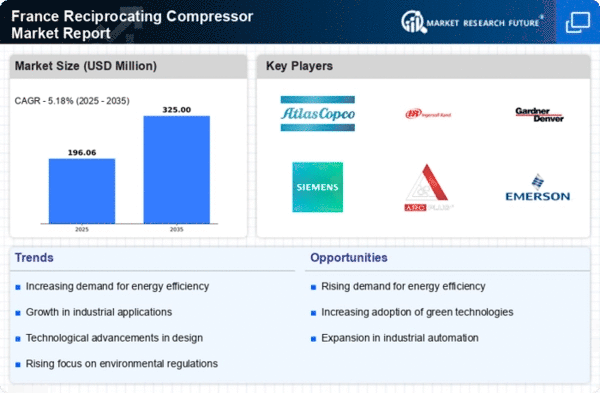
As per Market Research Future analysis, the France reciprocating compressor market size was estimated at 186.4 USD Million in 2024. The France reciprocating compressor market is projected to grow from 196.06 USD Million in 2025 to 325.0 USD Million by 2035, exhibiting a compound annual growth rate (CAGR) of 5.1% during the forecast period 2025 - 2035

Key Market Trends & Highlights

The France reciprocating compressor market is experiencing a transformative shift towards energy efficiency and smart technology integration.

  • The market is witnessing a rising demand for energy efficiency, driven by both industrial and commercial sectors.
  • Integration of smart technologies is becoming increasingly prevalent, enhancing operational efficiency and monitoring capabilities.
  • Regulatory support for sustainable practices is shaping market dynamics, particularly in the largest segment of industrial applications.
  • Technological advancements in manufacturing and a growing focus on environmental regulations are key drivers propelling market growth.

Market Size & Forecast

2024 Market Size 186.4 (USD Million)
2035 Market Size 325.0 (USD Million)
CAGR (2025 - 2035) 5.18%

Major Players

Atlas Copco (SE), Ingersoll Rand (US), Gardner Denver (US), Siemens (DE), Boge Compressors (DE), Emerson Electric (US), Hitachi (JP), Kirloskar Pneumatic (IN), Cameron (US)

Our Impact
Enabled $4.3B Revenue Impact for Fortune 500 and Leading Multinationals
Partnering with 2000+ Global Organizations Each Year
30K+ Citations by Top-Tier Firms in the Industry

France Reciprocating Compressor Market Trends

The reciprocating compressor market in France was currently experiencing notable developments driven by various factors. The increasing demand for energy-efficient solutions across multiple industries, including manufacturing and HVAC, appears to be a primary catalyst for growth. Additionally, the push for sustainability and reduced carbon emissions is prompting companies to invest in advanced technologies that enhance the efficiency of reciprocating compressors. This trend aligns with France's commitment to environmental goals, suggesting a favorable landscape for innovation in this sector. Moreover, The market was witnessing a shift towards automation and smart technologies. Manufacturers are integrating IoT capabilities into their products, allowing for real-time monitoring and predictive maintenance. This evolution not only improves operational efficiency but also reduces downtime, which is crucial for industries reliant on continuous processes. As the landscape evolves, the reciprocating compressor market is likely to adapt to these technological advancements, ensuring that it remains competitive and responsive to the needs of various sectors.

Rising Demand for Energy Efficiency

The focus on energy efficiency was becoming increasingly pronounced in the reciprocating compressor market. Industries are seeking solutions that minimize energy consumption while maximizing output. This trend is likely to drive innovation in compressor design and technology, as manufacturers strive to meet the growing expectations for sustainability.

Integration of Smart Technologies

The incorporation of smart technologies into reciprocating compressors was gaining traction. Features such as IoT connectivity enable enhanced monitoring and control, allowing for predictive maintenance and improved operational efficiency. This trend reflects a broader movement towards automation in industrial processes.

Regulatory Support for Sustainable Practices

Government initiatives aimed at promoting sustainable practices are influencing the reciprocating compressor market. Regulations encouraging reduced emissions and energy consumption are prompting manufacturers to develop more environmentally friendly products. This regulatory landscape is likely to shape future innovations and market dynamics.

France Reciprocating Compressor Market Drivers

Growing Industrial Applications

The expanding industrial sector in France significantly influenced the reciprocating compressor market. Industries such as oil and gas, chemical processing, and food and beverage are increasingly utilizing reciprocating compressors for various applications, including refrigeration, gas compression, and air supply. The demand for these compressors is expected to rise as industries seek reliable and efficient solutions to meet their operational needs. In 2024, the industrial sector is anticipated to contribute approximately 30% to the overall market share of reciprocating compressors. This growth is attributed to the need for enhanced productivity and energy efficiency in industrial operations. As companies invest in upgrading their equipment, the reciprocating compressor market is likely to benefit from increased sales and technological advancements tailored to specific industrial requirements.

Increased Investment in Infrastructure

The reciprocating compressor market in France is poised for growth due to increased investment in infrastructure development. Government initiatives aimed at modernizing transportation, energy, and utility sectors are creating a surge in demand for reliable compressor systems. These investments are expected to enhance the efficiency of various operations, including power generation and distribution. The infrastructure sector is projected to account for approximately 25% of the total market share by 2026, driven by the need for advanced compressor solutions. As new projects are launched, the demand for reciprocating compressors is likely to rise, providing manufacturers with opportunities to expand their market presence. This trend indicates a positive outlook for the reciprocating compressor market, as infrastructure development continues to be a priority for the French government.

Emerging Demand for Customized Solutions

The reciprocating compressor market is witnessing a shift towards customized solutions tailored to specific customer needs. As industries in France become more specialized, the demand for compressors that can meet unique operational requirements is increasing. Manufacturers are responding by offering bespoke designs and configurations that enhance performance and efficiency. This trend is particularly evident in sectors such as pharmaceuticals and automotive, where precision and reliability are paramount. The market for customized reciprocating compressors is expected to grow by approximately 20% over the next few years, as companies seek to optimize their processes. This growing demand for tailored solutions indicates a dynamic shift in the market, where flexibility and innovation are becoming key drivers of success.

Rising Focus on Environmental Regulations

In France, the reciprocating compressor market is increasingly shaped by stringent environmental regulations aimed at reducing emissions and promoting sustainability. The government has implemented various policies that encourage industries to adopt cleaner technologies, including energy-efficient compressors. Compliance with these regulations is becoming essential for companies to maintain their operational licenses and avoid penalties. As a result, there is a growing trend towards the adoption of eco-friendly reciprocating compressors that minimize environmental impact. This shift is expected to drive market growth, as businesses seek to align with regulatory standards while enhancing their corporate social responsibility initiatives. The market is projected to see a rise in demand for compressors that meet these environmental criteria, potentially increasing their market share by 15% over the next few years.

Technological Advancements in Manufacturing

The reciprocating compressor market in France is experiencing a notable shift due to technological advancements in manufacturing processes. Innovations such as improved materials and precision engineering techniques enhance the efficiency and reliability of compressors. These advancements not only reduce operational costs but also extend the lifespan of the equipment. As a result, manufacturers are increasingly adopting these technologies to meet the growing demand for high-performance compressors. The market was projected to grow at a CAGR of approximately 4.5% over the next five years, driven by these technological improvements. Furthermore, the integration of automation in manufacturing processes is likely to streamline production, thereby reducing lead times and costs. This trend indicates a robust future for the reciprocating compressor market, as companies strive to enhance their competitive edge through superior product offerings.


Market Segment Insights

By Type: Portable (Largest) vs. Stationary (Fastest-Growing)

The France reciprocating compressor market exhibits a significant divide between portable and stationary types. Portable models currently hold the largest share of the market, favored for their versatility and ease of use across various applications. This segment thrives in sectors such as construction and maintenance, where mobility is paramount. Conversely, stationary compressors, while smaller in market share, are rapidly gaining traction due to their efficiency and durability, particularly in fixed installations in industrial applications. Growth trends indicate a rising demand for stationary compressors driven by the ongoing automation of industries and the increasing focus on energy efficiency. These units are experiencing an uptick as more businesses opt for centralized air systems to meet rising operational needs without sacrificing performance. Meanwhile, portable compressors continue to evolve, integrating advanced technologies to enhance performance, further solidifying their position in the market.

Portable (Dominant) vs. Stationary (Emerging)

Portable reciprocating compressors are characterized by their compact design and mobility, making them ideal for tasks requiring flexibility such as in construction, landscaping, and repairs. Their ability to provide immediate power supply makes them a preferred choice for professionals on the go. In contrast, stationary compressors are designed for permanent installations and are typically used in larger industrial applications. They tend to be more powerful and efficient, catering to extensive operational demands. This segment is gaining momentum as industries demand reliable, long-term solutions that minimize downtime while maximizing output, marking it as an emerging player in the market.

By Lubrication: Oil-Free (Largest) vs. Oil Filled (Fastest-Growing)

In the France reciprocating compressor market, the lubrication segment is notably divided into Oil-Free and Oil Filled categories. The Oil-Free segment dominates the market, driven by its advantages in environmental sustainability and reduced maintenance needs. While the Oil Filled segment also plays a critical role, its share is significantly lower, yet it serves a vital function in high-demand applications where lubrication is necessary for optimal performance. Looking ahead, the growth trends indicate that while the Oil-Free segment continues to attract attention due to increasing regulations and consumer preference for eco-friendly options, the Oil Filled segment is recognized as the fastest-growing segment. This growth can be attributed to the rising demand for heavy-duty compressors in industrial applications, necessitating reliable lubrication systems for efficiency and longevity.

Lubrication: Oil-Free (Dominant) vs. Oil Filled (Emerging)

The Oil-Free segment is characterized by lower operational costs and higher reliability, making it the preferred choice for many end-users in various industries. Its appeal lies in its ability to operate without the need for lubricants, which minimizes contamination and maintenance requirements. Conversely, the Oil Filled segment, while currently secondary, is emerging rapidly due to its capability to handle heavier loads and high pressures in industrial settings. Both segments cater to distinct market needs, with the Oil-Filled compressors gaining traction as industries focus on efficiency and performance, thus ensuring sustained growth in this area.

By Stage Type: Single Stage (Largest) vs. Multi Stage (Fastest-Growing)

In the France reciprocating compressor market, the stage type segment is primarily divided into single stage and multi stage compressors. Currently, single stage compressors dominate the market with a notable share, as they are favored for their simplicity and cost-effectiveness in various applications. Meanwhile, multi stage compressors are gaining traction, driven by increasing demands for efficiency and performance in industrial applications. The growth trajectory for multi stage compressors is particularly dynamic, positioning them as the fastest-growing category within the segment. Several factors drive this trend, including heightened industry standards for energy efficiency and the need for higher pressure applications. As companies strive for performance improvements and lower operational costs, multi stage compressors are becoming the preferred choice, fostering an environment of innovation and rapid adoption across multiple industries.

Stage Type: Single Stage (Dominant) vs. Multi Stage (Emerging)

Single stage compressors are characterized by their straightforward design, which allows for easier maintenance and lower operational costs, making them the dominant choice among users with basic pressure requirements. These compressors operate on a single compression cycle, providing adequate performance for various applications, especially in smaller setups. In contrast, multi stage compressors are emerging as a strong alternative, offering enhanced efficiency by utilizing multiple compression stages to achieve higher pressures. This feature makes them ideal for complex industrial processes that demand greater reliability and energy savings. Consequently, the rising awareness of efficiency and sustainability is pushing multi stage compressors to the forefront of the market.

By Type: Single Acting (Largest) vs. Double Acting (Fastest-Growing)

In the France reciprocating compressor market, Single Acting compressors hold the largest market share among the segment values, driven by their simplicity and robustness in various applications. The Double Acting variant, while having a smaller share, is rapidly gaining traction due to its higher efficiency and output capabilities, making it a preferred choice in specialized sectors. Growth trends for these compressors are primarily influenced by advancements in technology and increasing industrial applications. The demand for energy-efficient and high-performance compressors is on the rise, propelling the development of innovative solutions. Additionally, regulatory push for environmental sustainability is enhancing the adoption of compressors that meet stringent emission standards, further supporting the growth of Double Acting compressors in the market.

Single Acting: Dominant vs. Double Acting: Emerging

Single Acting compressors are known for their reliability and cost-effectiveness, making them a dominant choice in various industrial applications. They operate on one side of the piston, which simplifies their design and reduces maintenance costs. In contrast, Double Acting compressors are emerging as a formidable competitor due to their ability to deliver twice the output in a similar footprint, thereby enhancing productivity for manufacturers. Their design allows for pressure generation on both strokes of the piston, which translates to greater efficiency and reduced operational costs. As industries strive for optimal performance, the growth of double acting compressors is expected to accelerate, leading to a dynamic shift in market preferences.

By End User: Oil & Gas (Largest) vs. Pharmaceutical (Fastest-Growing)

In the France reciprocating compressor market, the Oil & Gas segment holds the largest share, predominantly driven by the significant demand for efficient compression solutions in extraction and processing activities. This sector benefits from ongoing investments in infrastructure and technology, which support reliability and operational efficiency. Other notable segments include Manufacturing and Chemical Plants, which collectively cater to diverse industrial applications, enhancing market dynamics. The Pharmaceutical segment is emerging as the fastest-growing segment, fueled by the industry’s need for high-precision compressors that meet stringent quality and regulatory standards. Growing healthcare demands, especially in vaccine production, are pushing investments in advanced compressor technology. Additionally, the drive towards automation and improved efficiencies leads to increased integration of reciprocating compressors in production processes across various industries.

Oil & Gas: Dominant vs. Pharmaceutical: Emerging

The Oil & Gas segment stands as the dominant player in the France reciprocating compressor market, primarily due to extensive use in upstream and downstream operations where efficiency is crucial for maximizing output and minimizing costs. This segment benefits from robust demand linked to global energy dynamics and technological advancements. On the other hand, the Pharmaceutical segment is emerging rapidly, focusing on the production of vaccines and biopharmaceuticals that require specialized equipment with high reliability and compliance to health standards. This growth is driven by increasing investments in healthcare infrastructure and innovation, leading to a heightened demand for tailored compressor solutions that can operate under stringent parameters. Both segments highlight a critical balance between efficiency and compliance, positioning them strategically in the market.

Get more detailed insights about France Reciprocating Compressor Market

Key Players and Competitive Insights

The reciprocating compressor market in France exhibits a dynamic competitive landscape characterized by a blend of innovation, strategic partnerships, and regional expansion. Key players such as Atlas Copco (SE), Ingersoll Rand (US), and Siemens (DE) are actively shaping the market through their distinct operational focuses. Atlas Copco (SE) emphasizes sustainability and energy efficiency in its product offerings, which aligns with the growing demand for environmentally friendly solutions. Ingersoll Rand (US) has been focusing on digital transformation, integrating advanced technologies into its compressors to enhance performance and reliability. Siemens (DE), on the other hand, is leveraging its expertise in automation and digitalization to optimize compressor operations, thereby enhancing efficiency and reducing operational costs. Collectively, these strategies contribute to a competitive environment that prioritizes innovation and technological advancement.
The business tactics employed by these companies reflect a concerted effort to localize manufacturing and optimize supply chains. The market structure appears moderately fragmented, with several players vying for market share while also collaborating through strategic alliances. This collective influence of key players fosters a competitive atmosphere where innovation and customer-centric solutions are paramount, allowing companies to differentiate themselves in a crowded marketplace.
In October 2025, Atlas Copco (SE) announced the launch of a new line of energy-efficient reciprocating compressors designed to reduce energy consumption by up to 30%. This strategic move not only reinforces Atlas Copco's commitment to sustainability but also positions the company as a leader in energy-efficient solutions, catering to the increasing regulatory pressures for lower emissions in industrial applications. The introduction of this product line is likely to enhance customer loyalty and attract new clients seeking to improve their environmental footprint.
In September 2025, Ingersoll Rand (US) unveiled a partnership with a leading software company to develop AI-driven predictive maintenance solutions for its reciprocating compressors. This initiative aims to minimize downtime and enhance operational efficiency for customers. By integrating AI technology, Ingersoll Rand (US) is not only improving its product offerings but also addressing the growing demand for smart industrial solutions. This strategic alignment with technology partners could potentially lead to a competitive edge in the market, as customers increasingly seek integrated solutions that enhance productivity.
In August 2025, Siemens (DE) expanded its manufacturing capabilities in France by investing €10 million in a new facility dedicated to producing advanced reciprocating compressors. This investment underscores Siemens' commitment to regional expansion and its strategy to meet the rising demand for high-performance compressors in the European market. By localizing production, Siemens (DE) can reduce lead times and enhance its responsiveness to customer needs, thereby strengthening its competitive position in the market.
As of November 2025, the competitive trends in the reciprocating compressor market are increasingly defined by digitalization, sustainability, and the integration of AI technologies. Strategic alliances are becoming more prevalent, allowing companies to pool resources and expertise to drive innovation. The shift from price-based competition to a focus on technological advancement and supply chain reliability is evident, suggesting that future competitive differentiation will hinge on the ability to innovate and deliver sustainable solutions. Companies that can effectively navigate these trends are likely to emerge as leaders in the evolving landscape.

Key Companies in the France Reciprocating Compressor Market include

Industry Developments

The France Reciprocating Compressor Market has seen significant developments in recent months, particularly in Jul2023 when Emerson Electric revealed a new line of energy-efficient compressors aimed at reducing operational costs and emissions for various industries. This aligns with ongoing environmental initiatives in France targeting reduced greenhouse gas emissions. Boge Compressors has also announced an expansion of its facilities in France to enhance production capabilities, responding to an increasing demand for reliable air compression solutions.

In the arena of mergers and acquisitions, in June 2023, Ingersoll Rand acquired a small French technology firm focusing on smart compressor technologies, which bolstered its offerings in the digital compressor sector. The market has been influenced heavily by the rising need for automation and energy efficiency, leading to a projected growth in market valuation. In the past 2-3 years, France has launched government incentives for energy-efficient equipment, pushing adopters like GE Oil and Gas and Atlas Copco to innovate further in their product lines.

The continued focus on sustainability and technological advancement is reshaping the landscape of the reciprocating compressor market in France.

Future Outlook

France Reciprocating Compressor Market Future Outlook

The Reciprocating Compressor Market in France is projected to grow at a 5.18% CAGR from 2025 to 2035, driven by industrial demand, energy efficiency, and technological advancements.

New opportunities lie in:

  • Development of energy-efficient compressor models for industrial applications.
  • Expansion into renewable energy sectors with specialized compressors.
  • Integration of IoT technology for predictive maintenance solutions.

By 2035, the market is expected to achieve robust growth, driven by innovation and strategic investments.

Market Segmentation

France Reciprocating Compressor Market Type Outlook

  • Single Acting
  • Double Acting
  • Diaphragm

France Reciprocating Compressor Market End User Outlook

  • Oil & Gas
  • Pharmaceutical
  • Chemical Plants
  • Refrigeration Plants
  • Manufacturing
  • Automotive
  • Others

France Reciprocating Compressor Market Stage Type Outlook

  • Single Stage
  • Multi Stage

France Reciprocating Compressor Market Lubrication Outlook

  • Oil-Free
  • Oil Filled

Report Scope

MARKET SIZE 2024 186.4(USD Million)
MARKET SIZE 2025 196.06(USD Million)
MARKET SIZE 2035 325.0(USD Million)
COMPOUND ANNUAL GROWTH RATE (CAGR) 5.18% (2025 - 2035)
REPORT COVERAGE Revenue Forecast, Competitive Landscape, Growth Factors, and Trends
BASE YEAR 2024
Market Forecast Period 2025 - 2035
Historical Data 2019 - 2024
Market Forecast Units USD Million
Key Companies Profiled Atlas Copco (SE), Ingersoll Rand (US), Gardner Denver (US), Siemens (DE), Boge Compressors (DE), Emerson Electric (US), Hitachi (JP), Kirloskar Pneumatic (IN), Cameron (US)
Segments Covered Type, Lubrication, Stage Type, Type, End User
Key Market Opportunities Adoption of energy-efficient technologies in the reciprocating compressor market enhances sustainability and operational cost savings.
Key Market Dynamics Rising demand for energy-efficient reciprocating compressors driven by stringent environmental regulations in France.
Countries Covered France
Leave a Comment

FAQs

What is the expected market size of the France Reciprocating Compressor Market in 2024?

The France Reciprocating Compressor Market is expected to be valued at 102.52 million USD in 2024.

What will be the projected market size of the France Reciprocating Compressor Market by 2035?

By 2035, the market is projected to reach a value of 235.0 million USD.

What is the expected CAGR for the France Reciprocating Compressor Market from 2025 to 2035?

The expected CAGR for the market from 2025 to 2035 is 7.833%.

Which are the major players in the France Reciprocating Compressor Market?

Key players in the market include Emerson Electric, Boge Compressors, Ingersoll Rand, and Atlas Copco.

What is the market value for Portable reciprocating compressors in 2024?

The market value for Portable reciprocating compressors is estimated to be 25.0 million USD in 2024.

How much is the Stationary type of reciprocating compressors valued at in 2035?

The Stationary type is expected to be valued at 70.0 million USD by 2035.

What is the projected market size for single acting compressors in 2024?

The single acting compressors are projected to be valued at 20.0 million USD in 2024.

What market value is expected for diaphragm compressors in 2035?

By 2035, diaphragm compressors are expected to reach a market value of 28.0 million USD.

What are the growth drivers for the France Reciprocating Compressor Market?

Growth drivers include increasing industrial applications and the need for efficient gas compression solutions.

What impact might global conflicts have on the France Reciprocating Compressor Market?

Global conflicts could potentially disrupt supply chains and affect market stability, impacting growth projections.

Download Free Sample

Kindly complete the form below to receive a free sample of this Report

Compare Licence

×
Features License Type
Single User Multiuser License Enterprise User
Price $4,950 $5,950 $7,250
Maximum User Access Limit 1 User Upto 10 Users Unrestricted Access Throughout the Organization
Free Customization
Direct Access to Analyst
Deliverable Format
Platform Access
Discount on Next Purchase 10% 15% 15%
Printable Versions