×
Request Free Sample ×

Kindly complete the form below to receive a free sample of this Report

* Please use a valid business email

Leading companies partner with us for data-driven Insights

clients tt-cursor
Hero Background

UK Reciprocating Compressor Market

ID: MRFR/EnP/53103-HCR
200 Pages
Snehal Singh
February 2026

UK Reciprocating Compressor Market Research Report By Type (Portable, Stationary, single acting, double acting, diaphragm), By Lubrication (Oil-Free, Oil-Filled), By Stage Type (single stage, stage) and By End User (oil & gas, pharmaceutical, chemical plants, refrigeration plants, manufacturing, automotive, others)- Forecast to 2035

Share:
Download PDF ×

We do not share your information with anyone. However, we may send you emails based on your report interest from time to time. You may contact us at any time to opt-out.

UK Reciprocating Compressor Market Infographic
Purchase Options

UK Reciprocating Compressor Market Summary

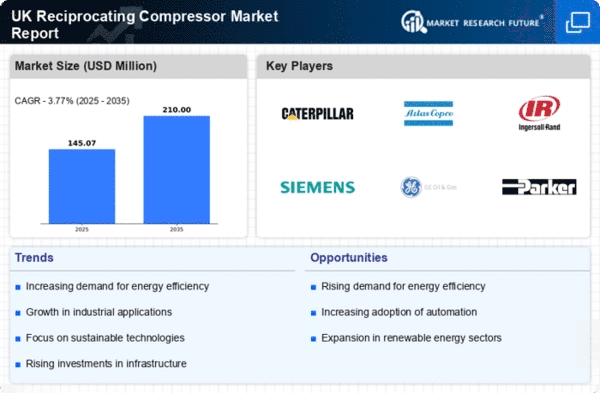
As per Market Research Future analysis, the UK reciprocating compressor market size was estimated at 139.8 USD Million in 2024.. The UK reciprocating compressor market is projected to grow from 145.07 USD Million in 2025 to 210.0 USD Million by 2035, exhibiting a compound annual growth rate (CAGR) of 3.7% during the forecast period 2025 - 2035

Key Market Trends & Highlights

The UK reciprocating compressor market is experiencing a transformative shift driven by technological advancements and sustainability initiatives.

  • Technological advancements are enhancing the efficiency and performance of reciprocating compressors across various applications.
  • The manufacturing sector remains the largest segment, while the oil and gas sector is identified as the fastest-growing segment in the UK market.
  • Sustainability initiatives are prompting companies to adopt energy-efficient solutions, aligning with global environmental goals.
  • Rising demand in the manufacturing sector and increased focus on energy efficiency are key drivers propelling market growth.

Market Size & Forecast

2024 Market Size 139.8 (USD Million)
2035 Market Size 210.0 (USD Million)
CAGR (2025 - 2035) 3.77%

Major Players

Caterpillar Inc (US), Atlas Copco AB (SE), Ingersoll Rand Inc (US), Siemens AG (DE), GE Oil & Gas (US), Parker Hannifin Corporation (US), Boge Compressors (DE), Hitachi Ltd (JP), Gardner Denver Holdings Inc (US)

Our Impact
Enabled $4.3B Revenue Impact for Fortune 500 and Leading Multinationals
Partnering with 2000+ Global Organizations Each Year
30K+ Citations by Top-Tier Firms in the Industry

UK Reciprocating Compressor Market Trends

The reciprocating compressor market is currently experiencing notable developments, driven by various factors including technological advancements and increasing demand across multiple sectors. The rise in industrial activities, particularly in manufacturing and energy, has led to a heightened need for efficient and reliable compression solutions. Furthermore, the emphasis on energy efficiency and sustainability is prompting manufacturers to innovate and enhance their product offerings. This trend is likely to continue as industries seek to reduce operational costs while adhering to environmental regulations. In addition, the market is witnessing a shift towards automation and smart technologies. The integration of IoT and advanced monitoring systems into reciprocating compressors is enhancing operational efficiency and predictive maintenance capabilities. This evolution not only improves performance but also extends the lifespan of equipment, thereby providing significant cost savings for end-users. As the market evolves, it appears that the focus will remain on developing high-performance compressors that meet the diverse needs of various applications, from refrigeration to gas processing.

Technological Advancements

Recent innovations in design and materials are enhancing the efficiency and reliability of reciprocating compressors. Manufacturers are increasingly adopting advanced engineering techniques to improve performance and reduce energy consumption.

Sustainability Initiatives

There is a growing emphasis on environmentally friendly practices within the reciprocating compressor market. Companies are focusing on developing products that minimize emissions and comply with stringent environmental regulations.

Automation and Smart Technologies

The integration of automation and smart technologies is transforming the operational landscape. Enhanced monitoring systems and IoT capabilities are enabling predictive maintenance, which can lead to reduced downtime and improved efficiency.

UK Reciprocating Compressor Market Drivers

Growth in Oil and Gas Sector

The oil and gas sector in the UK is witnessing a resurgence, which may positively influence the reciprocating compressor market. With the increasing exploration and production activities in the North Sea, there is a heightened demand for reliable compression solutions. Reciprocating compressors are essential for various applications in this sector, including gas processing and transportation. The UK government has projected that the oil and gas sector could contribute approximately £50 billion to the economy by 2025, indicating a robust market for reciprocating compressors. Additionally, the need for enhanced safety and efficiency in operations is likely to drive the adoption of advanced compressor technologies. As the oil and gas sector continues to evolve, the reciprocating compressor market is expected to benefit from this growth.

Increased Focus on Energy Efficiency

The growing emphasis on energy efficiency in the UK is influencing the reciprocating compressor market. With rising energy costs and stringent regulations aimed at reducing carbon emissions, industries are increasingly seeking energy-efficient solutions. Reciprocating compressors, known for their efficiency and reliability, are becoming a preferred choice for various applications. The UK government has set ambitious targets to reduce greenhouse gas emissions by 68% by 2030, which may drive industries to adopt more efficient technologies. In 2025, it is estimated that energy-efficient compressors could reduce operational costs by up to 30%, making them an attractive investment for businesses. This focus on energy efficiency is likely to propel the demand for reciprocating compressors, as companies strive to meet regulatory requirements and enhance their sustainability profiles.

Rising Demand in Manufacturing Sector

The manufacturing sector in the UK is experiencing a notable resurgence, which appears to be driving the growth of the reciprocating compressor market. As industries such as automotive, aerospace, and food processing expand, the need for efficient and reliable compression solutions becomes increasingly critical. In 2025, the manufacturing sector is projected to contribute approximately £200 billion to the UK economy, indicating a robust demand for reciprocating compressors. These compressors are essential for various applications, including refrigeration and air conditioning, which are integral to manufacturing processes. The increasing focus on production efficiency and cost reduction further propels the adoption of reciprocating compressors, as they offer high reliability and performance. Consequently, the growth of the manufacturing sector is likely to be a significant driver for the reciprocating compressor market in the UK.

Infrastructure Development Initiatives

Infrastructure development initiatives in the UK are poised to create substantial opportunities for the reciprocating compressor market. The government has committed to investing over £600 billion in infrastructure projects over the next decade, focusing on transportation, energy, and utilities. These projects necessitate the use of reciprocating compressors for various applications, including powering pneumatic tools and providing compressed air for construction activities. The demand for energy-efficient and high-performance compressors is likely to increase as infrastructure projects progress. Furthermore, the emphasis on sustainable construction practices may lead to the adoption of advanced reciprocating compressor technologies that align with environmental standards. As a result, the ongoing infrastructure development initiatives are expected to significantly impact the growth trajectory of the reciprocating compressor market.

Technological Innovations in Compressor Design

Technological innovations in compressor design are emerging as a key driver for the reciprocating compressor market. The development of advanced materials and smart technologies is enhancing the performance and efficiency of these compressors. Innovations such as variable speed drives and advanced control systems are enabling better energy management and operational efficiency. In 2025, it is anticipated that the market for technologically advanced compressors will grow by approximately 15%, reflecting the increasing demand for high-performance solutions. Furthermore, the integration of IoT technologies into compressor systems is likely to provide real-time monitoring and predictive maintenance capabilities, which can significantly reduce downtime and operational costs. As industries in the UK seek to optimize their operations, the focus on technological innovations is expected to propel the growth of the reciprocating compressor market.


Market Segment Insights

By Type: Portable (Largest) vs. Stationary (Fastest-Growing)

In the UK reciprocating compressor market, the market share is predominantly held by portable compressors, which are favored for their versatility and ease of transport. This segment caters to various applications across industries, from construction to automotive, meeting the needs of users who require mobility in their operations. Meanwhile, stationary compressors are steadily gaining traction as they provide enhanced performance and efficiency for fixed applications, contributing to a competitive market landscape. The growth trends for portable compressors are driven by increasing demand in sectors that prioritize flexibility and on-site operations. Conversely, the stationary segment is witnessing rapid growth fueled by advancements in technology and a shift towards energy-efficient solutions. Both segments are evolving, with manufacturers focusing on optimizing performance and integrating smart technologies to enhance user experience, ensuring sustained growth in the UK reciprocating compressor market.

Type: Portable (Dominant) vs. Stationary (Emerging)

Portable compressors are characterized by their lightweight design and mobility, making them ideal for on-site applications where space and accessibility are constraints. They dominate the market due to their widespread use in various industries including construction, maintenance, and even home projects. Their ease of transport ensures they meet the dynamic needs of users. On the other hand, stationary compressors are emerging as a crucial component in facilities requiring stable and continuous power supply. These units are typically larger, designed for heavy-duty applications, and often feature advanced technology for enhanced efficiency. The growing emphasis on operational efficiency and energy savings positions stationary compressors as an important segment to watch in the evolving market.

By Lubrication: Oil-Free (Largest) vs. Oil Filled (Fastest-Growing)

In the UK reciprocating compressor market, the lubrication segment displays a distinct split in market share between oil-free and oil-filled compressors. Currently, oil-free compressors hold a larger share due to their growing popularity among environmentally conscious consumers and industries seeking reduced maintenance costs. Oil-filled compressors, while trailing in overall share, are gaining traction due to their robustness and efficiency for specific applications, The growth trends within this lubrication segment are significant as advancements in oil-free technology continue to attract investment. Moreover, the demand for eco-friendly solutions is propelling oil-free compressors as a leading choice in various sectors. Conversely, oil-filled compressors are witnessing increased demand in heavy-duty applications, leveraging their established performance characteristics and reliability to capitalize on opportunities in the market.

Lubrication: Oil-Free (Dominant) vs. Oil Filled (Emerging)

Oil-free compressors are regarded as the dominant force in lubrication within the UK reciprocating compressor market, primarily attributed to their enhanced efficiency and lower environmental impact. These compressors eliminate the need for lubricant, making them ideal for industries where oil contamination is a concern. Conversely, oil-filled compressors are emerging as notable alternatives, characterized by their ability to handle higher loads and extended operational life. They provide significant advantages in heavy industrial applications where durability and performance are paramount. The contrasting attributes of these two types create a dynamic market environment, catering to diverse customer preferences and application needs.

By Stage Type: Single Stage (Largest) vs. Multi Stage (Fastest-Growing)

In the UK reciprocating compressor market, the distribution of market share highlights Single Stage compressors as the largest segment, preferred for their simplicity and cost-effectiveness. Meanwhile, Multi Stage compressors are gaining traction, especially in applications requiring high pressure and efficiency, making them a significant competitor in the landscape. Growth trends indicate that the Multi Stage segment is experiencing rapid expansion due to increasing demand for energy-efficient solutions in industrial applications. Technological advancements and rising awareness about operational efficiency are driving this shift. The dynamic nature of the market suggests a robust future for Multi Stage compressors as industries seek advanced solutions to enhance productivity and reduce environmental impact.

Single Stage: Dominant vs. Multi Stage: Emerging

Single Stage compressors are characterized by their straightforward design, which allows for easy maintenance and lower operational costs. They are predominantly utilized in applications that require moderate pressures, making them suitable for various industries such as refrigeration and air-conditioning. Conversely, Multi Stage compressors are emerging as a preferred choice for applications that demand higher pressure levels and efficiency. These compressors leverage advanced engineering to provide enhanced performance and are increasingly adopted in sectors like oil and gas and automotive manufacturing. The ability to handle high-pressure applications while maintaining efficiency positions Multi Stage compressors as a key player in the evolving UK reciprocating compressor market.

By Type: Double Acting (Largest) vs. Diaphragm (Fastest-Growing)

In the UK reciprocating compressor market, the segment values are distributed with Double Acting units holding the largest market share, driven by their efficiency and versatility in industrial applications. Single Acting compressors follow, offering simpler design and operation, while Diaphragm compressors, though currently smaller in share, are gaining traction due to their superior performance in specialized applications. Growth trends for these segments are influenced by the expanding industrial sector and increasing demand for energy-efficient solutions. Double Acting compressors are expected to remain dominant, but Diaphragm designs are emerging rapidly due to innovations in materials and technology that enhance their reliability and application range. The overall market reflects a shift towards more specialized and efficient compressor solutions.

Double Acting (Dominant) vs. Diaphragm (Emerging)

Double Acting compressors are characterized by their ability to compress gas on both the forward and reverse strokes, leading to higher efficiency and output. This makes them particularly favored in industries where reliability and performance are critical. In contrast, Diaphragm compressors offer unique advantages such as leak-free operation and the handling of corrosive or sensitive gases, making them suitable for specialized applications in sectors like pharmaceuticals and food processing. As the UK reciprocating compressor market evolves, the competition between these two segment values is set to intensify, with Diaphragm models rapidly gaining a foothold due to rising environmental and safety requirements.

By End User: Oil & Gas (Largest) vs. Pharmaceutical (Fastest-Growing)

The UK reciprocating compressor market exhibits significant diversity in its end user segments, with Oil & Gas dominating the landscape. This sector commands a considerable portion of the market share, driven by the continuous demand for energy and processing capabilities. On the other hand, segments such as Pharmaceutical, Chemical Plants, and others also contribute to the market but with comparatively smaller shares. Each segment plays a critical role in supporting various industrial applications, reflecting the multifaceted needs of the UK economy. In recent years, growth trends indicate a rising demand for reciprocating compressors across sectors, particularly in Pharmaceutical where innovation in drug manufacturing is accelerating. The sector is witnessing an influx of investments aimed at enhancing production efficiency and adhering to stringent quality standards. Moreover, the Automotive and Manufacturing segments are increasingly adopting advanced compressor technologies to optimize performance, signaling a dynamic shift influenced by automation and sustainability initiatives.

Oil & Gas (Dominant) vs. Pharmaceutical (Emerging)

The Oil & Gas segment stands as the dominant force within the UK reciprocating compressor market, characterized by its extensive infrastructure and established operational practices. This segment relies heavily on robust compressor systems for efficient gas extraction and processing. Meanwhile, the Pharmaceutical segment is emerging rapidly, spurred by advancements in biopharmaceutical manufacturing and the need for highly reliable compressed air systems to maintain product integrity. The growth in this sector reflects a shift towards producing more complex therapeutic products, requiring precision and innovation in compressor technologies. Both segments are pivotal but cater to distinct industrial demands, showcasing the varied applications of reciprocating compressors in the UK.

Get more detailed insights about UK Reciprocating Compressor Market

Key Players and Competitive Insights

The reciprocating compressor market exhibits a dynamic competitive landscape, characterized by a blend of innovation and strategic maneuvers among key players. Major companies such as Caterpillar Inc (US), Atlas Copco AB (SE), and Ingersoll Rand Inc (US) are at the forefront, each adopting distinct strategies to enhance their market positioning. Caterpillar Inc (US) focuses on integrating advanced technologies into its product offerings, aiming to improve efficiency and reduce emissions. Meanwhile, Atlas Copco AB (SE) emphasizes sustainability, investing in eco-friendly compressor solutions that align with global environmental standards. Ingersoll Rand Inc (US) appears to be concentrating on expanding its digital capabilities, leveraging data analytics to optimize compressor performance and maintenance.
The business tactics employed by these companies reflect a concerted effort to localize manufacturing and optimize supply chains, which is crucial in a moderately fragmented market. This competitive structure allows for a diverse range of products and services, catering to various industrial needs. The collective influence of these key players shapes market dynamics, as they strive to differentiate themselves through technological advancements and customer-centric solutions.
In October 2025, Caterpillar Inc (US) announced a strategic partnership with a leading renewable energy firm to develop hybrid compressor systems. This collaboration is significant as it not only enhances Caterpillar's product portfolio but also positions the company as a leader in sustainable technology within the sector. The move is likely to attract environmentally conscious customers and strengthen its market share.
In September 2025, Atlas Copco AB (SE) launched a new line of energy-efficient reciprocating compressors designed for the oil and gas industry. This product introduction is pivotal, as it addresses the growing demand for energy-efficient solutions in a sector that is increasingly scrutinized for its environmental impact. By aligning its offerings with industry needs, Atlas Copco is poised to capture a larger segment of the market.
In August 2025, Ingersoll Rand Inc (US) unveiled a digital platform that integrates AI-driven analytics for predictive maintenance of compressors. This initiative is crucial, as it not only enhances operational efficiency but also reduces downtime for customers. The integration of AI into their product offerings signifies a shift towards more intelligent and responsive compressor systems, which could redefine customer expectations in the market.
As of November 2025, the competitive trends in the reciprocating compressor market are increasingly defined by digitalization, sustainability, and the integration of AI technologies. Strategic alliances are becoming more prevalent, as companies recognize the need to collaborate to enhance their technological capabilities. Looking ahead, competitive differentiation is likely to evolve from traditional price-based competition to a focus on innovation, technological advancements, and supply chain reliability. This shift underscores the importance of adapting to market demands and leveraging technology to maintain a competitive edge.

Key Companies in the UK Reciprocating Compressor Market include

Industry Developments

The UK Reciprocating Compressor Market has witnessed significant developments in recent months, particularly with a focus on enhancing energy efficiency and sustainability. Major players, including Emerson Electric, Ingersoll Rand, and Atlas Copco, are advancing their technologies, prioritizing innovations that reduce emissions and lower operational costs. Current affairs indicate a shift towards more environmentally responsible practices as companies respond to increasing regulatory pressures aimed at reducing carbon footprints. 

Notably, Emerson Electric's recent acquisition of a niche technology startup in September 2023 aims to bolster their capabilities in delivering high-efficiency compressor solutions. As for market valuation, the growth trajectory is promising, attributed to rising demand in various sectors like oil and gas, manufacturing, and construction, which has encouraged companies such as Gardner Denver and Danfoss to expand their offerings. The cumulative effect of these advancements is contributing to a more competitive landscape within the UK, showcasing a blend of innovation and strategic partnerships while reflecting broader industry trends focused on sustainability and efficiency improvements.

Future Outlook

UK Reciprocating Compressor Market Future Outlook

The Reciprocating Compressor Market is projected to grow at a 3.77% CAGR from 2025 to 2035, driven by industrial demand, energy efficiency regulations, and technological advancements.

New opportunities lie in:

  • Development of energy-efficient compressor models for industrial applications.
  • Expansion into renewable energy sectors with specialized compressors.
  • Integration of IoT technology for predictive maintenance solutions.

By 2035, the market is expected to achieve robust growth, driven by innovation and strategic investments.

Market Segmentation

UK Reciprocating Compressor Market Type Outlook

  • Single Acting
  • Double Acting
  • Diaphragm

UK Reciprocating Compressor Market End User Outlook

  • Oil & Gas
  • Pharmaceutical
  • Chemical Plants
  • Refrigeration Plants
  • Manufacturing
  • Automotive
  • Others

UK Reciprocating Compressor Market Stage Type Outlook

  • Single Stage
  • Multi Stage

UK Reciprocating Compressor Market Lubrication Outlook

  • Oil-Free
  • Oil Filled

Report Scope

MARKET SIZE 2024 139.8(USD Million)
MARKET SIZE 2025 145.07(USD Million)
MARKET SIZE 2035 210.0(USD Million)
COMPOUND ANNUAL GROWTH RATE (CAGR) 3.77% (2025 - 2035)
REPORT COVERAGE Revenue Forecast, Competitive Landscape, Growth Factors, and Trends
BASE YEAR 2024
Market Forecast Period 2025 - 2035
Historical Data 2019 - 2024
Market Forecast Units USD Million
Key Companies Profiled Caterpillar Inc (US), Atlas Copco AB (SE), Ingersoll Rand Inc (US), Siemens AG (DE), GE Oil & Gas (US), Parker Hannifin Corporation (US), Boge Compressors (DE), Hitachi Ltd (JP), Gardner Denver Holdings Inc (US)
Segments Covered Type, Lubrication, Stage Type, Type, End User
Key Market Opportunities Adoption of energy-efficient technologies drives growth in the reciprocating compressor market.
Key Market Dynamics Rising demand for energy-efficient solutions drives innovation in the reciprocating compressor market amid regulatory pressures.
Countries Covered UK
Leave a Comment

FAQs

What is the expected market size of the UK Reciprocating Compressor Market in 2024?

The UK Reciprocating Compressor Market is expected to be valued at approximately 153.78 million USD in 2024.

What will be the projected market size in 2035?

By 2035, the market is projected to reach around 267.9 million USD.

What is the expected CAGR for the UK Reciprocating Compressor Market from 2025 to 2035?

The expected CAGR for the UK Reciprocating Compressor Market during this period is 5.176%.

Which type of reciprocating compressor is anticipated to have the largest market share by 2035?

The double acting type is expected to hold the largest share, projected to reach 90.0 million USD by 2035.

Who are the key players in the UK Reciprocating Compressor Market?

Major players include Emerson Electric, Boge Compressors, Ingersoll Rand, Siemens, and Atlas Copco among others.

What market size is projected for the Portable type of reciprocating compressors by 2035?

The Portable type is expected to reach a value of 52.0 million USD by 2035.

What are the main growth drivers for the UK Reciprocating Compressor Market?

The demand for energy-efficient and portable compressors in various industrial applications is propelling market growth.

How much is the Stationary type of reciprocating compressor expected to be valued at in 2024?

The Stationary type is anticipated to have a market value of 40.0 million USD in 2024.

What challenges does the UK Reciprocating Compressor Market currently face?

Challenges include maintaining efficiency and addressing environmental regulations in compressor manufacturing.

What impact do emerging trends have on the UK Reciprocating Compressor Market?

Emerging trends such as advancements in automation and IoT integration are expected to significantly enhance operational efficiencies.

Download Free Sample

Kindly complete the form below to receive a free sample of this Report

Compare Licence

×
Features License Type
Single User Multiuser License Enterprise User
Price $4,950 $5,950 $7,250
Maximum User Access Limit 1 User Upto 10 Users Unrestricted Access Throughout the Organization
Free Customization
Direct Access to Analyst
Deliverable Format
Platform Access
Discount on Next Purchase 10% 15% 15%
Printable Versions