×
Request Free Sample ×

Kindly complete the form below to receive a free sample of this Report

* Please use a valid business email

Leading companies partner with us for data-driven Insights

clients tt-cursor
Hero Background

France Low Speed Vehicle Market

ID: MRFR/AT/52468-HCR
200 Pages
Sejal Akre
February 2026

France Low Speed Vehicle Market Research Report By Power output (8 kW, 8–15 kW, >15 KW) - Growth & Industry Forecast 2025 To 2035

Share:
Download PDF ×

We do not share your information with anyone. However, we may send you emails based on your report interest from time to time. You may contact us at any time to opt-out.

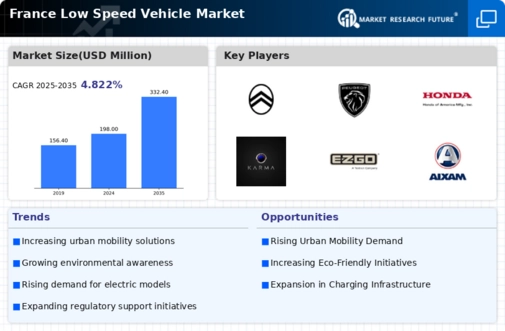
France Low Speed Vehicle Market Infographic
Purchase Options

France Low Speed Vehicle Market Summary

As per analysis, the France Low Speed Vehicle Market is projected to grow from USD 396.0 Million in 2024 to USD 634.07 Million by 2035, exhibiting a compound annual growth rate (CAGR) of 4.37% during the forecast period (2025 - 2035).

Key Market Trends & Highlights

The France low speed vehicle market is experiencing a notable shift towards electric vehicles driven by regulatory support and changing consumer preferences.

  • The electric vehicle segment remains the largest in the low speed vehicle market, reflecting a growing consumer inclination towards sustainable transportation.
  • Hybrid vehicles are emerging as the fastest-growing segment, indicating a shift in consumer preferences for versatile mobility solutions.
  • Personal use vehicles dominate the market, while commercial use vehicles are witnessing the fastest growth, suggesting evolving urban mobility needs.
  • Regulatory support and environmental concerns are key drivers propelling the adoption of low speed vehicles in urban areas.

Market Size & Forecast

2024 Market Size 396.0 (USD Million)
2035 Market Size 634.07 (USD Million)
CAGR (2025 - 2035) 4.37%

Major Players

Groupe Renault (FR), Citroen (FR), Peugeot (FR), Microcar (FR), Ligier (FR), Chatenet (FR), Aixam (FR), Bollinger Motors (US), Yamaha Motor Co (JP)

Our Impact
Enabled $4.3B Revenue Impact for Fortune 500 and Leading Multinationals
Partnering with 2000+ Global Organizations Each Year
30K+ Citations by Top-Tier Firms in the Industry

France Low Speed Vehicle Market Trends

The France Low Speed Vehicle Market is currently experiencing a notable transformation, driven by a combination of regulatory changes and evolving consumer preferences. The French government has been actively promoting the use of low-speed vehicles as part of its broader strategy to reduce urban congestion and lower emissions. This initiative aligns with the European Union's environmental goals, which emphasize sustainable transportation solutions. As a result, manufacturers are increasingly focusing on developing innovative models that cater to the specific needs of urban commuters, particularly in densely populated areas. Furthermore, the rise of electric low-speed vehicles is reshaping the market landscape, as consumers seek eco-friendly alternatives that offer convenience and efficiency. In addition to regulatory support, the france low speed vehicle market is witnessing a shift in consumer attitudes towards mobility. There is a growing recognition of the benefits associated with low-speed vehicles, such as reduced operating costs and ease of parking. This trend is particularly evident in urban centers, where traditional vehicles often face restrictions and higher costs. As more individuals and businesses consider low-speed vehicles as viable transportation options, the market is likely to expand further. The interplay between government initiatives, consumer demand, and technological advancements suggests a promising future for the france low speed vehicle market, with potential for increased adoption and innovation in the coming years.

Regulatory Support for Low-Speed Vehicles

The French government is actively encouraging the adoption of low-speed vehicles through various incentives and regulations. This support is aimed at reducing urban congestion and promoting environmentally friendly transportation options. As a result, manufacturers are adapting their offerings to align with these governmental initiatives.

Shift in Consumer Preferences

There is a noticeable change in consumer attitudes towards low-speed vehicles, particularly in urban areas. Individuals are increasingly recognizing the advantages of these vehicles, such as lower operating costs and ease of maneuverability. This shift is likely to drive demand and expand the market.

Technological Advancements in Electric Vehicles

The rise of electric low-speed vehicles is significantly influencing the france low speed vehicle market. Innovations in battery technology and charging infrastructure are making these vehicles more accessible and appealing to consumers, thereby enhancing their market presence.

France Low Speed Vehicle Market Drivers

Shift in Consumer Preferences

There is a noticeable shift in consumer preferences towards low-speed vehicles in France, driven by increasing environmental awareness and the desire for cost-effective transportation solutions. Consumers are becoming more inclined to choose vehicles that are not only economical but also environmentally friendly. This trend is reflected in the rising sales of electric low-speed vehicles, which have seen a year-on-year increase of approximately 20% in 2025. The France low speed vehicle market is witnessing a demographic shift, with younger consumers particularly favoring these vehicles for short commutes and urban travel. This change in consumer behavior suggests a potential for sustained growth in the market, as more individuals prioritize sustainability and efficiency in their transportation choices.

Urbanization and Traffic Congestion

Urbanization and the resulting traffic congestion in French cities are driving the demand for low-speed vehicles. As urban populations continue to grow, the need for efficient and compact transportation solutions becomes increasingly critical. Low-speed vehicles, which are often smaller and more maneuverable than traditional cars, offer a practical alternative for navigating congested urban environments. In 2025, it is estimated that urban areas in France will account for over 70% of low-speed vehicle usage, as residents seek to avoid the frustrations of traffic jams and limited parking. This trend indicates a strong potential for growth within the France low speed vehicle market, as more individuals opt for these vehicles to enhance their mobility in densely populated areas.

Regulatory Support for Low-Speed Vehicles

The France low speed vehicle market benefits from robust regulatory support aimed at promoting sustainable transportation. The French government has implemented various policies that encourage the use of low-speed vehicles, particularly in urban areas. For instance, the introduction of low-emission zones in cities like Paris has created a favorable environment for low-speed vehicles, which are often electric or hybrid. This regulatory framework not only facilitates the adoption of these vehicles but also aligns with France's broader environmental goals. As of 2025, approximately 15% of new vehicle registrations in urban areas are expected to be low-speed vehicles, indicating a growing acceptance and reliance on this segment. Such supportive measures are likely to enhance the market's growth trajectory, making it a pivotal driver in the France low speed vehicle market.

Technological Advancements in Electric Vehicles

Technological advancements in electric vehicles are significantly influencing the France low speed vehicle market. Innovations in battery technology, such as increased energy density and faster charging capabilities, are making low-speed electric vehicles more appealing to consumers. In 2025, the average range of electric low-speed vehicles has improved to approximately 150 kilometers on a single charge, addressing one of the primary concerns of potential buyers. Furthermore, the integration of smart technologies, such as connectivity features and advanced safety systems, enhances the overall user experience. These advancements not only attract new customers but also encourage existing vehicle owners to consider upgrading to newer models, thereby stimulating market growth. The ongoing evolution of technology in this sector is likely to play a crucial role in shaping the future of the France low speed vehicle market.

Environmental Concerns and Sustainability Initiatives

Environmental concerns are becoming a central focus in the France low speed vehicle market, as consumers and policymakers alike prioritize sustainability. The French government has set ambitious targets for reducing greenhouse gas emissions, which include promoting the use of low-speed electric vehicles. In 2025, initiatives such as subsidies for electric vehicle purchases and investments in charging infrastructure are expected to further incentivize consumers to transition to low-speed vehicles. This growing emphasis on sustainability is likely to resonate with environmentally conscious consumers, leading to an increase in demand for low-speed vehicles. The alignment of market offerings with these sustainability initiatives suggests a promising outlook for the France low speed vehicle market, as it adapts to meet the evolving expectations of the public.


Market Segment Insights

By Vehicle Type: Electric Vehicle (Largest) vs. Hybrid Vehicle (Fastest-Growing)

In the France low-speed vehicle market, the distribution of vehicle types showcases significant diversity. Electric vehicles dominate the segment, appealing to environmentally conscious consumers and aligning with government initiatives favoring zero-emission transportation. Hybrid vehicles follow, gaining traction due to their ability to offer improved fuel efficiency while maintaining versatility. Internal combustion engine vehicles continue to have a presence, albeit diminishing, as regulations tighten around emissions. Solar-powered vehicles are niche but are gaining interest due to emerging technologies.

Electric Vehicle (Dominant) vs. Hybrid Vehicle (Emerging)

Electric vehicles stand out as the dominant choice among low-speed vehicles in France, driven by increasing consumer awareness about sustainability and regulatory support for eco-friendly transportation. They boast a robust infrastructure with charging stations, making them desirable for urban use. Conversely, hybrid vehicles are emerging as a viable alternative, combining traditional fuel engines with electric power. This aligns with the growing trend towards sustainability as consumers seek versatile mobility solutions. The flexibility of hybrids appeals to those hesitant to fully transition to electric vehicles, particularly in regions where charging infrastructure is less developed.

By Usage: Personal Use (Largest) vs. Commercial Use (Fastest-Growing)

In the France low speed vehicle market, the usage segment is primarily dominated by personal use, which accounts for a significant share as consumers increasingly favor low speed vehicles for short commutes and local errands. Commercial use is emerging as the fastest-growing segment, driven by businesses looking for cost-effective and environmentally friendly transportation solutions. Public transport and leisure activities also contribute to the segment but trail behind personal and commercial use in terms of market share.

Personal Use (Dominant) vs. Commercial Use (Emerging)

Personal use vehicles represent the most substantial segment within the France low speed vehicle market, favored for their convenience, efficiency, and suitability for urban environments. These vehicles are typically used for day-to-day commutes, errands, and local travel, appealing to a wide range of consumers who prioritize cost-saving and sustainability. On the other hand, commercial use is quickly gaining traction, with growing interest from businesses seeking eco-friendly fleet options or last-mile delivery solutions. These vehicles offer operational cost benefits and are ideal for navigating congested urban areas, thus positioning commercial use as an emerging powerhouse in the market.

By Regulatory Compliance: Low Emission Standards (Largest) vs. Safety Regulations (Fastest-Growing)

In the France low speed vehicle market, regulatory compliance is an essential segment encompassing various standards that vehicles must meet. The Low Emission Standards dominate this landscape, ensuring that vehicles produce fewer emissions and align with environmental targets. In contrast, Safety Regulations have emerged as the fastest-growing aspect, driven by increasing public demand for safer driving experiences and heightened regulatory scrutiny on vehicle safety features.

Low Emission Standards (Dominant) vs. Safety Regulations (Emerging)

Low Emission Standards are at the forefront of the France low speed vehicle market, reflecting the growing emphasis on sustainability and reducing environmental impact. These standards require manufacturers to implement advanced technologies to lower emissions, thus positioning them favorably among eco-conscious consumers. Alternatively, Safety Regulations are rapidly evolving, with new laws promoting enhanced safety features and standards being introduced regularly. This emerging focus on safety reflects societal shifts and government initiatives aimed at decreasing road accidents and ensuring better protection for users. The dynamic nature of both segments presents opportunities for innovation and compliance-driven investment in low-speed vehicle development.

By Target Demographics: Urban Residents (Largest) vs. Environmentally Conscious Consumers (Fastest-Growing)

In the France low-speed vehicle market, Urban Residents hold the largest market share, reflecting their preference for compact, efficient transportation options due to the increasing congestion and restrictions on traditional vehicles in urban areas. Suburban Residents also contribute significantly, although they represent a more niche segment. The Elderly Population is steadily growing in influence as they seek mobility solutions that cater to their specific needs, while Environmentally Conscious Consumers are gaining traction as the push for sustainable mobility grows.

Urban Residents: Dominant vs. Environmentally Conscious Consumers: Emerging

Urban Residents are characterized by their need for practical and efficient transport solutions in densely populated areas. They prefer low-speed vehicles that are easy to maneuver and offer cost-effective options, which include electric models and small-sized vehicles. On the other hand, Environmentally Conscious Consumers are emerging as a significant market segment, driven by a desire for sustainable and eco-friendly products. This group often prioritizes electric and hybrid low-speed vehicles that minimize carbon footprints. The influence of both segments reflects shifting consumer preferences towards mobility solutions that are not only practical but also align with environmental values, creating a dynamic interplay between established and emerging market needs.

By Price Range: Economical (Largest) vs. Premium (Fastest-Growing)

In the France low speed vehicle market, the price segment distribution showcases a clear preference among consumers, with the Economical segment capturing the majority of market share. This segment is favored for its affordability and is tailored to budget-conscious buyers, leading to its dominance. Conversely, the Premium segment is on the rise, appealing to a niche market looking for enhanced features, luxury, and distinct design. This notable trend indicates a shift in consumer preferences towards high-end offerings for low speed vehicles. Growth trends in the price range segment are driven by evolving customer expectations and environmental consciousness. As more buyers opt for low speed vehicles, the demand for economical options continues to grow, supported by incentives for sustainable transportation. However, the Premium segment is experiencing rapid growth due to increasing disposable income and a desire for innovative technology and superior comfort in urban mobility solutions. This dynamic indicates both segments will play essential roles in shaping market strategies moving forward.

Economical (Dominant) vs. Premium (Emerging)

The Economical segment in the France low speed vehicle market stands out as a dominant force, primarily due to its affordability and accessibility, making it a popular choice among urban commuters and environmentally conscious consumers. These vehicles are designed to provide cost-effective solutions for short-distance travel while ensuring reliability and functionality. On the other hand, the Premium segment is emerging, characterized by features that prioritize luxury, advanced technology, and superior performance. As consumers' preferences shift towards personalization and sophistication, demand for premium low speed vehicles is anticipated to rise, driven by an increasingly affluent demographic seeking enhanced urban transportation options.

Get more detailed insights about France Low Speed Vehicle Market

Key Players and Competitive Insights

The low speed vehicle market in France is characterized by a competitive landscape that is increasingly shaped by innovation, sustainability, and strategic partnerships. Key players such as Groupe Renault (FR), Citroen (FR), and Ligier (FR) are actively redefining their operational focus to adapt to evolving consumer preferences and regulatory frameworks. Groupe Renault (FR) has positioned itself as a leader in electric mobility, emphasizing the development of low-speed electric vehicles that cater to urban environments. Citroen (FR), on the other hand, appears to be leveraging its heritage in compact vehicle design to enhance its offerings in this segment, while Ligier (FR) focuses on the customization of vehicles to meet specific consumer needs, thereby enhancing its market appeal. Collectively, these strategies indicate a shift towards a more innovative and consumer-centric competitive environment.
In terms of business tactics, localizing manufacturing and optimizing supply chains are becoming increasingly critical. The market structure is moderately fragmented, with several players vying for market share, yet the influence of major companies remains substantial. This competitive dynamic encourages smaller firms to innovate rapidly, while larger entities benefit from economies of scale and established brand recognition. The interplay between these tactics and the competitive structure suggests a market that is both dynamic and responsive to external pressures, such as regulatory changes and consumer demand for sustainable options.
In December 2025, Groupe Renault (FR) announced a partnership with a leading battery manufacturer to enhance the efficiency of its low-speed electric vehicles. This strategic move is likely to bolster Renault's position in the market by ensuring a reliable supply of advanced battery technology, which is crucial for improving vehicle performance and reducing costs. Such partnerships may also signal a broader trend towards vertical integration within the industry, as companies seek to control more aspects of their supply chains.
In November 2025, Citroen (FR) unveiled a new line of low-speed vehicles designed specifically for urban use, featuring advanced connectivity options. This launch reflects Citroen's commitment to integrating digital technologies into its vehicles, which could enhance user experience and operational efficiency. The emphasis on connectivity may also align with broader trends in the automotive industry, where digitalization is becoming a key differentiator.
In October 2025, Ligier (FR) expanded its production capabilities by investing in a new manufacturing facility in France, aimed at increasing output and reducing lead times. This investment not only demonstrates Ligier's commitment to meeting growing demand but also highlights the importance of local production in maintaining competitive advantage. By enhancing its manufacturing capabilities, Ligier is likely to improve its responsiveness to market changes and consumer preferences.
As of January 2026, the competitive trends in the low speed vehicle market are increasingly defined by digitalization, sustainability, and the integration of artificial intelligence. Strategic alliances are playing a pivotal role in shaping the landscape, as companies collaborate to enhance their technological capabilities and market reach. The shift from price-based competition to a focus on innovation and technology is evident, with firms prioritizing supply chain reliability and product differentiation. Looking ahead, it seems that competitive differentiation will increasingly hinge on the ability to innovate and adapt to changing consumer expectations, rather than merely competing on price.

Key Companies in the France Low Speed Vehicle Market include

Industry Developments

The France Low Speed Vehicle Market recently saw significant developments, with a focus on increasing electric vehicle adoption among major companies. Citroen and Peugeot have been actively launching new electric models tailored for urban mobility, reflecting growing consumer demand for efficient transport solutions. Groupe Renault has also advanced its electric vehicle regulations and offerings, aiming to capture a larger share of the market. In terms of mergers and acquisitions, there have been no reported significant mergers involving the specified companies such as Honda, Daimler AG, or Karma Automotive in the last few months.

However, recent trends have indicated a burgeoning interest in collaborations and technological partnerships, especially in the electric low-speed vehicle segment. The market has maintained a positive trajectory with companies like Aixam Mega, Ligier, and Biro reporting steady growth in sales due to the increased acceptance of low-speed vehicles in urban policies aimed at reducing carbon emissions. Notably, developments over the last few years have witnessed a push for regulatory frameworks advocating low-speed vehicles as viable alternatives for city commuting, contributing to ongoing growth and investment in the sector.


Future Outlook

France Low Speed Vehicle Market Future Outlook

The France low speed vehicle market is projected to grow at a 4.37% CAGR from 2025 to 2035, driven by urbanization, environmental regulations, and technological advancements.

New opportunities lie in:

  • Development of electric low speed vehicle models for urban delivery services. Partnerships with local governments for shared mobility solutions. Integration of smart technology for fleet management and tracking.

By 2035, the market is expected to be robust, driven by innovation and sustainable practices.

Market Segmentation

France Low Speed Vehicle Market Usage Outlook

  • Personal Use
  • Commercial Use
  • Public Transport
  • Leisure Activities

France Low Speed Vehicle Market Price Range Outlook

  • Economical
  • Mid-Range
  • Premium

France Low Speed Vehicle Market Vehicle Type Outlook

  • Electric Vehicle
  • Hybrid Vehicle
  • Internal Combustion Engine
  • Solar Powered Vehicle

France Low Speed Vehicle Market Target Demographics Outlook

  • Urban Residents
  • Suburban Residents
  • Elderly Population
  • Environmentally Conscious Consumers

France Low Speed Vehicle Market Regulatory Compliance Outlook

  • Low Emission Standards
  • Safety Regulations
  • Vehicle Size Regulations
  • Noise Regulations

Report Scope

MARKET SIZE 2024 396.0(USD Million)
MARKET SIZE 2025 415.1(USD Million)
MARKET SIZE 2035 634.07(USD Million)
COMPOUND ANNUAL GROWTH RATE (CAGR) 4.37% (2024 - 2035)
REPORT COVERAGE Revenue Forecast, Competitive Landscape, Growth Factors, and Trends
BASE YEAR 2024
Market Forecast Period 2025 - 2035
Historical Data 2019 - 2024
Market Forecast Units USD Million
Key Companies Profiled Groupe Renault (FR), Citroen (FR), Peugeot (FR), Microcar (FR), Ligier (FR), Chatenet (FR), Aixam (FR), Bollinger Motors (US), Yamaha Motor Co (JP)
Segments Covered Vehicle Type, Usage, Regulatory Compliance, Target Demographics, Price Range
Key Market Opportunities Growing demand for eco-friendly transportation solutions in urban areas of the france low speed vehicle market.
Key Market Dynamics Growing demand for low speed vehicles in urban areas driven by environmental regulations and consumer preference for sustainable transport.
Countries Covered France
Leave a Comment

FAQs

What is the current valuation of the France low speed vehicle market?

The market valuation was 396.0 USD Million in 2024.

What is the projected market size for the France low speed vehicle market by 2035?

The projected valuation for 2035 is 634.07 USD Million.

What is the expected CAGR for the France low speed vehicle market during the forecast period?

The expected CAGR for the market from 2025 to 2035 is 4.37%.

Which companies are the key players in the France low speed vehicle market?

Key players include Groupe Renault, Citroen, Peugeot, Microcar, Ligier, Chatenet, Aixam, Bollinger Motors, and Yamaha Motor Co.

What are the main vehicle types in the France low speed vehicle market?

The main vehicle types include Electric Vehicles, Hybrid Vehicles, Internal Combustion Engine Vehicles, and Solar Powered Vehicles.

How does the market segment by usage look in terms of valuation?

In 2024, Personal Use was valued at 158.4 USD Million, while Commercial Use was at 118.2 USD Million.

What are the projected valuations for the different vehicle types by 2035?

By 2035, Electric Vehicles are projected to reach 254.0 USD Million, while Internal Combustion Engine Vehicles may reach 190.0 USD Million.

What demographic segments are targeted in the France low speed vehicle market?

Target demographics include Urban Residents, Suburban Residents, the Elderly Population, and Environmentally Conscious Consumers.

What is the valuation of the market segment focused on environmentally conscious consumers?

The valuation for Environmentally Conscious Consumers was 218.8 USD Million in 2024 and is expected to grow significantly.

How do regulatory compliance factors impact the France low speed vehicle market?

Regulatory compliance factors such as Safety Regulations and Low Emission Standards are projected to influence market valuations significantly.

Download Free Sample

Kindly complete the form below to receive a free sample of this Report

Compare Licence

×
Features License Type
Single User Multiuser License Enterprise User
Price $4,950 $5,950 $7,250
Maximum User Access Limit 1 User Upto 10 Users Unrestricted Access Throughout the Organization
Free Customization
Direct Access to Analyst
Deliverable Format
Platform Access
Discount on Next Purchase 10% 15% 15%
Printable Versions