×
Request Free Sample ×

Kindly complete the form below to receive a free sample of this Report

* Please use a valid business email

Leading companies partner with us for data-driven Insights

clients tt-cursor
Hero Background

France Contactless Smart Card Market

ID: MRFR/ICT/62892-HCR
200 Pages
Aarti Dhapte
February 2026

France Contactless Smart Card Market Research Report By Type (Proximity Cards, CPU/MPU Cards), By Application (BFSI, Government, Transportation), and By Technology (Smartcard Integrated Circuits, Memory Smart Cards)- Forecast to 2035

Share:
Download PDF ×

We do not share your information with anyone. However, we may send you emails based on your report interest from time to time. You may contact us at any time to opt-out.

France Contactless Smart Card Market Infographic
Purchase Options

France Contactless Smart Card Market Summary

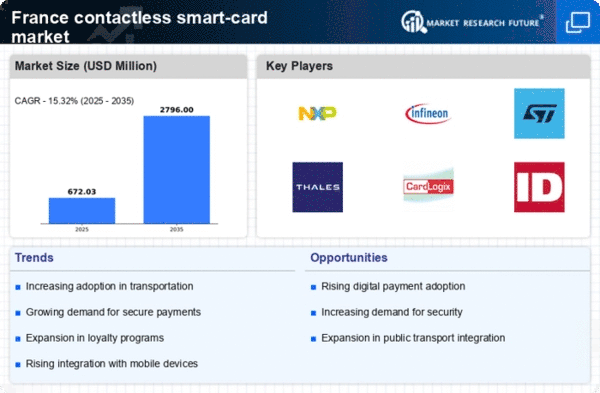
As per Market Research Future analysis, the France Contactless Smart Card Market size was estimated at 582.75 USD Million in 2024. The Contactless Smart-card market is projected to grow from 672.03 USD Million in 2025 to 2796.0 USD Million by 2035, exhibiting a compound annual growth rate (CAGR) of 15.3% during the forecast period 2025 - 2035

Key Market Trends & Highlights

The France contactless smart-card market is experiencing robust growth driven by technological advancements and increasing consumer demand.

  • The retail segment represents the largest share of the France contactless smart-card market, reflecting a shift towards seamless payment solutions.
  • The fastest-growing segment is the transportation sector, as cities enhance their public transit systems with contactless payment options.
  • Enhanced security features are becoming a focal point for consumers, leading to greater trust in contactless transactions.
  • Key market drivers include the growing demand for contactless payments and the expansion of contactless infrastructure across France.

Market Size & Forecast

2024 Market Size 582.75 (USD Million)
2035 Market Size 2796.0 (USD Million)
CAGR (2025 - 2035) 15.32%

Major Players

NXP Semiconductors (NL), Infineon Technologies (DE), STMicroelectronics (FR), Gemalto (NL), CardLogix (US), Identiv (US), HID Global (US), MIFARE (NL)

Our Impact
Enabled $4.3B Revenue Impact for Fortune 500 and Leading Multinationals
Partnering with 2000+ Global Organizations Each Year
30K+ Citations by Top-Tier Firms in the Industry

France Contactless Smart Card Market Trends

The France Contactless Smart Card Market is experiencing notable growth, driven by the increasing demand for secure and efficient payment solutions. In France, the adoption of contactless technology has gained momentum, particularly in urban areas where convenience is paramount. Consumers are increasingly favoring contactless payments for everyday transactions, which has led to a rise in the issuance of contactless smart cards by financial institutions. This trend is further supported by advancements in technology, enhancing the security features of these cards and addressing consumer concerns regarding fraud and data breaches. Moreover, the French government has been proactive in promoting digital payment solutions, aligning with broader European initiatives aimed at fostering a cashless society. This regulatory support, combined with the growing acceptance of contactless payments in retail, transportation, and other sectors, suggests a robust future for the contactless smart-card market. As more businesses and consumers embrace this technology, the landscape is likely to evolve, with innovations in card design and functionality emerging to meet diverse consumer needs. The market appears poised for continued expansion, reflecting a shift in payment preferences and technological advancements.

Increased Adoption in Retail

The contactless smart-card market is witnessing a surge in adoption within the retail sector. Retailers are increasingly integrating contactless payment systems to enhance customer experience and streamline transactions. This trend is likely to continue as consumers seek faster and more convenient payment options.

Enhanced Security Features

Security remains a critical concern for consumers in the contactless smart-card market. Innovations in encryption and biometric authentication are being introduced to bolster the security of transactions. These advancements may help alleviate consumer apprehensions regarding fraud and data breaches.

Government Initiatives

The French government is actively promoting the use of contactless payment solutions as part of its digital transformation strategy. Initiatives aimed at encouraging cashless transactions are likely to drive further growth in the contactless smart-card market, aligning with broader European goals for digital finance.

France Contactless Smart Card Market Drivers

Supportive Regulatory Environment

The regulatory environment in France is increasingly supportive of the contactless smart-card market, facilitating its growth and adoption. Government policies aimed at promoting digital payments and enhancing financial inclusion are creating a favorable landscape for contactless technologies. As of 2025, regulations have been established to streamline the integration of contactless payment systems in various sectors, including public transportation and retail. The contactless smart-card market is benefiting from these initiatives, as they encourage businesses to adopt contactless solutions to comply with regulatory standards. Additionally, the French government has launched campaigns to educate consumers about the benefits of contactless payments, further driving market penetration. This supportive regulatory framework is likely to foster innovation and investment in the contactless smart-card market, ultimately enhancing the overall payment ecosystem in France.

Expansion of Contactless Infrastructure

The expansion of contactless infrastructure across France is a critical driver for the contactless smart-card market. As more merchants and service providers adopt contactless payment terminals, the accessibility and convenience of using contactless smart cards are significantly enhanced. Recent data indicates that the number of contactless payment terminals has increased by 40% in the past year, reflecting a growing commitment to modernizing payment systems. The contactless smart-card market is thus positioned to benefit from this infrastructure expansion, as consumers are more likely to utilize contactless cards when they encounter widespread acceptance. Furthermore, the integration of contactless technology in public transport systems is also contributing to market growth, as commuters increasingly prefer the ease of using contactless cards for fare payments. This ongoing expansion of contactless infrastructure is expected to drive further adoption and innovation within the contactless smart-card market.

Growing Demand for Contactless Payments

The contactless smart-card market in France is experiencing a notable surge in demand, primarily driven by the increasing preference for contactless payment methods among consumers. As of 2025, approximately 60% of transactions in retail settings are conducted using contactless technology, reflecting a significant shift in consumer behavior. This trend is further supported by the convenience and speed associated with contactless payments, which are perceived as safer and more efficient. The contactless smart-card market is thus poised for growth, as both consumers and merchants embrace this technology. Additionally, the rise of e-commerce and mobile payments has contributed to the expansion of contactless solutions, with many retailers integrating these systems into their payment infrastructure. This growing demand is likely to propel innovation and investment within the contactless smart-card market, fostering a competitive landscape that benefits both consumers and businesses.

Technological Advancements in Card Issuance

Technological advancements in card issuance are playing a pivotal role in shaping the contactless smart-card market in France. Innovations such as improved chip technology and enhanced encryption methods are making contactless cards more secure and efficient. As of 2025, the market has seen a 25% increase in the adoption of advanced chip technology, which not only enhances security but also improves transaction speed. The contactless smart-card market is benefiting from these advancements, as financial institutions and service providers are increasingly investing in state-of-the-art card production techniques. This trend is likely to continue, as the demand for secure and efficient payment solutions grows. Furthermore, the integration of biometric authentication features into contactless cards is expected to further bolster consumer confidence, thereby driving market growth. The ongoing evolution of technology in card issuance is thus a key driver for the contactless smart-card market.

Rising Consumer Awareness of Security Features

Consumer awareness regarding security features associated with contactless smart cards is on the rise in France, significantly impacting the contactless smart-card market. As individuals become more informed about the potential risks of card fraud and data breaches, they are increasingly seeking payment solutions that offer robust security measures. Recent surveys indicate that 70% of consumers prioritize security when choosing payment methods, which has led to a greater emphasis on the development of secure contactless smart cards. The contactless smart-card market is responding to this demand by implementing advanced security protocols, such as tokenization and encryption, to protect user data. This heightened focus on security not only reassures consumers but also encourages wider adoption of contactless payment solutions across various sectors, including retail and transportation. As security concerns continue to shape consumer preferences, the contactless smart-card market is likely to experience sustained growth.


Market Segment Insights

By Type: Proximity Cards (Largest) vs. CPU/MPU Cards (Fastest-Growing)

The France contactless smart-card market exhibits a distinct distribution in market share between proximity cards and CPU/MPU cards. Proximity cards hold the largest share, favored for their ease of use in various applications such as access control and public transportation. On the other hand, CPU/MPU cards, though currently smaller in market share, are rapidly gaining traction due to their enhanced security features and processing capabilities, appealing to sectors requiring high-transaction speeds and data security. Growth trends indicate a shifting consumer preference towards smart cards that offer improved performance and security. This is fueled by the increasing need for contactless payments and identification solutions, which in turn drives innovation in CPU/MPU technology. Factors such as advancements in card production, the rise of cashless transactions, and heightened security concerns highlight the dynamic nature of this segment in the France contactless smart-card market.

Proximity Cards (Dominant) vs. CPU/MPU Cards (Emerging)

Proximity cards dominate the market due to their widespread adoption in various sectors, including public transit and corporate access control. Their convenience and simplicity to use make them a preferred choice among consumers. In contrast, CPU/MPU cards, characterized by their superior processing capabilities and enhanced security features, represent an emerging segment. As businesses and consumers prioritize security and efficiency, these cards are likely to experience rapid growth. The flexibility of CPU/MPU cards allows for complex applications, appealing to high-security environments like banking and government services. As a result, both segments play crucial roles in shaping the landscape of the France contactless smart-card market.

By Application: BFSI (Largest) vs. Transportation (Fastest-Growing)

In the France contactless smart-card market, the BFSI segment holds the largest market share, driven by increasing adoption in banking transactions and secure access control solutions. The government sector follows closely, leveraging smart card technology for identification and authentication purposes in various public services. Transportation is emerging as a key segment, reflecting rising investments in contactless payment systems for public transit, which enhance user experience and operational efficiency. Growth trends in the application segments are heavily influenced by technological advancements and consumer preferences. The BFSI sector continues to dominate due to the critical need for secure financial transactions, while the government sector is expanding with digital transformation initiatives. The transportation segment is the fastest-growing, propelled by the need for contactless solutions post-pandemic, improving convenience for users, and supporting cashless economies.

BFSI (Dominant) vs. Transportation (Emerging)

The BFSI sector stands as the dominant force in the France contactless smart-card market, characterized by its strong focus on secure transactions and fraud prevention measures. Banks and financial institutions are increasingly integrating smart cards into their services to ensure customer security and enhance service efficiency. In contrast, the transportation segment is emerging, fueled by the transition to cashless payment methods in public transit systems. This growth reflects a broader acceptance of contactless technology among commuters, facilitating quick and hassle-free fare payments. The demand for seamless travel experiences is encouraging innovation and investment in this space, positioning transportation as a vital area for future market expansion.

By Technology: Smart Card Integrated Circuits (Largest) vs. Memory Smart Cards (Fastest-Growing)

In the France contactless smart-card market, the Smart Card Integrated Circuits segment holds a significant share due to its widespread application across various industries, including banking and transportation. This dominance is driven by the essential role of integrated circuits in ensuring secure and efficient data processing for contactless transactions. On the other hand, Memory Smart Cards, while smaller in market share, are rapidly gaining attention due to the increasing demand for security features in various applications such as identification and access control, leading to their swift rise in popularity. The growth trends within the technology segment reveal a robust framework fueled by advancements in secure transaction technologies and the expanding IoT ecosystem. Consumers and businesses alike are increasingly prioritizing secure and convenient payment solutions, which is enhancing the demand for both Smart Card Integrated Circuits and Memory Smart Cards. The technological enhancements in memory capabilities and integration are slated to bolster their acceptance in emerging markets, creating new opportunities for growth in this segment.

Technology: Smart Card Integrated Circuits (Dominant) vs. Memory Smart Cards (Emerging)

Smart Card Integrated Circuits are deemed the dominant force in the technology sector of the France contactless smart-card market due to their critical role in facilitating secure transactions. These circuits provide the essential architecture for a broad range of applications, from financial transactions to access control. In contrast, Memory Smart Cards are emerging as a popular alternative, especially in applications requiring enhanced data storage and security features. Their ability to store vast amounts of data securely makes them particularly appealing in sectors such as healthcare and government, where data protection is paramount. As technological advancements continue to progress, both segments are expected to adapt and innovate, catering to the evolving needs of various industries.

Get more detailed insights about France Contactless Smart Card Market

Key Players and Competitive Insights

The contactless smart-card market in France is characterized by a dynamic competitive landscape, driven by technological advancements and increasing consumer demand for seamless payment solutions. Key players such as NXP Semiconductors (NL), Infineon Technologies (DE), and STMicroelectronics (FR) are at the forefront, each adopting distinct strategies to enhance their market positioning. NXP Semiconductors (NL) focuses on innovation in secure connectivity solutions, while Infineon Technologies (DE) emphasizes partnerships to expand its product offerings. STMicroelectronics (FR) is leveraging its expertise in semiconductor technology to drive digital transformation in the sector. Collectively, these strategies contribute to a competitive environment that is increasingly shaped by technological innovation and strategic collaborations.In terms of business tactics, companies are localizing manufacturing and optimizing supply chains to enhance efficiency and responsiveness to market demands. The market structure appears moderately fragmented, with several key players exerting influence over various segments. This fragmentation allows for a diverse range of products and services, fostering competition that drives innovation and customer choice.

In October NXP Semiconductors (NL) announced a strategic partnership with a leading fintech company to develop next-generation contactless payment solutions. This collaboration is expected to enhance the security and speed of transactions, positioning NXP as a leader in the evolving payment landscape. The strategic importance of this partnership lies in its potential to capture a larger market share by addressing the growing consumer preference for secure and efficient payment methods.

In September Infineon Technologies (DE) launched a new line of contactless smart cards designed specifically for the European market, incorporating advanced security features. This move is significant as it aligns with the increasing regulatory focus on data protection and privacy, thereby enhancing Infineon’s competitive edge. By addressing these regulatory requirements, Infineon is likely to strengthen its market position and appeal to a broader customer base.

In August STMicroelectronics (FR) expanded its production capabilities in France, investing €50 million in a new manufacturing facility dedicated to contactless smart cards. This investment underscores STMicroelectronics' commitment to meeting the rising demand for contactless solutions and enhancing its operational capacity. The strategic importance of this expansion is multifaceted; it not only boosts local employment but also positions the company to respond more effectively to regional market needs.

As of November current trends in the contactless smart-card market include a strong emphasis on digitalization, sustainability, and the integration of artificial intelligence (AI) into product offerings. Strategic alliances are increasingly shaping the competitive landscape, enabling companies to pool resources and expertise. Looking ahead, competitive differentiation is likely to evolve from traditional price-based competition to a focus on innovation, technological advancements, and supply chain reliability. This shift suggests that companies that prioritize these areas will be better positioned to thrive in the future.

Key Companies in the France Contactless Smart Card Market include

Industry Developments

At the Mobile World Congress in February 2023, Infineon Technologies demonstrated its SECORATM Connect solutions, which allow ultra-compact wearables like watches and rings to serve as safe contactless payment methods.

This was a big step toward making contactless cards and gadgets more usable. Later, in November 2023, Infineon demonstrated its dedication to future-proof identity security at TRUSTECH Paris by showcasing a post-quantum ePassport prototype and the SECORATM Pay Bio biometric card demonstrator.

When NXP Semiconductors' SN220 secure chip was validated by the Car Connectivity Consortium as the first for digital car key systems in July 2024, it marked a significant milestone and strengthened its position in Europe's next-generation mobility solutions.

At SmartTech Asia in September 2023, STMicroelectronics unveiled advancements in metal payment cards, dynamic CVV cards, and biometric cards, with potential uses in France and the wider EU market. Most recently, in April 2025, ST introduced the ST25R500/501 NFC readers, which are designed for automotive settings and support digital keys and improved in-car payments.In the meantime, Thales (Gemalto) and IDEMIA have maintained their position as leaders in France, growing secure ID issuance programs and biometric smart card programs to fortify Europe's digital identity ecosystem.

Future Outlook

France Contactless Smart Card Market Future Outlook

The Contactless Smart Card Market is projected to grow at a 15.32% CAGR from 2025 to 2035, driven by technological advancements, increased demand for secure transactions, and expanding applications in various sectors.

New opportunities lie in:

  • Integration of contactless payment solutions in public transportation systems.
  • Development of customized smart-cards for loyalty programs in retail.
  • Expansion of contactless smart-cards in healthcare for patient identification and records management.

By 2035, the market is expected to achieve substantial growth, driven by innovation and diverse applications.

Market Segmentation

France Contactless Smart Card Market Type Outlook

  • Proximity Cards
  • CPU/MPU Cards

France Contactless Smart Card Market Technology Outlook

  • Smart Card Integrated Circuits
  • Memory Smart Cards

France Contactless Smart Card Market Application Outlook

  • BFSI
  • Government
  • Transportation

Report Scope

MARKET SIZE 2024 582.75(USD Million)
MARKET SIZE 2025 672.03(USD Million)
MARKET SIZE 2035 2796.0(USD Million)
COMPOUND ANNUAL GROWTH RATE (CAGR) 15.32% (2025 - 2035)
REPORT COVERAGE Revenue Forecast, Competitive Landscape, Growth Factors, and Trends
BASE YEAR 2024
Market Forecast Period 2025 - 2035
Historical Data 2019 - 2024
Market Forecast Units USD Million
Key Companies Profiled NXP Semiconductors (NL), Infineon Technologies (DE), STMicroelectronics (FR), Gemalto (NL), CardLogix (US), Identiv (US), HID Global (US), MIFARE (NL)
Segments Covered Type, Application, Technology
Key Market Opportunities Integration of advanced security features enhances consumer trust in the contactless smart-card market.
Key Market Dynamics Rising consumer demand for secure payment solutions drives innovation in the contactless smart-card market.
Countries Covered France
Leave a Comment

FAQs

What is the expected market size of the France Contactless Smart Card Market in 2024?

The France Contactless Smart Card Market is expected to be valued at 582.75 million USD in 2024.

What is the projected market size for the France Contactless Smart Card Market by 2035?

By 2035, the overall market for France Contactless Smart Cards is projected to reach 4,415.0 million USD.

What is the expected CAGR for the France Contactless Smart Card Market from 2025 to 2035?

The expected CAGR for the France Contactless Smart Card Market from 2025 to 2035 is 20.213%.

Which type of smart cards is expected to dominate the market in terms of valuation?

Proximity Cards are expected to dominate the market with a valuation of 250.0 million USD in 2024.

What is the estimated market value for CPU/MPU Cards in the France Contactless Smart Card Market in 2024?

The estimated market value for CPU/MPU Cards in 2024 is 332.75 million USD.

What is the projected market size for Proximity Cards by 2035?

The projected market size for Proximity Cards by 2035 is 1,825.0 million USD.

Who are the key players in the France Contactless Smart Card Market?

Key players in the France Contactless Smart Card Market include KONA I, Infineon Technologies, and NXP Semiconductors.

What is the expected market value for CPU/MPU Cards by 2035?

The expected market value for CPU/MPU Cards by 2035 is estimated to be 2,590.0 million USD.

What are the emerging trends in the France Contactless Smart Card Market?

Emerging trends include increased adoption of smart cards in payment systems and enhanced security features.

How do current market conditions affect the France Contactless Smart Card Market?

Current market conditions contribute to accelerated growth and demand for contactless payment solutions.

Download Free Sample

Kindly complete the form below to receive a free sample of this Report

Compare Licence

×
Features License Type
Single User Multiuser License Enterprise User
Price $4,950 $5,950 $7,250
Maximum User Access Limit 1 User Upto 10 Users Unrestricted Access Throughout the Organization
Free Customization
Direct Access to Analyst
Deliverable Format
Platform Access
Discount on Next Purchase 10% 15% 15%
Printable Versions