×
Request Free Sample ×

Kindly complete the form below to receive a free sample of this Report

* Please use a valid business email

Leading companies partner with us for data-driven Insights

clients tt-cursor
Hero Background

France Biologic Therapy Market

ID: MRFR/Pharma/52746-HCR
200 Pages
Rahul Gotadki
February 2026

France Biologic Therapy Market Research Report: Size, Share, Trend Analysis By Therapy Type (Monoclonal Antibodies, Vaccines, Cell Therapy, Gene Therapy), By Applications (Oncology, Autoimmune Diseases, Infectious Diseases, Cardiovascular Diseases), By Route of Administration (Intravenous, Subcutaneous, Intramuscular) and By End Users (Hospitals, Clinics, Home Healthcare) - Growth Outlook & Industry Forecast 2025 To 2035

Share:
Download PDF ×

We do not share your information with anyone. However, we may send you emails based on your report interest from time to time. You may contact us at any time to opt-out.

France Biologic Therapy Market Infographic
Purchase Options

France Biologic Therapy Market Summary

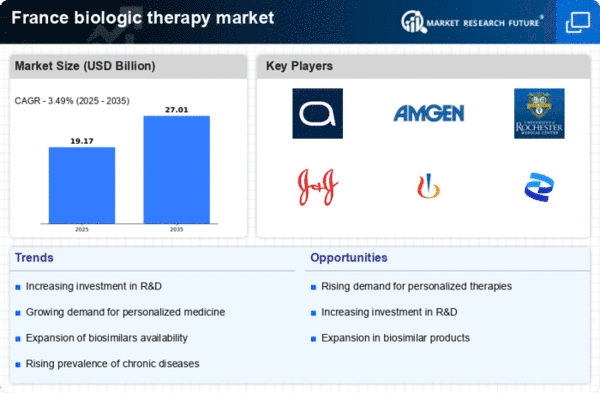
As per Market Research Future analysis, the France Biologic Therapy Market size was estimated at 18.52 USD Billion in 2024. The Biologic Therapy market is projected to grow from 19.17 USD Billion in 2025 to 27.01 USD Billion by 2035, exhibiting a compound annual growth rate (CAGR) of 3.4% during the forecast period 2025 - 2035

Key Market Trends & Highlights

The France biologic therapy market is experiencing robust growth driven by innovation and increasing demand for personalized treatments.

  • The market is characterized by a rising demand for targeted therapies, particularly in oncology and autoimmune disorders.
  • Regulatory support for innovation is fostering the development of new biologic therapies, enhancing treatment options.
  • Personalized medicine is gaining traction, with a focus on tailoring therapies to individual patient profiles, especially in rare diseases.
  • Key market drivers include the increasing prevalence of chronic diseases and advancements in biologic research, which are propelling market expansion.

Market Size & Forecast

2024 Market Size 18.52 (USD Billion)
2035 Market Size 27.01 (USD Billion)
CAGR (2025 - 2035) 3.49%

Major Players

AbbVie (US), Amgen (US), Roche (CH), Johnson & Johnson (US), Novartis (CH), Pfizer (US), Bristol-Myers Squibb (US), Sanofi (FR), Gilead Sciences (US)

Our Impact
Enabled $4.3B Revenue Impact for Fortune 500 and Leading Multinationals
Partnering with 2000+ Global Organizations Each Year
30K+ Citations by Top-Tier Firms in the Industry

France Biologic Therapy Market Trends

The France Biologic Therapy Market is currently experiencing notable growth, driven by advancements in biotechnology and an increasing prevalence of chronic diseases. In France, the demand for biologic therapies is on the rise, as healthcare providers and patients alike seek innovative treatment options that offer improved efficacy and safety profiles. The French healthcare system is adapting to these changes, with regulatory bodies facilitating the approval and reimbursement processes for new biologic products. This evolving landscape suggests a promising future for biologic therapies, as they become integral to treatment protocols across various medical specialties. Moreover, the emphasis on personalized medicine is reshaping the biologic therapy market. Tailored treatments that consider individual patient characteristics are gaining traction, leading to better outcomes and enhanced patient satisfaction. The French government is actively supporting research initiatives aimed at developing novel biologic therapies, which may further stimulate market growth. As the healthcare sector continues to embrace innovation, the biologic therapy market is poised to expand, offering new opportunities for stakeholders involved in drug development, manufacturing, and distribution.

Rising Demand for Targeted Therapies

There is an increasing preference for targeted biologic therapies among healthcare professionals and patients. These therapies are designed to address specific disease mechanisms, leading to more effective treatment outcomes. This trend is particularly evident in the management of autoimmune disorders and certain cancers, where traditional therapies may not provide adequate relief.

Regulatory Support for Innovation

The regulatory environment in France is becoming more conducive to the introduction of new biologic therapies. Authorities are streamlining approval processes and enhancing reimbursement frameworks, which encourages pharmaceutical companies to invest in research and development. This supportive landscape is likely to accelerate the availability of innovative treatments.

Focus on Personalized Medicine

The shift towards personalized medicine is significantly influencing the biologic therapy market. Treatments are increasingly being tailored to individual patient profiles, which enhances therapeutic efficacy and minimizes adverse effects. This trend aligns with broader healthcare goals of improving patient outcomes and optimizing resource allocation.

France Biologic Therapy Market Drivers

Advancements in Biologic Research

Ongoing advancements in biologic research are propelling the growth of the biologic therapy market. Innovations in biotechnology and genetic engineering are leading to the development of novel biologic agents that offer improved efficacy and safety profiles. In France, research institutions and pharmaceutical companies are investing heavily in R&D, with expenditures reaching approximately €3 billion annually. This investment is fostering a robust pipeline of new biologics, which are expected to enter the market in the coming years. The biologic therapy market is thus benefiting from a continuous influx of innovative products, which are likely to enhance treatment outcomes and patient satisfaction.

Supportive Reimbursement Policies

Supportive reimbursement policies in France are playing a crucial role in the growth of the biologic therapy market. The French healthcare system has established frameworks that facilitate the reimbursement of biologic treatments, making them more accessible to patients. Recent reforms have streamlined the approval process for new biologics, ensuring that effective therapies reach patients in a timely manner. As a result, the uptake of biologic therapies is expected to rise, with reimbursement rates for these treatments being favorable. The biologic therapy market is thus likely to benefit from these policies, as they enhance patient access and encourage healthcare providers to prescribe biologics.

Increasing Prevalence of Chronic Diseases

The rising incidence of chronic diseases in France is a pivotal driver for the biologic therapy market. Conditions such as rheumatoid arthritis, psoriasis, and various cancers are becoming more prevalent, necessitating advanced treatment options. According to recent health statistics, chronic diseases account for approximately 70% of all deaths in France, highlighting the urgent need for effective therapies. Biologic therapies, known for their targeted action and efficacy, are increasingly being adopted in clinical settings. This trend is likely to continue, as healthcare providers seek innovative solutions to manage these complex conditions. The biologic therapy market is thus positioned to expand significantly, driven by the demand for specialized treatments that address the unique needs of patients suffering from chronic ailments.

Rising Awareness and Education on Biologics

There is a growing awareness and education regarding biologic therapies among healthcare professionals and patients in France. Initiatives aimed at educating stakeholders about the benefits and applications of biologics are becoming more prevalent. This increased knowledge is likely to lead to higher adoption rates of biologic therapies in clinical practice. Surveys indicate that approximately 60% of healthcare providers in France are now familiar with the latest biologic treatments, compared to just 30% five years ago. The biologic therapy market is thus experiencing a shift, as informed patients and providers are more inclined to consider biologics as viable treatment options.

Growing Investment in Healthcare Infrastructure

The expansion of healthcare infrastructure in France is a significant driver for the biologic therapy market. The French government has been actively investing in healthcare facilities and services, with a budget allocation of over €200 billion for the healthcare sector in recent years. This investment is aimed at improving access to advanced therapies, including biologics. As hospitals and clinics upgrade their capabilities, the availability of biologic therapies is expected to increase, facilitating better patient access. The biologic therapy market stands to gain from this enhanced infrastructure, as more healthcare providers are equipped to administer these complex treatments.

Market Segment Insights

By Type: Monoclonal Antibodies (Largest) vs. Cell Therapy (Fastest-Growing)

In the France biologic therapy market, Monoclonal Antibodies dominate the segment, holding a significant share compared to other types. Their extensive clinical applications and established presence in treatment protocols make them a preferred choice among healthcare providers. On the other hand, Cell Therapy has emerged as a competitive player, carving out its niche as practitioners explore innovative treatment options across various conditions, thus contributing to a diversified market landscape. The growth trends within this market segment are propelled by advancements in research and development, especially in personalized medicine. Monoclonal Antibodies have shown robust sales growth due to their efficacy in targeting specific diseases, predominantly cancer. Meanwhile, Cell Therapy is gaining momentum driven by technological advancements and increasing investments in regenerative medicine. The intersection of technology and biology is creating avenues for growth, making Cell Therapy one of the fastest-growing areas.

Monoclonal Antibodies (Dominant) vs. Cell Therapy (Emerging)

Monoclonal Antibodies represent the dominant force in the France biologic therapy market. These targeted therapies are mainly utilized for conditions such as cancer, autoimmune diseases, and infectious diseases. Their ability to specifically target antigens provides a therapeutic advantage, leading to higher efficacy and fewer side effects compared to traditional treatments. In contrast, Cell Therapy is emerging as a promising solution, especially for conditions that require tissue regeneration and repair. With ongoing clinical trials and a growing knowledge base, Cell Therapy holds a significant potential for future applications, particularly in areas such as oncology and neurological disorders, making it a key area of interest for continued research and development.

By Application: Oncology (Largest) vs. Autoimmune Diseases (Fastest-Growing)

In the France biologic therapy market, the oncology segment significantly dominates the application sector, showcasing a substantial share compared to other areas. Autoimmune diseases follow closely, with infectious and cardiovascular diseases being smaller segments. The therapeutic focus on oncology stems from the heightened prevalence of cancer, driving innovations and investments in biologic therapies specifically tailored for this condition. The growth trends for the France biologic therapy market indicate that autoimmune diseases are the fastest-growing segment, fueled by increasing awareness, improved diagnostic capabilities, and a rising patient population. Innovative treatments and biologics are reshaping care approaches, making this segment increasingly attractive to investors and healthcare providers alike, setting a competitive landscape where speed of growth is crucial.

Oncology (Dominant) vs. Autoimmune Diseases (Emerging)

Oncology holds a dominant position in the France biologic therapy market, characterized by advanced therapeutic interventions and a robust pipeline of biologics tailored for various cancer types. The prevalence of cancer, coupled with substantial research and funding, supports this segment's continuing growth and innovation. In contrast, autoimmune diseases represent an emerging segment with significant potential, driven by a surge in diagnoses and a growing understanding of treatment modalities. This area leverages advancements in immunotherapy and monoclonal antibodies, positioning it as a critical focus for future developments, particularly as patient demands evolve and personalized medicine gains traction.

By Route of Administration: Intravenous (Largest) vs. Subcutaneous (Fastest-Growing)

In the France biologic therapy market, the route of administration segment is predominantly led by the intravenous method, capturing a significant share due to its rapid onset of action and suitability for patients requiring immediate therapeutic effects. Subcutaneous administration follows, gaining traction among patients who prefer self-administration and needing less monitoring. Intramuscular methods hold a smaller market share, primarily utilized for specific therapies requiring deeper delivery. Growth trends indicate a substantial shift towards subcutaneous administration, fueled by technological advancements in delivery devices and a growing preference for outpatient care. The market is also witnessing an increase in biologics that can be effectively delivered subcutaneously, further driving adoption. Intravenous routes maintain their dominance in acute settings, but emerging self-administration trends are reshaping the competitive landscape.

Intravenous (Dominant) vs. Subcutaneous (Emerging)

Intravenous administration remains the dominant route in the France biologic therapy market due to its effectiveness for patients needing immediate treatment. It is particularly favored in hospital settings where rapid action is critical. On the other hand, subcutaneous administration is emerging as a preferred choice for maintaining patient comfort and adherence, particularly for chronic conditions. Devices such as prefilled syringes and autoinjectors enhance patient convenience. As more products enter the market tailored for subcutaneous delivery, this route's growth trajectory is expected to accelerate. The balance between urgent care needs and long-term treatment regimens reveals a dynamic interplay in route preferences, which is key to understanding market evolution.

By End-user: Hospitals (Largest) vs. Home Healthcare (Fastest-Growing)

In the France biologic therapy market, the end-user segmentation reveals that hospitals command the largest share, primarily due to the higher volume of patients requiring advanced treatments. Hospitals serve as crucial centers for delivering biologic therapies, benefiting from well-established infrastructure and access to specialized personnel. Clinics also play a significant role, but they do not match the extensive capacity and resources found in hospitals. Home healthcare is emerging rapidly, driven by the increasing demand for at-home treatments and the growing preference for personalized healthcare solutions. Factors such as technological advancements in telemedicine and patient monitoring systems have contributed to this growth. The shift towards home-based therapies offers patients convenience and flexibility, making it a compelling choice for many.

Hospitals: Dominant vs. Home Healthcare: Emerging

Hospitals are the dominant end user in the France biologic therapy market, characterized by their extensive resources, specialized staff, and established protocols for handling complex biologic treatments. They often provide a wide array of therapies and have the capability to cater to a large patient population effectively. On the other hand, home healthcare is an emerging segment that is gaining traction due to its innovative approach to patient care. This segment offers individuals the comfort of receiving treatments in their own homes, facilitated by advancements in technology such as remote monitoring and telehealth services. The growing emphasis on personalized medicine and patient-centered care is driving the expansion of both segments, each serving distinct yet critical roles in the therapeutic landscape.

Get more detailed insights about France Biologic Therapy Market

Key Players and Competitive Insights

The biologic therapy market in France is characterized by a dynamic competitive landscape, driven by innovation, strategic partnerships, and a focus on patient-centric solutions. Major players such as AbbVie (US), Roche (CH), and Sanofi (FR) are at the forefront, each employing distinct strategies to enhance their market presence. AbbVie (US) emphasizes innovation through its robust pipeline of biologics, particularly in immunology and oncology, while Roche (CH) focuses on personalized medicine and diagnostics, leveraging its strong research capabilities. Sanofi (FR), on the other hand, is actively pursuing collaborations to expand its biologic offerings, particularly in rare diseases, thereby enhancing its competitive positioning.The market structure appears moderately fragmented, with several key players influencing the competitive dynamics. Companies are increasingly localizing manufacturing and optimizing supply chains to enhance efficiency and responsiveness to market demands. This trend not only reduces operational costs but also aligns with the growing emphasis on sustainability and local sourcing, which resonates well with regulatory expectations and consumer preferences.

In October AbbVie (US) announced a strategic partnership with a leading French biotech firm to co-develop a novel biologic therapy targeting autoimmune diseases. This collaboration is expected to leverage both companies' strengths in research and development, potentially accelerating the time to market for innovative treatments. Such partnerships are indicative of a broader trend where established firms seek to enhance their portfolios through collaboration with agile biotech companies.

In September Roche (CH) launched a new biologic therapy aimed at treating a rare form of cancer, which has shown promising results in clinical trials. This launch not only reinforces Roche's commitment to oncology but also highlights its strategy of focusing on high-value therapies that address unmet medical needs. The introduction of this therapy is likely to strengthen Roche's market position and enhance its reputation as a leader in innovative cancer treatments.

In August Sanofi (FR) expanded its biologics manufacturing facility in France, a move that underscores its commitment to increasing production capacity for its growing portfolio of biologic therapies. This expansion is strategically important as it positions Sanofi to better meet the rising demand for biologics in Europe, while also enhancing its operational efficiency. Such investments reflect a broader trend of companies prioritizing local production capabilities to ensure supply chain reliability.

As of November the competitive landscape is increasingly shaped by trends such as digitalization, sustainability, and the integration of artificial intelligence in drug development. Strategic alliances are becoming more prevalent, allowing companies to pool resources and expertise to drive innovation. The shift from price-based competition to a focus on technological advancement and supply chain reliability is evident, suggesting that future competitive differentiation will hinge on the ability to innovate and deliver high-quality, reliable therapies.

Key Companies in the France Biologic Therapy Market include

Industry Developments

Recent developments in the France Biologic Therapy Market have highlighted significant activity among major pharmaceutical companies. Gilead Sciences has continued to expand its antiviral portfolio, enhancing its position in the treatment of HIV and hepatitis by launching new therapies. In September 2023, Novartis announced the expansion of its gene therapy program in France, aiming to address rare diseases more effectively. 

Notably, Merck has increased its investment in Research and Development for immunotherapy treatments, marking a substantial growth in market valuation. In the sphere of mergers and acquisitions, Amgen acquired a French biotech firm in October 2023 to bolster its pipeline in chronic disease management, while Johnson and Johnson is rumored to be in talks for a collaboration with a local biotech entity, although specifics remain undisclosed. 

Furthermore, Roche has reported an upsurge in sales of its biologic therapies for oncology in France, strengthening its market presence. The recent trends are indicative of a robust market with growing investment, innovative treatments, and strategic partnerships focused on enhancing the efficiency and accessibility of biologic therapies for patients across France.


Future Outlook

France Biologic Therapy Market Future Outlook

The Biologic Therapy Market in France is projected to grow at a 3.49% CAGR from 2025 to 2035, driven by technological advancements, increasing chronic disease prevalence, and enhanced healthcare access.

New opportunities lie in:

  • Development of personalized biologic therapies targeting specific patient demographics.
  • Expansion of telehealth services for biologic therapy consultations and follow-ups.
  • Investment in advanced manufacturing technologies for cost-effective biologic production.

By 2035, the biologic therapy market is expected to achieve robust growth and innovation.

Market Segmentation

France Biologic Therapy Market Type Outlook

  • Monoclonal Antibodies
  • Vaccines
  • Cell Therapy
  • Gene Therapy

France Biologic Therapy Market End-user Outlook

  • Hospitals
  • Clinics
  • Home Healthcare

France Biologic Therapy Market Application Outlook

  • Oncology
  • Autoimmune Diseases
  • Infectious Diseases
  • Cardiovascular Diseases

France Biologic Therapy Market Route of Administration Outlook

  • Intravenous
  • Subcutaneous
  • Intramuscular

Report Scope

MARKET SIZE 202418.52(USD Billion)
MARKET SIZE 202519.17(USD Billion)
MARKET SIZE 203527.01(USD Billion)
COMPOUND ANNUAL GROWTH RATE (CAGR)3.49% (2025 - 2035)
REPORT COVERAGERevenue Forecast, Competitive Landscape, Growth Factors, and Trends
BASE YEAR2024
Market Forecast Period2025 - 2035
Historical Data2019 - 2024
Market Forecast UnitsUSD Billion
Key Companies ProfiledAbbVie (US), Amgen (US), Roche (CH), Johnson & Johnson (US), Novartis (CH), Pfizer (US), Bristol-Myers Squibb (US), Sanofi (FR), Gilead Sciences (US)
Segments CoveredType, Application, Route of Administration, End-user
Key Market OpportunitiesEmerging gene therapies and personalized medicine drive growth in the biologic therapy market.
Key Market DynamicsRising demand for personalized biologic therapies drives innovation and competition within the French healthcare landscape.
Countries CoveredFrance
Leave a Comment

FAQs

What is the expected market size of the France Biologic Therapy Market in 2024?

The France Biologic Therapy Market is expected to be valued at 13.89 billion USD in 2024.

What will be the market size of the France Biologic Therapy Market by 2035?

By 2035, the market is projected to reach a value of 20.25 billion USD.

What is the expected CAGR for the France Biologic Therapy Market from 2025 to 2035?

The expected compound annual growth rate for the market during this period is 3.487 percent.

Which therapy type holds the largest market share in the France Biologic Therapy Market in 2024?

Monoclonal Antibodies will dominate the market with a valuation of 5.0 billion USD in 2024.

What are the projected market values for Vaccines in the France Biologic Therapy Market by 2035?

Vaccines are expected to reach a market value of 5.0 billion USD by 2035.

Who are the key players in the France Biologic Therapy Market?

Prominent companies include Gilead Sciences, Novartis, Merck, and several other major pharmaceutical firms.

What is the market size for Cell Therapy in the France Biologic Therapy Market in 2024?

Cell Therapy is valued at approximately 3.0 billion USD in the year 2024.

What challenges might the France Biologic Therapy Market face during the forecast period?

Potential challenges include regulatory hurdles and competition from biosimilars.

What opportunities are present in the France Biologic Therapy Market by 2035?

There are significant opportunities for growth in emerging therapies like Gene Therapy, projected to reach 3.75 billion USD.

How is the current competitive landscape in the France Biologic Therapy Market?

The market is characterized by strong competition among key players, each vying for market share through innovation and strategic partnerships.

Download Free Sample

Kindly complete the form below to receive a free sample of this Report

Compare Licence

×
Features License Type
Single User Multiuser License Enterprise User
Price $4,950 $5,950 $7,250
Maximum User Access Limit 1 User Upto 10 Users Unrestricted Access Throughout the Organization
Free Customization
Direct Access to Analyst
Deliverable Format
Platform Access
Discount on Next Purchase 10% 15% 15%
Printable Versions